You’re doing it now

This speech is still the best advice for anyone in the academic or artistic line of work.

https://thecomicscomic.com/2015/07/23/dana-goulds-just-for-laughs-keynote-address-of-2015-youre-doing-it-now/

If audio doesn’t work for you at the moment, here’s a transcript:

This post might seem lazy. Because it is. But it’s also a measure of my accumulated wisdom. Not so much that I’ve perfectly internalized the wisdom of this piece in my bodhisattva-like personification of enlightenment. Rather, it is a demonstration of my wisdom because I have written and posted it in lieu of an anger-filled rant about the horrors of politicians pandering to their base in which I imply vast swaths of humanity are less-than-perfect people. Nope. Don’t need it. This is better. Listen to what Dana has to say and think about how it applies to your career.

Happy Labor Day, here’s a prediction

Rather than engage in meaningful labor on this hallowed day, I will instead make a prediction: if a significant tax on unrealized capital gains is introduced, the following markets will enjoy increased prices:

  1. Art
  2. Accountants

Now, what will define the art in question is beyond me, but I imagine unrealized gains from art will be easier to quantify if the art in question exists as anything more than one of a kind, so I expect definitively “one-of-a-kind” pieces i.e. classics will experience the lion share of increased demand.

As for accountants, the demand for training in how to properly ledger assets to remain outside the bounds of quantifiable equity assets will prove a boon to anyone with an accounting degree. Accounting talent for establishing loan collateral two degrees removed from equity will similarly grow in value.

I have additional predictions, but putting them forth under my name and defending them in a public forum would require a meaningful amount of labor, which I am not willing to provide today.

Why was the Democratic Convention so patriotic?

Election season tends to spoil watching sports that have ad breaks, but one positive (for me at least) is that there is constant pedagogical fodder for my public choice & political economy class, particularly with regards to the median voter thereom. The biggest gripe with the MVT that people just insist on bringing up is the minor detail that it is obviously always wrong, which just misses the point entirely. Politics is neither fast nor slow. It’s more geological in that is slow to change until it isn’t. It can be painfully slow to watch coalitions 1. Coalesce 2. Cooperate 3. Fall apart 4. Return to 1. But politics is also opportunistic, which means responses to context can sometimes manifest relatively quickly. I would argue that nothing can provoke a more stark change in a political coalition than when their opposition abandons a position or brand that appeals to the median voter.

I tend to view Trumpology the same way I view Sovietology: it’s interesting to consume out of curiosity but we probably won’t have a deep understanding and know who was right until 20 years after the fact. Warren Nutter was right about the Soviet Union being an industrial ruse, but in his time he was mostly dismissed. My mental model of Trump and his team is that he’s a bad-faith business person who leverages transaction costs to the hilt and whose narcissism makes him effective at assembling imcompetent yes men. But, and I can’t emphasize this enough, we don’t really know what’s happening internally, there’s just too much noise in the information stream. What we can effectively observe, however, is the policy bundle and platform messaging on which he is compaigning.

That bundle is overwhelmingly negative. Beyond traditional scapegoating, the picture being painted of the current United States is bleak. Pessimistic, dystopian imagery appeals to plenty of people from the left and right extremes, but I struggle to think of a time in US history where the median American did not believe in America as both a good idea and a good place to live. A lot of people when discussing the MVT focus on the prediction that both parties will, in a vaccuum, arrive at identical platforms, an idea that seems false on it’s face. This is not unlike the prediction of physics that a feather and a bowling ball will fall at the same velocity in a vacuum – to demostrate that they don’t from the top of your apartment building is to both miss the point and place the people around you in intellectual (if not mortal) danger.

The most important insight in the MVT is the gravity of the median. Or, in the case of the current election, the speed with which one party will reclaim any branding opportunities around said median when the opposition abandons them. I have no doubt there are some veteran leaders within the RNC that are fuming over the long term costs of letting the Democratic party claim the mantle of the more patriotic and optimistic party. These are the kind of brands that are hard to take from the opposition- you pretty much have to wait for them, in a moment of foolishness or chaotic happenstance, to release their grip. Which I suspect the Republicans have.

I have no doubt the Democrats will find a way to do makes similar mistakes with this or other positions in the future. Politics is chaos and the median voter is far easier to find on an abstract two-dimensional curve than in reality. But that doesn’t mean we can pretend the median voter isn’t out there and that they don’t matter. It’s a simple model that may always be wrong, but it will never lead you astray.

Interpreting candidate policies

Interpreting policy talking points from people running for office is difficult for a variety reasons, but it essentially boils down to the fact that voters often do not want the outcomes that would be produced by the policies they will in fact vote for. Candidates, in turn, must find a way to promise policies they will either do their best not to deliver or, if they do deliver them, said policies will be bundled with other policies that will mitigate their effect.

Interpreting the true intended policy bundle being signaled by a candidate is fraught with traps, not least of which our personal biases. If I want to like a candidate, for social or identity reasons, I will have a tendency to interpret their policy proposals as part of a broader, unspoken, bundle that I like. If I don’t want to like a candidate, perhaps because they are a petty, boorish lout whose principle aptitude appears to be grifting at the margins of legality and leveraging the high transaction costs of our legal system, then I will subconsciously interpret each policy proposed as part of a more insidious unspoken bundle.

How should voters and pundits navigate an environment where information is limited and bias is largely unavoidable? I don’t know, but here’s how I try anyway.

  1. Assume every candidate has basic competency in appealing to their base.
  2. Assume every candidate wants to appeal to the median voter.
  3. Do not assume anyone knows who the median voter is.
  4. Assume both candidates and their advisors have the same capacity to assess how their respective bases will react to a proposal and how it will actually impact them, but do not assume they know how the median voter will react and be affected.

In essence, candidates will always have a deeper familiarity, with greater repeated interactions, with their voter and donor bases. They know how they will react and how they will actually be impacted. Platforms will be designed around navigating contexts where popularity and expected impact are in conflict. What this means is that, in the aggregate,

  1. A candidate stands to do the most damage when advocating for policies that will aid their base at the expense of the median
  2. A candidate will create the most uncertainty when the desires of their base are at odds with the consequences for their base.

For example, assume both major parties are advocating for trade restrictions. Let’s call them the Plurality party and the Majority parties. Trade restrictions will hurt the median voter, full stop. The Plurality party, whose indentity constitutes a minority of the total population but the largest share of the population of any subgroup, stands to gain the most through policies that extract from others in a negative sum game. It will be easier to take their candidate’s policies at face value because of uncertainty around the median voters preferences, in part due to voter uncertainty about how policies will affect them.

The Majority party, on the other hand, is more fractured in the subgroups that constitute its more numerous whole. They can be thought of an encompassing group coping with the high costs of intragroup bargaining. Their greater numerical advantage in elections is partly, if not wholly, nullified by difficulty solving collective action problems and their need to solve positive sum games whose benefits are spread too thinly to excite their base. Further, the Majority party is inclusive of the median voter, about which there is greater uncertainty. The Majority party, as such, has greater incentive to rely on a form of subtextual deception. To win elections, they will need to propose the policies that the various elements their base wants while also bundling them with other policy elements that will mitigate their consequences in the aggregate and leave options open downstream as consquences for the median are made manifest. Interpreting proposals of the Majority party demands more Straussian reading, which also means that greater care is needed in monitoring your own bias. Because all complex political economy aside, sometimes parties do in fact just have bad ideas.

Good luck.

Insuring the suspension of disapproval

My wife and I were watching Guy Ritchie’s “Sherlock Holmes” (2009) last night. There is a chase/fight scene where a large commercial ship being repaired along a dock is detroyed as collateral damage. She asked me “What are the consequences of that ship being destroyed?” I had to admit that I didn’t fully know the state of the insurance market in Victorian England, but suffice it to say a few businesses and/or families were likely ruined. Which led to a conversation about collateral damage outside of the main narrative in movies and insurance. Sorry, that’s just what happens when you marry an economist. Things to consider the next time you’re filtering your prospects.

Which got me thinking: how much does the suspension of our disapproval of the protagonist’s actions (similar to the suspension of disbelief) depend on our undeclared faith in the insurance market of a fictional world? We don’t worry about destroyed livelihoods because we assume everything is simply absorbed as a tail event against which everything is insured. Car through front window? Automotive insurance tail event. Plane crashing onto the Vegas strip? Aeronautical tail event. Godzilla’s tail sweeping through a city? Giant lizard tail tail event.

How about the rise of the antihero? How many heists include a character shouting exposition to a crowd of cowering bank customers that they are there to steal money from the insurance company rather than the customers? The filmmaker needs the audience to suspend disbelief that bank’s have multiple customers inside in the age smart phones and suspend disapproval of the morality of the thieves’ actions as they steal from what they can only hope the audience will deem a souless corporation that can absorb the loss without broader consequence.

There’s two intellectual rabbit holes you can go down when you start thinking about insurance. You can dive in vertically, asking how much of our daily lives, including the consumption of narratives, is dependent on the presumption of insurance. You can also start thinking horizontally: how many dimensions of our lives boil down to creating formal and informal sources of insurance. We acquire formal health, home, pet, and automotive insurance. We also join groups, like churches, synagogues, mosques, and (yes) cults for social insurance. One motive to have children is to insure against the limitations and isolation of old age. Anything and everything we invest in, both individually and as a society, that softens the tail events at the expense of the expected outcome is a form of insurance.

It can go on and on. If anything, it takes care at some point to stop seeing everything as a form of insurance. Why did they feature an actor in the poster and the trailer despite their only appearing for 14 minutes in the film? Why were they paid more than double the lead actors? Oh, right. They’re an insurance policy against a catastrophic opening weekend. If the movie is good, but needs word of mouth to spread for people to starting coming out, you need to survive to a second weekend to start making money. Better to eat a chunk of your expected profits on a big name than risk getting dumped from theaters before the audience can find you.

What’s that you say? No one goes to theater’s anymore? Oh. Well, there’s some risk you can’t insure against.

The median voter remains (probabilistically) undefeated

The median voter wanted a younger candidate. The median voter appears to now have a younger candidate. The immediate result:

Polymarket doesn’t have it crossing over yet, but Biden at his nadir before dropping out was at 34%. Today shares of Harris winning are at 45%. Put in equity terms, a share of the Democrative candidate winning has increased 33% in a month on Polymarket.

Biden got the nomination and eventually won in 2020 by appealing to the median voter, even while pundits from his base whined. Harris will, if she wants to win, do much of the same. It will be interesting to see if the Republican candidate responds in kind, but its difficult to the see the dimensions on which they can depart from their candidate’s highly, ahem…specific brand.

On field experiments and null effects

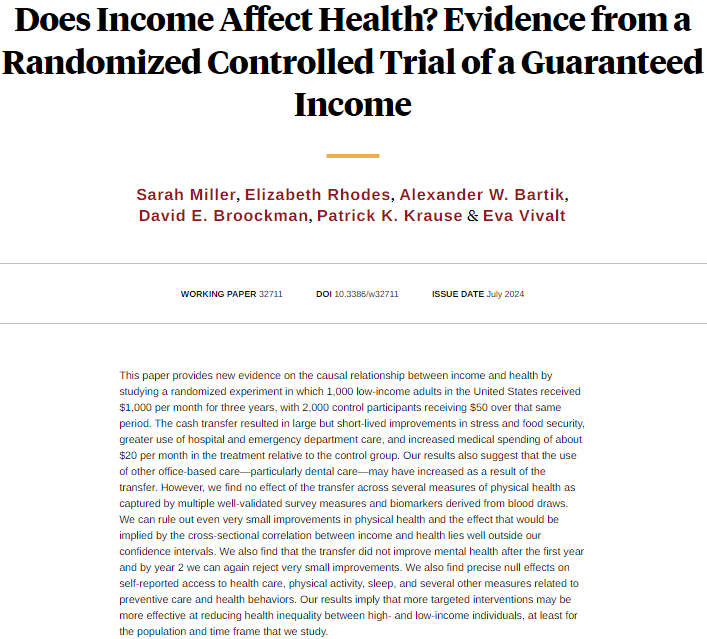
The most interesting new paper in months dropped in last week: “Does Income Affect Health? Evidence from a Randomized Control Trial of a Guaranteed Income

All the broad strokes are there in the abstract: $1000 per month, 2,000 participants (half treated), for three years. It’s the biggest, highest salience experimental test of a universal basic income program to date. There’s a lot of detail, but the broad strokes findings are that nothing happened. That is to say, there was a lot of precise null effects. And that is absolutely fascinating! I’ve gone back in forth on my feelings about a large scale UBI policy, and this is certainly more evidence that gives me pause, but my biggest takeaway is that policy research really should culimate in a series of field experiments whenever possible. Not because of identification or external validity or any of the other reasons economists fight in intellectual perpetuity, but because it’s easier to accept null results as sufficiently precise. It’s easier to acknowledge and accept that there is no observed effect because the treatment mechanism truly had no net effect within an experimental design.

Conducting research using observational data to produce causally identified conclusions is to fight a battle on multiple fronts. These fronts usually relate to the all the possible sources of bias, of endogeneity, within your analysis. You’re observing x causing y to increase, but the reality is that x is correlated with z, and that is what is actually causing y to increase. That’s a tough fight, believe me, as hypothetical sources of varying degrees of plausibility are hurled at your analysis from all directions. But at least there is an argument to be had. There’s something to fight against and over.

Null results face a far more insidious argument: there’s just too much noise in your analysis. Too many sources of variation, to much measurement error, too much something (that I don’t have to bother unpacking) and that’s why your standard errors are too big to identify the true underlying effect. There’s also a simple, and annoying, institutional reality: there’s no t-test for a precise zero. There’s no p value, so threshold for statistical significance that says this is a “true zero”. All we can say is that the results fail to reject the null. It’s subjective. And in a world of 2 percent acceptance rates at top journals, good luck getting through a review process where the validity of statistical interpretaton is assessed in a purely subjective manner.

Field experiments enjoy far more grace with null results. As random control trials, they can argue that their null effects are, in fact, causally estimated. If conducted within sufficient power (i.e. number of observations relative to feasible impact), then the results are simply the results. There’s no arguments to be had about instrumental variables, regression discontinuity cutoffs, or synthetic control designs. Measurement error will rarely be a problem given an appropriate design. External validity…well there’s no getting around external validity gripes, but should those concerns appear then the opposition has already accepted the statistical validity of your null results. You’ve already won.

I’m not puffing up my own team here, either. I’ve conducted several lab experiments, but never a field experiment. They are large, lengthy, and costly endeavors. I aspire to run a couple before my career runs its course, but I’ve built nothing on them to date. But they’ve grown in my estimation, even admidst concerns over participant gaming and external validity, precisely because you can run your experiment, observe no measurable impact on anything, and proclaim in earnest that that is precisely what happened. Nothing.

Who will blow the whistle?

A President has about a 1 in 6 chance of dying while in office*, making it by far the most dangerous job in the United States. Sources of danger include stress, public speaking in inclement weather, and targeted violence. They clearly age rapidly, estimated by at least one doctor to be at twice the normal rate. Given this danger, their compensation seems comparably modest. One possible explanation is asymmetric information, though this should diminish after four years on the job, which leaves open the possibility of coercion. In what looks to me to be a truly awful and underpaid occupation, that so few Presidents step down after their first term is at least suggestive evidence that many Presidents serve under the duress of their parties. If it was any other job, OSHA would be inundated with complaints.

I’ve often said that Nixon resigning was the greatest day in the history of American democracy. The commander in chief of the most powerful army in the history of the world to that point was asked to give up power. And he did, with no blood shed, a moment arguably unprecedented in the history of the world. Yesterday the President chose not to run for re-election. He was, with little doubt, pressured by members of his party to do so. This is a truly great thing. Regardless of whether or not he would have won or lost, been a good President or not, the point is that powerful people wanted to influence a decision made by the most powerful person in the world and did so, again without any threat of violence. This is as good a sign as you can ask for that democracy is maintaining its single greatest advantage over other forms of government: the peaceful transition and acquisition of power.


*Yes, I know the 1 in 6 number is based on deaths throughout the 250 years and that it, like other jobs, has probably gotten safer. I still think the relative danger ranking remains accurate but, in any case, maybe just learn to play along.

Maximizing winning versus minimizing losing

Spain just defeated England 2-1 to win the UEFA European Championship. I watched a fair amount of the last two European championships and the previous Men’s and Women’s World Cups, and one thing that stood out is the dichotomy in playing styles amongst the top 4-6 teams in their relative risk aversion. Putting aside the bottom teams whose relative talent level make it difficult to play anything but highly defensive soccer (bunkering in with 11 players behind the ball AKA parking the bus), it nonetheless remains shocking their seeming chasm in aggression between teams.

Watching England and Spain over the previous month, it is uncanny how much more willing to lose the Spanish sides were. Pressing hard, playing incisive but risky passes, each and every game they ran the risk of losing to a team that was fortunate enough to score off of an poorly placed pass or chaotic bounce. England, in point of contrast, played incredibly conservatively, themselves looking to win a close match by converting a small number of scoring opportunities at a higher rate through their superior talent and/or settling the match in a penalty shootout.

Playing conservatively is a valid strategy. Jose Mourinho bored countless millions of viewers while coaching superior teams to trophies that should have 1-0 etched onto them for eternity. But while watching these games and the those in the English Premiere League I’ve become aware of the compulsion English announcers have to for ascribing nearly every goal to an error made by the defense rather than an achievement of the offense. Spain scored two stunning goals today and the English commentator could not help but attribute at least (maybe both?) to the English team “falling asleep”.

This to me is another opportunity to ask yourself and others “What we are maximizing or minimizing?” Spain was maximizing the chance of winning the tournament. That meant focusing on nothing but the probability of winning each game. They were maximizing the mean. England, on the other hand, was minimizing the probability of losing to an inferior team. They were minimizing the variance. For two-thirds of the final, they continued to minimize the variance and eventually ended up down 1-0. They then subbed their obviously injured captain (who happens to be the best penalty kick taker in the world, maybe ever), put on a younger player, and were immediately more aggressive. They scored and then were scored upon. The bore the fruits and the costs of greater risk. I don’t know what would have happened if they had taken more risk the whole game, but I suspect their probability of winning would have increased.

When you see an organization that is minimizing variance that is often a good thing. It means they are valuing downside risk in a proper manner. In many sports contexts, however, over emphasis on minimizing downside risk is, to my eyes, an example of actors minimizing expected criticism. If England is looking for an explanation why they, the oft-proclaimed inventors of football, have not won a major international tournament in 58 years, the intense risk aversion within team managers seems a first order concern. Yes, I know, Italy has won plenty of tournaments being boring, but I would note that as offensive tactics have reduced the expected mean outcome of conservative play, they have themselves adapted, while England appears to be “fighting the last war”, so to speak.

I’m not English and have no particularly rooting interest, other than a hatred for boring sports (Audere est Facere). Boring, however, doesn’t offend me quite much as suboptimal outcome maximization and resource deployment. For that I must applaud the Spanish national team on their victory. May they stand as an example of the rewards for bravery, rational bravery, in any market.

The median voter can save us all…if the system allows for it

Macron calls for a snap election, the gears of political bargaining begin turning after Marine le Pen wins the first round and the threat of a nationalist government becomes very real, a center-left coalition emerges, and et voila a surprisingly strategic median voter snatches victory from the jaws of xenophobic cruelty.

Can such things happen in the US system? Yes and no. The US is neither a parliamentary system nor do we have a two-stage majority-rule electoral rule, but the same bargaining occurs beyond closed doors, yielding new and sometimes surprising coalitions. The political bargaining behind candidates, however, is beholden to the primary system, so it’s not always clear when bargaining plays out and what actually transpires. For example, as the prospects of President Biden winning re-election over former President Trump, there is increasing speculative expectation of an alternative Democratic candidate despite the party already nominating the President.

The process happening as we speak is a messy process, absent explicit institutional rules and, in the case of the Democratic candidate, a player with veto power, both effectively and literally. The gravity of the median voter is far weaker when the rules, or in this case the absence of specific rules, lead to large transaction costs and, in turn, enormous uncertainty. Whether the US median voter will hold in November’s election is unclear. All we can do for the moment is doff our caps to French voters, their (in my opinion superior) voting rules, and the political operators who bargained the country out of a potentially disastrous new administration.