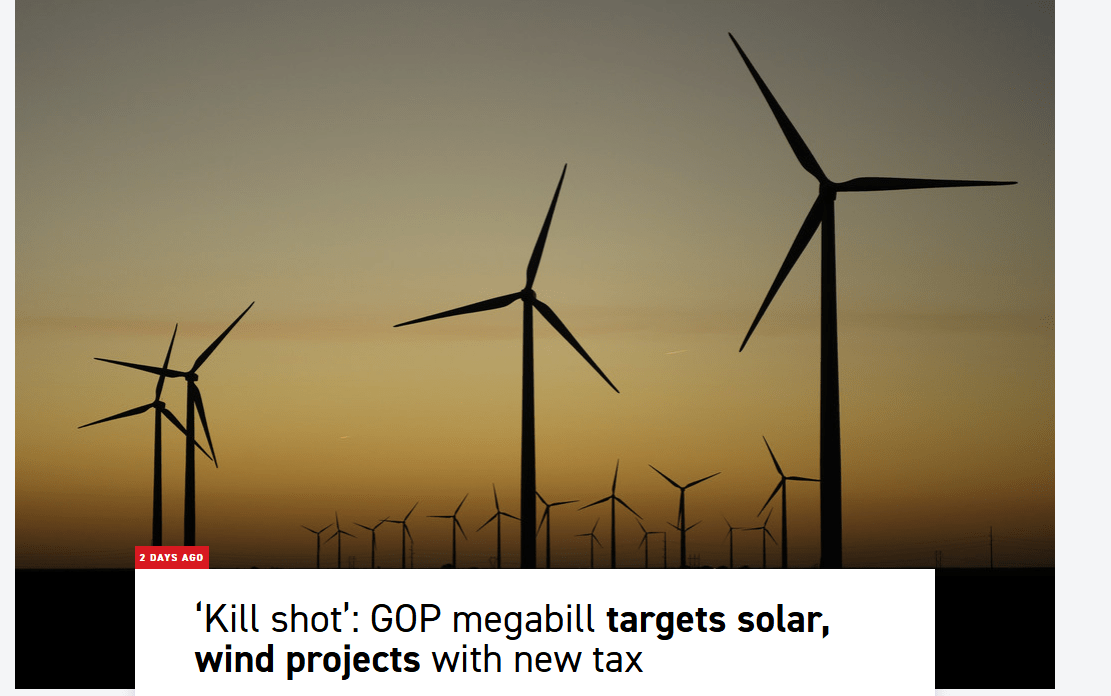
It goes almost without saying that there is absolutely no economic rationale for such a tax. It’s almost a perfect inversion of a classic optimal Pigouvian tax. There is no way to frame this other than as rent-seeking run amok.
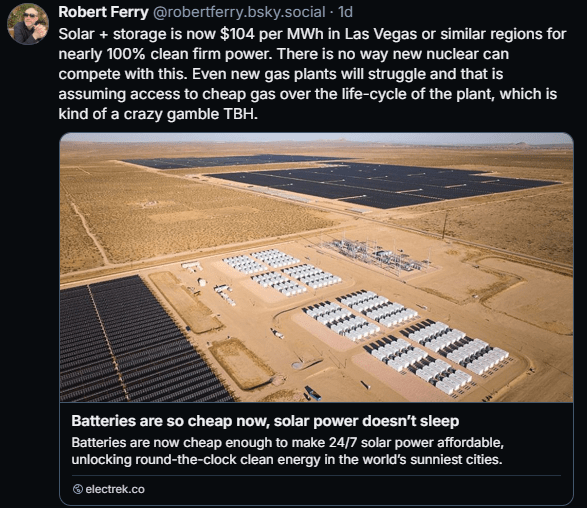
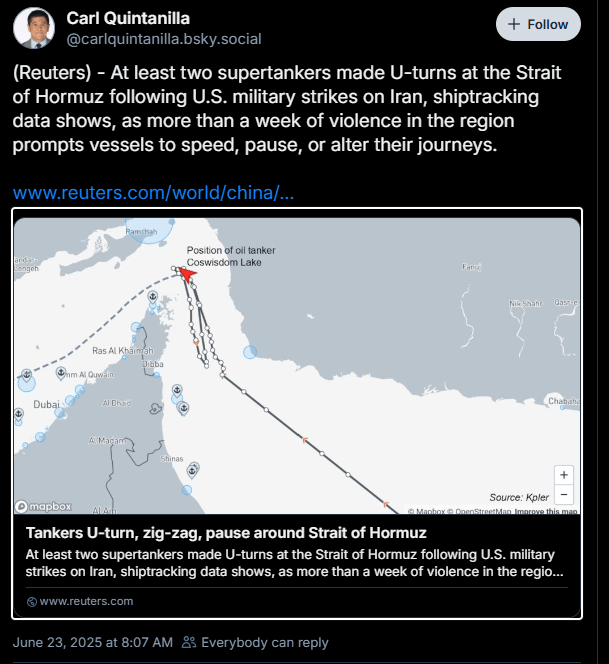
So, will rising oil prices help to further cement the role of solar power even as subsidies dry up? Or will we see a doubling down on rent seeking efforts to keep non-fossil fuel energy sources at bay? Who’s to say!
The term comes from wrestling, which is fitting because for years I’ve been stealing Dana Gould’s line “Politics is just professional wrestling in suits.” There are limits to my casual theft, though. I will not pretend that I am the first to observe that politics has deeply internalized the kayfabe code of vehemently declaring beliefs or expectations in no way actually held while simultaneously understanding that your rivals are doing the same.
I am curious whether you can undermine your own political agenda or influence by going too far, by committing too much to a fictional worldview. Much like Serpico, if you go too deep you can lose track of the real you. Grandstanding in front of the cameras is one thing, but if you want to trade in the political marketplace, you need to be able to credibly do so in good faith. I can’t help but wonder if part of the inability of Congress to assert it’s constitutional power in face of Executive overreach is a political market failue. Has the information and signal quality between represenatives been so eroded that prices and, in turn, exchanges can’t emerge?
On a more optimistic note, however, I expect that at some point a political party will find advantage in have better norms of credible signaling if only because they will have an easier time solving their own collective action problem. The question remains, though, at what point will the political advantage of superior collective action dominate the electoral advantage of earnestly lying to voters?
“Cruikshank played a crucial role in terminating Reconstruction and launching the one-party, segregationist regime of “Jim Crow” that prevailed in the South until the 1960s. The circuit court opinion of Justice Joseph Bradley unleashed the second and decisive phase of Reconstruction-era terrorism…” – Pope, James Gray. “Snubbed Landmark: Why United States v. Cruikshank (1876) Belongs at the Heart of the American Constitutional Canon.” Harv. CR-CLL Rev. 49 (2014): 385.
The Civil War was over, but the seceding states remained in open conflict with the federal government. Southern states, particulary those with majority Black populations, were desperate to terminate institutional reconstruction and purge the federal agents tasked with ensuring Black voting rights. The levers of state government were still in White hands, but that control was becoming tenuous. It is not wholly outlandish to suggest that Jim Crow as we know it may never have come to be if the US Supreme Court had not handed down a now infamous decision that effectively left Black men and women to fend for themselves. Freed from slavery only 13 years earlier, they now had to contend with state and local governments intent on maintaining the status quo of White supremacy in every way possible. It would be nearly a hundred years before the Voting Rights Act of 1965 would begin to restore the franchise to Black individuals.
California is in full conflict with federal government as we speak. Federal agents under the moniker of ICE are attempting to detain and subsequently deport individuals they deem to be of questionable legal residence. There have been multiple examples of individuals with fully legal claims to residence in the form of green cards, student visas, or full blown birthright citizenship who have been taken into custody by ICE and CBP agents (masked, armed, and in full military fatigues). Absent familial notification or any form of due process, there was always the question of whether a state authority would ever treat these takings of individuals as extralegal kidnappings.
Am I using inflammatory language? I’m not sure that I am. ICE and CBP officials have make strong declarations that they believe themselves to be unbeholden to court decisions, due process, or the Constitution. State and local law enforcement in California have made it clear that they will not aid ICE in any way shape or form save preventing violence in the streets as protesters have arrived in sufficient numbers that ICE agents were effectively herded into narrow spaces and prevented from exiting with the individuals they had detained.
Just in case it is not patently obvious how I feel on the matter, the protesters are on the right side of history. The federal government is overreaching in a more gratuitous and unconstitutional manner than at any moment in the previous 40 years. This is, in terms of our federalist structure, the inverse of Jim Crow and Cruikshank. State governments are in position to defend the liberties and rights of their residents against the extralegal encroachment of federal agents. If anything, I find myself grateful that such a standoff is occurring in California, a state with the scale and resources to stand against the federal government. I know the Trump administration is threatening to “cut off” California from federal money, but that’s a strange tactic. California net loses between $71 and 83 billion per year in federal spending minus taxes paid by residents. California is the 4th largest economy in the world. California is a mess, their housing market is atrocious, they manage their forests and wildfire prevention quite poorly, but it is nonetheless the single most economically important state in the US by a cavernous margin. California can say “no” to the federal government. They may find themselves with national guard troops on their streets. They can ask then ask them to be removed. They can ask ICE and CBP to leave.
This is a significant test of our federalist republic. Cruikshank served as the political fulcrum of its time by denying the federal government’s obligation to intervene and in doing so handed the power to deny basic constitutional rights to state and local governments, and the country has in many ways never wholly recovered. As we speak the federal government is taking action on behalf of the current presidential administration to deny basic constitutional rights. How a state’s ability to protect those rights against the federal government on behalf of its residents plays out may be the political fulcrum of our next 50 years.
Which isn’t to say that there aren’t monsters who have found their way into and adjacent to power, but they are always limited by the beliefs held by the people on the ground doing the dirty work. The revelation in the quote below is that for all the cruelty and uncertainty being imposed by ICE, USBP, and the agents deputized from local law enforcement, it isn’t meeting the ambitions of those who want more than terror and lib-owning headlines. They know their days are limited and that to make the America, at the margin, as Whiter as is possible, and to do so they need the broadest possible net cast based on little more than racial/ethnic density:
The Washington Examiner (the conservative news outlet) reports that Stephen Miller screamed at ICE officials: "What do you mean you're going after criminals? Why aren't you at Home Depot? Why aren't you at 7-Eleven?" Kinda blows up the narrative that they care about public safety.
What’s limiting them is that for as much selection as there is on politics, information sources, and social networks into the individual agents on the ground, their aren’t enough who actually want to maximize thecruelty and racial homogeneity. Most, I strongly suspect, just want to do their jobs. Many, I hope, no doubt do buy the false narratives of immigrant criminality, but those who mirror the darkest ambitions are probably (hopefully) too few in number to produce the outcomes desired by the architects of the current national travesty that shames us all.
So keep doing to the little things that keep the false narrives from becoming folk wisdom. The conversations across weak social ties that run counter to the fear-mongering and deception. Every agent and field officer who, consciously or unconsciously, finds themselves doubting the wholesale slandering of immigrants and racial groups is more sand in the gears slowing a machine that is on borrowed political time. Every day lost is a day won. Every TACO a month. Every court case a quarter. Just keep slowing it down.
“We hurt the ones we love because we can” is a cliche, though perhaps I should be attributing it to a specific writer. Its truth is something that I find extends beyond our close familial, platonic, and romantic relationships. The mechanism behind misdirected aggression is simple: we are exposed to a source of stress that we are unable to affect, and the innocent bystanders most proximate to us become collateral damage specifically because we can affect them. The anger inside us needs to go somewhere and, in a parable of true irony, your mutual affection becomes the channel through which you express anger and frustration that has nothing to do with them.
There are a lot economists, writers, pundits, public intellectuals whose work I consume. Often I agree, sometimes I don’t, but I keep reading them because I consistently learn from them. Lately I’ve found myself becoming more frustrated with a greater share of their writing, often because they’re not being hard enough on the Trump administration, attempts to dismantle core insitutions, or the indiscriminate cruelty behind the rampant incompetence. I want them to be meaner and angrier and more direct. I want them to have an affect that I can’t. To be clear, I’ve attributed more power and influence to them than they actually have, but I think that’s not the real problem.
The real problem is that I know that no one in the Trump administration cares that they are cruel or incompetent. You can, at best, embarrass these people briefly, but you can’t shame them. They only internalize consequences and they’ve yet to experience any. They have coalesced around the singular belief that has served as the North Star for Trump’s entire life: there are no rules. Rules are fake. An illusion. A mass delusion. There are no rules and you can do whatever you want in the moment that serves your ambitions and ego and then move on to the next thing.
What do you do when your entire mechanism for affecting and contributing to world is the written word, criticism, the speaking of evidence-based truth to power and that power doesn’t care? What I find myself tempted to do, and what a lot commentators our there (especially on bluesky) are doing, is attacking the people who might and do actually listen with an undeserved fury. The criticism is often valid, but it’s just 30% meaner than it needs to be. More personal. More cruel.
I care about AI. I care about energy subsidies. I care about crime and education and health. But, if I’m being honest, there are times every day when I don’t. I’m a professor, I care about and contribute to bleeding edge research, but the moment we are living through isn’t about PhD level questions. These are 5th grade social studies times. Democracy. Rule of law. Citizenship. All men are created equal. Basic human dignity. That’s the reality and it’s not hyperbole.
I hope everyone will keep doing their research and commentary about the nitty gritty of day to day science. I also hope that everyone will take the time to grant just a bit more space emphasizing the basics, to leave no doubt about where they stand. Becaue no matter how someone might identify politically, in this moment it’s mostly irrelevant. Liberal, conservative, libertarian, classical liberal, neoliberal, new liberal, social democrat. The differences are trivialities. There are only two groups that matter: those who want to keep the basic institutions intact and those that want to burn it to ground. That’s it.
So just keep that in mind when you’re mad about someone online, about what they wrote, what you think they believe. Are they trying to hold the world together while bandits are stripping the walls for copper and carving out chunks of marble from every load-bearing pillar? If the answer is yes then they deserve grace. I’m trying and I hope you’ll do the same for me.
As of 10:30am this morning Berkeshire Hathaway is down 5.6% on the news that Warren Buffet is retiring at the end of the year. At first blush, this makes sense. Buffet is an irreplaceable input into their production function. However, the man is 94 years old, a full 24 years after nearly everyone retires, so this was not exactly an unforseeable event. Why wasn’t more of this already baked into the price? Further, this would appear a far better outcome – announcing retirement more than 6 months in advance- than a more sudden and unfortunate event, such as the passing of a man in his mid 90s. It’s not unreasonable to suggest that both event possibilities would be baked into the price and, with his retirement beingthe better outcome, thus the price could have even gone up.
To me, this is a reminder that there limits to how much Knightian uncertainty can be baked into a price. Put another way, it is a reminder of the costs that uncertainty (nearly?) always imposes on markets. We would all, voters and legislaters, be wise to remember that as the current Presidential administration continues to inject seeming daily boluses of constitutional, existential, and economic uncertainty into our lives.
“From 2005 to 2019, forty US states raised the dollar value threshold delineating misdemeanor and felony theft, reducing the expected punishment for a subset of property crimes. Using an event study framework, we observe significant and growing increases in theft after a state reform is passed. We then show that reduced sanctions for theft have broader effects in the market for illegal activity. Consistent with a mechanism of substitution across income-generating crimes, we find decreases in both drug distribution crimes and the probability that a released offender previously convicted of drug distribution is reincarcerated for a new drug conviction.”
For those interested in a bit more of the nitty-gritty, we analyze both arrest and recidivism data within a stacked event study because we are dealing with staggered (diffent years) and fully-absorbing treatments (i.e. once they raise it they never lower it back). States raise their felony theft thresholds for a portfolio of stated and unstated reasons, but the reality is that the value of the marginal stolen good is often deteriorated by decades of inflation only to be doubled or tripled by a single act of legislation. This makes for an excellent before/after experimental setting to test the effect on crime.
We’re going to look at two things broadly: arrests and recidivism. The importance of arrests is straightforward: they give us a sense of the rates of crime across populations. Recidvism is more subtle. More on that in a bit.
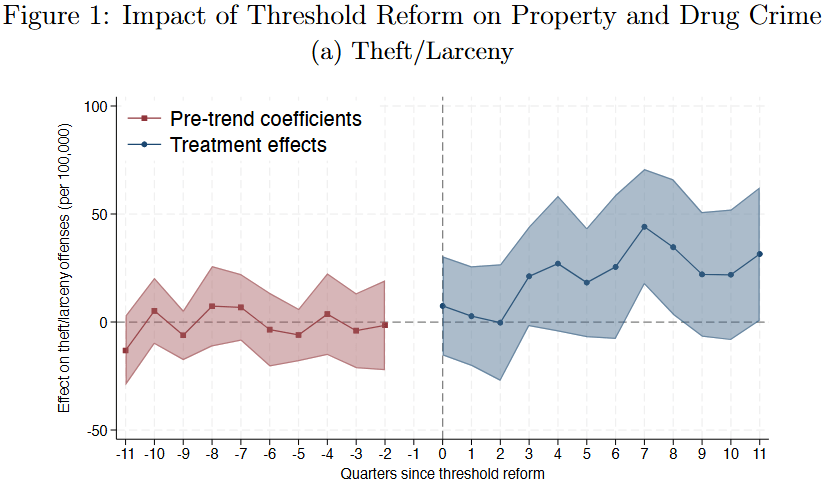
In the quarters leading up to a threshold change (above) we see flat pre-trend with a coefficient of zero i.e. nothing happening. Nothing happening is good, it means that neither law enforcement nor criminals exhibit any sign of anticipating the change. Once a given state makes the change, we see an uptick in rates of theft within 6 months that persists for three years. Speculating beyond that is dangerous – too many other things happening in the world. But criminals seem to be responding.
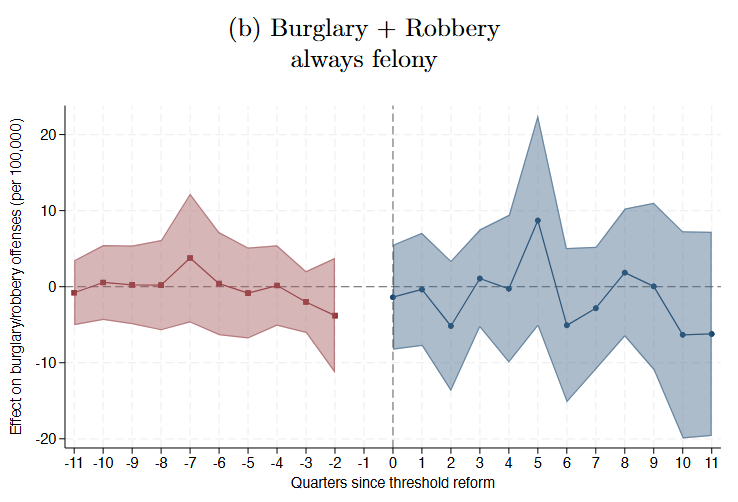
We don’t see any effect on Burglary or Robbery, however (below). This is also a sign of rational criminals since these thresholds don’t apply (i.e. they are always a felony, regardless of property value). In other words, we don’t see an effect on all property crime, just on those crimes for which expected punishment is reduced.
We do, however, see an interested effect on drug distribution (below). In the quarters after a theft threshold reduction, we see a significant and persisting reduction in drug arrests. Yes, we include controlling covariates for medical and recreational marijuana legalization. There’s something else going on here. Are people exiting one income-generating crime for another?
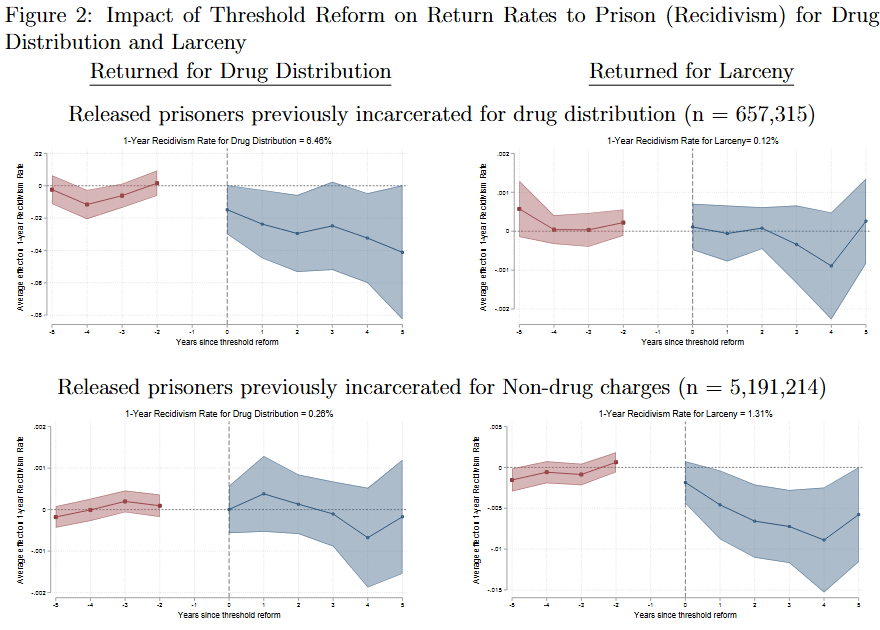
This is where recidivism comes in. Using detailed, restricted-access, prisoner records, we track when prisoners are released and if/when they are returned to prison. By stratifying the analysis by the crime types they were previously incarcerated for, we can separately estimate the effects of felony threshold changes on individuals with human and social capital in the drug distribution business from those who do not. What we observed is both striking and subtle.
For indidividuals previously incarcerated for drug distribution (top left), their rate of return for future drug convictions is immediately lower with a reduction in the felony threshold. For those who were never in the drug trade, there is no effect (bottom left). Reducing the expected punishment for theft is pulling individuals out of the drug business.
Now let’s look at the return rate for felony larceny. For most prisoners (bottom right), there is a massive reduction in the rate of return for larceny. This makes complete sense – if more theft is classified as a misdemeanor, you are much less likely to be re-incarcerated with a new sentence for it. When we look at prisoners previously incarcerated for drug distribution, however, there is no observed effect (apologies for the changing y axis scales, there’s no good way to keep them constant). What does this mean? We interpret this as evidence that the reduction in punishment for theft is canceled out by the shift into theft as a preferred way of earning income. The labor substitution effect cancels out the effect of reduced punishment.
There’s obviously a lot more in the paper. No, there is not an effect on violent crime (Table 2). No, there is not an observed effect on officer enforcement intensity (Appendix Table A3). No, we can’t do a regression discontinuity at the threshold values (too much bunching, see Appendix Figure A7). The conclusions are both obvious and subtle, but the most important may simply be the reminder that all policies have tradeoffs and spillovers, no matter how narrow they might seem.
TLDR; When states increase the property value threshold delineating misdemeanor from felony theft, prospective criminals respond by a) committing more theft and b) substituting out of drug distribution and into theft. This pattern of substitution in the criminal labor market is more evidence that criminals are not only rational and respond to deterrence incentives, but are also selecting across criminal options, which means we should expect spillovers across crimes when policies create differential changes in expected punishments, enforcement, and returns.