Rockonomics Highlights

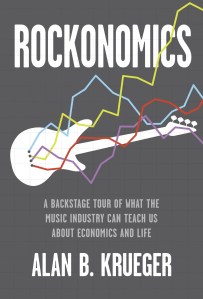
I missed Alan Kreuger’s 2019 book on the economics of popular music when it first came out, but picked it up recently when preparing for a talk on Taylor Swift. It turns out to be a well-written mix of economic theory, data, and interviews with well-known musicians, by an author who clearly loves music. Some highlights:

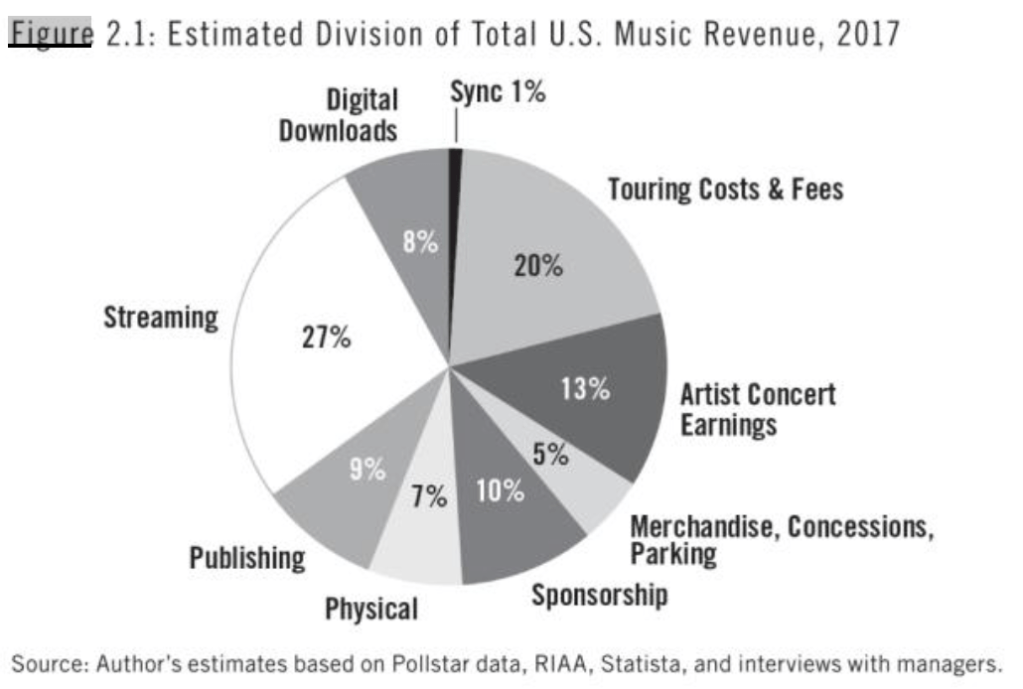
[Music] is a surprisingly small industry, one that would go nearly unnoticed if music were not special in other respects…. less than $1 of every $1,000 in the U.S. economy is spent on music…. musicians represented only 0.13 percent of all employees [in 2016]; musicians’ share of the workforce has hovered around that same level since 1970.

there has been essentially no change in the two-to-one ratio of male to female musicians since the 1970s

The gig economy started with music…. musicians are almost five times more likely to report that they are self-employed than non-musicians

30 percent of musicians currently work for a religious organization as their main gig. There are a lot of church choirs and organists. A great many singers got their start performing in church, including Aretha Franklin, Whitney Houston, John Legend, Katy Perry, Faith Hill, Justin Timberlake, Janelle Monae, Usher, and many others

Continue reading

Leave Me Alone and I’ll Make You Rich

That is the title of a 2020 book by Dierdre McCloskey and Art Carden. It attempts to sum up McCloskey’s trilogy of huge books on the “Bourgeois Virtues” in one short, relatively easy to read book. I haven’t read the full trilogy, so I can’t say how good the new book is as a distillation, but I found that it was easy to read and at least makes me think I understand McCloskey’s basic thesis for why the world got rich. I share some highlights here.

Part 1 of the book aims to establish that the world did in fact get richer over recent centuries, plus give a basic explanation of liberal political thought. If you already know this you could skip this part and cut down an easy 189 page read to a very easy 106 page read (part 1 is for some reason written in a way that assumes you disagree with the authors, which grates when you don’t, or perhaps also if you do).

Part 2 gets to what I at least came for- digging into the history to solve the puzzle of why the Industrial Revolution / Great Enrichment took off when and where it did. Which means first, explaining why many things people think made 18th century England special were actually common elsewhere, like markets:

Continue reading

Predicting College Closures

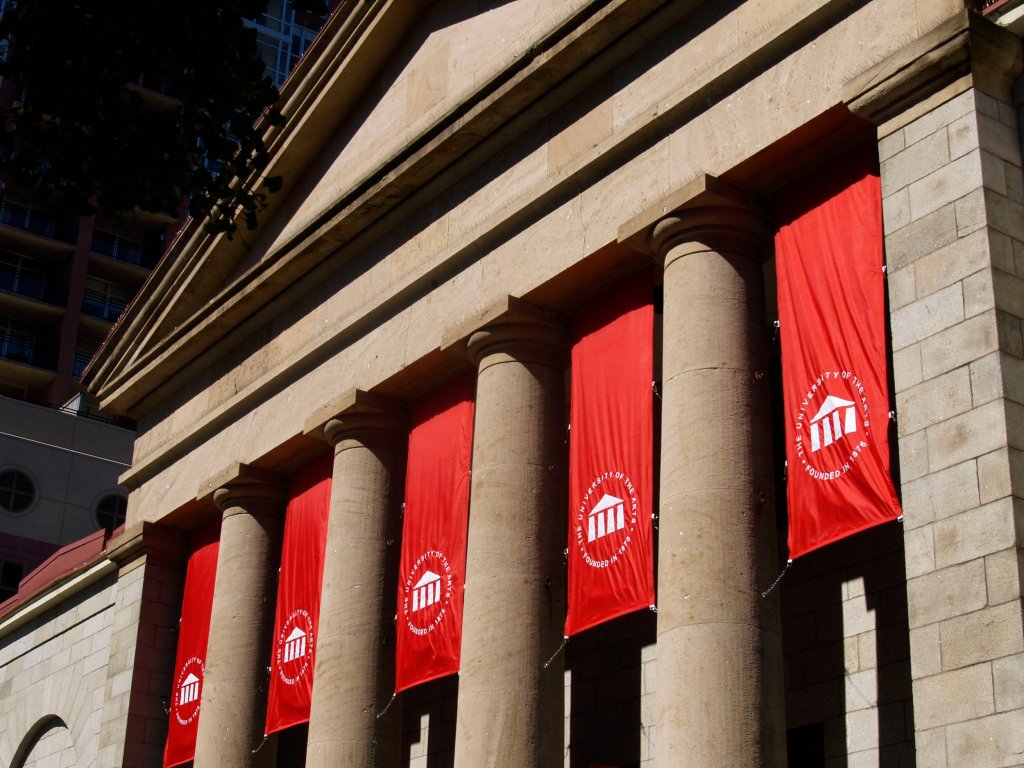
This week the University of the Arts in Philadelphia announced they were closing effective immediately, leaving students scrambling to transfer and faculty desperate for jobs. U Arts now joins Cabrini University and Birmingham-Southern as some the 20 US colleges closing or being forced to merge so far this year. This trend of closures is likely to accelerate given falling birth rates that mean the number of college-age Americans is set to decline for decades; short-term issues like the FAFSA snafu and rising interest rates aren’t helping either.

All this makes it more important for potential students and employees to consider the financial health of colleges they might join, lest they find themselves in a UArts type situation. But how do you predict which colleges are at significant risk of closing? One thing that jumps out from this year’s list of closures is that essentially every one is a very small (fewer than 2000 undergrad) private school. Rural schools seem especially vulnerable, though this year has also seen plenty of closures in major cities.

Source

There appear to be a number of sources tracking the financial health of colleges, though most are not kept up to date well. Forbes seems to be the best, with 2023 ratings here; UArts, Cabrini, and Birmingham-Southern all had “C” grades. If you have access to them, credit ratings would also be good to check out; Fitch offers a generally negative take on higher ed here.

In a 2020 Brookings paper, Robert Kelchen identified several statistically significant predictors of college closures:

I used publicly available data compiled by the federal government to examine factors associated with college closures within the following two to four years. I found several factors, such as sharp declines in enrollment and total revenue, that were reasonably strong predictors of closure. Poor performances on federal accountability measures, such as the cohort default rate, financial responsibility metric, and being placed on the most stringent level of Heightened Cash Monitoring, were frequently associated with a higher likelihood of closure. My resulting models were generally able to place a majority of colleges that closed into a high-risk category

The Higher Learning Commission reached similar conclusions. Of course, there is a danger in identifying at-risk colleges too publicly:

Since a majority of colleges identified of being at the highest risk of closure remained open even four years later, there are practical and ethical concerns with using these results in the policy process. The greatest concern is that these results become a self-fulfilling prophecy— being identified as at risk of closure could hasten a struggling college’s demise.

Still, would-be students, staff and faculty should do some basic research to protect themselves as they considering enrolling or accepting a job at a college. College employees would also do well to save money and keep their resumes ready; some of these closures are so sudden that employees find out they are out of a job effective immediately and no paycheck is coming next month.

Abnormal Times Call for Abnormal Policies

The Fed made two mistakes during the Great Recession of 2007-2009: being too slow and weak in their initial reaction to the financial crisis, and being too hurried in their attempts to return to a ‘normal’ policy stance. The first mistake turned what could have been a minor road bump into the worst recession in decades, and the second mistake meant it took a full decade from the start of the crisis in 2007 for unemployment to return to pre-crisis levels.

The rapid recovery from the Covid recession shows that the Fed learned from its first mistake in 2007. In 2020, the Fed acted quickly and decisively, so that despite the worst pandemic in a century the US experienced a recession that lasted only months, and it took unemployment barely 2 years to return to pre-Covid levels. But the Fed’s talk about cutting rates this year makes me worry they did not learn the second lesson. Despite all their talk of being “data driven”, I don’t see how a dispassionate look at current inflation, labor market, or financial data could lead them to be considering rate cuts; if anything it currently suggests rate hikes.

Why then is the Fed talking rate cuts? Of course you can dig and find a few data points to support cuts, but I think the driving factor is simply a feeling that interest rates are currently above “normal”. They are digging to find data points to support cuts because they want to return rates to “normal”, just as in the early to mid 2010’s they were digging for reasons to raise rates to “normal”. Rather than being consistently too hawkish or too dovish, they are consistently too eager to return rates to “normal” when circumstances are still abnormal.

This is not simply out of a social and political desire to avoid appearing “weird”, though that is definitely a factor. There is also a long academic tradition of measuring the stance of monetary policy by comparing current interest rates to a neutral, “natural” rate of interest, r*. But this tradition has problems. The “natural” rate of interest is always changing, and at any given time we can’t really know for sure what it is. The current Fed Funds rate may be higher than it has been in recent years, but that doesn’t necessarily mean it is above the current natural rate of interest; the natural rate itself could have risen too. This is why interest rates aren’t a great way to measure the stance of monetary policy. At times Chair Powell himself has made the same point, saying that trying to set policy by comparing to the “natural” rate of interest r* is like “navigating by the stars under cloudy skies”.

Lacking such celestial guidance, I can only hope the Fed will make good on their promise to be data-driven and navigate by the guideposts they can see around them: measures like current inflation and unemployment, or market-based forecasts of such measures.

Fear of the Unknown and Fear of the Known

Alfred Hitchcock’s ‘Psycho’ famously omits graphic violence. You never see the bad guy stab anyone – though it’s heavily implied. Some say that this accounts for the impact of the film. The most thrilling parts are left to the viewer’s imagination. And a person’s imagination can be pretty terrifying. The delight of the unseen was especially appropriate at a time of 13 inch televisions and black-and-white movies. If the graphics on the screen couldn’t carry the movie, then the graphics in a person’s mind would do the trick.

Fast forward to ‘Burn Notice’. I don’t watch this show, but my in-laws do. They have a huge TV with a super high resolution. The TV has a diagonal span that almost surpasses my height. I’m short, but not that short. This is a big TV.  I’ve only seen Burn Notice at their house. It strikes me as poorly acted, poorly written, and self-serious to the point of absurdity. I keep expecting that self-referential nod to the open secret that the show is ridiculous, but it never comes. It’s a bad show. From all that I can see in high definition, there’s nothing worth seeing.

What is so good that I watch? Although I’m seven years late, I’ve recently been watching Marvel’s Luke Cage. Being a superhero show, some of the standards are lowered. The script is weak at times, the acting is OK, and the plot has some credibility holes. But the point of the show is to explore a world in which superheroes exist, and one of them happens to live in Harlem. Luke Cage is part of the earlier Marvel cadre of post-acquisition-by-Disney shows that also includes Iron Fist, Daredevil, & Jessica Jones. These shows are less tongue-in-cheek and comedic than the later shows like Loki, Wandavision, or Moon Knight. I enjoy watching Luke Cage on a small 40 inch television, and occasionally on my phone.  

Then I stayed at an Airbnb last weekend that had a HUGE TV. This thing easily had a diagonal measure that surpassed my height. After getting the kids down and answering emails, I sat down to enjoy my current go-to show before hitting the hay. And dang it if I wasn’t distracted the entire time. On this massive screen I could see every pore on everyone’s face and every blank stare parading as acting. I could see each and every glare of poor lighting and every character’s ill-timed reply and change of expression.  Most of the show is one big charade.

Much to my dismay, I had discovered that I was watching ‘bad tv’. Let me be clear. I’m not supposed to watch bad tv. That’s the realm of those other people. But me? I have enlightened preferences and a refined pallet. I’m not a person who watches bad tv. But that grandiose self-conception has been dashed by this serendipitous visit to a nice Airbnb.

I’ve had some time to dwell on my new revelation and this is what I’ve settled on. First, I’m going to keep watching Luke Cage on my small TV and I’m going to enjoy it. There is little that I can do now about the nagging knowledge that, given a higher resolution, it’s not a good show. You can’t unknow things. Second, maybe Burn Notice isn’t a bad show. Maybe it’s just a bad show when I can see too much detail, such as on my in-law’s TV. Maybe I would enjoy it on a TV with lower resolution. Regardless, I’m not going to watch it.

Third, now I have a new margin of preference over shows and movies. Now I consider whether a show or movie would be helped or hurt by more visual detail. Quick-paced, big-budget action shows like Jack Ryan are probably better in greater detail. Game of Thrones is probably better as a 4k experience. But shows in which the comedy or the drama unfolds by virtue of the circumstances, rather than the visual spectacle, are probably best watched at a lower resolution. When the audience experience hinges on implications and connections that occur in the viewer’s mind, that’s probably a better show at a lower resolution. Luke Cage is a ‘good’ show in low-res. In high-res, I’m afraid that see too much.

When Hitchcock omitted visual detail, he leaned on the mind’s eye to fill in the gaps. He was guiding the brain toward conjuring the unnerving scenes that he could not as easily mimic on screen. Advances in home entertainment have moved the goalpost. A more detailed viewing experience changes the type of shows that we are willing to watch because we have a new criteria for fitness. The supply side response on the part of studios is that shows lacking visual stimulation will need to lean more on the mind’s eye and our interpretations of social interactions in order to for audiences to experience the best version of the show. Because the best version won’t be in front of us. We know too much.

OpenAI wants you to fool their AI

OpenAI created the popular Dall-E and ChatGPT AI models. They try to make their models “safe”, but many people make a hobby of breaking through any restrictions and getting ChatGPT to say things its not supposed to:

Source: Zack Witten

Now trying to fool OpenAI models can be more than a hobby. OpenAI just announced a call for experts to “Red Team” their models. They have already been doing all sorts of interesting adversarial tests internally:

Now they want all sorts of external experts to give it a try, including economists:

This seems like a good opportunity to me, both to work on important cutting-edge technology, and to at least arguably make AI safer for humanity. For a long time it seemed like you had to be a top-tier mathematician or machine learning programmer to have any chance of contributing to AI safety, but the field is now broadening dramatically as capable models start to be deployed widely. I plan to apply if I find any time to spare, perhaps some of you will too.

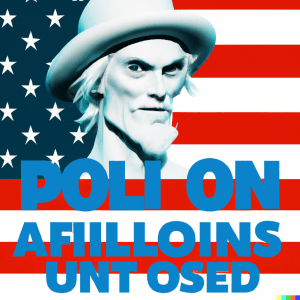
The models definitely still need work- this is what I got after prompting Dall-E 2 for “A poster saying “OpenAI wants you…. to fool their models” in the style of “Uncle Sam Wants You””

Gari Melchers

Who’s your favorite artist? Warhol? Picasso? Van Gogh? Maybe someone much earlier, such as Michelangelo or Titian? Of course, there is something about the style or subjects that you enjoy. But something about the artist’s personal life might also matter to you. Personally, I’m a fan of Hieronymus Bosch, about whom we know little, and William Blake, who had some social and political opinions that would still be considered liberal even today.

Picasso, Dalle, and Warhol were all eccentric. Picasso had multiple girlfriends who didn’t get along, Dalle enjoyed exemplifying surrealism in his dress and behavior, and Warhol was a reclusive hoarder. Their eccentricity increases their allure and fosters an aura of mystique that they are privy to some unknown truths.

Continue reading

Waxing Crescent: New Orleans 2013-2023

The scars of Hurricane Katrina were still obvious eight years afterward when I moved to New Orleans in 2013. Where I lived in Mid-City, it seemed like every block had an abandoned house or an empty lot, and the poorer neighborhoods had more than one per block. Even many larger buildings were left abandoned, including high-rises.

Since then, recovery has continued at a steady pace. The rebuilding was especially noticeable when I spent a few days there recently for the first time since moving away in 2017. The airport has been redone, with shining new connected terminals and new shops. The abandoned high-rise at the prime location where Canal St meets the Mississippi has been renovated into a Four Seasons. Tulane Ave is now home to a nearly mile-long medical complex, stretching from the old Tulane hospital to the new VA and University Medical Center complex. There are several new mid-sized health care facilities, but most striking is that Tulane claims to finally be renovating the huge abandoned Charity Hospital:

Old Charity Hospital, January 2023

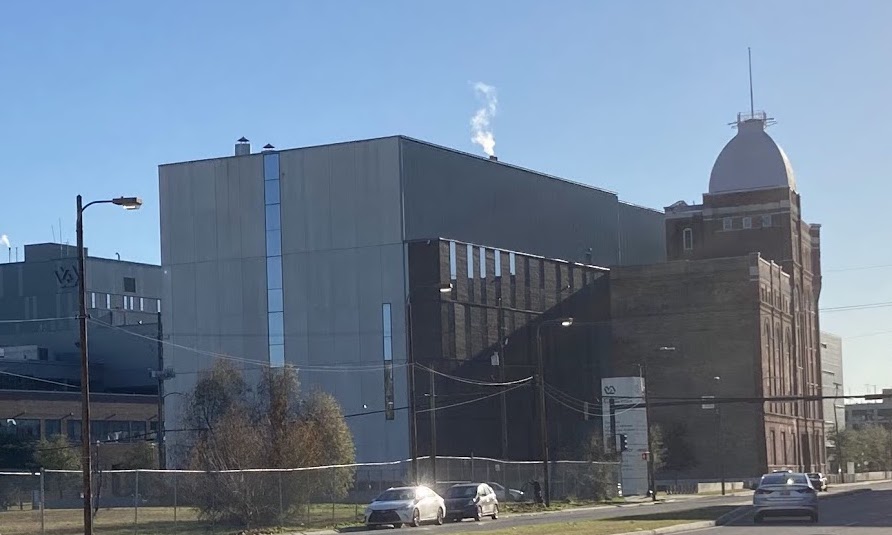
The new VA hospital opened in 2016 as mostly new construction, but they’ve now managed to fully incorporate the remnants of the abandoned Dixie Beer brewery:

VA Hospital incorporating old Dixie Beer tower, January 2023

Dixie beer itself opened a new beer garden in New Orleans East, and just renamed itself Faubourg Brewery. Some streets named for Confederates have also been renamed, though you can still see plenty of signs of the past, like the “Jeff Davis Properties” building on the street renamed from Jefferson Davis Parkway to Norman C Francis Parkway.

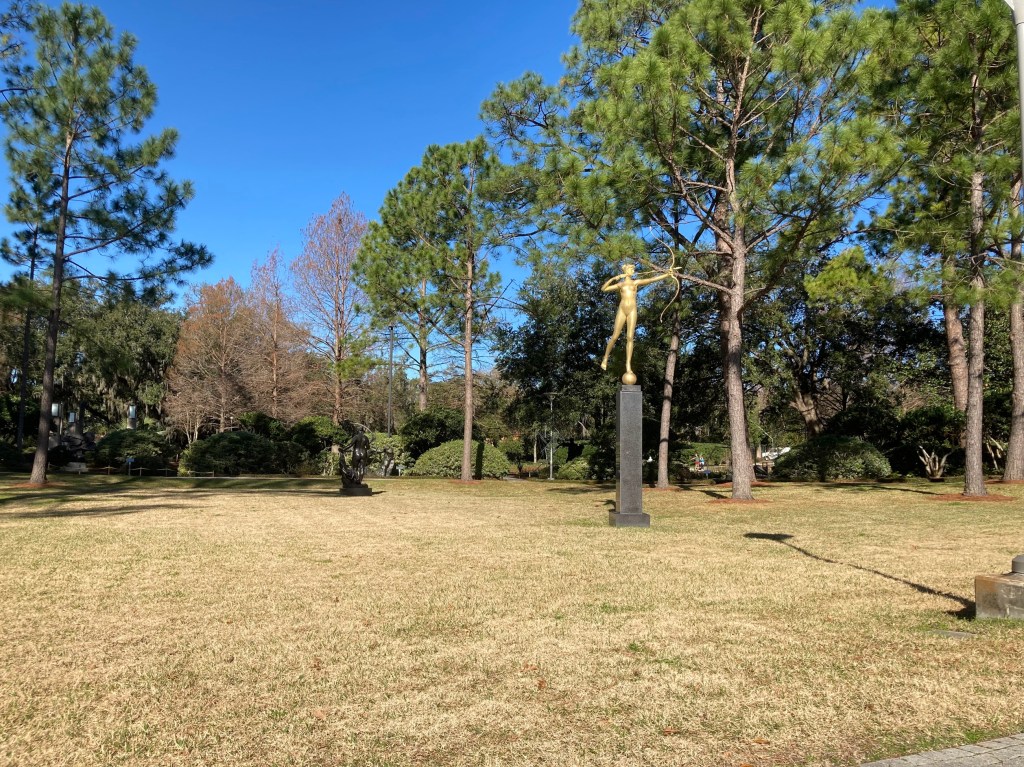
Other big additions I noticed are the new Childrens’ Museum and the greatly expanded sculpture garden in City Park:

Of course, even with all the improvements, many problems remain, both in terms of things that still haven’t recovered from the hurricane, and the kind of problems that were there even before Katrina. The one remaining abandoned high-rise, Plaza Tower, was actually abandoned even before Katrina.

My overall impression is that large institutions (university medical centers, the VA, the airport, museums, major hotels) have been driving this phase of the recovery. The neighborhoods are also recovering, but more slowly, particularly small business. Population is still well below 2005 levels. I generally think inequality has been overrated in national discussions of the last 15 years relative to concerns about poverty and overall prosperity, but even to me New Orleans is a strikingly unequal city; there’s so much wealth alongside so many people seeming to get very little benefit from it.

The most persistent problems are the ones that remain from before Katrina: the roads, the schools, and the crime; taken together, the dysfunctional public sector. Everywhere I’ve lived people complain about the roads, but I’ve lived a lot of places and New Orleans roads were objectively the worst, even in the nice parts of town, and it isn’t close. The New Orleans Police Department is still subject to a federal consent decree, as it has been since 2012. The murder rate in 2022 was the highest in the nation. Building an effective public sector seems to be much harder than rebuilding from a hurricane.

As much as things have changed since 2013, my overall assessment of the city remains the same: its unlike anywhere else in America. It is unparalleled in both its strengths and its weaknesses. If you care about food, drink, music, and having a good time, its the place to be. If you’re more focused more on career, health, or safety, it isn’t. People who fled Katrina and stayed in other cities like Houston or Atlanta wound up richer and healthier. But not necessarily happier.

The NFT Market Is Mushrooming – Why??

Saturday Night Live fans were introduced to Non-Fungible Tokens (NFTs) a year ago with this skit. Most people know that an NFT is a digital ownership certificate of some asset. That could be a physical asset, or a purely digital asset, like a crude graphic of an ape wearing a sailor’s hat which people are willing to pay hundreds of thousands or millions of dollars for.

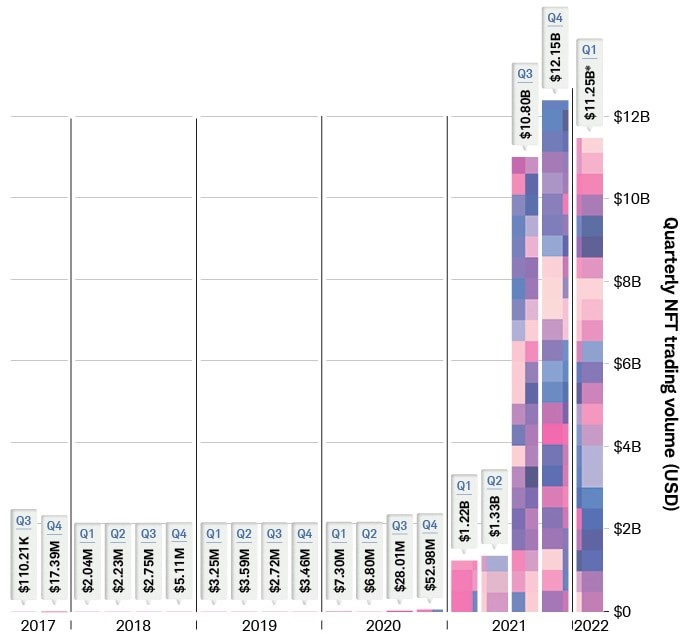
The NFT market volume exploded in the second half of 2021:

On-line chain transactions as tracked by DappRadar. Source: Schwab.

The global NFT market is projected to grow from $1.9 billion in 2021 to $5.1 billion by 2028, an annual growth rate of some 18%.

But, why??? Why would people plunk down millions of dollars for just a certificate of ownership of something which may not be particularly beautiful or functional? It is just not something that would ever occur to me.

Part of the answer must be that there are a lot of people who have a lot of money that they don’t really need. This may be a function of the ever-increasing income inequality, but we will not go down that rabbit hole. But still, assuming some 30-something has 50 grand that he doesn’t need  — why spend it on an NFT?

I did a real quick search on this topic. The most common reason appears to be the same reason many people buy rare coins or rare wines or other “collectibles” – they hope that someone else will pay them a higher price in the future. There also seems to be a sense of participating in some “community”, e.g., of Bored Ape Yacht Club aficionados. Much of it comes down to the psychology of what others will pay for something, which can be often explained in hindsight, but can be hard to predict if some asset class has not yet become “hot”.

It turns out that there are some other nuances to NFTs beside just hoping some “greater fool” will pay you more for the ownership of your ape drawing five years from now. I will conclude by pasting in some excerpts from an article on the Hyperglade blog, which frames the discussion partly in terms of the familiar economic concept of scarcity:

The key value proposition that NFTs often claim is scarcity. NFTs, as their name suggests, are each inherently unique on the blockchain, i.e. they can be attributed to a specific ‘hash’ or ID. But scarcity alone doesn’t drive value – it has to be a ‘scarcity’ that people want. 

One of the first types of scarcity that people want is exclusivity. Exclusivity in this context means something that is very rare and has attributes of originality. Long before NFTs existed, collectibles took center stage in this arena. For example, trading cards, comic books, and antique toys were very valuable due to their scarcity and history associated with them. For example, the Captain America Comics No. 1, from 1941 sold for over $3 million! The NFT equivalent of this would be Jack Dorsey’s first tweet, which went for $2.9 million. Jack’s tweet illustrates the quintessential NFT qualities; distinct historical moment, a special creator, and only one of them. 

Collectible NFTs come in many forms (in image, audio, or video formats), but the primary category is art (e.g. the Beeple NFT), followed by music, and sports moments (e.g. NBA top shot). Subsequently, given the depth of the cultural penetration of the content involved, collectibles are the most popular reason for investing in NFTs. According to Crypto.com’s NFT survey of ~30,000 polled users, 47% of those who own NFTs bought them for collectible value. Their primary motive – to be able to ‘flip’ (sell) at a higher price.

Access to a Network

More recently however, is the emergence of NFT collections that empower communities. These collections give holders access to special privileges, primarily access to special cryptocurrency related services and benefits (e.g. higher investment rates). For example, The famous Bored Ape Yacht club holders get to attend special events, E.g. in October 2021, members celebrated annual Ape Fest in New York City, Bright Moments Gallery.

Assets in virtual worlds and gaming

If you haven’t heard of them already, Virtual digital worlds are computer-simulated environments in which users roam around using their personal avatars. So NFTs neatly solve the problem of immutable land ownership. And depending on the demand, access and foot-traffic to certain places in these simulated world prices for virtual lands have skyrocketed. For example, even the cheapest land in decentraland exceeds $10,000. In a very similar way, web 3.0 games are expanding the use case by digitizing in-game assets so that they can be physically owned by players on the blockchain. In-game assets can include characters, cards, skins, etc. a list of which you can find here.

Simone Biles and the Trojan War

When star gymnast Simone Biles decided to sit out the Olympics this week to ‘focus on herself’, both those praising her and those criticizing her seemed to treat this like a unique story that wouldn’t have happened in earlier generations. But it reminds me of one of the oldest recorded stories in the world, one that predates even the first ancient Greek Olympics of 776 BC- Achilles’ decision to sit out the Trojan War.

Here is Biles this week:

We also have to focus on ourselves, because at the end of the day we’re human, too… We have to protect our mind and our body, rather than just go out there and do what the world wants us to do.

Here is Achilles, greatest of the Greek warriors, thousands of years ago:

Him do I hate even as the gates of hell who says one thing while he hides another in his heart; therefore I will say what I mean. I will be appeased neither by Agamemnon son of Atreus nor by any other of the Danaans, for I see that I have no thanks for all my fighting. He that fights fares no better than he that does not; coward and hero are held in equal honour, and death deals like measure to him who works and him who is idle. I have taken nothing by all my hardships- with my life ever in my hand; as a bird when she has found a morsel takes it to her nestlings, and herself fares hardly, even so man a long night have I been wakeful, and many a bloody battle have I waged by day against those who were fighting for their women. With my ships I have taken twelve cities, and eleven round about Troy have I stormed with my men by land; I took great store of wealth from every one of them, but I gave all up to Agamemnon son of Atreus. He stayed where he was by his ships, yet of what came to him he gave little, and kept much himself….

Agamemnon has taken her from me; he has played me false; I know him; let him tempt me no further, for he shall not move me. Let him look to you, Ulysses, and to the other princes to save his ships from burning…. I will draw my ships into the water and then victual them duly; to-morrow morning, if you care to look, you will see my ships on the Hellespont, and my men rowing out to sea with might and main. If great Neptune vouchsafes me a fair passage, in three days I shall be in Phthia. I have much there that I left behind me when I came here to my sorrow, and I shall bring back still further store of gold, of red copper, of fair women, and of iron, my share of the spoils that we have taken; but one prize, he who gave has insolently taken away. Tell him all as I now bid you, and tell him in public that the Achaeans may hate him and beware of him should he think that he can yet dupe others for his effrontery never fails him.

As for me, hound that he is, he dares not look me in the face. I will take no counsel with him, and will undertake nothing in common with him. He has wronged me and deceived me enough, he shall not cozen me further; let him go his own way, for Jove has robbed him of his reason. I loathe his presents, and for himself care not one straw. He may offer me ten or even twenty times what he has now done, nay- not though it be all that he has in the world, both now or ever shall have; he may promise me the wealth of Orchomenus or of Egyptian Thebes, which is the richest city in the whole world, for it has a hundred gates through each of which two hundred men may drive at once with their chariots and horses; he may offer me gifts as the sands of the sea or the dust of the plain in multitude, but even so he shall not move me till I have been revenged in full for the bitter wrong he has done me. I will not marry his daughter; she may be fair as Venus, and skilful as Minerva, but I will have none of her: let another take her, who may be a good match for her and who rules a larger kingdom. If the gods spare me to return home, Peleus will find me a wife; there are Achaean women in Hellas and Phthia, daughters of kings that have cities under them; of these I can take whom I will and marry her. Many a time was I minded when at home in Phthia to woo and wed a woman who would make me a suitable wife, and to enjoy the riches of my old father Peleus. My life is more to me than all the wealth of Ilius while it was yet at peace before the Achaeans went there, or than all the treasure that lies on the stone floor of Apollo’s temple beneath the cliffs of Pytho. Cattle and sheep are to be had for harrying, and a man buy both tripods and horses if he wants them, but when his life has once left him it can neither be bought nor harried back again. 

My mother Thetis tells me that there are two ways in which I may meet my end. If I stay here and fight, I shall not return alive but my name will live for ever: whereas if I go home my name will die, but it will be long ere death shall take me. To the rest of you, then, I say, ‘Go home, for you will not take Ilius.’ Jove has held his hand over her to protect her, and her people have taken heart. Go, therefore, as in duty bound, and tell the princes of the Achaeans the message that I have sent them; tell them to find some other plan for the saving of their ships and people, for so long as my displeasure lasts the one that they have now hit upon may not be

In either case, economists aren’t surprised to see people stop showing up to work when they think the costs to them exceed the benefits, even when that work is itself unusual and could benefit their country.