Literature Review is a Difficult Intellectual Task

As I was reading through What is Real?, it occurred to me that I’d like a review on an issue. I thought, “Experimental physics is like experimental economics. You can sometimes predict what groups or “markets” will do. However, it’s hard to predict exactly what an individual human will do.” I would like to know who has written a little article on this topic.

I decided to feed the following prompt into several LLMs: “What economist has written about the following issue: Economics is like physics in the sense that predictions about large groups are easier to make than predictions about the smallest, atomic if you will, components of the whole.”

First, ChatGPT (free version) (I think I’m at “GPT-4o mini (July 18, 2024)”):

I get the sense from my experience that ChatGPT often references Keynes. Based on my research, I think that’s because there are a lot of mentions of Keynes books in the model training data. (See “”ChatGPT Hallucinates Nonexistent Citations: Evidence from Economics“) 

Next, I asked ChatGPT, “What is the best article for me to read to learn more?” It gave me 5 items. Item 2 was “Foundations of Economic Analysis” by Paul Samuelson, which likely would be helpful but it’s from 1947. I’d like something more recent to address the rise of empirical and experimental economics.

Item 5 was: “”Physics Envy in Economics” (various authors): You can search for articles or papers on this topic, which often discuss the parallels between economic modeling and physics.” Interestingly, ChatGPT is telling me to Google my question. That’s not bad advice, but I find it funny given the new competition between LLMs and “classic” search engines.

When I pressed it further for a current article, ChatGPT gave me a link to an NBER paper that was not very relevant. I could have tried harder to refine my prompts, but I was not immediately impressed. It seems like ChatGPT had a heavy bias toward starting with famous books and papers as opposed to finding something for me to read that would answer my specific question.

I gave Claude (paid) a try. Claude recommended, “If you’re interested in exploring this idea further, you might want to look into Hayek’s works, particularly “The Use of Knowledge in Society” (1945) and “The Pretense of Knowledge” (1974), his Nobel Prize lecture.” Again, I might have been able to get a better response if I kept refining my prompt, but Claude also seemed to initially respond by tossing out famous old books.

Continue reading

Rockonomics Highlights

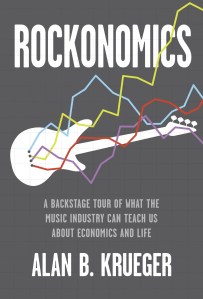
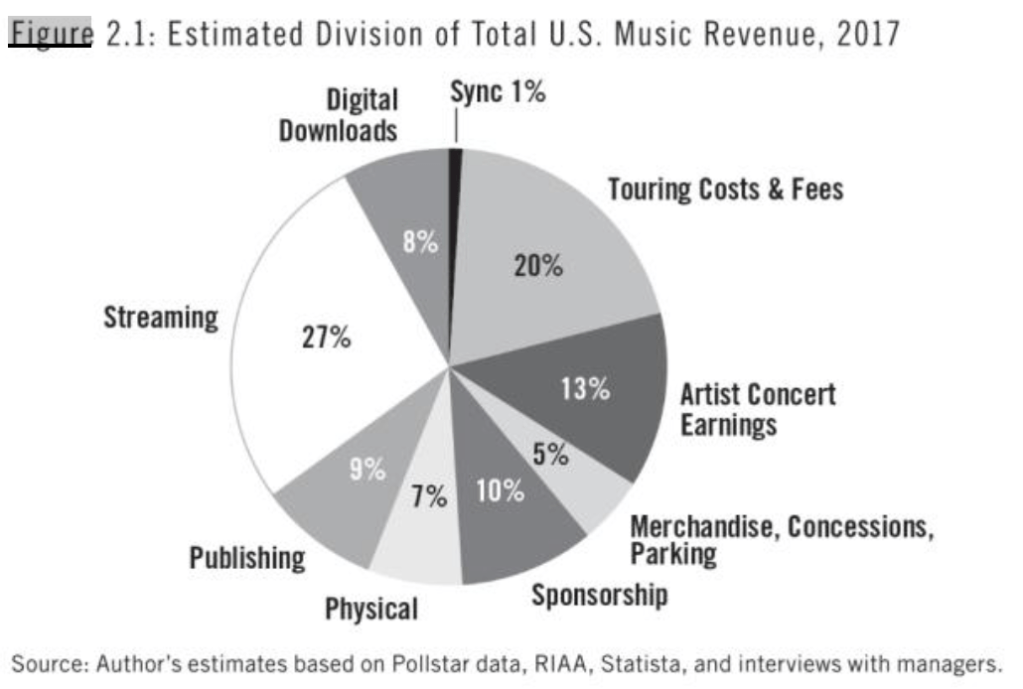
I missed Alan Kreuger’s 2019 book on the economics of popular music when it first came out, but picked it up recently when preparing for a talk on Taylor Swift. It turns out to be a well-written mix of economic theory, data, and interviews with well-known musicians, by an author who clearly loves music. Some highlights:

[Music] is a surprisingly small industry, one that would go nearly unnoticed if music were not special in other respects…. less than $1 of every $1,000 in the U.S. economy is spent on music…. musicians represented only 0.13 percent of all employees [in 2016]; musicians’ share of the workforce has hovered around that same level since 1970.

there has been essentially no change in the two-to-one ratio of male to female musicians since the 1970s

The gig economy started with music…. musicians are almost five times more likely to report that they are self-employed than non-musicians

30 percent of musicians currently work for a religious organization as their main gig. There are a lot of church choirs and organists. A great many singers got their start performing in church, including Aretha Franklin, Whitney Houston, John Legend, Katy Perry, Faith Hill, Justin Timberlake, Janelle Monae, Usher, and many others

Continue reading

Leave Me Alone and I’ll Make You Rich

That is the title of a 2020 book by Dierdre McCloskey and Art Carden. It attempts to sum up McCloskey’s trilogy of huge books on the “Bourgeois Virtues” in one short, relatively easy to read book. I haven’t read the full trilogy, so I can’t say how good the new book is as a distillation, but I found that it was easy to read and at least makes me think I understand McCloskey’s basic thesis for why the world got rich. I share some highlights here.

Part 1 of the book aims to establish that the world did in fact get richer over recent centuries, plus give a basic explanation of liberal political thought. If you already know this you could skip this part and cut down an easy 189 page read to a very easy 106 page read (part 1 is for some reason written in a way that assumes you disagree with the authors, which grates when you don’t, or perhaps also if you do).

Part 2 gets to what I at least came for- digging into the history to solve the puzzle of why the Industrial Revolution / Great Enrichment took off when and where it did. Which means first, explaining why many things people think made 18th century England special were actually common elsewhere, like markets:

Continue reading

One Up on Wall Street in the Meme Stock Era

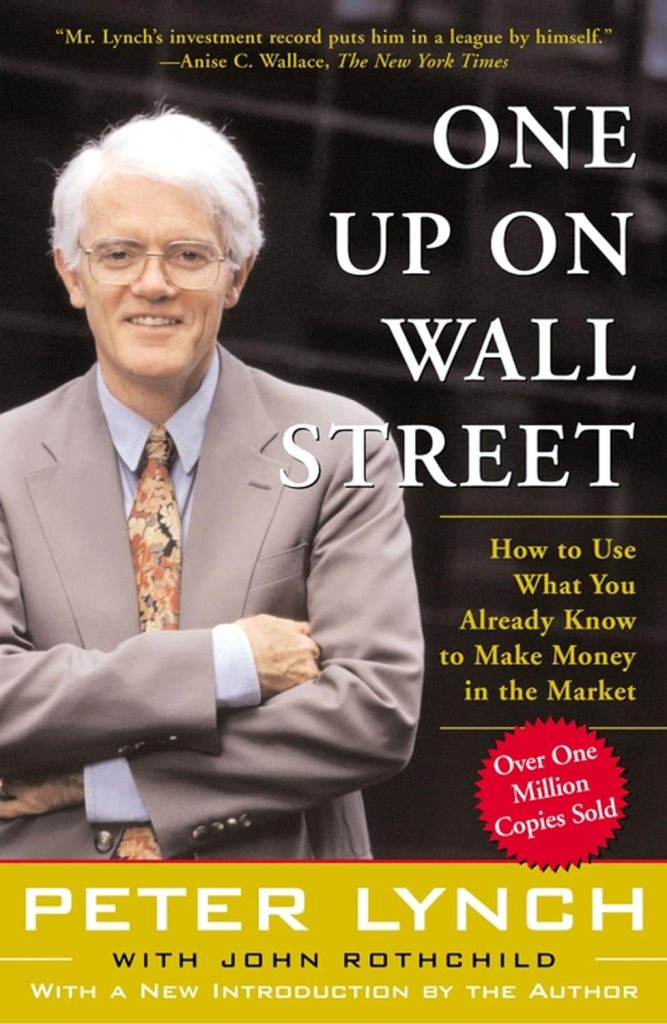
Peter Lynch was one of the most successful investors of the 1970’s and 1980’s as the head of the Fidelity Magellan Fund. In 1989 he explained how he did it and why he thought retail investors could succeed with the same strategies in the bestselling book “One Up on Wall Street”. Given the meme stock exuberance of retail investors in the past few years, I thought the book might be due for a comeback.

Instead interest seems flat, and when I do hear Peter Lynch mentioned it is by institutional investors more than retail. But the book seems to me like it is still valuable, so I’ll share some highlights here. This one could easily have been written this year:

Where did the Dow close? I’m more interested in how many stocks went up versus how many went down. These so-called advance/decline numbers paint a more realistic picture. Never has this been truer than in the recent exclusive market, where a few stocks advance while the majority languish. Investors who buy “undervalued” small stocks or midsize stocks have been punished for their prudence. People are wondering: How can the S&P 500 be up 20 percent and my stocks are down? The answer is that a few big stocks in the S&P 500 are propping up the averages.

I see why the book hasn’t caught on with meme stock traders:

Nobody believes in long-term investing more passionately than I do… I think of day-trading as at-home casino care.

I’ve never bought a future nor an option in my entire investing career, and I can’t imagine buying one now. It’s hard enough to make money in regular stocks without getting distracted by these side bets, which I’m told are nearly impossible to win unless you’re a professional trader.

So where does he think retail investors have a chance to get “One Up on Wall Street”?

Continue reading

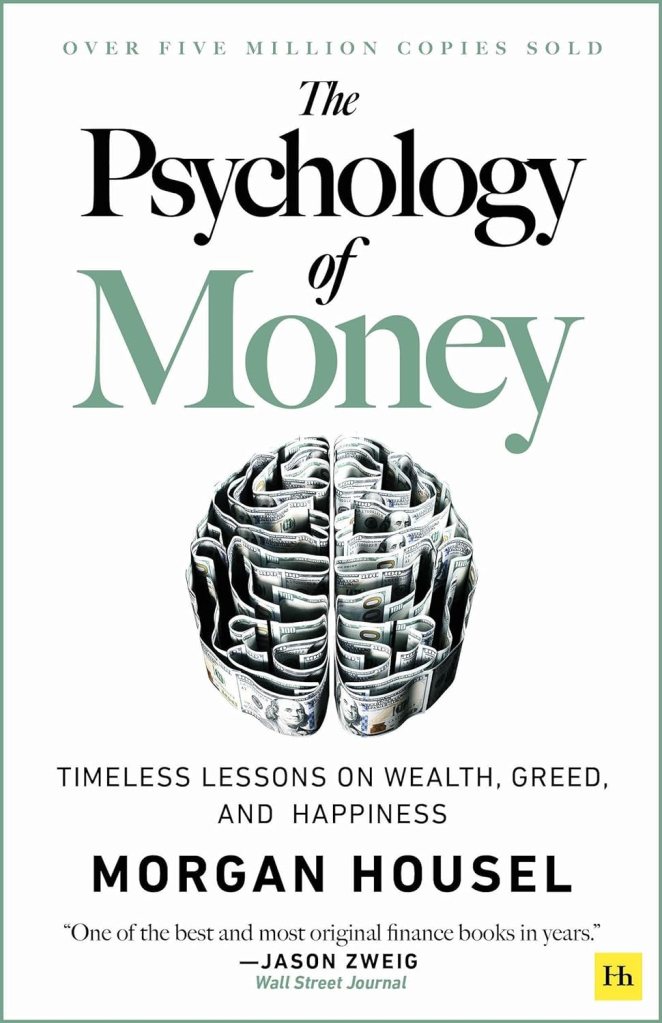
The Calming Psychology of Money

Morgan Housel’s Psychology of Money is not much like other personal finance books. Rather than making recommendations about exactly what to do and how to do it, Housel tells stories about how people’s different attitudes toward money serve them well or poorly. His stance is that most people already know what they should do, so he doesn’t need to explain that, but instead needs to explain why people so often don’t do what they know they should (e.g. save more). The book is not only pleasant to read, but at least for me exerts a calming effect I definitely do not normally associate with the finance genre, as if the subtext of “just be chill, be patient, follow the plan and everything will be alright” is continually seeping into my brain. Some highlights:

The idea of retirement is fairly new. Labor force participation for men over 65 is only about 20% today, but was well over 50% prior to the introduction of Social Security. Even once it started, Social Security paid in real terms about a quarter of what it does today. Plus pensions weren’t as common as people think; as of 1975 only a quarter of those over 65 had pensions, and most of those didn’t pay much. The 401k didn’t exist until 1978; the Roth IRA until 1998. “It should surprise no one that many of us are bad at saving and investing for retirement. We’re not crazy. We’re all just newbies.”

If you are disappointed whenever the price of your stocks goes down, you are in for a bad time, though you will do well if you can just ignore it:

“Netflix stock returned more than 35,000% from 2002 to 2018, but traded below its previous all-time high on 94% of days. Monster Beverage returned 319,000% from 1995 to 2018- among the highest returns in history- but traded below its previous high 95% of the time during that period…. this is the price of market returns.”

Housel isn’t very prescriptive because he recognizes how much people differ: “I can’t tell you what to do with your money, because I don’t know you. I don’t know what you want. I don’t know when you want it. I don’t know why you want it.”

At the end explains what he does with his own money: “Effectively all of our net worth is a house, a checking account, and some Vanguard index funds.” He convincingly argues that his way isn’t for everyone; he paid off his house early but “I don’t try to defend this decision to those pointing out its flaws, or to those who would never do the same. On paper it’s defenseless. But it works for us. We like it. That’s what matters.”

The closest he gets to specific recommendation is “for most investors, dollar-cost averaging into a low-cost index fund will provide the highest odds of long-term success.” There are lots of more general recommendations about good mindsets to take, for instance:

The few people who know the details of our finances ask, ‘What are you saving for? A house? A boat? A new car?’ No, none of those. I’m saving for a world where curveballs are more common than we expect.

Overall this is an easy book to recommend- it is both pleasant and easy to read, and gives good advice. My main complaint is that it is short on the nuts and bolts of how you actually do this stuff; for someone who doesn’t already know, it would pair well with a book that is stronger on that front, like I Will Teach You to Be Rich.

Childhoods of exceptional people

Henrik Karlsson read lots of biographies of geniuses and tried to sum up the things their childhoods had in common here. Some highlights:

At least two-thirds of my sample was home-educated (most commonly until about age 12), tutored by parents or governesses and tutors. The rest of my sample had been educated in schools (most commonly Jesuit schools).

As children, they were integrated with exceptional adults—and were taken seriously by them.

They had time to roam about and relied heavily on self-directed learning

A common theme in the biographies is that the area of study which would eventually give them fame came to them almost like a wild hallucination induced by overdosing on boredom. They would be overcome by an obsession arising from within.

They were heavily tutored 1-on-1

An important factor to acknowledge is that these children did not only receive an exceptional education; they were also exceptionally gifted.

There is lots of discussion of John Stuart Mill and John Von Neumann, who each had major contributions to economics:

When they were done, James Mill took his son’s notes and polished them into the book Elements of Political Economy. It was published the year John Stuart turned fifteen….

There is a moving scene in John Stuart Mill’s biography, when John Stuart is about to set out into the world and his father for the first time lets him know that his education had been . . . a bit particular. He would discover that others his age did not know as much as he did. But, his father said, he mustn’t feel proud about that. He’d just been lucky.

Let’s make more people lucky.

Other nice posts along similar lines are Erik Hoel’s “How Geniuses Used to Be Raised” (linked in Karlsson’s piece), and Scott Alexander’s review of Laszlo Polgar’s book “Raise a Genius” (about raising his 3 daughters to be chess grandmasters). Karlsson’s post, worth reading in full, is here.

Humanity’s Childhood and Chiefs

I’m going to explore a passage from The Dawn of Everything about whether humans reject Western civilization.

The introductory chapter of The Dawn of Everything is called “Farewell to Humanity’s Childhood.” The authors are idealists wrestling with big questions.

We can take [Steven] Pinker as our quintessential Hobbesian. (page 13)

For instance, if Pinker is correct, then any sane person who had to choose between (a) the violent chaos and abject poverty of the ‘tribal’ stage in human development and (b) the relative security and prosperity of Western civilization would not hesitate to leap for safety. (page 18)

Over the last several centuries, there have been numerous occasions when individuals found themselves in a position to make precisely this choice – and they almost never go the way Pinker would have predicted.

Continue reading

Accounting Appears Before Literature

For a current research project on institutions, I skimmed The Dawn of Everything (2021).

I liked this passage about an archaeological site in Syria. The following items were found in a destroyed village where people are estimated to have lived 8,000 years ago:

These devices included economic archives, which were miniature precursors to the temple archives at Uruk and other later Mesopotamian cities.

These were not written archives: writing, as such, would not appear for another 3,000 years. What did exist were geometric tokens made of clay, of a sort that appear to have been used in many similar Neolithic villages, most likely to keep track of the allocation of particular resources.

In chunks, the book has fascinating stuff like the quote above. However, D-o-E is the second book I have read this year that tries to do too much. A book on “everything” sounds incredibly fun to write, and I’m the type who would try, so I take these as a warning.

What is more intriguing than history? Emily Wilson said it well, concerning some of the oldest records we have of human words:

I think we should stop selling classics as, “These are the societies that formed modern America, or that formed the Western canon” — which is a really bogus kind of argument — and instead start saying, “We should learn about ancient societies because they’re different from modern societies.” That means that we can learn things by learning about alterity. We can learn about what would it be to be just as human as we are, and yet be living in a very, very different society.

Cowen on Smith at AdamSmithWorks

I’m at AdamSmithWorks this week with “TYLER COWEN ON THE GREATEST ECONOMIST OF ALL TIME (GOAT)

To be on Cowen’s short list is a compliment. Of all the thinkers and writers in recorded history, Adam Smith is one of only six writers that Cowen gives serious consideration to. Next, readers will ask, “Did our guy win?”

Tyler’s book will make no one happy because he does not take anyone’s side unequivocally. A huge fan of Adam Smith (and I know several) might have wanted a book about why Adam Smith is designated as the GOAT. I don’t want to ruin the book for anyone who hasn’t read it. What you will get is very interesting and thoughtful, so I hope you’ll read the manuscript* sometime, even if your guy doesn’t win.

*completely free – can get it on your Kindle somehow I heard

My previous posts about Tyler’s GOAT book:

Tyler Supporting Women in the GOAT book 

What We Are Learning about Paper Books  – I did write the AdamSmithWorks post in collaboration with the GPT version of the book, as a first step, along with my own memory of having read the book. And then, secondly, I consulted the book manuscript. The GPT performed fairly well… considering that it’s a GPT. I suppose I thought that interrogating the GPT would save me time. However, I can now say authoritatively that Tyler’s actual writing is so much better than what you will get from the GPT. Among other things, the GPT is much more boring than Tyler’s actual manuscript.

Daniel Kahneman: Psychologist and Economist, Pathbreaker and Popularizer

Daniel Kahneman, the psychologist who won a Nobel prize in economics and wrote the best-selling book “Thinking Fast and Slow“, died yesterday at age 90. Others will summarize his biography and the substance of his work, but I wanted to highlight two aspects of his style that I think fueled his unusual success among both the public and economists.

For the public, I found his writing to be unusually engaging:

Daniel Kahneman’s new book amazes me. Not so much due to the content, though I’m sure that will blow your mind if you haven’t previously heard about it through studying behavioral economics or psychology or reading Less Wrong. It is the writing style: Kahneman is able to convey his message succinctly while making it seem intuitive and fascinating. Some academics can write tolerably well, but Kahneman seems to be on a level with those who write popularly for a living- the style of a Jonah Lehrer or Malcolm Gladwell, but no one can accuse the Nobel-prize-winning Kahneman of lacking substance.

This made me wonder if it is simply an unfair coincidence that Kahneman is great at both writing and research, or causation is at work here. True, in more abstract and mathematical fields great researchers do not seem especially likely to be great writers (Feynman aside). But to design and carry out great psychology experiments may require understanding the subject intuitively and through introspection. This kind of understanding- an intuitive understanding of everyday decision-making- may be naturally easier to share than other kinds of scientific knowledge, which use processes (say, math) or examine territories (say, subatomic particles) which are unfamiliar to most people. Kahneman says that he developed the ideas for most of his papers by talking with Amos Tversky on long walks. I suspect that this strategy leads to both good idea generation and a good, conversational writing style.

But how did a psychologist get economists to not just take his work seriously, but award him the top prize in our field? One key step was learning to speak the language of our field, or coauthor with people who do. For instance, summarizing the results of an experiment as showing indifference curves crossing where rationally they should not:

Finally, something that helped Kahneman appeal to all parties was that he avoided the potential trap of being the arrogant behavioral economist. Most economists have a natural tendency toward arrogance, kept somewhat in check by our belief that most people are fundamentally rational. Behavioral economists who think most people are irrational can be the most arrogant if they think they are the only sane one, and should therefore tell everyone else how to behave. But Kahneman avoided this by seeming to honestly believe he is just as subject to behavioral biases as everyone else.