Elizabeth Gilbert of Eat, Pray, Love delivered an insight, second-hand from “Deborah the psychologist”.
I remember a story my friend Deborah the psychologist told me once. Back in the 1980s, she was asked by the city of Philadelphia if she could volunteer to offer psychological counseling to a group of Cambodian refugees—boat people—who had recently arrived in the city. Deborah is an exceptional psychologist, but she was terribly daunted by this task. These Cambodians suffered the worst of what humans can inflict on each other—genocide, rape, torture, starvation, the murder of their relatives before their eyes, then long years in refugee camps and dangerous boat trips to the West where people died and corpses were fed to sharks—what could Deborah offer these people in terms of help? How could she possibly relate to their suffering?
“But don’t you know,“ Deborah reported to me, “what all these people wanted to talk about, once they could see a counselor?“
It was all: I met this guy when I was living in the refugee camp, and we fell in love. I thought he really loved me, but then we were separated on different boats, and he took up with my cousin. Now he’s married to her, but he says he really loves me, and he keeps calling me, and I know I should tell him to go away, but I still love him and I can’t stop thinking about him. And I don’t know what to do…
I don’t agree with Elizabeth L. Cline on everything, but she’s written a reasonable book for Americans today. The Conscious Closet has some good advice for everyone.
A decade ago, Cline wrote Overdressed: The Shockingly High Cost of Cheap Fashion which investigated the environmental toll of clothes and the labor controversies. Since then, she has been working on what consumers can do differently.
Not every American household has practical knowledge of laundry and sewing anymore. Cline offers suggestions on how to economically maintain clothes longer by making sensible home repairs or washing them less. (Don’t wash a pair of jeans after just one wear. I don’t.) The Conscious Closet came out in 2019, so it’s up-to-date concerning chemicals and certifications and websites that operate today.
The way we wash and dry our clothes uses a lot of water and energy. If a person was looking for a way to lower their environmental footprint, then a marginal reduction of laundry loads might be a relatively easy way to do it. Since almost every American has an electric dryer, we have lost the tacit knowledge of how to air dry clothes. She gives the practical reminder, for example, that dark color clothes will fade if exposed to extended sunlight.
I feel like Cline could be even more conscious about the opportunity cost of time. She does explicitly acknowledge that in her chapter about re-selling your unwanted clothes.
I’m writing an article about fast-fashion, so I’m reading Fashionopolis by Dana Thomas.
This paragraph is from the intro chapter:
Since the invention of the mechanical loom nearly two and a half centuries ago, fashion has been a dirty, unscrupulous business that has exploited humans and Earth alike to harvest bountiful profits. Slavery, child labor, and prison labor have all been integral parts of the supply chain at one time or another – including today. On occasion, society righted the wrongs, through legislation or labor union pressure. But trade deals, globalization, and greed have undercut those good works.
She invokes religion with “good works.” Thomas and I are of different opinions concerning globalization and “greed” and legislation. My instinct is to rip this paragraph apart. Has legislation never been motivated by greed? Has globalization not improved the lives of children? Has the mechanical loom not improved the lives of women who used to spend hours spinning and weaving by hand?
I am also reading pastor Tim Keller’s biography right now, so I’m having a What Would TK Do moment.
With his gifts (smart, funny, articulate…), Keller could have made a fortune by taking a side. He could have picked the Right or the Left. He could have expertly appealed to a Side, convincing them that they were good-smart and the Other is evil-stupid. Instead, Keller relentlessly stayed in the center. One of his books is actually called Center Church.
There have been a lot of popular papers in the past decade or so that make use of textual analysis. A fun one is “The Mainstreaming of Marx” by Magness & Makovi. They use Google Ngram to analyze the popularity of people mentioned in books and determine when Karl Marx became popular. “Measuring Economic Policy Uncertainty” by Baker, Bloom, & Davis is one of my favorites. They use set theory to detect terms in newspapers that denote economic policy uncertainty. In this post, I’m just going to describe practical differences between the two data sources and how the interpretations differ.
Ngram
Ngram measures takes a term and measures how popular that term is in its corpus of book text, which is about 6% of all books ever written (in English, anyway). Because popularity is expressed as a percent, we can make direct popularity level comparisons among words. For example: “Cafe” & “Coffee Shop”. In the figure below, we can see that the word “cafe” was more popular in books until very recently.
In November 1738, clothier Henry Coulthurst informed weavers that he was cutting their piecework rates and would henceforth pay them in goods rather than cash. Needless to say, they were upset. Food prices were rising, and lower wages meant hunger and want.
Over three days in December, the weavers rioted. They smashed Coulthurst’s mill, wrecked his home, and “drank, carried out, and spilt, all the Beer, Wine and Brandy in the cellars.” They returned the following day to demolish Coulthurst’s house…
Wow. Our paper on cutting nominal wages is called “If Wages Fell During a Recession” We ran an experiment in which workers could retaliate if they experienced a nominal wage cut. They did! They couldn’t smash their employer’s house, but some of the slighted workers dropped their effort level down to the minimum level which meant that their employer made no more money in the experiment.
In my talk at IUE (show notes here and YouTube video), I connect the wage cut paper to another experiment on beliefs. One wonders, considering how serious the consequences turned out to be for Henry Coulthurst, why he was not able to anticipate the backlash against wage cuts. Being wrong was costly for him.
People are not always good at appreciating how strongly others have become attached to their own reference points. That’s why the paper on beliefs is called “My Reference Point, Not Yours“
In the tapestry of human progress studies, two authors, Adam Smith and Virginia Postrel, have left their mark on the story of productivity and innovation. Their books, written centuries apart, both explore the power of specialization and the division of labor.
Part of the reason this came out this week is that I’m reading The Fabric of Civilization. So good! It had come highly recommended before, but I finally have an excuse to read it because I’m working on an article about fashion.
Tim Keller, who was the founding pastor of Redeemer Presbyterian Church in New York City, died last week. Starting and growing a church in Manhattan takes talent. I am reading Tim Keller’s biography by Collin Hansen through the lens of Tyler’s Talent book.
How did a successful leader and famous speaker get started? Keller is not described in the book as an outgoing child. Although academically gifted, “He grew up socially awkward, a wallflower…”
In 1968, Keller started at Bucknell University. Keller, who would go on to write multiple best-selling books, may have refined some of his writing skills through his coursework. From my reading, the most important aspect of his college experience was not the classes but the chance to be a leader of a campus (religious) club and having so many peers close by to practice “working” with. “Some 2,800 students lived within short walking distance of each other…[on campus].”
He planned retreats and invited famous guest speakers who appealed to his audience. He got feedback on the effectiveness of different messages and programs. Due to Keller’s efforts, the college club chapter meetings more than doubled in size. You can see the beginnings of the man who would go on to manage a large organization and attract over 5,000 people to hear him on the Sunday after 9/11.
In the debate over the value of a college education, the value of the experience students gain from holding officer positions in campus clubs is underrated. The information or credentials that can be obtained through online classes doesn’t build this kind of social capital. For leaders of organizations, college clubs are how some of them gained momentum and developed confidence.
Students can learn in a low stakes environment. For example, an ambitious club president can get 20 students to show up for pizza instead of 8. Club leaders get to make the key decisions and solve the problems that determine the success of their organization, because the faculty are too busy to micromanage club meetings. This gives students accurate feedback on the success of their own ideas.
In-person campus-based education is more than acquiring knowledge from textbooks. It is a dynamic environment in which students can develop social skills and form their network for future professional support. By participating in these organizations, students learn collaboration, decision-making, problem-solving, and mentoring — skills that are transferable across various domains of life.
I’m reading The Property Species by Bart Wilson. I like chapter 4 “What is Right is Not Taken Out of the Rule, but Let the Rule Arise Out of What Is Right,” partly because I got to play a small part in this line of research.
Along with several coauthors, Bart Wilson has run experiments in which players have the ability to make and consume goods. According to the instructions that all players read at the beginning of the experiment, “when the clock expires… you earn cash based upon the number of red and blue items that have been moved to your house.”
Property norms can emerge in these environments, and sometimes subjects take goods from each other in an action that could be called “stealing.” The experimental instructions do not contain any morally loaded words like “stealing,” but subjects use that word to describe the activities of their counterparts.
Here is a conversation from the transcript of the chat room players can use to communicate while they produce and trade digital goods:
E: do you want to do this right way?
F: wht is the right way
E: the right way is I produce red you make blue then we split it nobody gets 100 percent profit but we both win
One hundred years ago, the British writer G.K. Chesterton traveled to the United States for a lecture tour. He published his observations of America in What I Saw in America (1922). In an essay titled “The American Businessman”, Chesterton notes with surprise how passionate Americans appear about their professional work.
Chesterton recognizes this enthusiasm for work as more than mere greed.
This is the intro to my latest article for the OLL Reading Room. I discuss the American work ethic and Chesterton’s prescient insight into American economic dynamism compared to Britain. (Relatedly, Alex on British stagnation this week.)
Here’s a fun bit of the book that I didn’t include in the OLL article. Chesterton wrote this about seeing New York City for the first time:
But there is a sense in which New York is always new; in the sense that it is always being renewed. A stranger might well say that the chief industry of the citizens consists of destroying their city; but he soon realises that they always start it all over again with undiminished energy and hope. At first I had a fancy that they never quite finished putting up a big building without feeling that it was time to pull it down again; and that somebody began to dig up the first foundations while somebody else was putting on the last tiles. This fills the whole of this brilliant and bewildering place with a quite unique and unparalleled air of rapid ruin.
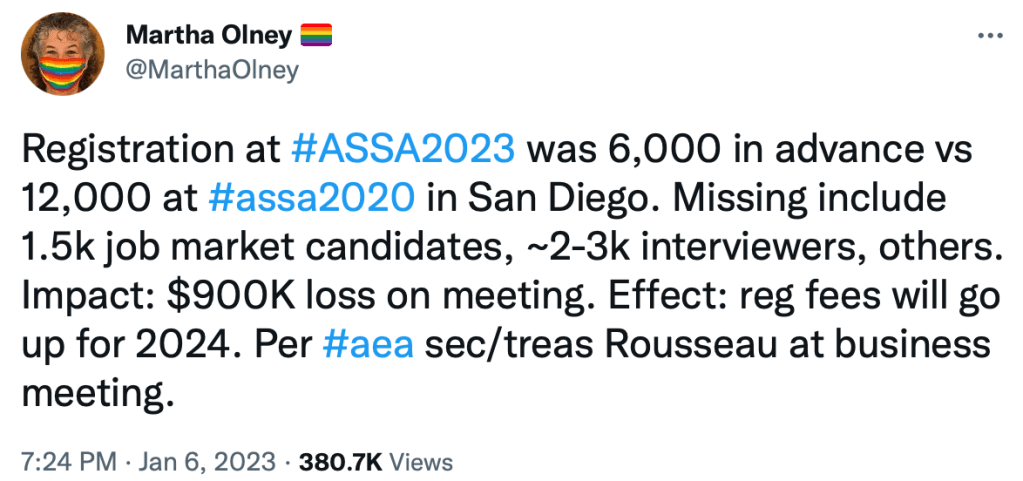
I expected the meetings would shrink, but I was still surprised by how much they did:
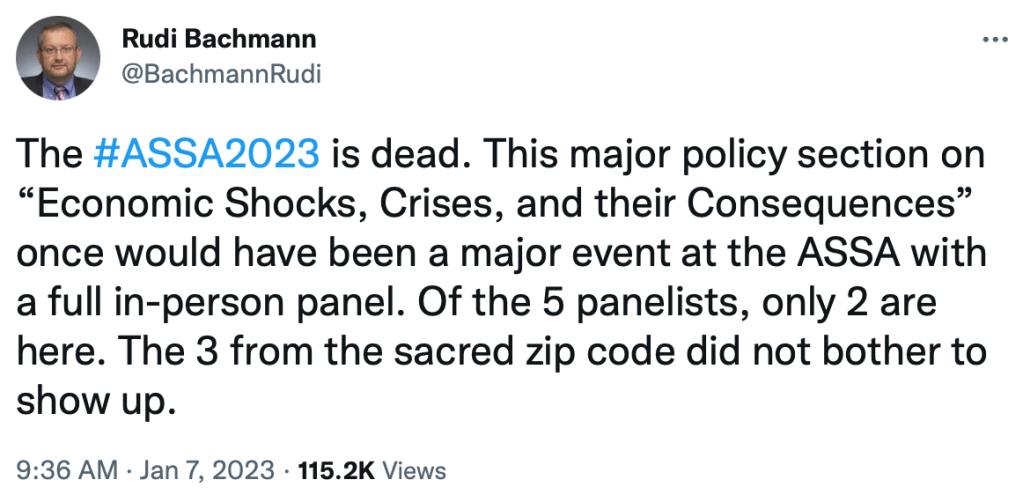
That said, I mostly didn’t notice the smaller numbers on the ground, because most of the missing people are those on the job market, who used to spend most of their time shut away doing interviews anyway. There was still a huge variety of sessions and most seemed well-attended. ASSAs is also still unparalleled for pulling in top names to give talks; I got to talk to Nobel laureate Roger Myerson at a reception. But there may be a trend of the big names being more likely to stay remote:
The big problem with attendance falling to 6k is that they’ve planned years worth of meetings with the assumption of 12k+ attendance. Getting one year further from Covid and dropping mask and vaccine mandates might help some, but the core issue is that 1st-round job interviews have gone remote and aren’t coming back. The best solution I can think of is raising the acceptance rate for papers, which in recent history has been well under 20%.
In terms of the actual economic research, two sessions stood out to me:
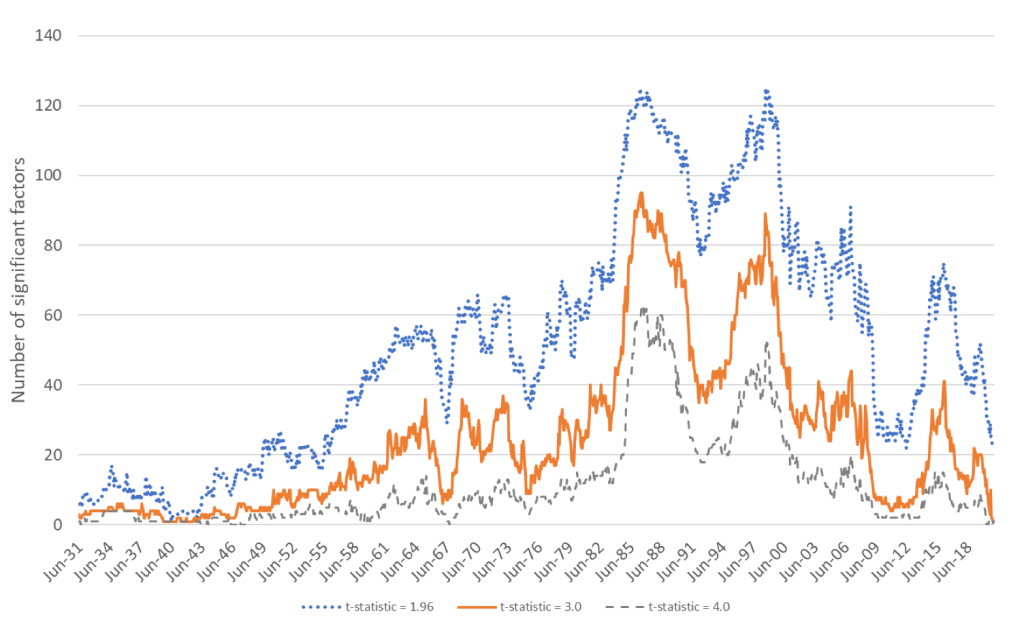
How many factors are there in the stock market? Classic work by Fama and French argues for 3 (size, value, and market risk), but the finance literature as a whole has identified a “zoo” of over 500. Two papers presented one after the other at ASSA argued for two extremes. “Time Series Variation in the Factor Zoo” argues that the number of factors varies over time, but is quite high, typically over 20 and sometimes over 100:
In contrast, “Three Common Factors” argues that there really are just 3 factors, though they are latent and not the same as the Fama-French 3 factors. In this case, the whole zoo of factors in the literature is mostly non-robust results driven by p-hacking and a desire to find more factors (fortune and fame potentially await those who do). Overall these asset pricing papers make me want to look into all this myself; when reading them I’m always struck by an odd mix of reactions- “I don’t understand that”, “why would you do it that way, it seems wrong and unnecessarily complicated”, and “why didn’t the field settle such a seemingly basic question decades ago?”.
Hayek: A Life this session covered the new book by Bruce Caldwell (who taught me much of what I know of the history of economic thought) and Hansjoerg Klausinger. Discussants Emily Skarbek and Stephen Durlauf agreed it is surprisingly readable for a long work of original scholarship, calling it a beautifully written 800p pageturner. Vernon Smith asked Caldwell if Hayek read the Theory of Moral Sentiments. Caldwell: “he cited it.” Smith: “but did he read it? Seems like he didn’t understand it very well.” Caldwell agreed he may not have, or if he did it was a German translation.
Vernon Smith’s own talk featured great comments on market instability: instability in markets comes from retrading. Markets are stable when consumers just value goods for their use, like haircuts and hamburgers. The craziness and potential for bubbles and crashes comes in when people are thinking about reselling something, whether it be tulips, stocks, houses, or crypto.
I asked Bruce Caldwell at a reception how he was able to finish writing such a big book that involved lots of archival work and original research. He said “one chapter at a time”, and noted that its fine to write the easiest chapters first to get the ball rolling.
Overall, while ASSA is diminished from the pre-Covid days and I often disagree with the AEAs decisions, its still a top-tier conference, especially when in New Orleans.


 Economist Writing Every Day