I suspect that Mises may have felt somewhat restless after writing Socialism. He had taken a very good stab at describing the socialist economy and its inadequacy for the promotion of human flourishing. By 1940 fascism had arisen in both Italy and in Germany, who Mises considered the clear antagonists of World War II. Further, the communist Soviets were allied with Germany at the time of writing Interventionism.
A communist-fascist alliance may seem strange to idealogues, but it appeared quite natural to Mises that the two distasteful versions of socialism should find cooperation convenient to achieve their own ends. In America, the revelations of German atrocities had yet to arrive and there were many sympathizers with both Russia and Germany. In Britain, union leaders were promoting the idea of socialism as a reward to the public who would be bearing the costs of the war.
Mises thought that the disfunction of socialism was adequate to describe its ultimate failure as an economic system. However, socialist tendencies were pervasive in the liberal market economies among both idealogues and demagogues enough to make the transition to socialism a very real threat. After all, while socialism may not be a stable regime in a dynamic world, certain features within specific market economies may nonetheless tend toward it. What is the cause of such tendencies?
I recommend two games for teaching kids to read their “sight words”. In early school grades, learning sight words can mean doing boring homework or rote memorization of flash cards. Instead use
These are both fun interactive games that will get kids reading and talking about sight words. Zingo Sight Words is easier, so I recommend starting there. It’s a lot like bingo with a fun plastic dispenser. Kids can do the matching task to win the game even if they are not yet confident with reading.
Sight Word Swat is a little more advanced but good for expanding vocabulary past the first 50 words. It’s fast paced and fun. Someone yells out a word and then two players compete to “swat” with a plastic mallet the correct “fly” that has the word. Also, if the kid isn’t competitive, they could swat the correct word without time pressure.
Next, I’ll recommend a game that will not remotely feel like an educational exercise. “Spot It” is a genius card game. The tin is small, so you can store it easily and travel with it. The game is easy to teach to new friends because it’s just matching visual patterns. Spot It requires zero reading – not even reading numbers. So, a kid as young as 4 could potentially jump in and start trying to get matches. One of the great things about Spot It is that you play a series of mini games. It’s not the nightmare of a Monopoly game that could take multiple days to finish. So, if you are a parent with limited time to spend on card games, you can parachute in and out quickly.
All of these items are under $20 and potentially all of them could make fun holiday gifts, although your mileage may vary for gifting books and getting smiles. Personally, I bought the sight word games when we needed them for learning instead of trying to make them Christmas gifts.
I had been looking forward to reading the Phantom Tollbooth with my kids for a long time. This is the kind of book that you should read as soon as they are ready to understand most of the action, but not before. If too much is going over their heads, then it isn’t fun. In my case, this book prompted a lot of questions and great conversations with the 7-year-old. The book will teach kids a lot, but if you keep your tone light it feels like just another adventure story.
Its Nobel Prize season- the economics prize will be announced Monday, while most prizes are announced this week. My favorite so far is the Medicine prize being awarded to Svante Pääbo “for his discoveries concerning the genomes of extinct hominins and human evolution”. He figured out how to sequence DNA from Neanderthal remains despite the fact that they were 40,000 years old.
As recently as 2010 it was controversial to suggest that Neanderthals might have mixed with humans, until Pääbo’s DNA definitively settled the debate, showing that “Neanderthals and Homo sapiens interbred during their millennia of coexistence. In modern day humans with European or Asian descent, approximately 1-4% of the genome originates from the Neanderthals”
While the Neanderthal genome settled an existing controversy, Pääbo’s other big discovery came entirely unlooked for. The Nobel Foundation explains:
In 2008, a 40,000-year-old fragment from a finger bone was discovered in the Denisova cave in the southern part of Siberia. The bone contained exceptionally well-preserved DNA, which Pääbo’s team sequenced. The results caused a sensation: the DNA sequence was unique when compared to all known sequences from Neanderthals and present-day humans. Pääbo had discovered a previously unknown hominin, which was given the name Denisova. Comparisons with sequences from contemporary humans from different parts of the world showed that gene flow had also occurred between Denisova and Homo sapiens. This relationship was first seen in populations in Melanesia and other parts of South East Asia, where individuals carry up to 6% Denisova DNA.
Pääbo’s discoveries have generated new understanding of our evolutionary history. At the time when Homo sapiens migrated out of Africa, at least two extinct hominin populations inhabited Eurasia. Neanderthals lived in western Eurasia, whereas Denisovans populated the eastern parts of the continent. During the expansionof Homo sapiens outside Africa and their migration east, they not only encountered and interbred with Neanderthals, but also with Denisovans
The same techniques that enabled these discoveries have been applied much more widely throughout the field of Paleogenomics, which continues to rewrite what we thought we knew about history and pre-history. The field has been advancing so quickly over the last decade that its hard to keep up with it. I’ve found the best introduction to be David Reich’s Who We Are and How We Got Here, though again the field is moving so fast that a 2018 book is already a bit out of date. Razib Khan is always writing about the latest updates at Unsupervized Learning. If you haven’t kept up with this stuff since school, this post and diagram give a quick introduction to how much our understanding of human origins has recently changed:
Many undergraduates take at least one business analytics course at the 200 course level. A book that I and other professors at our business school have selected to teach business statistics is by Albright and Winston
This book provides three essential ingredients to a successful course:
Covering core concepts like descriptive statistics and optimization
Providing relevant examples in a business context (e.g. how much inventory should a retail store order)
Showing step-by-step instructions for how to do applications in a specific software which in this case is Excel
Microsoft Excel is essential for business school graduates (arguably all college graduates). No one is born knowing how to select cells or enter formulas. The book does not assume anything, so the professor does not have to require supplementary material on how to use Excel. There are lots of exercise and examples that teach proficiency in the tool while demonstrating the concepts. Analytics courses should be hands-on.
Sometimes statistics courses do not feel like they allow for critical thinking or discussions. There is only one correct formula for an average, and it is merely and exactly what the formula determines it to be. Therefore, an interesting addition to a technical class is the book by Muller
Muller spends most of the book pointing out cases where measuring results backfired. He is not so much against “analytics” as he is skeptical of pay-for-performance management schemes. Many of these schemes were sold to the public as incredible technocratic improvements, such as No Child Left Behind. I do not always agree with Muller, but he gives students something to debate. Note that only select chapters should be assigned so that it does not take up too much time from the other course material.
This textbook teaches R and analytics at the same time. The professor does not have to provide a separate R curriculum or require students to buy a second book.
The running example in the textbook is an airline business scenario that is interesting and builds with the complexity of the subject matter. The authors provide the dataset that students can work with for the airline case study. Many examples in the textbook use data that is available online and therefor can be imported to R with just a few lines of code.
One semester is not enough time to cover every chapter in the book. I emphasize predictive analytics, so I skip the chapters on maps and shiny apps.
I do some supplemental lectures on concepts in predictive analytics before students reach the chapters on regression and decision trees. For example, overfitting is a new concept to undergraduates. I want them to have a more intuitive grasp of that subject before learning the R code to separate data into training and validation sets.
Note that these students have already taken what has traditionally been called Business Statistics, so they already understand basic descriptive statistics and graphing. The book is no substitute for that primary class.
There are free supplementary materials online for learning R. Students find message boards especially helpful in pinpointing answers for questions that come up while coding.
Last year, our economics department launched a data analytics minor program. The first class is a simple 2 credit course called Foundations of Data Analytics. Originally, the idea was that liberal arts majors would take it and that this class would be a soft, non-technical intro of terminology and history.
However, it turned out that liberal arts majors didn’t take the class and that the most popular feedback was that the class lacked technical challenge. I’m prepping to teach the class and it will have two components. A Python training component where students simply learn Python. We won’t do super complicated things, but they will use Python extensively in future classes. The 2nd component is still in the vein of the old version of the course.
I’ll have the students read and discuss “Big DataDemystified” by David Stephenson. He spends 12 brief chapters introducing the reader to the importance of modern big data management, analytics, and how it fits into an organization’s key performance indicators. It reads like it’s for business majors, but any type of medium-to-large organization would find it useful.
Davidson starts with some flashy stories that illustrate the potential of data-driven business strategies. For example, Target corporation used predictive analytics to advertise baby and pregnancy products to mothers who didn’t even know that they were pregnant yet. He wets the appetite of the reader by noting that the supercomputers that could play Chess or Go relied on fundamentally different technologies.
The first several chapters of the book excite the reader with thoughts of unexploited potentialities. This is what I want to impress upon the students. I want them to know the difference between artificial intelligence (AI) and machine learning (ML). I want them to recognize which tool is better for the challenges that they might face and to see clear applications (and limitations).
AI uses brute force, iterating through possible next steps. There are multiple online tic-tac-toe AI that keep track records. If a student can play the optimal set of strategies 8 games in a row, then they can get the general idea behind testing a large variety of statistical models and explanatory variables, then choosing the best.
But ML is responsive to new data, according to what worked best on previous training data. There are multiple YouTubers out there who have used ML to beat Super Mario Brothers. Programmers identify an objective function and the ML program is off to the races. It tries a few things on a level, and then uses the training rounds to perform quite well on new levels that it has never encountered before.
There are a couple of chapters in the middle of the book that didn’t appeal to me. They discuss the question of how big data should inform a firm’s strategy and how data projects should be implemented. These chapters read like they are written for MBAs or for management. They were boring for me. But that’s ok, given that Stephenson is trying to appeal to a broad audience.
The final chapters are great. They describe the limitations of big data endeavors. Big data is not a panacea and projects can fail for a variety of what are very human reasons.
Stephenson emphasizes the importance of transaction costs (though he doesn’t say it that way). Medium sized companies should outsource to experts who can achieve (or fail) quickly such that big capital investments or labor costs can be avoided. Or, if internals will be hired instead, he discusses the trade-offs between using open source software, getting locked in, and reinventing the wheel. These are a great few chapters that remind the reader that data scientists and analysts are not magicians. They are people who specialize and can waste their time just as well as anyone else.
Overall, I strongly recommend this book. I kinda sorta knew what machine learning and artificial intelligence were prior to reading, but this book provides a very accessible introduction to big data environments, their possible uses, and organizational features that matter for success. Mid and upper level managers should read this book so that they can interact with these ideas prudentially. Those with a passing interest in programming should read it for greater clarity and to get a better handle on the various sub-fields. Hopefully, my students will read it and feel inspired to be on one side or the other of the manager- data analyst divide with greater confidence, understanding, and a little less hubris.
What if you could get your phone or tablet to read Kindle or other text aloud to you? I have recently come across an easy way to do this. This is an economics blog, so I will note that this approach saves considerable money versus paying for audio books like Audible, or paying for the Narration option on Kindle. Most of us already have text books we have bought from e.g. Kindle. Also, if you search on the subject, there are various sources for free on-line books, including hundreds of thousands titles available through Libby/Overdrive via your public library. This text-to-voice method should work with all of these e-books.
Directions for iPhone/iPad: A short YouTube video “How to get your iPhone to read Kindle books aloud” by Kyle Oliver tells you all you need to know. The key step is to go to Settings, then Accessibility, then Spoken Content. At that screen, turn on Speak Screen. With Speak Screen ON, whenever you are on a page with text (including Kindle or other e-book), you swipe down from the top of the screen with two fingers. That will activate reading of that page of text. Also, a little speech control panel will appear. That panel will allow you to play/pause/jump forward and back. It will also allow you to you toggle between multiple speeds: 1x, 1.5x, 2x, & 1/2x.
If you want, while you are in the Spoken Content screen you can also turn on Speak Selection. That will give a Speech option to read aloud just whatever text that you have select, and then stop.
Also, on in the Spoken Content screen there is a Voices link, for selecting what voice you want to hear. You can experiment with various voices. I have found that the male Siri voice (“Siri voice 1”) is preferable. The female Siri is too syrupy sweet listen to for long, and most of the other voices are robotic. I find that if I select a new voice, I have to turn the reading off, then on again to get the new voice to start working. One more tip from that YouTube is to dim your screen, since with continuous reading of Kindle pages, the screen will stay on, and drain the battery quickly if the screen is bright.
Once you do the two-finger swipe down to commence reading, it should keep reading onto following pages as well. For unknown reasons that does not work sometimes. I find that using the jump forward then jump back buttons on the little speech control panel unsticks this functionality.
(In this blog post I originally referenced 2017 video Kindle Android Text to Speech . This got rave comments back when it was first put on YouTube, but more recent comments there suggest that Android may have changed so that this approach no longer works well).
There is a harder way to do all the above, which is to download a separate text-to-speech app like Speechify or Voice Dream Reader. These apps will read most text that is on your screen, but NOT Kindle or other e-books that have Digital Rights Management (DRM) protection. For these e-books, you’d have to download yet another app such as Epupor Ultimate on your computer, download your Kindle files onto your computer, then run Epupor on these files to create unprotected versions. Then, I suppose, load these files back onto your phone/tablet where the text-to-speech app can access them to read aloud. This does not seem worth it (compared to the simple method above using built-in iPhone/Android capabilities) unless you want to utilize some extra feature of the outside text-to-speech app.
Note: Under the subject of low cost text to speech, there are apps like Librivox or (using your local library) Overdrive or Libby that offer free audiobooks – see this article by LifeWire. Also, you can find audio versions (which probably violate copyright) of many popular and classic books on YouTube. If a book is already available as an audiobook, it is probably better to use that format for listening to it, rather than downloading it in text form and then using the approach here for listening.
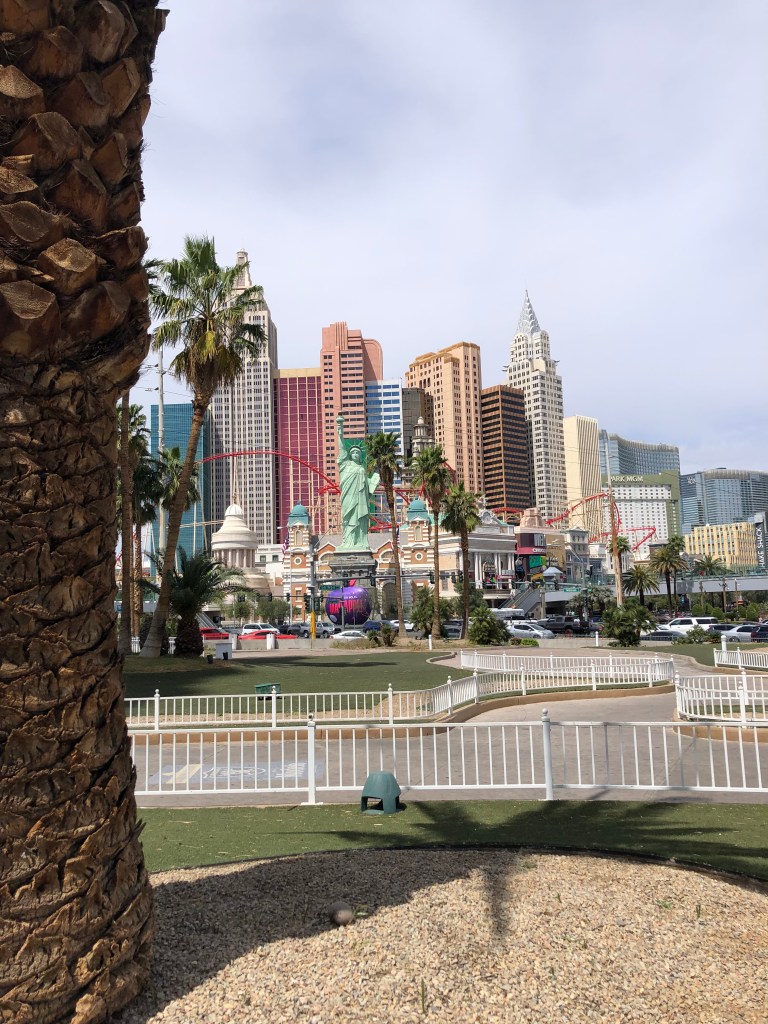
By one definition of the word, Las Vegas is the textbook example of decadence. Is the physical structure of The Strip evidence of American decline? Ross Douthat specifically mentions Disneyland and Las Vegas together in his book, The Decadent Society. He calls them “consumer sublime” which, along with the iPhone, creates a fake experience rather than building something real (like Space Travel).
In his CWT, Douthat expounds on Vegas explaining that, “it represents a kind of simulated sublimity where you are creating models of all of the great achievements of the human species in the modern world and practicing various forms of entertainment around them. So in that sense, it is under my definition too, not just the chocolates-and-bondage-dens definition. I think it is decadent.”
I wrote about Disney World last month and I happened to have just been to Vegas. These places are nice, especially in Spring when it is sunny but not yet too hot.
The New York-New York resort was built in Las Vegas in 1997, followed by the opulent Bellagio in 1998. Paris and the Venetian, both nods to Old World centers of art and culture, were finished in 1999. This construction explosion was all happening during my childhood, and now it is established in modern culture by films such as Ocean’s 11 and The Hangover.
One thing Vegas has all to itself is its sign.
It also boasts to be a place where you are encouraged to overdose on drugs, alcohol, sex, and gambling. That’s not great, but it’s not what Douthat means by decadent. What I noticed is that it’s a loosely regulated place where they will sell you anything that gets you to take out your credit card. There are marijuana stores right across the street from Gucci stores. You pass slot machines on the way out of fancy restaurants.
Tattoo shop next to weed shop, directly across the street from upscale fashion boutiques. l’Arc de Triomphe brought to you by Martha Stewart
The entertainment-by-spending-money enterprise (Walt Disney World was expensive, too) all takes place in a cool physical setting. The pedestrian bridges on the main streets make it fun and practical to walk around, right past all the stores. The Strip is bordered by shiny tall hotels that each have a theme. The centerpiece, in my opinion, is the Paris resort.
How do you signal that civilization is here, when you are in the middle of Nevada-Mars? Meme the heart of European culture. Considering how yucky activity can get on the Strip, that nod to Europe provides a veneer of respectability to lure in rich people with families. I don’t only think of it in that cynical way. Plenty of Las Vegas is unique and new, but humans can only handle so much new at once. The Eiffel Tower is code. It’s a form of language that people understand. It makes us feel safe and perhaps even makes us safe by setting a tone for the style of partying.
Tourists are in a new place surrounded by strangers. Are we going to attack each other? Are Russian soldiers about to come through and massacre us? Do we agree about what is admirable? Everything feels like it is going to be fine, because we are here in civilization. If Americans ever do settle Mars, we’ll build an Eiffel Tower there, too.
This might all seem trivial, except that I have heard multiple people saying something about how Putin thought he could attack Ukraine at this moment because “he thinks the West is decadent.” That makes investigating the issue seem worthwhile.
As I concluded about Disney World, the problem is not that we have a few nice areas to practice escapism. A progressive society would build more of these places with access for more people. Let’s build a bigger Eiffel Tower in the desert that more people can fit under. If the French object, then make it a fake Empire State building. Big Ben, anyone?
The non-superficial problems Douthat mentions are serious. Our declining birth rate has plunged further since he published his book. Our political system seems just as sclerotic (Vegas is the place where developers got a “yes” while every other American city was saying “no”). As I said in my previous post, everyone should read his book and ponder.
To leave Las Vegas, I took an Uber for a morning flight. My driver came from Afghanistan three years ago. I told him I was glad he made it out before the Taliban took over and he said that it is bad there right now. He had to learn English in 6 months out of dire necessity so that he could get better jobs. Now he dreams, like so many Americans, of “getting out of this town”. What does he think of Las Vegas? His complaints are that it is too sunny and boring.
The destinations of his dreams are San Francisco or New York City. I informed him of the places I know that have less sunny days. I wish we could have talked more, but from what I can tell he has embarked on his American Dream. He was located with his parents (and perhaps more family members) in Las Vegas directly from Afghanistan. He’s young and dreams of leaving. However, he said his parents like where they are and want to stay put now that they have found a secure home. That puts the city in a new perspective. It may not be the aesthetic that Ross prefers, but families have found a home where there used to be uninhabited wilderness.
This is from The Price of Peace by Zachary Carter. What strikes me is the fact that a fleeing refugee doctor enabled Keynes to join the fight, again at the age of 58.
The following passage starts on page 316: “In the meantime, Keynes was at last in good health again. He owed his new energy in part to Hitler’s aggression. In 1939, Keynes had hired János Plesch, a Hungarian Jewish doctor who had relocated to London after fleeing Nazi persecution.
[Plesch resolved Keynes persistent throat infections by administering one of the earliest antibiotics (that was developed in German labs by Bayer before the war!).]
“After two decades of depression, however, the British economy was entering the fight of its life in ragged condition. … On the eve of war, worker productivity was 125 percent higher in the United States than it was in Britain.
“In the meantime, Germany had shifted its offensive focus to London. The Blitz…
“British diplomats didn’t have time to waste. After trying everything else, they brought in Keynes.”
“So Keynes went to Washington in May 1941 to negotiate more practical terms of cooperation and promptly infuriated nearly everyone he met.”
My thoughts: Money wins wars. Wars redistribute talent. Talent makes money. Is the cycle still going? Is this a post-industrialization phenomenon only? Will Tyler’s upcoming book on talent shed any light on this topic?
Podcast with Anne Applebaum on dictators (May overlap considerably with your Twitter stream of info, but at least you could walk while learning and take a scrolling break.)
The destruction of value is graphic and tragic, caused by Russia invading Ukraine this month. Of course violence is common, around the world and throughout history. Violence and repression lead to poverty. Only in rare circumstances have autocracy and despotism been escaped, so that commerce can flourish and wealth can be shared.
Last week I blogged about my nice experience at Disney World. I was happy to see them telling the story of technological growth at The Carousel of Progress ride. At Disney, people really commit to their stories. Adults don’t wear mouse ears or Jedi robes ironically, in the park. The Carousel of Progress message is 100% optimistic about our future, without any cynicism or hedging. There is no mention of government institutions or which legal arrangements will allow progress to continue.
Here is some political economy that is missing from the ride. I quote, without indenting, from the late P.J. O’Rourke’s book On the Wealth of Nations. O’Rourke explains, sometimes using Adam Smith’s words, how in rare circumstances humans managed to rise out of poverty and subjugation.
Beginning of Chapter 7: The first two books of The Wealth of Nations are Adam Smith’s creed of economic progress. Smith placed his faith… in the logic of common sense. We are required to care for ourselves. We act upon this requirement. Our actions are demonstrably beneficial to others. The economy progresses, QED. Or it would, Smith wrote, “if human institutions had never thwarted those natural inclinations.”
More from Chapter 7, on pre-Medieval history of Europe: Smith wrote that the “rapine and violence which the barbarians exercised” left Western Europe “sunk into the lowest state of poverty.” Commerce was destroyed, towns were deserted, fields were left uncultivated. But although the rule of law and the legal title to property that goes with it were destroyed, the result was not “Imagine no possessions/ I wonder if you can.”
End of Chapter 7, an explanation of how economic progress started in the Westwhen the merchants gained some freedom: Adam Smith argued that the inclination of the feudal overlords to be selfish was so strong that it overwhelmed their instinct for self-preservation:
All for ourselves, and nothing for other people, seems, in every age of the world, to have been the vile maxim of the masters of mankind. As soon, therefore, as they could find a method of consuming the whole value of their rents themselves, they had no disposition to share them with other persons. For a pair of diamond buckles… they exchanged… the price of the maintenance of a thousand men for a year, and with it the weight and authority which it could give them. The buckles, however, were to be all their own… whereas in the more ancient method of experience they must have shared with at least a thousand people… and thus, for the gratification of… vanities, they gradually bartered their whole power and authority.
Never complain that the people in power are stupid. It is their best trait.
Joy writing again: “Stupid” refers to the fact that the European lords could have maintained their own power if they had been willing to keep themselves and everyone else poor through continued violence. Consider who is currently being being crazy versus “stupid,” in Europe and elsewhere.
In Disney World’s Magic Kingdom, you can get off the Carousel of Progress and walk across the park, past the Main Street shops, to a dark scary ride called The Pirates of the Caribbean. Someone could teach a travel course where students do both rides and then discuss wealth creation. It would pair nicely with a Doug North reading. Then, everyone could ride “It’s Small World” ironically.









 Economist Writing Every Day