Ladies, Tyler Cowen has done us a solid. He included John Stuart Mill as a contender for the greatest economist of all time in large part because of his insights on gender equality.
I’m short on time at the moment. I’d like to do a better job than this, with more nuance about Hayek, but here’s the most I can do this week:
This is the 4th year in a row that the crew has put together some recommendations on products or books that we actually use, for your consideration in holiday gift buying. I’m going to put things into categories of Stuff for Adults, Kid’s Toys, Books for Adults, and Kid’s Books
Stuff for Adults (Men can be hard to shop for, so this might save Christmas!)
Scott says these scissors are amazing: “Fiskars 9 Inch Serrated Titanium Nitride Shop Shears”, available from Amazon here. Unlike some thick, heavy, or stubby heavy-duty shears, these have the feel of regular scissors, with fairly long, narrow blades. The handles are fairly substantial, and very comfortably contoured to the hand/thumb. The real magic is in the blades. They are sharp, with a very hard titanium nitride coating. Also, they have fine serrations in the cutting edge, that tend to grip the material in place as you are cutting.
Zachary recommends 5 things that he really uses at home
Food makes great presents for adults. Just give me Doritos, thanks.
Kid’s Toys
A wonderful game that you might not already have is Protect the Penguin. It’s high-energy but much less work than something like Twister. I actually enjoy playing it, too.
I’ll re-up from last year that Spot It is incredible and fits in your coat pocket. Fun for all ages. Several versions of the game. Not everyone has to know how to read or add to play so good for events with lots of ages represented. LEGO sets are always fun. If you keep the difficulty level age-appropriate than your kid should be able to play independently for an hour. I’ll put up one link but of course there are many thousands to choose from that can be tailored to any interest. My son likes Minecraft-themed sets.
Books for Adults
If you want to see all the books we have read and reviewed, just click on the Books category or go to
Not all of those posts are going to give you quick gift ideas, so if I had to pick out one from the last year it would be:
Secondhand: Travels in the New Global Garage Sale is a great book in my summer stack on fast fashion. I have always been interested in the combination problem-blessing of too much stuff. Adam Minter explains perfectly what many of us have been curious about.
You might have a relative who is very environmentally conscious or works hard to reuse and recycle. They might think it’s interesting to learn about the secondhand markets in America and beyond.
Kid’s Books
I’m reading The Hobbit aloud to my son right now and I highly recommend the experience. It’s going to take us months to get through it by reading a few pages at a time around bedtime.
Camp Out!: A Graphix Chapters Book (Bug Scouts #2) Funny graphic novel series about a group of friends in a scout troop. Probably especially fun for a kid who is in some kind of scouts program. Calvin and Hobbes is another comic series that my kid genuinely looks forward to reading.
Joke books can lead to great conversations. If the kid wants to know why something is funny, you can end up talking for a long time about the complex world.
See what we recommended in previous years. We have always had a mix of kid and adult items.
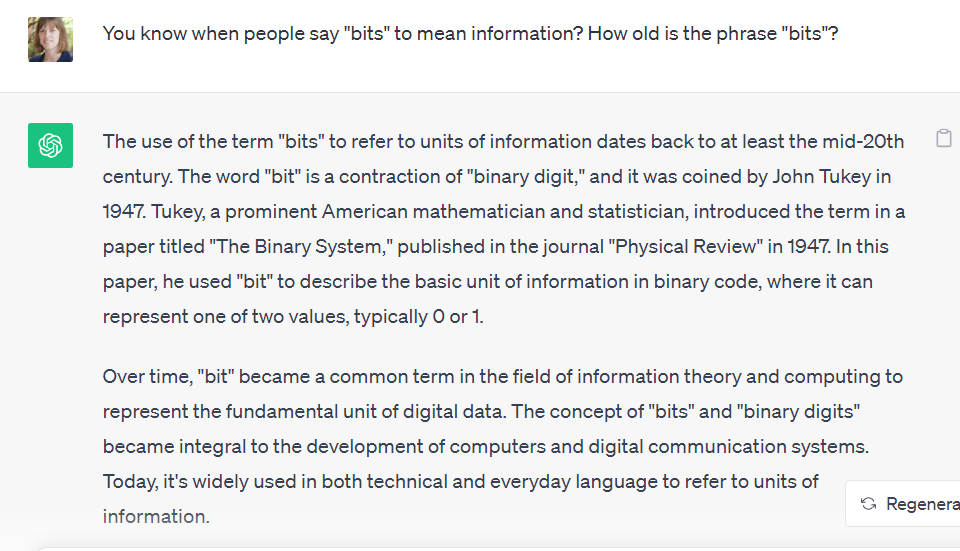
I suppose books were, for a time, the cheapest way to convey bits of information, before anyone had heard of “bits”. I asked ChatGPT to do my boring work and rehearse the history of the term “bits” so I could get my facts straight for this post.
Based on my other research, I was not confident that this paper called “The Binary System” exists. I could find no evidence of it from 5 minutes of googling. When I asked ChatGPT about it, ChatGPT apologized and said it probably isn’t real.
That kind of error would have been less likely with paper books that had human editors and authors. We hardly thought about this benefit of the old system, until it was gone. Because books had some cost to write and print, it made economic sense to employ an editor to ensure quality. For a while, no one would have thought of spewing out this ocean of associated terms that we get from ChatGPT, because it was too expensive. So, the first underappreciated benefit of printed books was that they were relatively more accurate.
This is the first “generative book” that I had ever accessed. I did the worst thing, right away. I asked the Chatbot to give away the ending, and it did.
I wish I could have bought the paper book and read until the end, using the suspense as a device to get me to learn new details about famous economists. Books and movies used to be able to use suspense to keep the audience engaged. Before generative books, that just seemed like the only way.
I didn’t think of books as special until I used a phone to (try to) learn. Now I put more value on the hours I spent reading paper books when I was younger. Authors were manipulating me through that rigid medium. I was forced to wade through pages and pages to get to the point. But what value is the “point” without the context? Getting to the point through arguments and examples, instead of just seeing a tweet, made us smarter. The second benefit of books was that we were forced to work harder.
Generative books are a further step toward poastmodernism.
A middle ground I can imagine is asking the chatbot to play coach instead of search engine. What if the Chatbot could write you a shorter version of the book that cuts out the parts you would have skimmed in a paper book? Still, just knowing that you were skimming certain parts actually created context. I took that for granted, until now.
Something has happened in the world outside of our screens that feels both “full circle” and “anti-Network State”. The BBC announced that an American tech billionaire bought the English pub where J.R.R. Tolkien and C.S. Lewis famously met to talk with a group of friends.
We could just see pictures of that place on the internet. You can see my 2014 pilgrimage to it pictured below. But people want to go in person, if they can afford it. That used to just be the only way to do things. Now that we can see what it is like to live through digital media, we are discovering the value that existed all along in 3-D doings.
Speaking of Tolkien, I’m reading The Hobbit aloud to my son right now and I highly recommend the experience. I’m glad that he is capable of enjoying it, since the pacing is so different from the media and games on screens. To get an elementary-aged boy reading from paper, I also recommend Calvin and Hobbes.
We like to put up recommendations for holiday gifting at this time of year. That paperback of Calvin and Hobbes would make a great gift for a kid (or adult!).
Zachary told us that he has printed out our own blogs for the week to read at home on paper. That’s “full circle.” Maybe print has something for us, even if it is more expensive than scrolling screens.
Buying new hardcover books at a bookshop regularly can be prohibitively expensive. But if you look at used books, you can easily walk out of a rummage sale with 10 quality books for $10.
Also, sometimes ordering older print paperback books or DVDs on Amazon is extremely cheap. Here are some of the cheap Amazon media purchases I made in 2023. I might have found them even cheaper at a local garage sale, but getting it delivered to my house saves a lot of time. I recommend all of these items over scrolling mobile screens.
Some people might prefer Kindle to paperback because it allows them to maintain a larger “library”. If you have very limited space to store books, then I can understand that advantage. However, I know that I learn better from paper. Printed media might still be worth paying for.
Afterword: I printed out two chapters of Tyler’s new book and it’s excellent.
It’s mostly very smart and serious, but this paragraph made me laugh out loud.
It’s been almost a decade since I taught principles of economics classes. One major allocation of my time this semester is course prep, since I am teaching 3 different classes.
For my Principles of Microeconomics course, I chose Modern Principles of Economics, because I figured Tyler and Alex had done a good job and I have heard good reviews from others.
I’m writing a short review of their instructor resources, and then I’ll have to get back to course prep.
Like most textbooks, they provide you with slides that you can modify. Not having to start from scratch on lecture slides is great.
They also have teacher guides for each chapter. I find these helpful, because I have not taught this class in many years. Even though “I’m an economist,” there is still a technique to presenting these ideas for the first time to undergraduates. No need to re-invent that wheel completely.
They have suggestions for in-class activities. For example, to illustrate demand shifts, ask the students about a recent celebrity scandal and how that created a fall in the demand for concert tickets. It works. Everyone loves talking about celebrity scandals. It will be an evergreen idea. There are always new scandals for each semester – the students know more about it than the professors. My students (Fall 2023) informed me that Lizzo got in hot water for fat-shaming.
Their online learning platform called Achieve within MacMillan works well. It integrates really well with Canvas, our LMS. One warning I would give you is to make sure that students buy Achieve through an account on their .edu email address. I have headaches over students signing up with a personal email address and then not having their data integrate with Canvas.
You can sign up for EconInbox, which will email you topical relevant news stories right before you would want to present them in class. You’ll have to tell them ahead of time what your schedule of topics is, but that is something you ought to have worked out in your syllabus at the beginning of the semester. Obviously, you can’t cover every chapter in one semester. There are far more resources, generally, than you can use. But picking and choosing from a great library is easier than trying to build something from scratch yourself.
Lastly, the Cowen Tabarrok textbook integrates nicely with the free Marginal Revolution University video library. MRU is free to all. So, as an instructor you could still use it heavily even if you are not assigning their textbook or even if you are not doing Achieve. Still, I think that making use of the MRU resource is easiest if you are using their textbook. A fun video that might even be worth using class time for is Avengers: The Story of Globalization
The author of Secondhand, Adam Minter, simultaneously appreciates the value created by large “impersonal” markets and also paints colorful pictures of the individual people involved. He has respect for individuals in the system who, using local knowledge, extract all the value out of what rich people consider to be trash. Minter sits in the seat of Adam Smith.
But it is not the popular movement, but the travelling of the minds of men who sit in the seat of Adam Smith that is really serious and worthy of attention.
Lord Acton, Letter of Lord Acton to Mary Gladstone
Another piece about clothes from AdamSmithWorks is: “WHO ARE YOU WEARING?” FASHION PRODUCTION IN THE AGE OF ADAM SMITH. This article does “the pin factory” for clothes. The global supply chain is incredible, just looking at manufacturing alone. Minter takes it further by following goods all the way from their first consumer to their very last user.
There is some good news about how the world is getting better as the average person gets richer, but trash does also cause problems as we consume more stuff. Does Minter write about the environmental concerns of the “fast fashion” camp? He has a different idea than what others have proposed like taxing by volume or banning some commercial activity. In terms of practical advice, Minter advocates for labeling consumer goods by how long they are expected to last. It’s tragic when someone spends $20 on a good that will wear out after 1 year when they should have spent $30 on a good that will last 10 years. There are some “dollar bills on the ground” here because consumers don’t accurately assessing quality at the time of purchasing. The power of brands to signal quality helps with this problem, but if you don’t want washing machines piling up in landfills then you might want stores to put a greater emphasis on durability at the point of sale. We do something like that with nutrition labels, so it is possible.
Secondhand: Travels in the New Global Garage Sale is a great book in my summer stack on fast fashion. I have always been interested in the combination problem-blessing of too much stuff. Adam Minter explains perfectly what many of us have been curious about.
Secondhand is America-centric, but he also travels to Japan to observe a country that is ahead of us both in terms of the demographic crisis and the mechanisms for handling old stuff. The reports from Africa are very interesting.
I have been wondering what is happening with Goodwill and with recycling in general. What hope do we really have of keeping goods out of the landfill? What should I do with a shirt my kid has grown out of? (The lady at work I used to give clothes to now runs away at the sight of me. I gave her too many bags.)
The Goodwill collection center near me looks cluttered and weird. After reading Secondhand, I’m more optimistic about dropping off bags there.
The barrier to sorting the used goods of the rich world is the scarcity of time and attention. This paragraph about a used book seller in Japan is heart-breaking:
It’s a thirty-year-old hardback novel, and the edition is rare. If it were at a traditional bookstore, it’s command a premium price. But Bookoff is about volume, and there’s a problem: not only does it lack a barcode, but it lacks an ISBN… “So there’s no way to price it in Bookoff’s system,” Kominato says. With a grimace, he gently places it on top of the books filling the recycling cage and steps away. (pg 40)
At least the book will get recycled into new paper, and the reality is that it was providing negative value as clutter in someone’s home.
Back in America, Minter describes what happens to donated goods at Goodwill in detail. Sometimes high-quality clothes are identified, but it is hard to get a good price for them. Some customers expect to pay less than $5 for a shirt, no matter what.
Customers are all about price, not quality…They won’t buy a $6.99 shirt that will last. If that’s the option, they’ll buy a $2.99 shirt from Walmart. (pg 57)
Some consumers are in the habit of treating clothes almost like disposable goods instead of durable assets. They won’t pay for quality. Going out and getting a new replacement shirt costs less than lunch.
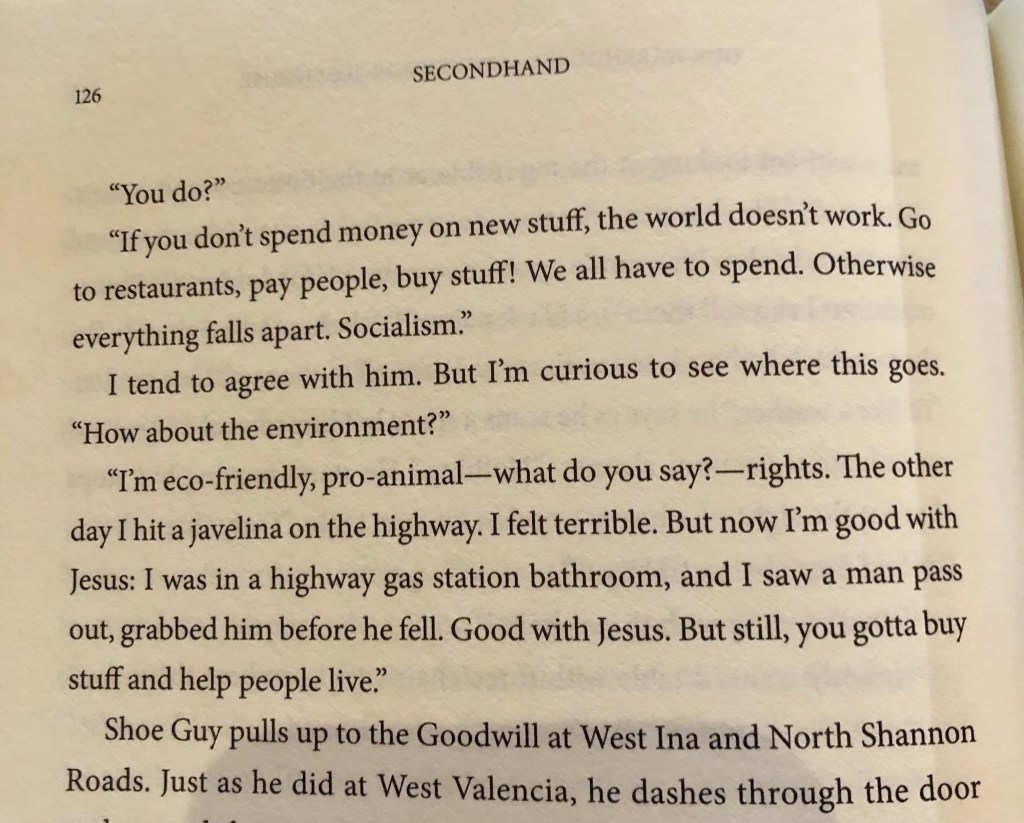
I don’t want to give away too much, since you will want to go get the book yourself. Here’s the funniest page:
Lastly, I’ll share a personal win. I know that I’ll need a school backpack for my youngest in August. I went to a local rummage sale and went to the backpack section. I found one that is good enough (some scuffs but plenty of sparkles). I’m happy about keeping this sparkly pink backpack out of the landfill for a few more years. I walked out of the sale with a load of gear that cost a total of $10. Next, I went to a coffee shop to work where I also spent $10. Used textiles and books are dirt cheap.
Elizabeth Gilbert of Eat, Pray, Love delivered an insight, second-hand from “Deborah the psychologist”.
I remember a story my friend Deborah the psychologist told me once. Back in the 1980s, she was asked by the city of Philadelphia if she could volunteer to offer psychological counseling to a group of Cambodian refugees—boat people—who had recently arrived in the city. Deborah is an exceptional psychologist, but she was terribly daunted by this task. These Cambodians suffered the worst of what humans can inflict on each other—genocide, rape, torture, starvation, the murder of their relatives before their eyes, then long years in refugee camps and dangerous boat trips to the West where people died and corpses were fed to sharks—what could Deborah offer these people in terms of help? How could she possibly relate to their suffering?
“But don’t you know,“ Deborah reported to me, “what all these people wanted to talk about, once they could see a counselor?“
It was all: I met this guy when I was living in the refugee camp, and we fell in love. I thought he really loved me, but then we were separated on different boats, and he took up with my cousin. Now he’s married to her, but he says he really loves me, and he keeps calling me, and I know I should tell him to go away, but I still love him and I can’t stop thinking about him. And I don’t know what to do…
I don’t agree with Elizabeth L. Cline on everything, but she’s written a reasonable book for Americans today. The Conscious Closet has some good advice for everyone.
A decade ago, Cline wrote Overdressed: The Shockingly High Cost of Cheap Fashion which investigated the environmental toll of clothes and the labor controversies. Since then, she has been working on what consumers can do differently.
Not every American household has practical knowledge of laundry and sewing anymore. Cline offers suggestions on how to economically maintain clothes longer by making sensible home repairs or washing them less. (Don’t wash a pair of jeans after just one wear. I don’t.) The Conscious Closet came out in 2019, so it’s up-to-date concerning chemicals and certifications and websites that operate today.
The way we wash and dry our clothes uses a lot of water and energy. If a person was looking for a way to lower their environmental footprint, then a marginal reduction of laundry loads might be a relatively easy way to do it. Since almost every American has an electric dryer, we have lost the tacit knowledge of how to air dry clothes. She gives the practical reminder, for example, that dark color clothes will fade if exposed to extended sunlight.
I feel like Cline could be even more conscious about the opportunity cost of time. She does explicitly acknowledge that in her chapter about re-selling your unwanted clothes.
I’m writing an article about fast-fashion, so I’m reading Fashionopolis by Dana Thomas.
This paragraph is from the intro chapter:
Since the invention of the mechanical loom nearly two and a half centuries ago, fashion has been a dirty, unscrupulous business that has exploited humans and Earth alike to harvest bountiful profits. Slavery, child labor, and prison labor have all been integral parts of the supply chain at one time or another – including today. On occasion, society righted the wrongs, through legislation or labor union pressure. But trade deals, globalization, and greed have undercut those good works.
She invokes religion with “good works.” Thomas and I are of different opinions concerning globalization and “greed” and legislation. My instinct is to rip this paragraph apart. Has legislation never been motivated by greed? Has globalization not improved the lives of children? Has the mechanical loom not improved the lives of women who used to spend hours spinning and weaving by hand?
I am also reading pastor Tim Keller’s biography right now, so I’m having a What Would TK Do moment.
With his gifts (smart, funny, articulate…), Keller could have made a fortune by taking a side. He could have picked the Right or the Left. He could have expertly appealed to a Side, convincing them that they were good-smart and the Other is evil-stupid. Instead, Keller relentlessly stayed in the center. One of his books is actually called Center Church.
There have been a lot of popular papers in the past decade or so that make use of textual analysis. A fun one is “The Mainstreaming of Marx” by Magness & Makovi. They use Google Ngram to analyze the popularity of people mentioned in books and determine when Karl Marx became popular. “Measuring Economic Policy Uncertainty” by Baker, Bloom, & Davis is one of my favorites. They use set theory to detect terms in newspapers that denote economic policy uncertainty. In this post, I’m just going to describe practical differences between the two data sources and how the interpretations differ.
Ngram
Ngram measures takes a term and measures how popular that term is in its corpus of book text, which is about 6% of all books ever written (in English, anyway). Because popularity is expressed as a percent, we can make direct popularity level comparisons among words. For example: “Cafe” & “Coffee Shop”. In the figure below, we can see that the word “cafe” was more popular in books until very recently.