The French magazine L’Express is widely read as magazines go. I was asked to give comments on fast fashion. An interview with me has been published in French at
Idées: Alors que Shein provoque une controverse nationale en France, l’économiste américaine invite à un regard nuancé sur la fast fashion, rappelant que le trop-plein de vêtements est un problème très récent dans l’histoire humaine.
Ideas: While Shein is causing a national controversy in France, the American economist urges a more nuanced view of fast fashion, reminding us that the overabundance of clothing is a very recent problem in human history.
I enjoyed talking with their reporter Thomas Mahler (kindly for me, in English). He informed me that French politicians are proposing to ban Shein from the country, meanwhile millions of people in France shop through Shein regularly.
There are 62 songs called “Better Man” just on Ultimate Guitar (which doesn’t claim to be comprehensive), plus many more slight variations like “A Better Man” or “Better Man Blues”. Some of these are obscure, but many are from well-known artists including Taylor Swift, Oasis, Ellie Goulding, Justin Bieber, and Pearl Jam; one by Robbie Williams inspired a major motion picture also called Better Man.
Meanwhile there is only one song on Ultimate Guitar called “Better Woman”, plus one variation (“A Better Woman”), both from artists I hadn’t heard of (Sera Cahoone and Beccy Cole). Why such an extreme difference?
Is it that men are the ones who are terrible and need improvement? Or are men the ones who see hope for improvement, while women can’t change or don’t want to? Let’s consider what the lyrics have to say about this. Reading though them all I saw a few recurring categories of “Better Man”:
Wish I Were Better: I count 33 of the 62 songs in this category. A man singing about how he wishes he were better, usually because of a woman, the classic “You Make Me Want to Be a Better Man“. Sometimes this is hopeful that he will be, sometimes regretful that he hasn’t been or despairing that he won’t be. Occasionally the inspiration to be better comes from someone other than a woman he’s in love with, such as Jesus, his dad, or his kids.
You Make Me Better: 13/62. Same idea as the last category, except the man has already become better. Again usually because of a woman, but sometimes because of someone else like God or his kids or his friends. Another 3 are a variation of this, I Got Better, where the man changed without anyone’s help or for a woman who isn’t convinced he really changed.
Wish You Were a Better Man: 4/62, but includes the hit by Taylor Swift. A woman wishes a man she loved were better. Another 2 songs including the Pearl Jam hit are a variant of this, Can’t Find A Better Man, where a woman stays with a bad man because she doesn’t see a better choice. Steven Seagal (yes, that Steven Seagal) reverses things and sings that a woman should leave him because she can do better. Then there’s 1 example of the genre where Hellyeah wishes his father were a better man.
One-offs: There are a few 1-off “Better Man” songs that seem to be in a category of their own: Beth Hart’s celebration of finding a better man, Ellie Goulding‘s odd insistence that “I’m the better man” (even though she’s a woman), and Ryan Innes’ entry which is the closest anyone comes to saying they wish they were a worse man. By the way, there appear to be zero songs out there called “Worse Man”- perhaps some day I’ll write one, but its a free idea and I’d be happy to see one of you beat me to it.
What about our 2 “Better Women”?Sera Cahoone’s song (the only one with the exact title “Better Woman”) is a standard “Wish I Were Better” entry, just as a woman (though the person she wants to be better for might still be a woman as usual):
So I step on up and be a better woman in your eyes From now on I’m gonna love everything about you
Beccy Cole’s “A Better Woman” concludes that she doesn’t actually want or need to become a better woman:
I ain’t changin’ nothin’ Just to have your lovin’ Yeah, I’m alright with who I am I don’t need to be a better woman – I just need a better man
The boring explanation for the gender discrepancy is that “Better Man” just scans better rhythmically. But I don’t think can explain a 60-2 (or 60-1 if we’re being strict) difference, and there seems the be a big underlying difference in the prevalence of these themes for men and women, not just titles. This matches up with the classic sayings from Camille Paglia:
A woman simply is, but a man must become
Or this one often attributed (probably incorrectly) to Einstein:
Women marry hoping that the man will change. Men marry hoping the woman will stay the same. Both are usually disappointed.
Whatever the cause, you can find the playlist I made of all 60 “Better Man” songs I could find on Youtube Music here:
I liked most of them (surprisingly given the range of genres and the fact that I hadn’t heard of most of the artists), but my favorite in this vein is to forget being a Better Man or Better Woman, and instead be “A Better Son/Daughter” like Rilo Kiley says:
Music majors earn more than people who didn’t graduate from college, even if they don’t end up working as musicians
Among musicians, music majors earn more than other majors
But among non-musicians, other majors earn much more than music majors
So on average a music major means higher income if you would be a musician anyway, or if you wouldn’t have gone to college for another major, but lower income than if you majored in something else and worked outside of music. The exact amounts depend on what you control for; this gets complex but this table gives the basic averages before controls:
Source: Table 2 of Bailey and Smith (2025), showing wage plus business income for respondents to the 2018-2022 American Community Survey
For better or worse, a music major also means you are much more likely to be a musician- 113 times more likely, in fact (this is just the correlation, we’re not randomizing people into the major). Despite that incredible correlation, only 9.8% music majors report being professional musicians, and only 22.3% of working musicians were music majors.
Sean Smith had the idea for this paper and wrote the first draft in my Economics Senior Capstone class in 2024. After he graduated I joined the paper as a coauthor to get it ready for journals, and it was accepted at SN Social Sciences last week. We share the data and code for the paper here.
I’m providing a rough transcription of the part that stood out to me, because he identified a prime big unanswered question. This is around minute 7 of the episode.
Host: Why is [the Property Species] an interesting topic deserving of a book?
Bart Wilson: “So, I work with primatologists… and I would talk to them about what I’m working on with my laboratory experiments on property. They would say, ‘Oh yeah. Dolphins do that, too, or baboons. … scrub jays re-cache their food if another scrub jay is watching them so they are protecting themselves against theft… so property is all over the animal kingdom. And then I’m also working with my colleague in the English department. In the humanities, property is a very narrow thing, something Western European. It’s very modern. And, so, in one part of the academy property is this broadly natural phenomenon and in another part of the academy it’s very local: only some humans have it. And so, as a social scientist…”
Bart identified a gap in understanding. Property cannot be both common to all animals and rare among humans. In his book The Property Species he spans that gap by claiming (spoiler alert) that property is common to all humans and only humans. Human language is an important piece of that story. No other animal can wield complex symbolic language.
In our new paper (manuscript forthcoming) we’ll be investigating how humans use symbolic language to describe nonrivalrous digital resources.
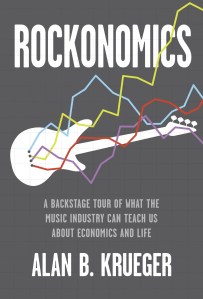
I missed Alan Kreuger’s 2019 book on the economics of popular music when it first came out, but picked it up recently when preparing for a talk on Taylor Swift. It turns out to be a well-written mix of economic theory, data, and interviews with well-known musicians, by an author who clearly loves music. Some highlights:
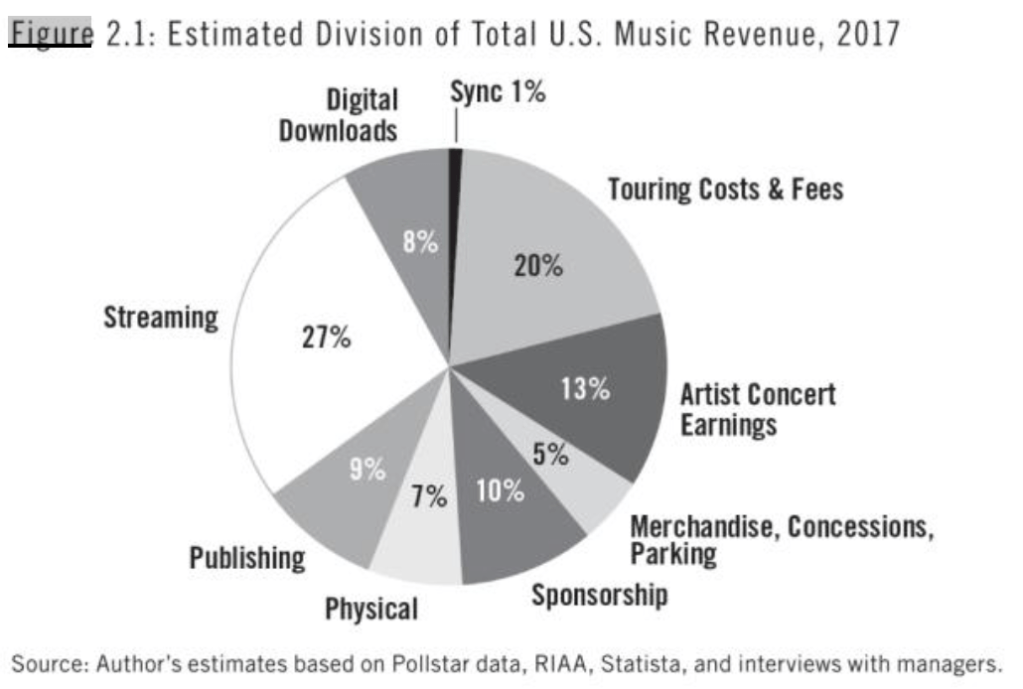
[Music] is a surprisingly small industry, one that would go nearly unnoticed if music were not special in other respects…. less than $1 of every $1,000 in the U.S. economy is spent on music…. musicians represented only 0.13 percent of all employees [in 2016]; musicians’ share of the workforce has hovered around that same level since 1970.
there has been essentially no change in the two-to-one ratio of male to female musicians since the 1970s
The gig economy started with music…. musicians are almost five times more likely to report that they are self-employed than non-musicians
30 percent of musicians currently work for a religious organization as their main gig. There are a lot of church choirs and organists. A great many singers got their start performing in church, including Aretha Franklin, Whitney Houston, John Legend, Katy Perry, Faith Hill, Justin Timberlake, Janelle Monae, Usher, and many others
Cowen’s 2nd Law states that there is a literature on everything. I would certainly expect there to be a literature on the best-selling musician in the world. And of course there is; Google Scholar returns 23,500 results for “Taylor Swift”, and we’ve done 5 posts here at EWED. But surprisingly, searching EconLit returns nothing, suggesting there are currently no published economics papers on Taylor Swift, though searching “Taylor” and “Swift” separately reveals hundreds of articles about the Taylor Rule and the SWIFT payment system. Google Scholar does report some economics working papers about her, but the opportunity to be the first to publish on Taylor Swift in an economics journal (and likely get many media interview requests as a result) is still out there.
Swift presents a variety of angles that could be worthy of a paper; re-recording her masters forcopyright reasons, her efforts to channel concert tickets to loyal fans over re-sellers, or her sheer macroeconomic impact. I’ve added a note about this to my ideas page (where I share many other paper ideas).
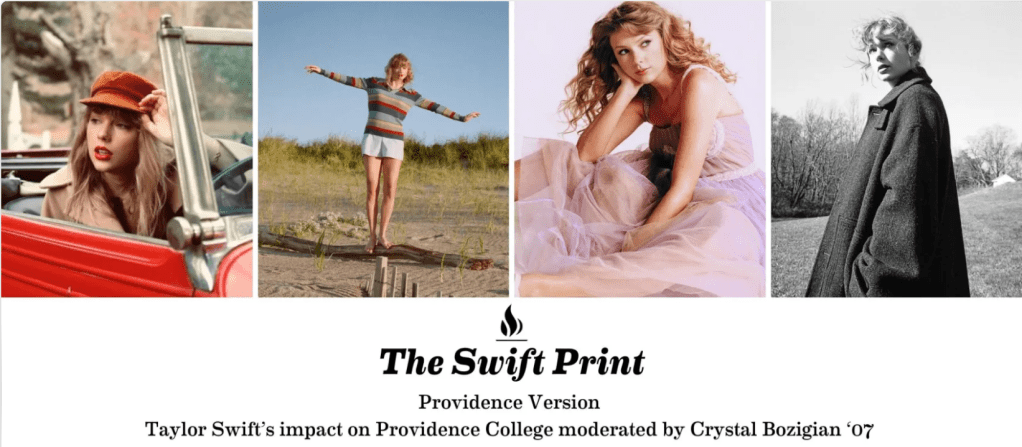
In the mean time, I’ll be giving a short talk on the Economics of Taylor Swift at 7pm Eastern on Monday, September 16th, as part of a larger online panel. The event is aimed at Providence College alumni, but I believe anyone can register here.
Update 10/25/24: A recording of the event is here, and a recording of a followup interview I did with local TV is here.
Recorded music sales peaked in 1999- then came Napster and other ways to listen to the exact music you want for free. Recorded music sales still haven’t fully recovered, but with the rapid growth of paid streaming since 2014, they have been increasing again:
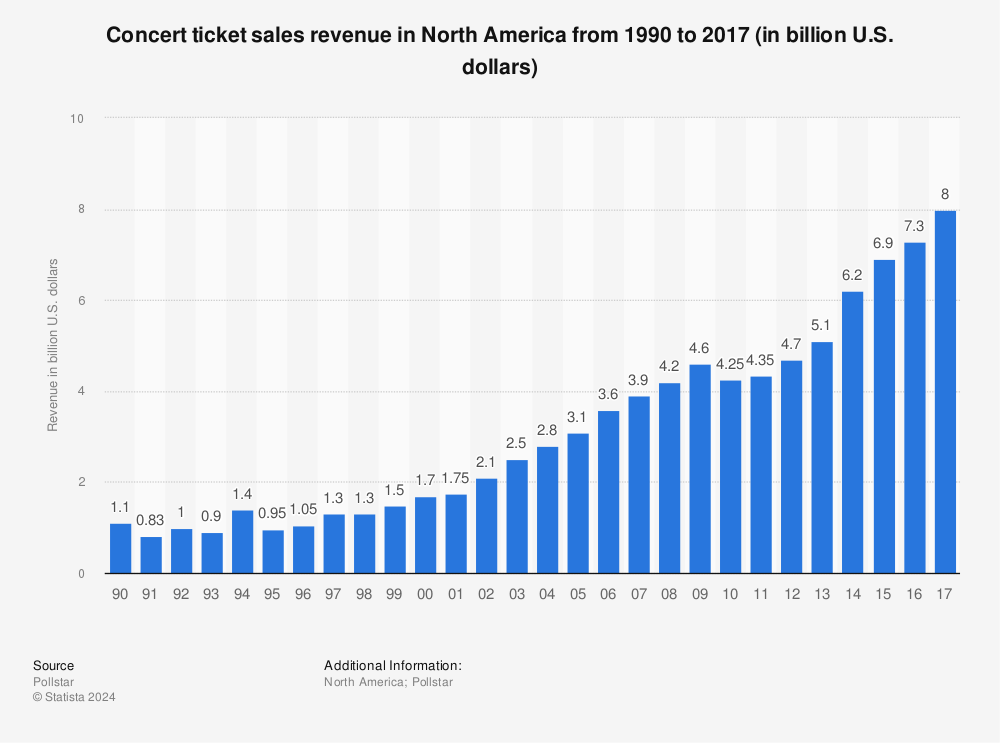
Meanwhile, live music sales have exploded since the ’90s:
The latest report from Pollstar on the top live tours is positively glowing:
2023 was a colossus, the likes of which the live industry has never before seen. If 2022 was a historic record-setting year, which it was, then this year completely blew it out of the water— by double digits. Total grosses for the 2023 Worldwide Top 100 Tours were up 46% to $9.17 billion
When you combine live and recorded sales, total spending on music has now passed the 1999 peak; this is the biggest the market for music has ever been. Of course, this doesn’t mean its an easy time to be a musician; touring is hard work and, as always, record labels and others are taking a big share of the money before it gets to artists. And opinions differ about whether today’s environment is good for creating good new music.
There are dozens of songs about how the road is hard, and the more time you spend on the road, the less they sound like cliches than like a simple and sometimes stark description of your life. Sooner or later everybody spots the exit that has their name on it –John Darnielle
The BLS data is noisy but suggests that the number of musicians in the US has been fairly flat and is projected to stay that way. A lot will depend on whether live music continues to grow, how much of that is captured by a few superstars, and whether the current streaming paradigm continues, or goes in a more or less artist-friendly direction. But now that consumers are willing to pay for music again, artists at least have a fighting chance.
U.S. Immigration and Customs Enforcement’s (ICE) Homeland Security Investigations (HSI) has joined forces with the Motion Picture Association (MPA) to launch a new initiative aimed at countering digital piracy and protecting a vital sector of the U.S economy.
Digital streaming services provide quick and easy access to creative works, such as music, television, movies. However, the growth of digital streaming services has presented new challenges when it comes to law enforcement’s ability to ensure vital copyright protection for the industry. This technology that has provided millions of people access to their favorite shows, has also enabled criminals to turn piracy into a crime that is no longer restricted to the hand-to-hand sale of illegally pirated media.
Digital piracy negatively impacts millions of jobs, results in less taxes being paid, and threatens innovation and creativity. Its effects are felt across multiple industries and includes the cost of corollary crimes on consumers such as the potential damage caused by hidden or embedded malware, as well as identity theft and financial crimes, such as credit card fraud.
Recall, Napster was shut down in 2001. Limewire was shut down in 2010. Illicit downloading is happening through other channels.
According to this graph, people spent almost as much on vinyl records as they did on CDs in 2018. The Economist provided a nice chart (last updated in 2019) on the rise of streaming revenue and the collapse of traditional records sales.
When music rights make the news, it’s generally because a superstar’s entire catalog is selling for hundreds of millions of dollars. That may be why I always assumed that buying music rights would be difficult and expensive- that you’d both have to know the right people to even hear about potential deals, and have to be quite rich to afford them.
But this week I found out about Royalty Exchange, a site that currently lists hundreds of music rights for sale. They certainly appear to make the process of finding and buying rights, and collecting royalties, easy (I haven’t bought any yet so can’t say for sure). They currently list songs and partial catalogs from all sorts of artists you’ve heard of:
When I say I find many listings to be surprisingly cheap, I mean this relative to the hundred million dollar deals you hear about. Of those that offer a list price (as opposed to simply asking for offers), the vast majority are over $10,000, and many are over $100,000. Overall I’d put it in the “luxury car” bucket- expensive enough that its a bad idea for a normal middle-class person to buy one, but cheap enough that they could if they really wanted to. It’s a bit of a better idea than a luxury car, since its more investment than consumption. But if I actually bought the Flogging Molly catalog like I want to, I’d be taking an unnecessary risk by putting a large proportion of my net worth in a single investment. Their music is great and I think it will maintain its popularity, but if I’m wrong and people stop listening to it I’d lose out. So, for most people it’s a bad idea in the same way that putting half your retirement account into a single company’s stock is bad idea. But I’m surprised its even possible.
Why are these rights so affordable? Sometimes, of course, its because the artist isn’t that popular. But why are the rights to songs and musicians that are household names affordable? It seems to mainly be because the rights have been sliced and diced so that you’re only buying a small piece of them. Consider Miley Cyrus above. First of all its only the rights to one of her songs (admittedly a hit song). Second, you’re only buying the rights for ten years (lifetime rights are sometimes available but naturally they cost more). Finally, you’re only buying some of the rights, in this case the right to get paid when someone publicly performs the song (but not when someone streams it or buys a copy):
Even given all that though, I’m surprised how cheap the rights are. I expected that people would overpay for them because they like an artist, or for the bragging rights. But the yields seem pretty reasonable, often over 10%. Yields could rise or fall over time as an artist becomes more or less popular, or as the economics of the music industry change, but current prices generally seem justified by the income stream. I look forward to having enough money that this could make sense as an investment for me; I expect I might in 10 or 20 years, but maybe some of you are already there.
The cheapest listing from an artist I’ve heard of, Busta Rhymes (only performance rights, only certain tracks)
The song “Anti-Hero” by Taylor Swift was the number-one song on charts in the United States and globally when it was released in October of 2022. Based on the record-breaking and continued popularity of the song, Swift’s struggles with self-loathing resonates with us.
It’s me, hi, I’m the problem, it’s me At tea time, everybody agrees
The theme of the song is that Swift feels like a moral monster who is exposed to the watching eyes of society. She imagines proper people gossiping about her flaws at teatime. This reference to British tea culture makes a perfect segue to the moral philosophy of Adam Smith. Those who only think of Smith as an early observer of modern economies might be surprised, but regular readers of AdamSmithWorks won’t be.
The impartial spectator is a key concept in Smith’s theory…





 Economist Writing Every Day