People Are Paying for Music Again

Recorded music sales peaked in 1999- then came Napster and other ways to listen to the exact music you want for free. Recorded music sales still haven’t fully recovered, but with the rapid growth of paid streaming since 2014, they have been increasing again:

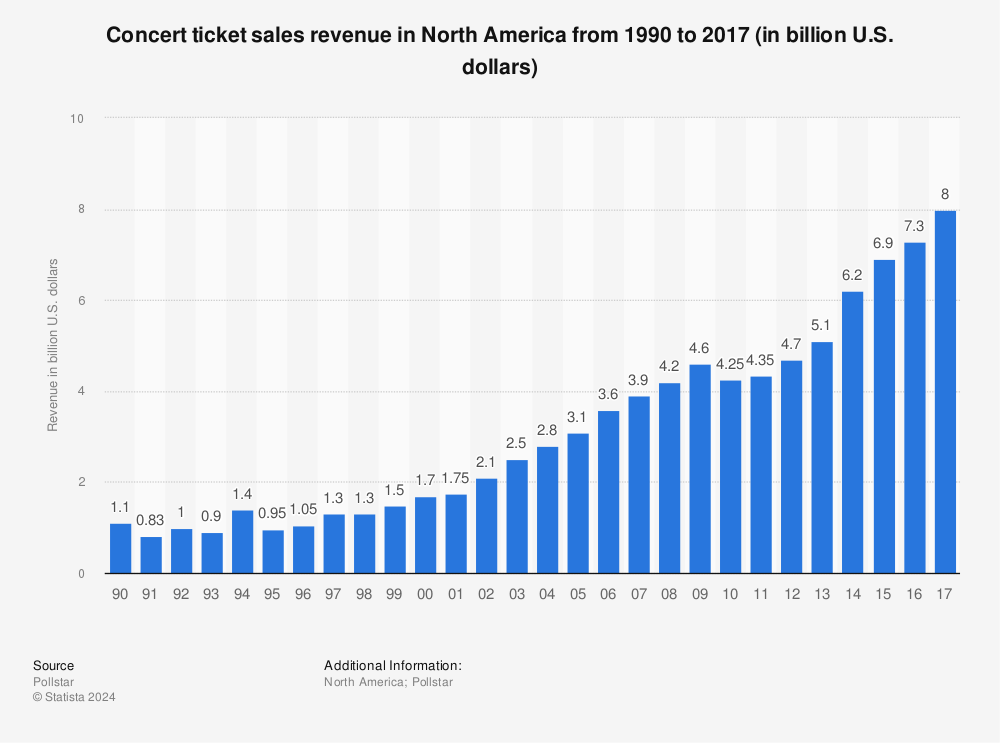
Meanwhile, live music sales have exploded since the ’90s:

Source: https://www.statista.com/statistics/306065/concert-ticket-sales-revenue-in-north-america/

The latest report from Pollstar on the top live tours is positively glowing:

2023 was a colossus, the likes of which the live industry has never before seen. If 2022 was a historic record-setting year, which it was, then this year completely blew it out of the water— by double digits. Total grosses for the 2023 Worldwide Top 100 Tours were up 46% to $9.17 billion

When you combine live and recorded sales, total spending on music has now passed the 1999 peak; this is the biggest the market for music has ever been. Of course, this doesn’t mean its an easy time to be a musician; touring is hard work and, as always, record labels and others are taking a big share of the money before it gets to artists. And opinions differ about whether today’s environment is good for creating good new music.

There are dozens of songs about how the road is hard, and the more time you spend on the road, the less they sound like cliches than like a simple and sometimes stark description of your life. Sooner or later everybody spots the exit that has their name on it –John Darnielle

The BLS data is noisy but suggests that the number of musicians in the US has been fairly flat and is projected to stay that way. A lot will depend on whether live music continues to grow, how much of that is captured by a few superstars, and whether the current streaming paradigm continues, or goes in a more or less artist-friendly direction. But now that consumers are willing to pay for music again, artists at least have a fighting chance.

The current alliance to counter digital piracy

U.S. Immigration and Customs Enforcement’s (ICE) Homeland Security Investigations (HSI) has joined forces with the Motion Picture Association (MPA) to launch a new initiative aimed at countering digital piracy and protecting a vital sector of the U.S economy.

The initiative is called Operation Intangibles.

Digital streaming services provide quick and easy access to creative works, such as music, television, movies. However, the growth of digital streaming services has presented new challenges when it comes to law enforcement’s ability to ensure vital copyright protection for the industry. This technology that has provided millions of people access to their favorite shows, has also enabled criminals to turn piracy into a crime that is no longer restricted to the hand-to-hand sale of illegally pirated media.

Digital piracy negatively impacts millions of jobs, results in less taxes being paid, and threatens innovation and creativity. Its effects are felt across multiple industries and includes the cost of corollary crimes on consumers such as the potential damage caused by hidden or embedded malware, as well as identity theft and financial crimes, such as credit card fraud.

There exists a National Intellectual Property Rights Coordination Center.

Recall, Napster was shut down in 2001. Limewire was shut down in 2010. Illicit downloading is happening through other channels.

According to this graph, people spent almost as much on vinyl records as they did on CDs in 2018. The Economist provided a nice chart (last updated in 2019) on the rise of streaming revenue and the collapse of traditional records sales.

Music Rights Are Surprisingly Cheap and Easy to Buy

When music rights make the news, it’s generally because a superstar’s entire catalog is selling for hundreds of millions of dollars. That may be why I always assumed that buying music rights would be difficult and expensive- that you’d both have to know the right people to even hear about potential deals, and have to be quite rich to afford them.

But this week I found out about Royalty Exchange, a site that currently lists hundreds of music rights for sale. They certainly appear to make the process of finding and buying rights, and collecting royalties, easy (I haven’t bought any yet so can’t say for sure). They currently list songs and partial catalogs from all sorts of artists you’ve heard of:

When I say I find many listings to be surprisingly cheap, I mean this relative to the hundred million dollar deals you hear about. Of those that offer a list price (as opposed to simply asking for offers), the vast majority are over $10,000, and many are over $100,000. Overall I’d put it in the “luxury car” bucket- expensive enough that its a bad idea for a normal middle-class person to buy one, but cheap enough that they could if they really wanted to. It’s a bit of a better idea than a luxury car, since its more investment than consumption. But if I actually bought the Flogging Molly catalog like I want to, I’d be taking an unnecessary risk by putting a large proportion of my net worth in a single investment. Their music is great and I think it will maintain its popularity, but if I’m wrong and people stop listening to it I’d lose out. So, for most people it’s a bad idea in the same way that putting half your retirement account into a single company’s stock is bad idea. But I’m surprised its even possible.

Why are these rights so affordable? Sometimes, of course, its because the artist isn’t that popular. But why are the rights to songs and musicians that are household names affordable? It seems to mainly be because the rights have been sliced and diced so that you’re only buying a small piece of them. Consider Miley Cyrus above. First of all its only the rights to one of her songs (admittedly a hit song). Second, you’re only buying the rights for ten years (lifetime rights are sometimes available but naturally they cost more). Finally, you’re only buying some of the rights, in this case the right to get paid when someone publicly performs the song (but not when someone streams it or buys a copy):

Even given all that though, I’m surprised how cheap the rights are. I expected that people would overpay for them because they like an artist, or for the bragging rights. But the yields seem pretty reasonable, often over 10%. Yields could rise or fall over time as an artist becomes more or less popular, or as the economics of the music industry change, but current prices generally seem justified by the income stream. I look forward to having enough money that this could make sense as an investment for me; I expect I might in 10 or 20 years, but maybe some of you are already there.

The cheapest listing from an artist I’ve heard of, Busta Rhymes (only performance rights, only certain tracks)

Adam Smith in Taylor Swift

See my latest post for Adam Smith Works.

TAYLOR SWIFT’S ANTI-HERO AS A SMITHIAN ANTHEM

The song “Anti-Hero” by Taylor Swift was the number-one song on charts in the United States and globally when it was released in October of 2022. Based on the record-breaking and continued popularity of the song, Swift’s struggles with self-loathing resonates with us. 

 It’s me, hi, I’m the problem, it’s me
 At tea time, everybody agrees

The theme of the song is that Swift feels like a moral monster who is exposed to the watching eyes of society. She imagines proper people gossiping about her flaws at teatime. This reference to British tea culture makes a perfect segue to the moral philosophy of Adam Smith. Those who only think of Smith as an early observer of modern economies might be surprised, but regular readers of AdamSmithWorks won’t be. 

The impartial spectator is a key concept in Smith’s theory…

At the end I even quote the song “Shake it Off.”

ASSA 2023: New Orleans!

Today the largest annual gathering of economists begins, in-person for the first time in 3 years. It won’t be as big as the pre-Covid conferences, but I’m excited to spend a few days in New Orleans for the first time since I moved away in 2017. I lived there for 4 years; in the eventful 5 years since my knowledge likely became somewhat out of date, but I hope I can still provide some guidance for those new to the city.

For most people the main destination is the French Quarter. People are right about this; it is great to walk through to see the old colonial buildings, hear the street music, and eat the food. Some of the ASSA hotels are in the Quarter, but for those staying downtown or in the Warehouse district its definitely worth the walk. The Quarter is a big, diverse place, not only for tourists. Bourbon Street is the tourist trap. It is probably worth seeing once, but be prepared for crowds, loud music, and touts trying to get you into bars and strip clubs. The standard advice now is to skip Bourbon St and hang out on Frenchman street instead- which is in the Marigny, just east of the Quarter. There are two blocks entirely packed with bars / jazz clubs. Any evening you will have at least 5 shows to choose from, usually jazz, usually with no cover. Café du Monde is the other Quarter attraction that everyone does, and with good reason. They have decent coffee, and great beignets (a donut / fried dough sort of thing drowned in powdered sugar). There is often a long line to get a table or to get to-go, but usually not for both at once. There is a river walk just south of Café Du Monde, and the Jackson Brewery building is just east- there is a good place to sit and look at the river beside their food court.

In a short trip it would be entirely reasonable to just stay in the Quarter. But if you’d like to get out, the main attraction of New Orleans to me is the parks. Audobon Park is west of the Quarter in Uptown. It stretches from the Mississippi river to the Tulane and Loyola campuses. City Park is north of the Quarter in Mid-City, and is home to the Art Museum and Sculpture Garden. Both can be reached by trolley, and both are full of lovely ponds and interesting waterfowl. At the big lake in city park you can rent kayaks, or get a ride in a gondola.

People associate New Orleans with Cajun food, but most of the Cajuns settled to the west. The traditional New Orleans cuisine is Creole- a blend of the Italian, French, and other settlers. When I think about what makes restaurants attractive, I think about three things- food, prices, and everything else (service, wait times, ambience). In New Orleans it is very easy to find places with great food at good prices, but rare to find good places that also have short wait times and good service (Commander’s Palace, the best restaurant in the city, is already booked solid). My restaurant recommendations are the thing most likely to be out of date, so I’ll keep it short:

  • Central Grocery- original home of the Mufalleta, a creole sandwich. In the French quarter. 
  • Dat Dog- fancy hot dogs (mostly sausages) with more toppings than you could ever want to choose from (including crawfish etouffee). One location is on Frenchman St- you can often hear live jazz from the bars by while sitting on their balcony. Cheap.
  • Hotel Monteleone- classy bar, often with live jazz, home to the rotating Carousel bar. One of many good places to try old New Orleans cocktails like the Sazerac. I’ll be staying here trying to get a spot on the Carousel.

New Orleans is unlike anywhere else in the US, almost like a Caribbean island (it practically is an island, surrounded by lakes, rivers, and swamps). The highs (food, music, knowing how to have a good time) are higher than just about anywhere else here, though the lows are also lower. One of the most special things about it is Mardi Gras. Mardi Gras day isn’t until February 21st this year, but Mardi Gras is really a whole season in New Orleans- and the first parade, Krewe of Joan of Arc, starts right in the Quarter on Friday January 6th (Twelfth Night).

Enjoy the city, and let me know if you’d like to meet up.

Context and age and soft skills

It is hard to know when oneself does not have enough context to appreciate a piece of art. When someone else lacks context, it is easier to see.

Consider my children watching last week’s Super Bowl halftime show. Snoop Dogg was performing on a stylized urban-themed stage. My kids could see the same thing I could see. They did not, remotely, “get it”.

You better lose yourself in the music…

“Lose Yourself” performed by Eminem

Children have little context for anything. But this half time show was a cultural moment. Millennials and Gen X experienced an awakening, or perhaps a collective crisis.

The following tweet got 60 thousand likes about how old the performers are. Everyone was calculating how many years had gone by since this hip hop and rap music was new. Decades have passed and now we who have the context to understand this music are feeling old.

In some nursing home in the year 2070, school children will trudge in and sing “Lose Yourself” because it makes the old people happy. The kids will not understand the appeal.

Matt and Ben are tweeting about music in code, but it happens to be a code I know. There are many codes that I do not know. I think that is part of what Tyler means in his latest posts about how “context is scarce”.

The real reason for writing about context this week is not the Super Bowl. I was reading yet more articles about tech skills and labor demand.* Once again, I came across the issue of soft skills. Could we say, “Soft skills are that which is scarce”?

When workers lack hard skills, it seems straight-forward to pack them off to a bootcamp. Teach them, for example, some functions in a programming language. The solution to a lack of soft skills is less clear, although maybe that is what decades of modern education is for. Corporate workers today need to know when to apply their skills and what tone to use in their email communication. They must not embarrass the company.

If a manager tells a worker to do “X task,” they cannot explain every detail. The worker needs to have the context to carry out the work on their own. Workers need to know the code.**

Could that be why so many employers desire a bachelor’s degree? Tyler wrote:

9. So much of education is teaching people context.  That is why it is hard, and also why it often does not seem like real learning.

Does this explain why there is simultaneously age discrimination and the ubiquitous “5 years of experience” hurdle for good jobs? Managers are looking for the sweet spot of current technical savvy and institutional context.

* I was reading a report by Quinn Burke. Here’s a published paper on soft skills and STEM. Here’s a blog of mine in which I wrote, “Trust falls and Tolkien is the prescription for this workforce.”

**funny Elf clip on The Code and dating

Modern loneliness in Toy Story 4 and Taylor Swift

I just saw Toy Story 4 (2019) because I’m a parent (don’t keep up with new releases – watch Pixar movies). The depiction of utter loneliness of the Gabby Gabby doll is one of the memorable parts of the movie. She knows that other people are experiencing human interaction, but she has none. Not a single human person notices her or needs her. Can you imagine that being the main plot of a movie made in 1940?

Loneliness is not completely new for humans. In the past, a lonely person might have had extra time to focus on nature, God, or books, or just immediate survival. Today, lonely people can be inundated with images of faces while also knowing that they have no real local friends. The Toy Story toys are like modern rich people in the sense that material survival is far from their minds. The toys can sit on a shelf for decades, awake and alone. No physical needs drive them out to a grocery store or into a service sector job. They have time to obsess over their social status, and the result can be tragic. (The fate of sitting on a museum shelf for years was discussed at length in Toy Story 2.)

Gabby Gabby reminded me of a bleak 2014 song by Taylor Swift called “Wildest Dream”. Swift sings as a female protagonist who sleeps with a handsome stranger knowing that he will leave her right afterwards. Here’s what she is hoping for:

I can see the end as it begins

My one condition is

Say you’ll remember me

Taylor Swift, 2014

She’s concerned that the man won’t remember the encounter at all. That is some malaise, yes? She has no hope at all for a lasting relationship. That is an illustration of one way that loneliness looks in the modern world.

From a male perspective, also in 2014, a similar sentiment is expressed in “Stay with Me” by Sam Smith.

I don’t want you to leave, will you hold my hand?

Again, the singer is asking for someone from a one-night stand to help fill a void of human connection instead of immediately leaving. Swift and Smith wonder aloud if there is some way to at least temporarily feel like they are close to another person.

These forms of loneliness in pop culture resonate with the public. Toy Story 4 yielded over $1B at the box office globally. “Wildest Dreams” was on music charts around the world. These forms are somewhat new, due to new technology and changing social customs. I’m not trying to write the next Bowling Alone (2000) in this blog post, but merely noting some current illustrations, inspired by Toy Story.

I bet a proper classicist could find us some illustrations of old-style loneliness. When I think of ancient loneliness, I think of to-be-King David hiding in desert caves trying to avoid being stabbed by a Bronze Age(?) sword. He chronicled some of those feelings as follows

Turn to me and be gracious to me, for I am lonely and afflicted. Relieve the troubles of my heart and free me from my anguish. … See how numerous are my enemies and how fiercely they hate me!

Psalm 25

David is lonely, but he’s also hiding from numerous nearby fierce enemies. So, it’s not exactly like Gabby Gabby who is sad that no one notices her at all. (In fact, maybe it puts our problems into some perspective.)

There is a recent 2020 New Yorker article, inspired by Covid lockdowns, on the history of loneliness. They consider the idea that this really is new. Maybe there would not have been a Gabby Gabby doll in ancient poems. As usual, economics is part of the story.

In “A Biography of Loneliness: The History of an Emotion” (Oxford), the British historian Fay Bound Alberti defines loneliness as “a conscious, cognitive feeling of estrangement or social separation from meaningful others,” and she objects to the idea that it’s universal, transhistorical, and the source of all that ails us. She argues that the condition really didn’t exist before the nineteenth century, at least not in a chronic form. It’s not that people—widows and widowers, in particular, and the very poor, the sick, and the outcast—weren’t lonely; it’s that, since it wasn’t possible to survive without living among other people, and without being bonded to other people, by ties of affection and loyalty and obligation, loneliness was a passing experience. …  to be chronically or desperately lonely was to be dying. The word “loneliness” very seldom appears in English before about 1800. 

The New Yorker, 2020

Lastly, Mike wrote a great piece on loneliness in art last year. He even introduced a formal economic model!

Watching Get Back

I enjoyed watching Get Back, the new documentary about making a Beatles album. Sometimes I skipped over rehearsal scenes. The streaming format allows you to treat Get Back like a coffee table book, if you choose, as opposed to a feature film that you watch all the way through in one sitting.

I know very little about The Beatles, aside from recognizing their hit songs. Here are my impressions after watching most of Get Back.

Paul McCartney is a rock star. His hair could have its own line in the closing credits. When Paul goofs off, he appears to be entertaining his bandmates because he loves playing for any audience. Conversely, John Lennon seems to joke around because he does not take their music seriously. Paul is motivated to make the Beatles excellent. Ringo’s ability to show up and be quiet is almost as important as Paul’s ability to lead.

I’ll put up my tribute. Then I’ll add more casual observations.

Continue reading →

Happy Fourth of July

Like most works of genuis, the Hamilton soundtrack is the result of much deliberate work. I just watched the documentary called “Hamilton: One Shot to Broadway”.

In one of the interviews with creater Lin-Manuel Miranda, he explained how he wrote each character with a different msuical style. George Washington has lines that sound militaristic, as opposed to the synchopated complex raps that Alexander Hamilton spits out. Hamilton is not merely undifferentiated “hip hop” music. Miranda used jazz music to inspire the Thomas Jefferson solos.

If you have already enjoyed the Disney+ recorded version and/or the soundtrack, then I recommend the documentary as an extension of the fun.

Happy Independence Day from EWED!