Click “Read More” for my epistemic trespassing on Afghanistan.
Continue readingPolitics
The War of Ideas Isn’t Over
I have spent some of the last week educating myself about Afghanistan. You might ask where I was back when the US had a strategic advantage. I now regret the time spent at the paint store squinting at 200 different shades of white. Here’s an idea: America gets only 20 paint colors until we achieve our foreign policy objectives. 40? All I know is that we are past the optimal number of shades of white, considering what just happened.
A lot of the “takes” in the past week have been on the subject of blame. Despite the fact that American lives are still at risk in Afghanistan, this has not been a unifying event, like 9/11 was.
Are we picking our battles in such a way that helps vulnerable people? Any energy spent fighting your enemy B is a resource you cannot use to fight enemy C. Incidentally, that is one of the points that President Biden made in his speech on August 16th. There is an opportunity cost to mean tweets.
I reached out to a veteran friend of mine for insight last week. This is part of what he told me:
Biggest mistake is looking at Afghanistan as a single cohesive entity. It isn’t. There is no national identity. The Kyrgyz, Uzbeks, and Kazaks of the north … Karzai was a Pashtun and always ensured the main leadership roles were Pashtun.
He said that there are sub-units of Afghan people opposed to the Taliban who are upset by the advance we all witnessed to Kabul. Divided people lose, and then they don’t have the capacity to help others.
There was a time when the Taliban were few in numbers and hanging on the fringes. One advantage they had is that they went with the “legalize it, tax it” drug policy. Farmers under their jurisdiction can grow opium poppy and pay the Taliban a fee. In the American sphere of influence, we were fighting against the laws of supply and demand. The American public is not the only destination market for illicit opioids, but it’s a big one. It’s pretty self-defeating to ask our security forces to fight against drugs when most Americans can’t be bothered about them.
Consider the movie Little Miss Sunshine, a beloved American comedy. Consider the grandpa. He’s not a perfect man. He has his little vices, like dropping F-bombs in front of his young granddaughter. And, he snorts heroin. It’s easy to imagine what a great rapport he has with his dealer. No one would report his behavior to the police.* The drug habit is not portrayed as a virtuous thing, but overall he’s a sympathetic figure.
There is a lot of muddled thinking in our society when it comes to drugs. The bill comes due.
Humans are very creative. The good news is that we could have more discussions about drugs and experiment with new policies. It’s not inevitable that laws regarding drugs will be the same next year, but there is a lot of inertia that needs to be overcome. A society where celebrities joke openly about doing illegal drugs is not going to also be a society that can effectively “reshape the world in its image”, to quote Tyler.
Tyler’s point is that this unfavorable outcome was not inevitable. From responses I read, many people offering opinions on Tyler’s article did not read past the headline. Nuance can’t be conveyed in a headline or a tweet. Tweet culture is a handicap right now, at a time when good complete ideas are badly needed. What happened in Afghanistan was complex. A tweet might be long enough to say what you would like to see happen, but it’s not long enough to help anyone.
The same Americans who tweet that they want refugees to live somewhere safe won’t go to a city council meeting and argue in favor of building high-density housing in their neighborhood. The same Americans who have tweeted that they hope the Taliban will build an “inclusive” society…
If you take the view that the failure in Afghanistan was inevitable, then Matt Y ’s explainer is ungated and helpful. There is also a lone voice saying that 20 years of “jail” had value.
If indeed this is a major crisis, then we are showing a lack of awareness when it comes to media. Some Americans alive today might not know about the role of media in fighting Nazis. Here is a fun read about that. In addition to WWII-era Brits, the Taliban are also strategic with media.
Considering that this is partly a war of ideas, I don’t know if taking Kabul so fast will look strategic in hindsight. There is much still to be determined. Had the Taliban consolidated power more incrementally, they would have been able to control the images that got out.
Here’s one image I won’t forget:

On the assumption that 20 times more people saw the image than liked it, this picture has been seen by well over 2 million people. Imagine how those girls’ lives have changed. “they are now with the Marines.” The entire world is breathlessly watching the airlift, and any abuses by the Taliban are headline news.
The media you choose to consume shapes the world around you. Every click is a vote for the kind of world you want. The war of ideas continues.
James Bailey here on information consumption (not on Afghanistan)
*It’s nothing glamorous or entertaining, but this is one approach to opioid use. As more parents lose children to fentanyl overdoses, more civic action is happening which generates publicity. Deaths from opioids increased rapidly after 2010. Little Miss Sunshine came out in 2006, so perhaps if it were made today they wouldn’t have taken such a cavalier approach to heroin.
Anti-coercive ways to fight Delta
Two weeks ago I predicted that Covid cases would continue to spike for at least two weeks due to the Delta variant, but argued against general shutdowns as a way to combat this spike. Two weeks later cases have indeed spiked, and while localities and organizations have been mandating masks and vaccines, we have largely avoided new lockdowns, at least in the US (Australia is reverting to its roots as a prison). In the last post I mostly said what we shouldn’t do to fight Delta, so today I want to show what a better response looks like.
The tendency of authorities to reach first for coercive solutions is a natural product of their incentives, but I’ve been disappointed to see the same tendency among the chattering classes. I think this is due to polarization- people are most interested in debating solutions that are identified with a specific side in politics or the culture war. Masks became blue-coded, so many reds oppose them even though they probably work. Likewise with vaccines, even though they definitely work well and funding them early was the greatest achievement of the Trump presidency. Meanwhile certain medications became red-coded, leading blues to oppose them before the evidence even came in. But many of the best non-coercive and anti-coercive solutions barely get discussed because they have no political valence, or a mixed one.
Fully Approve the Vaccines Already!
The Covid vaccines are still being distributed under an emergency use authorization. This lack of full approval is a source of vaccine hesitancy. More concretely, it also means that pharmaceutical companies aren’t allowed to advertize their vaccines, even though they are much more effective than the typical pharmaceutical you see advertized. The randomized control trials testing the vaccines have been complete for months, we are just waiting on the FDA to do their job.
Authorize Vaccines for Kids
The FDA still bans children under 12 from receiving the vaccine, saying they are waiting for more trial data. Last week, the American Academy of Pedicatrics argued that we have enough data to justify an Emergency Use Authorization for children aged 5-11 given, you know, the emergency. The government is going to make my 5 year old wear a mask to kindergarden won’t allow me (or my physician wife!) to get him a vaccine which would protect him and others much better than a mask.
Ventilation
Opening windows, modifying HVAC systems to bring in more outside air, and using air purifiers is about as effective as requiring masks and is definitely less of an imposition on people. But we don’t talk about it, partly because people took so long to recognize that Covid is spread through the air more than through droplets, and partly because it is less of an imposition on people and so never became a culture-war debate. Ventilation might be too boring to advocate but I think staying alive is very exciting.
Outpatient Treatments that Work
Repurposing existing drugs to fight Covid is a great idea that has not yet lived up to its promise, aside from the widespread use of Dexamethasone for inpatients with severe cases. The core problem is that it takes large randomized controled trials to really prove that a drug works, and these are expensive. Worse, pharmaceutical companies don’t want to pay for these expensive trials once their drug has gone off patent. This means that many promising treatments have been ignored, while a few have been over-promoted on the basis of observational studies and tiny RCTs (and worse, still promoted once large RCTs showed they probably don’t work). But the British government stepped up to fund the large trials that found Dexamethasone effective last year, and private donors have funded mid-size trials that just found Fluvoxamine reduced Covid hospitalization by 31%. This is excellent news because Fluvoxamine is a cheap and relatively safe anti-depressant that people can take at home. There are other promising treatments that have yet get funding for large RCTs; this is exactly the sort of thing that NIH should be throwing money at. While we’re waiting on compentent government, you can ask a doctor about outpatient treatment if you do get Covid.
Overall, many of our best tools for fighting Covid are being ignored despite, or perhaps because of, the fact that they maintain or increase our freedom.
Right now
When we make drugs illegal but continue to buy them in huge amounts, we make the world unstable. That’s only a small part of what is going on right now, but it’s worth saying.
Preferences for Equality and Efficiency
Most people would consider both equality and efficiency to be good. They are “goods” in the sense that more of them makes us happier. However, in some situations, there is a trade-off between having more equality and getting more efficiency. Extreme income redistribution makes people less productive and therefore lowers overall economic output.
Examining the preferences people have for efficiency and equality is hard to do because the world is complicated. For example, a lot of baggage comes along with real world policy proposals to raise(lower) taxes to do more(less) income redistribution. A voter’s preference for a particular policy could be confounded by their personal feelings toward a particular politician who might have just had a personal scandal.
With Gavin Roberts, I ran an experiment to test whether people would rather get efficiency or equality (paper on SSRN). Something neat that we can do in a controlled lab setting is systematically vary the prices of the goods (see my earlier related post on why it’s neat to do this kind of thing in the lab).
One wants to immediately know, “Which is it? Do people want equality or efficiency?”. If forced to give a short answer, I would say that the evidence points to equality. But overly simplifying the answer is not helpful for making policy. The demand curve for equality slopes down. If the price of equality is too high, then people will not choose it. In our experiment, that price could be in terms of either own income or in group efficiency. We titled our paper “Other People’s Money” because more equality is purchased when the cost comes in terms of other players’ money.
The main task for subjects in our experiment is to choose either an unequal distribution of income between 3 players or to pick a more equal distribution. Given what I said above that people like equality, you might expect that everyone will choose the more equal distribution. However, choosing a more equal distribution comes at a cost. Either subjects will give up some of their own earnings from the experiment or they will lower the total group earnings. As is true in policy, some schemes to reduce inequality are higher cost than others. When the cost is low, we observe many subjects (about half) paying to get more equality. However, when the cost is high, very few subjects choose to buy equality.
This bar graph from our working paper shows some of the average behavior in the experiment, but it does not show the important results about price-sensitivity.
Continue reading“Zoning Taxes” — The Cost of Residential Land Use Restrictions
Fascinating new working paper on why housing prices are so high in some markets, by Gyourko and Krimmel: “The Impact of Local Residential Land Use Restrictions on Land Values Across and Within Single Family Housing Markets.”
Key sentence from the abstract: “In the San Francisco, Los Angeles, and Seattle metropolitan areas, the price of land everywhere within those three markets having been bid up by amounts that at least equal typical household income.”
Economists, libertarians, and more recently “neoliberals” have long complained about land-use restrictions as a primary factor contributing to unaffordable housing. This paper provides some pretty solid data, at least for some housing markets.

Here’s a key chart from the paper, Figure 5. Notice that there is a lot of heterogeneity across cities. In San Francisco, land use restrictions add roughly four times the median household income to the price of housing. But in places like Columbus, Dallas, and Minneapolis, there is essentially no zoning tax. That’s not because these cities have no land use restrictions! It’s just that they aren’t currently binding.
The paper also notes that “zoning taxes are especially burdensome in large coastal markets.”
This is similar to what I showed in a very non-scientific map that I created (in about 5 minutes) for a Twitter thread that I wrote in January 2020 on housing prices. In that map and thread I pointed out that there are still lots of fine US cities where you can purchase homes for roughly 3 times median income (a commonly used rule of thumb for affordability).
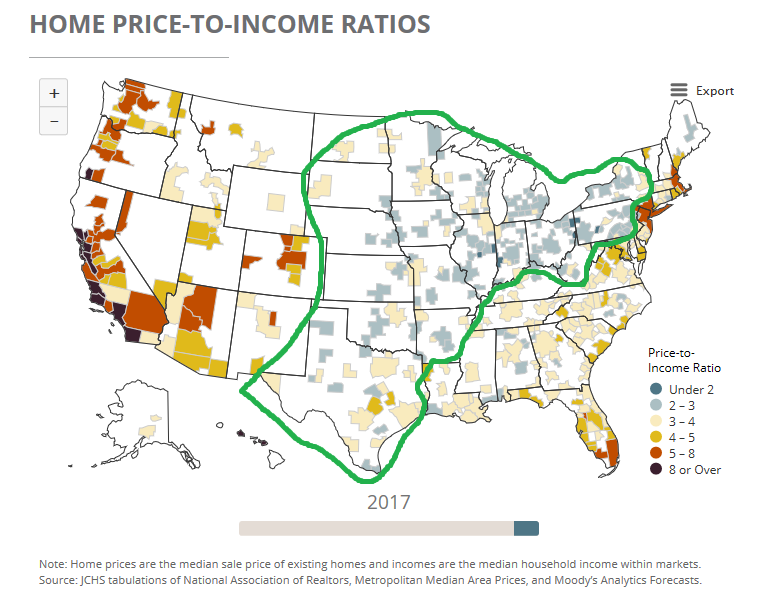
Will these cities continue to be affordable in the future? As demand increases, and supply-side restrictions remain in place, we would predict the same thing will happen to Columbus as happened to San Francisco. But probably not for decades.
So if you seek housing affordability, move to the Zone of Affordability! But let’s also work on reforming the rest of the country to make everywhere affordable.
Predicting the NYC Mayoral Race
Yesterday, co-blogger Jeremy asked “Should Andrew Yang Wait To Concede?” in the New York City mayoral race. He argued that while Yang finished 4th in 1st-place primary votes, the new Ranked Choice Voting system meant he could still win. This is of course true in theory- but today I argue it is very unlikely in practice.
I say this not because I have scrutinized all the polls to predict the exact distribution of 2nd- and 3rd-place votes, or because I think I know more than Jeremy about political science or New York. Instead, any time I’m wondering about whether something will happen and I don’t have a strong opinion based on my own knowledge, I simply check what markets have to say. In this case, there are prediction markets bearing on this exact issue. The odds from PredictIt, shown below, have Adams (who finished with the most 1st-place votes, 32%) as the heavy favorite, with Yang reduced to an approximately 1% chance of winning.
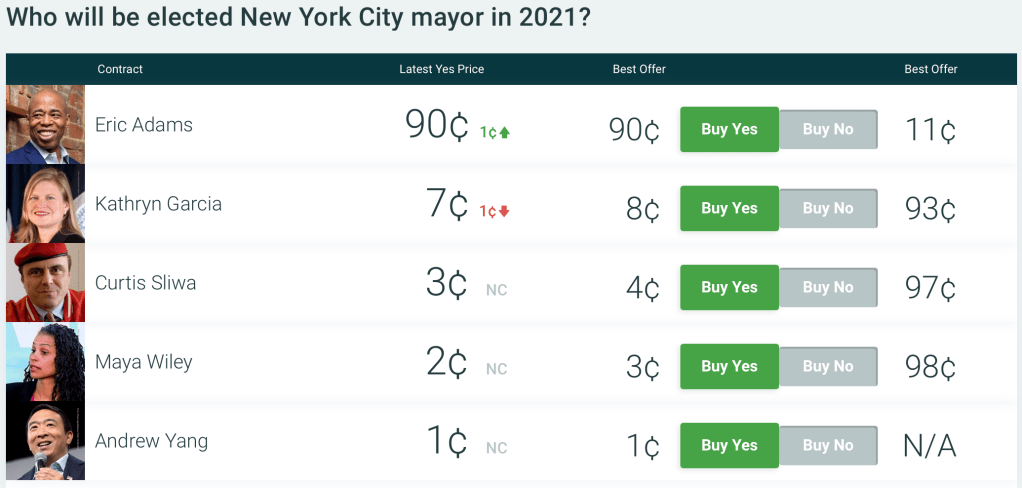
But Jeremy is right to highlight that the Ranked-Choice system makes it less obvious who will win. You can see PredictIt traders still think that Garcia, who finished with 19% of 1st-place votes, is substantially more likely to win than Wiley, who finished with 22% (though the new system didn’t matter in the Republican primary, where Sliwa won with a clear majority of 1st-place votes).
Crypto-based betting platform Polymarket has actually closed their market for Yang already, declaring that he lost, though they agree with PredictIt that the overall election isn’t over and that Garcia still has a real chance despite coming in 3rd for 1st-place votes.
Of course, prediction markets aren’t perfect- they are certainly less accurate (easier to beat) than the stock market, as my track record of betting in both shows. But they make for a great first approximation on subjects you don’t know well, and if you think you do know better, they offer you the chance to make money and to make the odds more accurate. If you think Yang will still win, you can go bet on PredictIt and potentially 100x your money. Or if you think this ranked choice stuff is nonsense and Adams obviously won, you can pick up an easy 10% return. Or if you’re like me in this case, you can stay out of it, take a quick glance at the markets, and get a good idea of what is likely to happen without having to read the news or the pundits.
Should Andrew Yang Wait to Concede?
Yesterday New York City held their mayoral primary elections. This was an exciting event for election system nerds (political scientists and public choice economists) because NYC is now using a form of ranked choice voting to determine the winner.
While this is not the first place in the US to use RCV (Maine, Alaska, and a handful of cities use it), it is still notable for a few reasons. First, this is America’s largest city. Second, there are a lot of viable candidates, which makes RCV especially interesting and useful.
Specifically, NYC is using a form of voting called instant runoff. There are currently 13 candidates, and voters indicate their top 5 in order. If no one has a majority (>50%) of the votes, then the rankings entered by voters come into play. And indeed that is what happened yesterday.
On the first round, only counting first place votes, Andrew Yang came in 4th with just under 12% of the votes. So last night he conceded.
But should Yang have conceded? Maybe not! Let’s explore how instant runoff works.
Continue readingEndless Frontiers: Old-School Pork or New Cold War Tech Race?
The Endless Frontiers Act passed the Senate Tuesday in a bipartisan 68-32 vote. What was originally a $100 Billion bill to reform and enhance US research in ways lauded by innovation policy experts went through 616 amendments. The bill that emerged has fewer ambitious reforms, more local pork-barrel spending, and some totally unrelated additions like “shark fin sales elimination”. But it does still represent a major increase in US government spending on research and technology- and other than pork, the main theme of this spending is to protect US technological dominance from a rising China. One section of the bill is actually called “Limitation on cooperation with the People’s Republic of China“, and one successful amendment was “To prohibit any Federal funding for the Wuhan Institute of Virology“
Continue readingHistory according to Polybius
It’s unusual for me to sit down on a weekend morning and read *literally checks notes* Polybius. This was assigned to me for a seminar. Here’s his proposal for the inevitable endless cycle of human leadership structures:
- Some humans are still alive. They band together because they are too weak to survive alone.
- A strong man who bravely defends the group in his youth becomes a monarch. “Kingship” is the next progression. Polybius assumes that people could consent to be under the leadership of a powerful and noble man.
- The king has children. The people venerate the descendants of the good king, but these princes and princesses will be spoiled and selfish. The princes “gave way to their appetites owing to this superabundance…” Thus, kingship becomes tyranny.
- Nobles overthrow the tyrants, and so become aristocrats. “But here again when children inherited this position of authority from their fathers, having no experience of misfortune and none at all of civil equality and liberty of speech… they abandon themselves to greed… and… rape…” The aristocracy becomes a corrupt oligarchy.
- Democracy emerges when people have “killed or banished the oligarchs” and the people remember being mistreated by kings. How does Polybius think democracy ends? Once again, it’s the new generation and the corruption they indulge in. Where do they end up? “… democracy in its turn is abolished and changes into a rule of force and violence.”
- There are two ways to get back to stage 1 monarchy. Life in the decline of a democracy is chaotic enough that people willingly back a strong man to protect them. Alternatively, he presents a “floods, famines, failure of crops… all arts and crafts perish…” scenario. A natural disaster, regardless of what stage in the political cycle humans were at before, will position the survivors to start again at monarchy.
 Economist Writing Every Day