Invasion of the Cooperation Snatchers

If you can tolerate a moment’s grandiosity, there’s no more important application of game theory than the evolutionary transition from prokaryotic cells to eukaryotic cells. All due deference to every game theorist ever, but the solution to the Prisoner’s Dilemma is literally in our DNA. One day cells were swimming around the primordial soup competing with each other in a zero-sum fight to the death for resources, the next they’re bonding together to form tissues to jointly acquire them. A couple billion years later and you’ve got hyper-specialization to the point of which cellular differentiation remains a bleeding-edge subject of biological research.

But this isn’t a post about the miracle of a body when it’s functioning perfectly. It’s about what happens when a cell goes rogue. When it defects on its neighbors and a cooperative strategy literal eons in the making. It starts gobbling up resources and reproduces at rates that threaten the whole enterprise, growing into a terrible little tumor of defection. The cooperative strategy in question moved passed simplicity countless generations ago: tissues employing Tit-for-Tat disaggregated back into the soup the first evolutionary round through. No, the strategy now is so fine-tuned it hasn’t had to deal with a major defector in eons of its collective evolutionary memory. If it is to succeed, it will have to selectively cut out those defecting cells without abandoning its core strategy, and do it fast, before it’s too late.

Which naturally brings me to the Republican party.

Political parties succeed based on two achievements. 1) They solve the collective action problem and, in doing so, achieve a scale of cooperation and exceed some critical mass threshold sufficient to self-perpetuate through the electoral process. The number of parties that can succeed at once, and the critical mass necessary to get to that point, are determined by the governing political institutions. 2) They maintain their cooperation at a scale sufficient to thwart the emergence of an alternative rival party.

Staying a dominant party is much easier than becoming one, but that doesn’t mean continued success is guaranteed. The weakness(es) of a party will depend on how it got there in the first place. The strategies for solving the collective action problem of this scale will be far more complicated than Tit-for-Tat or “Walk Away” and similar solutions distilled to the point of abstraction. They will involve all the solutions employed by cartels, religious groups, military forces, and every other collective dependent on high-levels of persistent cooperation. With that complexity comes weaknesses. Fault lines and backdoors that are typically guarded through a variety of social and legal barriers.

And they must be guarded, because the combination of scale and success will never cease to attract defectors. Those roaming cells, ostracized and cast out, always met with a wary eye, looking for a way in. Just imagine you are that rogue cell and you come across a population trained to always cooperate no matter what so long as it is deemed a member of the group. They seems so naïve! So vulnerable. But that’s how we succeeded! Always cooperate within the group. How big might your greed grow knowing you could defect and defect for all eternity, growing fatter and fatter off this suddenly maladapted globule of political ambition that can’t help but tear itself to shreds while giving you everything you ever wanted? It’s not just about the weakness of the party, but the kinds of agents these prospects are likely to attract.

In the coming weeks I’ll revisit this and ramble more about discuss some of the specific strategies employed by political parties, and the kinds of invasive agents and strategies they should expect. I’ll also speculate on how groups might institutionally respond and better protect themselves from both invading sociopaths, as well as their own hubris.

Inspiring articles:

Aimone, Jason A., et al. “Endogenous group formation via unproductive costs.” Review of Economic Studies 80.4 (2013): 1215-1236.

Aktipis, C. Athena, et al. “Cancer across the tree of life: cooperation and cheating in multicellularity.” Philosophical Transactions of the Royal Society B: Biological Sciences 370.1673 (2015): 20140219.

Allocating the vaccines: central planning or the free market?

In the short term, there are only a few million doses of the COVID vaccines available, but well over 100 million adults in the US that want to take the vaccine if offered for free to the consumer. There are also billions worldwide that would like the vaccine.

So who should get it first? In practice in the US, the allocation method has already been determined politically: the federal government will allocate vaccines to the states, and states will allocate them to individuals based on a priority list: health workers and the most vulnerable first, then teachers, etc. The NY Times has a tool that shows you your probable place in line.

But essentially the allocation method being used is central planning.

John Cochrane has proposed a “free market” solution: sell the vaccine to the highest bidder. Or at least, sell some doses to the highest bidder.

As an economist, there is always some appeal in thinking about a free market solution. But there is a problem in this case: there are positive externalities from taking the vaccine. It not only benefits me, but it also benefits others. My willingness to pay only reflects the benefit to me, the private benefit. The social benefit is mostly ignored by a simple auction, and in the aggregate for a vaccine most of the benefits are likely to be social benefits. But positive externalities don’t imply we need to use central planning!

Continue reading

Locals react to new condos

My local Facebook community group is a treasure trove of unfiltered NIMBY and YIMBY sentiments. I’m creating a “nimby” tag for blogs I write about them.

This FB post went up last week about some proposed townhouses that would be built on what is currently an ugly empty paved area of land on the side of a highway.

There were 40 “likes” and only 5 angry face reactions. Given some of the vitriol I have seen against building previously, I was surprised at how many people reacted positively. This can’t be treated as a scientific poll, but the fact that so many people bothered to say they approve was interesting to me.

Most of the land in our city is zoned for single-family detached houses, meaning most of it looks more like what people call suburbs.

Here’s what people said in the comments:

“I like the look. I also like Chaise’s term ‘vibrancy’.”

“ I wish they weren’t going to be so tall.” (Note that they are not tall. Most of this town used to be one-story 1-bathroom ranch houses, and there is a lot of nostalgia for those tiny houses.)

“Why are we junking up our downtown with condos.” (That one got 8 likes, and someone replied “because they sell.” Isn’t it astounding that someone would call this “junking”?)

“Almost Anything built in that location is a step in the right direction.” (8 likes)

Some people complained that this is not adding “affordable housing” to our city because these units are expensive. I might post more explicit debates over affordable housing in the future.  

Apparently, currently, there isn’t much opposition to developing an empty lot on the side of the highway with a few expensive units. There has been a WAR for the past year after a proposal to increase the density of housing closer to downtown. Anti-development types are angry that the city council is not doing more to block new building.

The prospective developer for this empty weed lot needs approval from the city council. Our city elections last month became rather contentious. It was, in part, a struggle between people who want to preserve curbs and doors just as they were in 1970 versus newer younger residents who are more pro-development.

Twitter flags versus censorship

Throughout this semester, I have asked some students in my data analytics class to think about how data is relevant to current events. Undergraduate Jack Brittle wrote this article about data and election news.

Sometimes public attention moves on quickly after an election is over. Today, on November 15th, voting and messaging is still being debated. It was a month ago on October 14th that Twitter locked up the digital platform of the New York Post, a right-leaning newspaper.

This was an important development in the debate about whether tech companies have the authority to censor posts written by users.

Twitter initially said that linking to the Post stories violated the social-media company’s policies against posting material that contains personal information and is obtained via hacking. As the story broke, Twitter began preventing users from tweeting the stories. Twitter locked the Post’s account, saying it would be unlocked only after it deleted earlier tweets that linked to the stories.” (Wall Street Journal). Twitter suspended a major American newspaper. This move is viewed by some as a direct threat to the freedom of the press. Twitter and other major tech companies came under fire for their ability to manipulate and control media. After major pressure and backlash, Twitter released the account back to the New York Post. “Twitter on Friday unlocked the New York Post’s Twitter account, ending a stalemate between the social-media company and the newspaper stemming from the latter’s publication of stories it said were based on documents obtained from the laptop of Hunter Biden. “We’re baaaaaaack,” the Post’s Twitter account tweeted on a Friday afternoon, just minutes after Twitter said that it was reversing its policies in a way that would allow the Post to be reinstated.” (Wall Street Journal).

It seems that Twitter backed down in that instance. The fundamental question has not been resolved. Should Big Tech censor material on their platforms?

First, there is a school of thought that believes Twitter has the right to control the flow of information on its platforms. Companies like Twitter are not breaking any laws by doing this. Do they not have the right to support and defend certain social causes? By only allowing users to see certain opinions and facts, Twitter can choose to support different policies. It’s not laws but our expectation of media that leads to controversy. Twitter should allow a free flow of information in order to create an open marketplace of ideas.

However, a new difficulty arises because of “fake news”. Now more than ever, media can be manipulated to create certain storylines by nefarious users. According to studies, “fake news” spreads nearly six times faster across digital platforms that real news stories. This leaves Twitter between a rock and a hard place. Do they control information spreading on their site and risk censoring the wrong material, like some consider to be the case of the New York Post article? Or do they take a hands-off approach, allowing all stories to have a place in the arena?

These giant tech firms have unprecedented power. Not only are they gaining massive amounts of data about people and firms, they also have the unique ability to shape their users’ outlook on a variety of ideas and events. These data giants are struggling with how to manage these capabilities and will no doubt continue to update and reform policy.

A example of evolving policies is the treatment of President Trump since November 3rd. Since election day, Donald Trump, has tweeted challenges to official vote counts. Trump has not only claimed voter fraud but also claimed he has won states where vote counts favor Joe Biden. Twitter has since developed a flagging system that adds a note on any tweet that Twitter deems misleading. Instead of censoring the president by locking the entire account, there are flags warning about disinformation. This system seems to be an improvement over previous ways Twitter has handled misleading information. It allows users to see all information but also be warned about potentially questionable information. I expect these policies to continue to evolve as tech companies grapple with the difficult task of managing the flow of information.

When will computers accurately predict elections?

Why can computers beat humans at chess but not predict election outcomes with great precision? Experts in 2020 mostly forecasted that Biden would win by a large enough margin to avoid the kind of quibbling and recounts we are now seeing. I don’t write this as a criticism of the high-profile clever Nate Silver, or any other forecaster. I’m thinking through it as a data scientist.

First, consider a successful application of modern data mining. How did AlphaZero “learn” to play chess? It generated millions of hypothetical games and decided to use the strategies that looked successful ex-post. AlphaZero has excellent data and lots of it.

If we think about actual election outcomes, there aren’t enough observations to expect accurate forecasts. If each presidential election is one observation, then there have only been about 50 since the founding hundreds of years ago. No data scientist would want to work with 50 data points.

You can’t say “in the years when ‘defund the police!’ was associated with Democrats, the GOP presidential candidate gained among married women”. There has only ever been one presidential election when that occurred. Judging by what I have been observing of the DNC post-mortem on Twitter in the past week, that might not happen again. See this tweet for example:

I know very little about political analysis. Only from what I know about data science, I would imagine that computers will get better at predicting the outcomes of races for the House of Representatives.

House representatives serve 2-year terms. There are over 400 House elections every 2 years.

Think about this over one decade of American history. There are actually more than 400 representatives in the house, but let’s imagine a “Shelter” of Reps with 400 members for ease of calculation.

In one decade, there are usually two presidential elections. That means we get 2 observations to learn from. In the same decade, there would be 400×5 “Shelter” elections. That yields 2,000 observations, which is considered respectable for the application of data mining methods.

One application of such a forecasting machine would be to determine which slogans are the most likely to lead to success.

Huge Prison Population in the U.S.

During some general reading on finance, I ran across the following two information-rich graphics from Hoya Capital on the U.S. prison population. On the first graph, the blue areas show the absolute numbers, and the green line shows the percent incarceration rate. A rate of 0.5% comes to 500 prisoners per 100,000 population.

This graph shows a huge rise in the state and federal prison population between 1980 and 2000. There seems general agreement that much of that increase in the prison population is due to mandatory sentencing laws, which require relatively long sentences. In particular, “three strikes and you’re out” laws may demand a life sentence for three felony convictions, if at least one of them is for a serious violent crime. Another factor was the increased criminalization of drug use (possession), in addition to drug dealing.

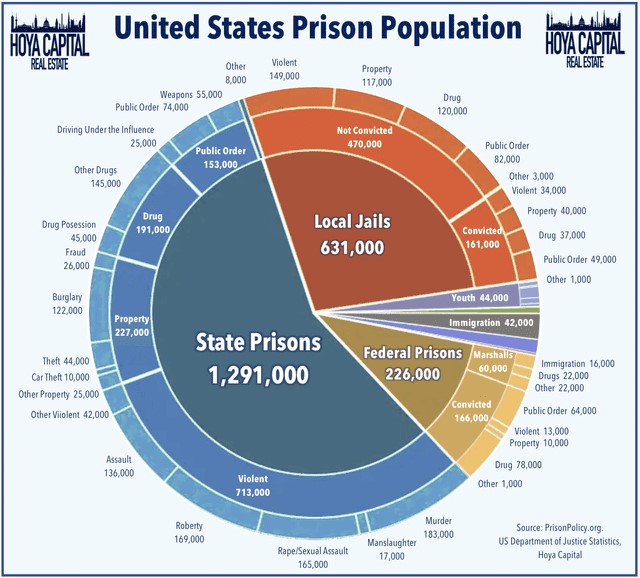
The graphic below shows the particular classes of crimes of which inmates of the state and federal prison systems have been convicted. The largest single category is violent crimes, but other types are significant, such as drug and property crimes, and “public order” crimes. Public order crimes include activities such as prostitution, gambling, alcohol, child pornography, and some drug charges. This graphic also includes the large number of people in local jails, most of whom are imprisoned awaiting trial or sentencing.

The total number of people under legal supervision in the U.S., including probation and parole, is over 6 million:

Source: Wikipedia

The U.S. has by far the largest official prison population in the world, and the highest incarceration rate. The following graph from Wikipedia depicts incarceration rates for several countries or regions as of 2009:

Most developed countries have incarceration rates of around 100-200 per 100,000, which is where the U.S. was in about 1970. The relatively high rate for Russia is attributed in large part to strict “zero tolerance” laws on drugs.

Again, the main driver for the high rates in the U.S. is the long sentences, driven by mandates. Wikipedia notes that there are other countries, including some in Europe, which have higher annual admissions to prison per capita than in the U.S. However, “The typical mandatory sentence for a first-time drug offense in federal court is five or ten years, compared to other developed countries around the world where a first time offense would warrant at most 6 months in jail… The average burglary sentence in the United States is 16 months, compared to 5 months in Canada and 7 months in England.” 

Policy debates on this topic continue. Obviously, we want to protect society from dangerous predators, but the direct and indirect costs to society for this level of incarceration are high. It seems like an area which is ripe for reform of some kind, though I do not claim to have a novel proposal.

Strange overnight switch in 2020 election betting markets

I share this tweet because it provides a good visual of a strange event last night. As results were coming in at night in the US, there was a sudden huge reversal. For months the markets had predicted a Biden win. Throughout the night there was some wild speculation in which some buyers were willing to bet Trump would win. Around the time respectable people start waking up in the US, the market flipped again. I hear some people saying on Twitter that they regret no buying during the night. Near 5am Eastern Time that Trumps chance of winning went back down under 50%. That is also when new information came in showing that Biden would likely win Wisconsin.

At the time I write this, votes are still being counted. It is expected that the ballots still to be counted will mostly give votes to Biden. The “blue wave” did not materialize in 2020. If Joe Biden wins the presidential election, it will not be with the overwhelming mandate that some expected.

Economists often promote using betting markets to get predictions of the future. There are lots of applications beyond politics. These high profile elections bring attention to betting markets. Maybe people will begin relying more on them in other fields. I think betting on temperature increases and rising sea levels would be interesting and useful.

The New Social Media Influence in the 2020 Presidential Election

Joy: I’m not an expert in elections or social media (unless having a Twitter habit counts). I asked Kate Zickel who manages political online accounts professionally to write about the current election:

It’s no secret that social media platforms like Facebook and Twitter have had a tremendous influence on political elections in America since their infancy in the mid 2000’s. While the exact impression of these platforms can be difficult to measure, it’s clear that their impact in 2020 is greater by far than in previous election cycles.

Data from SocialBankers reports that “While President Donald Trump’s use of Twitter has been widely acknowledged, and certainly had a tremendous impact on the outcome of the 2016 elections, former Vice President Joe Biden has actually surpassed the President in many key engagement metrics.” This includes the nearly 30 million American voters that comprise the largest percentage of Twitter’s user base at nearly 20%.

The New York Times’ Ben Smith recently explained how media and tech companies have evolved back into their roles as information gatekeepers leading up from the 2016 election. Twitter, for one, recently began pinning notices to the top of all U.S. Twitter users’ timelines warning about misinformation on mail-in voting while Google said it’s been pushing to make its core search products including YouTube into hubs for authoritative information about electoral processes and results.

Pre-bunking is yet another new election influencing tactic used by many news and information sources to prevent the spread of false information before it starts… at least that’s the idea.

There is, however, a direct inverse relationship between broadcast ad spends and digital ad spend since the 2018 midterms. For the first time ever, spending on digital political advertising has slightly surpassed cable. Still, advertising spent on broadcast television — mostly at the local level — reigns supreme.

And while the influence of social media at the polls isn’t exactly new, the 2020 presidential election has set a new precedent in this era of information gatekeeping.

Election Forecast by 538

I teach a data analytics course and I asked some students to write blogs on data and current events. This blog is by Jake Fischer.

Every four years, the United States seems to turn upside down with the Presidential election. Now, the nation has turned its eyes to predictive analytics to understand the future of our country. As of October 22, the time of the writing of this post, Joe Biden stands an 87% chance of winning the critical swing state of Florida. This seems like a significant margin, but how did we come to this understanding using data? How reliable is this fivethirtyeight forecast?

For starters, the 87% chance of winning is based on a simulation run by data analysts in 40,000 different scenarios, all of which are measuring different factors from voter turnout to demographics to the economic forecast of the day. This prediction also factors in the polling averages for each candidate from 8 different polls, each of which is given a grade of reliability and weighted accordingly. Hundreds of factors come into play when predicting an election, yet confidence in many of these numbers is at an all-time low. So, in answer to question two, the outlook is anything but certain.

This doubtful outlook is because, although Biden wins 87% of the elections, this does not factor in the margin he wins by. When truly looking at the data, you see that over half of the outcomes weighed in this 87% are decided by less than 1% of votes. Unfortunately, this does not leave much more for a margin of error as is required in most data analysis. 

This very popular website does not factor in the impact that the website itself has on voters. With millions of people reading this data and seeing that Biden stands a 87% chance of winning, there is a high likelihood that voters will simply not turn up at the polls. This distinct percentage of voter turnout that may chose not to turn up at the polls because of analytics like this, would significantly impact the data set and could actually throw the results in the entire opposite direction, particularly when the decision is already being decided by such a slim margin.

Even though data analysis has turned into a booming industry, with more accurate results than ever before, there are some instances in which predictive analytics has placed significant limitations on the outcome of important decisions, such as the presidential election. I say all of this to not place doubt on analytics, nor the credibility of the FiveThirtyEight organization, but rather to remind readers of the important factor that is the human condition. At the end of the day it is important to exercise your right to vote no matter what side of the aisle you stand on, and without allowing polling data to influence your decisions. Vote!

American Moments

The presidential debate on September 29, 2020 was an embarrassment. I don’t remember what the candidates said because I just kept panicking thinking about the fact that other people could see what was happening. Didn’t some adult somewhere have a kill switch?

After an hour of listening, I expressed my sincere wish that this had never happened:

Tyler had a more nuanced take:

It’s not just true in America. Much of what passes for “debate” is just people firing off talking points at each other. Usually it’s not quite so obvious and awkward because there are not such clear rules being broken.

If there’s one thing that Americans agree on, it’s that you wait your turn in line. This is the most basic schoolyard etiquette. No matter how rich or famous you are, cutting in line is deeply resented. It felt like President Trump was not taking turns (so then it was strange for me to fact check this and see that Biden spoke only 2 minutes less total than President Trump).

If it were in my power to undo that night I would. However, a new podcast gave me some more to ponder about in terms of what Americans can be proud of. A lot of true news comes out about Americans making mistakes. That can be useful for others. Audrey Tang said of our misdeeds:

COWEN: … the United States, has made … many mistakes … What’s our deeper failing behind all those mistakes?

TANG: I don’t know. Isn’t America this grand experiment to keep making mistakes and correcting them in the open and share it with the world? That’s the American experiment.

Being open about our mistakes might be the next best thing to not making them in the first place.

Tang, a transgender Taiwanese computer policy expert, said something that I think Americans can be happy about.

Speaking of software, here’s a recent conversation with a 5 year old about what exactly is software and what does it mean to buy it. My son imagined that if I bought it in a store I must have picked something up off a shelf. (I could have explained that software is a nonrival good, but I think it’s too soon.)