Tall poppies don’t get the calls

Ask anyone who grew up playing basketball as the tallest player on the court and they will, each and every one of them, tell you that players were allowed to foul them harder and more often. If you were tall you didn’t get the calls, full stop. Why? We could sort through a host of mechanisms, but they all boil down to “Being tall is an unfair advantage. It’s only fair that I, the shorter opposing player, am allow to slap you, chop you, kick you, trip you, grab you.” To be honest, I don’t think this is a particularly shocking phenomenon. “Tall poppies get cut down” is a cultural cliche for a reason. What is interesting is that it persists even amidst billions of dollars in market incentives pushing in the other direction.

The latest version is happening right now as the Oklahoma City Thunder are currently doing their best to end Victor Wembanyama’s nascent career each and every night, and the referees seem uninterested in realigning the incentives otherwise. At the moment the Spurs are currently up 65-43 in game 4 of the series. If the series goes 7, there’s at least a 20% change Wembanyama doesn’t make it to the end. Will they break his foot smashing down on it, break his leg tripping him, or dislocate his shoulder yanking down on it from a leveraged position? Don’t know, but they’re doing their best to make it happen.

Caitlin Clark came into the WNBA as the single greatest talent prospect in the history of women’s basketball. The abuse she suffers is well documented. Wayne Gretzky was the greatest hockey player of all time, but he was arguably only allowed to reach his potential because Bobby Orr’s careers was cut in half by a league that allowed teams to abuse him with little to know punishment. Bobby Orr’s sin was that he was such a better skater than everyone else that, if allowed to play without constant grabbing, hooking, and abuse tantamount to aggravated assault, he would have walked away with too many goals, wins, and Stanley Cups. It wasn’t fair that he was so much better, so they let the players even the odds. Having watched him limp away after only 7.5 seasons, the NHL took the unofficial position that Gretzky’s teammates (specifically, Dave Semenko and Marty McSorley) held carte blanche to assault anyone who touched Gretzkey. While perhaps not a culture-shifting solution, Gretzky did have a 20 year career that brought hockey to new heights of popularity, so it was ostensibly effective.

But none of that gets at the underlying economics. Elite players bring big audiences to sporting events, which in turn, brings in big money for everyone. The owners, players, and everyone in between gets richer when elite players shine under the biggest lights. So why chop them down? Well, first we have a collective action problem to solve, because, yes, the entire market benefits from superstars, but their opposition during the course of play in any one game have the individual incentives to do whatever they can get away with to win. That’s why we have referees, commissioners, and a players union: to solve those collective action problems. All of those rules and institutions are in place specifically to align incentives and bargain for outcomes that maximize welfare. So why aren’t they working?

When you find cliches at the front of your mind, decent chance you’re running up against psychology and behavioral economics. And as Victor Wembanyama is learning each and every night of the playoffs, “tall poppies get cut down”. It’s not fair that he’s the first 7’5″ player with elite NBA level skills to ever play the game. You know, I was never a fan of watching Shaq play basketball per se, but I always knew he should have scored at least 40 points every night. Yes, he committed 7 offensive fouls every game, but he also received 25 fouls that went uncalled. Players were allowed to maul him because it was unfair he was so much bigger, stronger, and more athletic. His career was only as long as it was because his body could endure the abuse. There has never been another player in NBA history who could have survived even 3 seasons receiving the abuse he did.

Putting aside simple behavioral explanations, we also should consider the possibility that NBA team owners and players are so far down the diminishing marginal returns to wealth, that the median participant would actually prefer to earn less money in order to maximize their own chance at winning a championship. They want parity, of a sort. Parity, but only once the playoffs arrive. The regular season is too long and everyone does, in fact, want to make money, so the abuse is minimal, but once the playoffs arrive, the collective preference is for parity delivered via weaker rule enforcement. There are only so many elite players, but everyone is capable of low-level violence. This preference for postseason parity may also explain why Oklahoma City’s best player, Shai Gilgeous-Alexander, has the reputation for simulating being fouled on every play. If you’re going to get fouled no matter what, you might was well maximize the probability of getting a foul call by forcing the referee to be observed observing the incident.

And, to be clear, parity may in fact be revenue maximizing. Just look at the NFL – the entire structure is designed to maximize the number of franchises who believe at the beginning of the season that their team has a chance to win it all. The players are relatively anonymous compared to NBA superstars, but fans are mostly there to root for laundry, and in the NFL, so long as that laundry doesn’t say NY Jets on it, there’s at least a glimmer of hope. Counter point, just look at the NFL. They understood that each team, especially once the playoffs started, had strong incentives to try to end the opposing quarterbacks career on each and every play. So the NFL introduced a battery of rules to protect quarterbacks, and it seems to have worked.

So maybe I’ve come full circle. Maybe this is what the NBA wants. But I really, really it’s hope not. Wemby is special. I’d like to see the very most of what he can become.
You’ll Never Walk Alone…to the Moon🚀?

As a dedicated supporter of Tottenham Hotspur Football Club, it is with much shame that I have referenced the anthem of Liverpool FC, but the sentiment implied by their club slogan is a powerful one.* To promise someone they will never have to suffer the torments of loneliness is to promise them a lifetime of riches. When we soft, vulnerable human beings find a source of community and support, we are loathe to give it up. Which is to say the promise of membership and threat of banishment are powerful means of solving collective action problems.

The promise of forever walking within columns of lockstep compatriots is a big part of why Gamestop (GME) went to the moon 🚀🚀🚀, but also why it came back down to earth. As Scott noted in his post, the story of the last, and most meteoric, stage of the Gamestop saga was the “short-squeeze”– short-sellers suddenly desperate to cover their positions found themselves needing more shares than existed, while the “unsophisticated” gamblers of r/wallstreetbets refused to sell their shares. Specifically, the large, but uncoordinated institutional short-position holders all pursued their independent self-interest, while the seemingly disaggregated redditors managed to solve their collective action problem. Which raises what, to me, is the most interesting question of the whole saga: if coordinating a short-squeeze is so lucrative, why doesn’t it happen more often? Put another way, why were a large number of strangers able to coordinate a complex financial gambit rarely pulled off by sophisticated institutional investors?


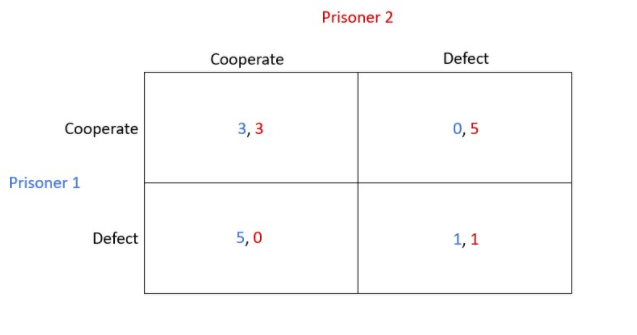
The answer, in part, is that they weren’t strangers. They may be anonymous to one another, absent recognition or connection in real life (IRL aka meatspace), but that doesn’t make them strangers. These men and women had built a community so deep they had their own (often incredibly offensive) language. Their own jokes. They had a culture and sources of status, going so far as to create their own within-group celebrities. And, absent any visible coordination, that culture had evolved in this moment toward a single idea: hold the stock. They were playing a massive prisoner’s dilemma game with each other. Can you form a group for the express purpose of creating a short-squeeze? Probably not – the very action of creating an identity around profit from financial speculation belies the prospect of building an identity valued more than pure profit by its members. That’s the rub – if you want to pull off a massive collective financial action, you’re going to have to build a group of people interested in financial collective action that nonetheless values the identity of the group above the profits of collective financial action. That’s what makes this Planet Money podcast about Gamestop so special– more than anyone anyone else, they seemed to understand that the absurdist emoji usage and language, the elaborate memes, the actual freaking sea-shanties, those weren’t just color for the story, they were the story. Hedge funds weren’t losing tens (hundreds?) of millions of dollars in a zero sum game to a bunch of idiots obsessed with chicken tender-centric memes and sea shanties. They were losing a millions of dollars in a zero sum game because of the memes and sea shanties.

https://blog.methodsconsultants.com/posts/the-prisoners-dilemma/

Put succinctly, at every stage leading up to and during the short-squeeze, each and every holder of Gamestock shares would have been better “defecting” on their r\wallstreetbets comrades-in-arms. Yes, the group is better off if everyone holds, but everyone knows the incentives faced by everyone else, which creates a seemingly irresistible economic gravity of self-interest (defect, defect). So how do we solve these collective action problems? Well, first and foremost, we change the payoffs. That’s what we do in successful families, mafias, and religious groups. It’s what we fail to do in our misfiring coups, cooperatives, and communes.

Yes, your bank account balance will increment upwards if you defect and sell your stock. But that also means you’re no longer a true Son of Gondor. Sure, no one else on the subreddit knows it, but you’ll know it. You’ll know it in your cold, lonely, traitorous heart. Sure, you can use the words and participate in the jokes, but will you ever know the same sense of fellow-feeling within the community as you knew before. That’s a real cost. Is it worth cashing in $5000 in profit a week early, especially knowing it might be worth more next week? Remember – the benefit of group identity doesn’t have to be greater than the profit at hand, it only has to be greater than the risk holding the stock bears for your future profit. Combined with a little motivated reasoning, and it quickly becomes clear how a community, formed independent of profit-via-collective-action, now suddenly becomes an engine of pro-social decision-making sufficient to create an existential threat to any institution over-leveraged on a short position.

The same payoff matrix, however, also demonstrates that a short-squeeze built around a group identity is living on borrowed time. With every short position that gets closed out, the price climbs both higher and closer to its (actually) inevitable peak. There are a finite number of short positions, and there is a finite number of days their share lenders will allow them to hold out, all of which mean a peak will be reached, after that point the price will begin to rapidly decline. Which all means that as the price rises the risk to holding also rises, both of which are increasing the opportunity costs of holding the stock, shifting the payoffs back to a classic Prisoner’s Dilemma. Sure, your group identity might be worth $5K, or even $50K, but there’s a point at which anonymous community is dominated by the prospect of material wealth. I’m not saying you can buy true friends, but eventually you can buy something that offers a close substitute for anonymous friends. Or an island.


*I mean, I personally believe “To Dare is to Do” is a far smarter and sexier slogan.

Invasion of the Cooperation Snatchers

If you can tolerate a moment’s grandiosity, there’s no more important application of game theory than the evolutionary transition from prokaryotic cells to eukaryotic cells. All due deference to every game theorist ever, but the solution to the Prisoner’s Dilemma is literally in our DNA. One day cells were swimming around the primordial soup competing with each other in a zero-sum fight to the death for resources, the next they’re bonding together to form tissues to jointly acquire them. A couple billion years later and you’ve got hyper-specialization to the point of which cellular differentiation remains a bleeding-edge subject of biological research.

But this isn’t a post about the miracle of a body when it’s functioning perfectly. It’s about what happens when a cell goes rogue. When it defects on its neighbors and a cooperative strategy literal eons in the making. It starts gobbling up resources and reproduces at rates that threaten the whole enterprise, growing into a terrible little tumor of defection. The cooperative strategy in question moved passed simplicity countless generations ago: tissues employing Tit-for-Tat disaggregated back into the soup the first evolutionary round through. No, the strategy now is so fine-tuned it hasn’t had to deal with a major defector in eons of its collective evolutionary memory. If it is to succeed, it will have to selectively cut out those defecting cells without abandoning its core strategy, and do it fast, before it’s too late.

Which naturally brings me to the Republican party.

Political parties succeed based on two achievements. 1) They solve the collective action problem and, in doing so, achieve a scale of cooperation and exceed some critical mass threshold sufficient to self-perpetuate through the electoral process. The number of parties that can succeed at once, and the critical mass necessary to get to that point, are determined by the governing political institutions. 2) They maintain their cooperation at a scale sufficient to thwart the emergence of an alternative rival party.

Staying a dominant party is much easier than becoming one, but that doesn’t mean continued success is guaranteed. The weakness(es) of a party will depend on how it got there in the first place. The strategies for solving the collective action problem of this scale will be far more complicated than Tit-for-Tat or “Walk Away” and similar solutions distilled to the point of abstraction. They will involve all the solutions employed by cartels, religious groups, military forces, and every other collective dependent on high-levels of persistent cooperation. With that complexity comes weaknesses. Fault lines and backdoors that are typically guarded through a variety of social and legal barriers.

And they must be guarded, because the combination of scale and success will never cease to attract defectors. Those roaming cells, ostracized and cast out, always met with a wary eye, looking for a way in. Just imagine you are that rogue cell and you come across a population trained to always cooperate no matter what so long as it is deemed a member of the group. They seems so naïve! So vulnerable. But that’s how we succeeded! Always cooperate within the group. How big might your greed grow knowing you could defect and defect for all eternity, growing fatter and fatter off this suddenly maladapted globule of political ambition that can’t help but tear itself to shreds while giving you everything you ever wanted? It’s not just about the weakness of the party, but the kinds of agents these prospects are likely to attract.

In the coming weeks I’ll revisit this and ramble more about discuss some of the specific strategies employed by political parties, and the kinds of invasive agents and strategies they should expect. I’ll also speculate on how groups might institutionally respond and better protect themselves from both invading sociopaths, as well as their own hubris.

Inspiring articles:

Aimone, Jason A., et al. “Endogenous group formation via unproductive costs.” Review of Economic Studies 80.4 (2013): 1215-1236.

Aktipis, C. Athena, et al. “Cancer across the tree of life: cooperation and cheating in multicellularity.” Philosophical Transactions of the Royal Society B: Biological Sciences 370.1673 (2015): 20140219.