Tall poppies don’t get the calls

Ask anyone who grew up playing basketball as the tallest player on the court and they will, each and every one of them, tell you that players were allowed to foul them harder and more often. If you were tall you didn’t get the calls, full stop. Why? We could sort through a host of mechanisms, but they all boil down to “Being tall is an unfair advantage. It’s only fair that I, the shorter opposing player, am allow to slap you, chop you, kick you, trip you, grab you.” To be honest, I don’t think this is a particularly shocking phenomenon. “Tall poppies get cut down” is a cultural cliche for a reason. What is interesting is that it persists even amidst billions of dollars in market incentives pushing in the other direction.

The latest version is happening right now as the Oklahoma City Thunder are currently doing their best to end Victor Wembanyama’s nascent career each and every night, and the referees seem uninterested in realigning the incentives otherwise. At the moment the Spurs are currently up 65-43 in game 4 of the series. If the series goes 7, there’s at least a 20% change Wembanyama doesn’t make it to the end. Will they break his foot smashing down on it, break his leg tripping him, or dislocate his shoulder yanking down on it from a leveraged position? Don’t know, but they’re doing their best to make it happen.

Caitlin Clark came into the WNBA as the single greatest talent prospect in the history of women’s basketball. The abuse she suffers is well documented. Wayne Gretzky was the greatest hockey player of all time, but he was arguably only allowed to reach his potential because Bobby Orr’s careers was cut in half by a league that allowed teams to abuse him with little to know punishment. Bobby Orr’s sin was that he was such a better skater than everyone else that, if allowed to play without constant grabbing, hooking, and abuse tantamount to aggravated assault, he would have walked away with too many goals, wins, and Stanley Cups. It wasn’t fair that he was so much better, so they let the players even the odds. Having watched him limp away after only 7.5 seasons, the NHL took the unofficial position that Gretzky’s teammates (specifically, Dave Semenko and Marty McSorley) held carte blanche to assault anyone who touched Gretzkey. While perhaps not a culture-shifting solution, Gretzky did have a 20 year career that brought hockey to new heights of popularity, so it was ostensibly effective.

But none of that gets at the underlying economics. Elite players bring big audiences to sporting events, which in turn, brings in big money for everyone. The owners, players, and everyone in between gets richer when elite players shine under the biggest lights. So why chop them down? Well, first we have a collective action problem to solve, because, yes, the entire market benefits from superstars, but their opposition during the course of play in any one game have the individual incentives to do whatever they can get away with to win. That’s why we have referees, commissioners, and a players union: to solve those collective action problems. All of those rules and institutions are in place specifically to align incentives and bargain for outcomes that maximize welfare. So why aren’t they working?

When you find cliches at the front of your mind, decent chance you’re running up against psychology and behavioral economics. And as Victor Wembanyama is learning each and every night of the playoffs, “tall poppies get cut down”. It’s not fair that he’s the first 7’5″ player with elite NBA level skills to ever play the game. You know, I was never a fan of watching Shaq play basketball per se, but I always knew he should have scored at least 40 points every night. Yes, he committed 7 offensive fouls every game, but he also received 25 fouls that went uncalled. Players were allowed to maul him because it was unfair he was so much bigger, stronger, and more athletic. His career was only as long as it was because his body could endure the abuse. There has never been another player in NBA history who could have survived even 3 seasons receiving the abuse he did.

Putting aside simple behavioral explanations, we also should consider the possibility that NBA team owners and players are so far down the diminishing marginal returns to wealth, that the median participant would actually prefer to earn less money in order to maximize their own chance at winning a championship. They want parity, of a sort. Parity, but only once the playoffs arrive. The regular season is too long and everyone does, in fact, want to make money, so the abuse is minimal, but once the playoffs arrive, the collective preference is for parity delivered via weaker rule enforcement. There are only so many elite players, but everyone is capable of low-level violence. This preference for postseason parity may also explain why Oklahoma City’s best player, Shai Gilgeous-Alexander, has the reputation for simulating being fouled on every play. If you’re going to get fouled no matter what, you might was well maximize the probability of getting a foul call by forcing the referee to be observed observing the incident.

And, to be clear, parity may in fact be revenue maximizing. Just look at the NFL – the entire structure is designed to maximize the number of franchises who believe at the beginning of the season that their team has a chance to win it all. The players are relatively anonymous compared to NBA superstars, but fans are mostly there to root for laundry, and in the NFL, so long as that laundry doesn’t say NY Jets on it, there’s at least a glimmer of hope. Counter point, just look at the NFL. They understood that each team, especially once the playoffs started, had strong incentives to try to end the opposing quarterbacks career on each and every play. So the NFL introduced a battery of rules to protect quarterbacks, and it seems to have worked.

So maybe I’ve come full circle. Maybe this is what the NBA wants. But I really, really it’s hope not. Wemby is special. I’d like to see the very most of what he can become.

Effort Transparency and Fairness Published at Public Choice

Please see my latest paper, out at Public Choice: Effort transparency and fairness

The published version is better, but you can find our old working paper at SSRN “Effort Transparency and Fairness

Abstract: We study how transparent information about effort impacts the allocation of earnings in a dictator game experiment. We manipulate information about the respective contributions to a joint endowment that a dictator can keep or share with a counterpart…

Employees within an organization are sensitive to whether they are being treated fairly. Greater organizational fairness is shown to improve job satisfaction, reduce employee turnover, and boost the organization’s reputation. To study how transparent information impacts fairness perceptions, we conduct a dictator game with a jointly earned endowment. 

The endowment is earned by completing a real effort task in the experiment, an analog to the labor employees contribute to employers. First, two players work independently to create a pool of money. Then, the subject assigned the role of the “dictator” allocates the final earnings between them.

In the transparent treatment, both dictators and recipients have access to complete information about their own effort levels and contributions, as well as those of their counterparts. In the non-transparent treatment, dictators have full information about the relative contributions of both players, but recipients do not know how much each person contributed to the endowment. The two treatments allow us to compare the behaviors of dictators who know they could be judged and held to reciprocity norms with dictators who do not face the same level of scrutiny.

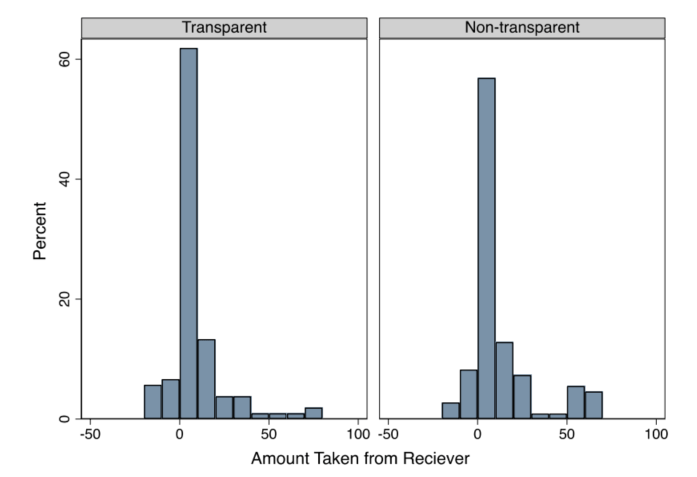
*drumroll* results:

This graph shows the amount of money the dictators take from the recipient contribution, in cents.  There are two ways to look at this. Notice the spike next to zero. Most dictators do not take much from what their counterpart earned. They are *dictators*, meaning they could take everything. Most take almost nothing, regardless of the treatment. We interpret this to mean that they are acting out of a sense of fairness, and we apply a humanomics framework to explain this in the paper.

Also, there is significantly more taken in non-transparency. When the worker does not have good information on the meritocratic outcome, then some dictators feel like they can get away with taking more. Some of this happens through what we call “shading down” of the amount sent by the dictator under the cover of non-transparency.

There is more in the paper, but the last thing I’ll point out here is that the “worker” subjects (recipients) anticipate that this will happen. The recipients forecast that the dictator would take more under non-transparency. In our conclusion, we mention that, even though the dictator seems to be at an advantage in a non-transparent environment, the dictator still might choose a transparency policy if it affects which workers select into the team.

View and download your article*   This hyperlink is good for a limited number of free downloads of my paper with Demiral and Saglam, says Springer the publisher. Please don’t waste it, but if you want the article I might as well put it out there. I posted this on 11/2/2024, so there is no guarantee that the link will work for you.

Cite our article: Buchanan, J., Demiral, E.E. & Sağlam, Ü. Effort transparency and fairness. Public Choice (2024). https://doi.org/10.1007/s11127-024-01230-9

Sticky Prices as Coordination Failure Working Paper

Sticky Prices as Coordination Failure: An Experimental Investigation” is my new paper with David Munro of Middlebury, up at SSRN.

We ask whether coordination failures are a source of nominal rigidities. This was suggested in a recent speech by ECB President Christine Lagarde. She said, “In the recent decades of low inflation, firms that faced relative price increases often feared to raise prices and lose market share. But this changed during the pandemic as firms faced large, common shocks, which acted as an implicit coordination mechanism vis-à-vis their competitors.”

Coordination failure was suggested as a possible cause of price rigidity in a theory paper by Ball and Romer (1991). They demonstrated the possibility for multiple equilibria, and we perform the first laboratory test to observe equilibrium selection in this environment.

We theoretically solve a monopolistically competitive pricing game and show that a range of multiple equilibria emerges when there are price adjustment costs (menu costs). We explore equilibrium selection in laboratory price setting games with two treatments: one without menu costs where price adjustment is always an equilibrium, and one with menu costs where both rigidity and flexibility are possible equilibria.

In plain language, for our general audience, the idea is that the prices you set might depend on what other people are doing. If other people are responding to a shock (for example, Covid driving up labor costs all over town might cause retail prices to rise) then you will, too. If every other store in town is afraid to raise prices, then there is a certain situation where you might resist adjusting your prices, too (price rigidity).

Results: First, when there is only one theoretical equilibrium, subjects usually conform to it. When cost shocks are large, price adjustment is a unique equilibrium regardless of the presence of menu costs, and we see that subjects almost always adjust prices. When cost shocks are small and there are menu costs rigidity is a unique equilibrium and subjects almost never adjust. Conversely, with small cost shocks subjects almost always adjust when there are no menu costs.

The more interesting cases are when the parameters allow for either rigidity or flexibility to be selected. We find that groups do not settle at the rigidity equilibrium. Rather, depending on the specific nature of the shock, between half and 80% of subjects adjust in response to a shock. The intermediate levels of adjustment are represented here in this figure as the red circles that fall between the red and green bands where multiple equilibria are possible.

In the figure above, the red circles are higher when the production cost shock gets further from zero in absolute value. We see that the proportion of subjects adjusting prices is proportional to the size of the cost shocks. This is consistent with the interpretation that the large post-COVID cost shocks acted as an implicit coordination mechanism for firms raising prices. Our results provide a number of interesting insights on nominal rigidities. We document more nuance in the paper regarding heterogeneity and asymmetry. Comments and feedback are appreciated! If it’s not clear from the EWED blog how to email me (Joy), find my professional contact info here. 

Purchasing Drinks with Push-ups.

Early in the summer of 2021, I was having fun. The semester was ended and traveling was on the horizon. Due to changes at my wife’s job I began driving to work instead of making the 20 minute trek by foot. And there was plenty of time to be social. And social I was — several days of the week. And, inevitably, drinks would be served. I was doing a lot less walking and a lot more drinking alcohol (responsibly).

I was footloose and fancy free. Until… The bathroom scale reminded me that I had surpassed the age of 30 years old. Being sedentary and drinking were starting to add up.

Right then and there, I made a decision. I would disincentivize my drinking, but I would also make drinking beneficial rather than detrimental to my waist line.

I made a deal with myself. For each drink that I had, I would have to ‘pay’ 25 push-ups. No exceptions. And, no borrowing from myself. Push-ups *had* to come first. None of this “I owe myself push-ups” nonsense (it’s a trap!). I could *save* for the future, however. Knowing that a social event was approaching, I’d build myself a nice little balance. And the exchange rate was constant: 25 push-ups per drink – always.

Who held me accountable? Me, myself, and I… And some incentive compatible approbation.

I wasn’t shy about any of it. At a outdoor beer garden with my wife and her cousin, I had prepared by banking 50 push-ups. But round 3 was impending… and I’m no square. So, over to the side, quite out of the way on the outdoor patio, I knocked out a quick 25. Round 4 came after still another 25.

Now let’s talk incentives. Requiring push-ups of myself increased my physical activity, so I felt better about my body. Further, if I hadn’t banked push-ups ahead of time, paying prior to each drink limited how many push-ups I could comfortably do. Once push-ups became uncomfortable, I stopped drinking.

That’s all great. But the social incentives were pivotal in keeping me dedicated. Upon seeing the push-ups in action, female friends would talk to my wife who quickly developed a well-crafted dialogue for each new observer, complete with convincingly spontaneous gesticulations and eye-rolls. I can’t say that I didn’t enjoy the attention.

Other men provided direct positive approval. I combined 3 activities that were already ‘manly’ when separate: muscle building, drinking, and dispassionate self control. Men would praise me immediately and similarly feel compelled to do there own sets of push-ups in my presence — as if being sedentary in my presence convicted them as guilty of something. At least one wife sent me a text after we had left town that included a picture of her husband knocking out some of his own pre-drink push-ups (Is this what it feels like to be an influencer??).

Aristotle would be proud.

I was very consistent for months. Being the summer and seeing a lot of friends and family, I did a lot of push-ups. But, as time passed, the exercise habit stuck even as the drinking began to pass by the wayside. What began as an arbitrary, self-imposed rule soon became a legit change in behavior. And then, that change in behavior became a practice. Did that practice improve my temperance and fortitude through habituation? Idk. But wouldn’t that be nice?