Using Taylor Swift to teach about Adam Smith

It’s a niche thing, but Art Carden and I wrote a collection of Taylor Swift/Adam Smith essays. I’m going to use some for teaching this semester, so I wanted to post this in case it’s useful for other teachers.

In introductory economics courses, students often encounter Adam Smith as a one-dimensional figure – the patron saint of self-interest who wrote about the “invisible hand” of the market. But Smith was a far more nuanced thinker, and his insights about human nature remain relevant today. The challenge is making these complex ideas accessible to modern undergraduates.

That’s where this comes in as a teaching aid. Through three recent articles examining Swift’s very public decisions and artistic output, we can introduce students to Smith’s key ideas in a way that feels immediately relevant and engaging. From Swift’s struggles with public perception in “Anti-Hero” to the economic implications of her homemade cinnamon rolls, these pieces provide concrete, contemporary examples that illuminate Smith’s dual role as both moral philosopher and economic thinker. Many undergraduates are already familiar with Swift’s music and public persona, providing an accessible entry point to Smith’s more abstract concepts.

Here’s the recommended order to introduce our articles and a blurb on what you can learn (seriously).

Anti-Hero as a Smithian Anthem” – This article introduces Smith’s foundational concept of the impartial spectator and his sophisticated view of human nature through a contemporary example. The article demonstrates that Smith wasn’t just an economist but a moral philosopher who understood how deeply humans care about others’ perceptions of them, showing students that economics isn’t just about money.

Taylor Swift & The World’s Most Expensive Cinnamon Rolls” – This piece provides a bridge between Smith’s moral philosophy and his economic thinking, using opportunity cost analysis while simultaneously showing how rational economic actors might “inefficiently” spend time on activities that build social bonds. The article illustrates how Smith’s ideas about sympathy and social connection exist alongside, not in opposition to, his economic insights about specialization and efficiency.

Would Adam Smith Tell Taylor Swift to Attend the Super Bowl?” – This article builds on the previous readings to explore the full complexity of Smith’s thought, showing how his ideas from both The Theory of Moral Sentiments and The Wealth of Nations can be applied to analyze real-world decisions.

Intersectionality Eliminates Measured Hiring Bias

The US Equal Opportunity Commission identifies characteristics by which an employee can’t be harassed, hired, paid, or promoted. A challenge with enforcing the non-discriminatory standards is that the evidence must be a slam dunk. There needs to be a smoking gun of a paper trail, recorded conversation, or multiple witnesses. Mere statistical regularities are insufficient for demonstrating that characteristics like race, age, or sex are being considered inappropriately.

If employees are all identically qualified, then we’d expect the employment at a firm to reflect the characteristics of the applicant pool, within a margin of error due to randomness. One difficulty is that plenty of discrimination can occur within that margin of error. A firm may not have sexist policies, but a single manager can be sexist once or even multiple times and still keep the firm-level proportions within the margin of error. This is especially stark if the company managers or officers are the primary positions for which discrimination occurs.

Another difficulty is that randomness can cause extreme proportions of employee characteristics. Having a workplace that is 95% male when the applicant pool is 60% male isn’t necessarily discriminatory. In fact, given a sample size, we can calculate how likely such an employee distribution would occur by randomness. Even by randomness, extreme proportions will inevitably occur.  As a result, lawsuits or complaints that have only statistical evidence of this sort don’t  go very far and tend not to win big settlements.

But this doesn’t stop firms from avoiding the legal costs anyway. Firms generally prefer not to have regulatory authorities snooping around and investigating. Most people break some laws even unintentionally or innocuously, and a government official on the premises increases the expected compliance costs. Further, even if untrue accusations are made, legal costs can be substantial. Therefore, firms have an incentive to ensure that they can somehow demonstrate that they are not being discriminatory based on legally protected characteristics.

However, as I said, extreme proportions happen randomly. If those extremes are interpreted as evidence of illegal discrimination, then the firms have an incentive to hire among identical applicants in a non-random manner. They have an incentive to tilt the scales of who gets hired in favor of achieving a specific distribution of race, sex, etc. People have a variety of feelings about this. Some call it ‘reverse discrimination’ or discrimination against a group that has not historically experienced widespread disfavor. Others say that hiring intentionally on protected characteristics can help balance the negative effects of discrimination elsewhere. I’m not getting into that fight.

Continue reading

What I Learned from Erwin Blackstone

I’m told that Professor Erwin Blackstone died earlier this year, but I haven’t been able to find anything like an obituary online; consider this a personal memorial.

I knew Dr. Blackstone first as the professor of my Industrial Organization class at Temple University, where he taught since 1976. He was a model of how to take students seriously and treat them respectfully; he always called on us as “Mr./Ms. Last Name” and thought carefully about our questions.

Of course I learned all sorts of particular things about IO, especially US antitrust law and history- from Judge Learned Hand and baseball’s antitrust exemption to current merger guidelines and cases. I would later ask Dr. Blackstone to join my thesis committee, where he would heavily mark up my papers with comments and critiques.

He was a key part of how I was able to become a health economist despite the fact that Temple lacked a true health economist on the tenure-track economics faculty while I was there (as opposed to IO or labor economists who did some health). Blackstone’s coauthor Joseph Fuhr– a true health economist who also had Blackstone on the committee of his 1980 dissertation- came part-time to teach graduate health economics. Blackstone and Fuhr worked together to write the health economics field exam I took.

Finally, I learned from Blackstone by reading his papers. While he wrote many on health economics, my personal favorite was his work with Andrew Buck and Simon Hakim on foster care and adoption. It convincingly demonstrated the problems of having one fixed price in an area that most people don’t think about as a “price” at all- adoption fees. Having one fairly high fee for all children means the few seen as most desirable by adopting parents (typically younger, whiter, healthier) get adopted quickly, while those seen as less desirable by would-be adoptive parents linger in foster care for years. Like much of his work, it pairs a simple economic insight with a rich explanation of the relevant institutional details.

Academics hope to live on through our work- through our writing and the people we taught. Having taught many thousands of students at Cornell, Dartmouth, and Temple over 55 years, served on dozens of dissertation committees, and published over 50 papers and several books, I expect that it will be a long, long time before Erwin Blackstone is forgotten.

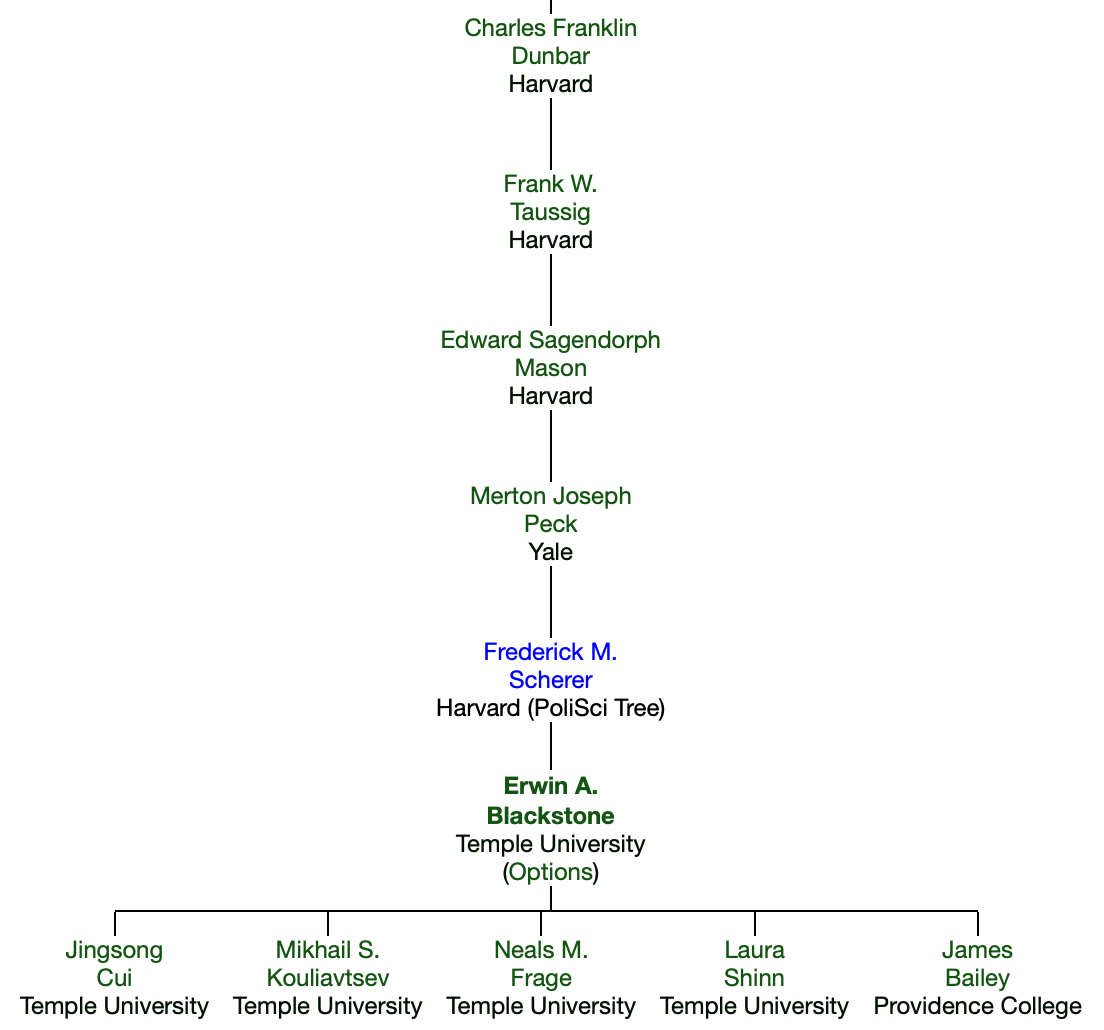
Source: Academic Tree. Charles Franklin Dunbar founded the Quarterly Journal of Economics in 1886.

Lump Sum Taxes: Never by Popular Demand

The tax code is complex. That’s not news. The US federal tax code is also very progressive. Apart from that, the tax code pushes social or other policy goals. The Earned Income Tax Credit, for example, acts as a negative income tax and increases after-tax wages for those who can claim it. The idea is to incentivize earnings.

Economists tend to really like lump-sum taxes (in theory). But, despite the profession’s influence, almost nobody supports them. First, what is a lump-sum tax? It’s a tax that ignores any activities of the target. A per capita lump-sum tax would target the young, the old, the indigent, the working, the rich, the disabled… everyone. The idea is that no behaviors, aside from breathing, incur or disqualify a person from owing the tax.

Economists like them because they don’t change the relative price of labor and leisure. Whereas a marginal tax rate reduces a worker’s effective wage, a lump sum tax leaves it unaffected. People aren’t disincentivized from working/earning. Using jargon, we say that a lump-sum tax is non-distortionary.

In the simple two-good model of consumption and leisure, marginal tax rates reduce the amount of consumption that one can afford with each hour of work, making leisure relatively more attractive. Lump-sum taxes reduce the affordable amount of both leisure and consumption. Affording less leisure is the same as saying that people work more hours. It happens for two reasons. 1) Poorer people must work enough to pay the inevitable tax bill and also reach an income level of sustenance. However much work sustenance entails, it’s surely more when there is a tax. 2) Since working and earning itself is not taxed, people at all levels of income decide to work more because their after-tax wage is higher relative to the case of a marginal income tax.

At this point someone gets what I call the “French” idea. The French idea is that if we provide a lump-sum subsidy, then we can all leisure more and consume less – the opposite of a lump sum tax. What a life! We can avoid the prisoner dilemma problem where we can’t credibly commit to shirking together or actually taking a lunch. By forcing a lump-sum subsidy on everyone, we’d work a little less and do it voluntarily. We can sit outside a cafe, enjoying our coffee, baguette, and cigarette without having to worry about our neighbor with their “go get’em” attitude making us look bad.

Continue reading

Parkinson’s Law Before Class

Parkinson’s Law, the principle that “work expands to fill the time available for its completion,” was originally intended as a satirical observation on bureaucratic inefficiencies. However, it has broader applications, especially in academic life. When preparing to teach an intermediate microeconomics class, for example, I often find that Parkinson’s Law applies: no matter how much time I dedicate, there’s always more content, illustrative examples, and analysis that could be included. The time invested in preparation creates a tradeoff between covering the broad spectrum of microeconomic theories versus delving deeply into a few core concepts. Either approach can be effective, but Parkinson’s Law reminds me that more preparation doesn’t always imply improvement.

Teaching intermediate microeconomics presents a natural tradeoff between breadth and depth. The course covers foundational concepts like consumer and producer theory, market structures, and welfare economics, and each of these areas is rich with intricate details, special cases, and real-world applications. A broader approach would expose students to more topics, providing a more comprehensive view of microeconomics. Exploring fewer topics fosters more critical thinking and analytical skills. Too much preparation on one topic can detract from time that could be spent introducing other essential concepts… Or other classes for that matter.

Let’s say I have a few hours to prepare for a Monday lecture on consumer theory. I might fall into a spiral of over-preparation: digging into endless variations of consumer surplus or finding additional applications that illustrate price elasticity. This is precisely what Parkinson’s Law warns against; if I pour time into my preparation, then the lecture becomes denser beyond the ideal for my students’ comprehension.

The extra hours may result in a more detailed presentation, but this doesn’t necessarily mean better learning outcomes. A concise, well-planned lecture is often just as effective—if not more so—than one crammed with detail. Overwhelming students with information that won’t stick is bad pedagogy.

Continue reading

Writing with ChatGPT Buchanan Seminar on YouTube

I was pleased to be a (virtual) guest speaker for Plateau State University in Nigeria. My host was (Emergent Ventures winner) Nnaemeka Emmanuel Nnadi. The talk is up on Youtube with the following timestamp breakdown:

During the first ten minutes of the video, Ashen Ruth Musa gives an overview called “The Bace People: Location, Culture, Tourist Attraction.”

Then I introduce LLMs and my topic.

Minute 19:00 – 29:00 is a presentation of the paper “ChatGPT Hallucinates Nonexistent Citations: Evidence from Economics

Minute 23:30 – 34 is summary of my paper “Do People Trust Humans More Than ChatGPT?

Continue reading

Probability Theory for the Minecraft Generation

If you are teaching statistics to 20-year-olds (or maybe even if you are not), you might be interested in ways to make probability theory more engaging. I watched a students eyes light up when I showed this in class, so that makes it feel worth sharing.

The Law of Large Numbers is a standard part of statistics or business analytics classes. Something that goes along with it conceptually is “The Law of Truly Large Numbers,” sometimes also called The Infinite Monkey Theorem. The idea is that if you put monkeys in front of typewriters, perhaps infinite monkeys with infinite typewriters and with infinite time, they will eventually write a Shakespeare play.

To illustrate this feature of probability theory for the video gamers, a fun and well-produced video is
“Can Mobs Beat Minecraft?” by Wifies

There is nothing inappropriate for students. The video is 13 minutes, which is too long to show during a class session. I recommend watching the first minute and a half and then explaining that the middle is a lot of gaming details to prove that it is technically possible that a randomly acting “mob” could eventually beat the entire Minecraft game, given enough time.

At the 10-minute mark, the math begins. You could watch about one more minute and a half to see how he tries to calculate the infinitesimally-small-and-yet-positive probability that this could happen. Given enough time, just about anything that is possible will happen.

Another possibility for a teacher is not to show the video in class but to offer it as an optional or extra credit assignment, so that a student who loves Minecraft could really have fun with it and other students can skip.

For me, this pairs with Chapter 5 on Probability for the textbook Applied Statistics in Business and Economics.

Another teaching tip. If you ever need to print out paper rulers, you might be Googling “printable rulers” and you’ll see a bunch of scams as the top results. THIS link works: https://www.brightonk12.com/cms/lib/MI02209968/Centricity/Domain/517/Ruler_6-inch_by_16.pdf

Paper on Finance and Economics Women Club

I am one of several founders of a club with the abbreviation F.E.W. for Finance and Economics Women. This is a student organization that we have at Samford and that Dr. Darwyyn Deyo runs at San Jose State University.

Read our report here: The Finance and Economics Women’s Network (FEW): Encouraging and Engaging Women in Undergraduate Programs published in the Journal of Economics and Finance Education

Our short paper is mostly a how-to guide including a draft of a club charter document. We describe our institutions and how we use this group to engage and encourage students. Please read it for more details on how to start a club.

Like most student groups, the FEW model relies on student leaders who take initiative. Having done this for more than 6 years, we have a growing network of alumni and local business partners who connect to current students through FEW events. Personally, I am lucky that 3 faculty members total support the club at my school.

Women are often minorities in upper-division econ and finance classes. Women also have some unique challenges when it comes to choosing career paths and navigating the workplace. These events (e.g. bringing in a manager from a local bank to talk with student over lunch) allow a space for students to ask questions they might not normally ask in a classroom setting or in a standard networking environment.

We report the results of a small survey in our paper. We can’t infer causality, nor did we run any experiments. However, we did find that women were more likely to report that a role model in their chosen profession influenced their choice of major. Part of the purpose of the FEW model is to expose students to a variety of role models who they might not otherwise connect with.

Here’s a news article with a picture of the founding group at Samford. I have great appreciation and respect for our student leaders who keep it going, and I am grateful to the graduates who stay in contact with us.

Suggested citation: Buchanan, Joy, and Darwyyn Deyo, “Finance and Economics Women’s (FEW) Network: Encouraging and Engaging Women in Undergraduate Programs” (2023) Journal of Economic and Finance Education, 22: 1, 1-14.

Interpreting New DIDs

If you didn’t know already, the past five years has been a whirl-wind of new methods in the staggered Differences-in-differences (DID) literature – a popular method to try to tease out causal effects statistically. This post restates practical advice from Jonathan Roth.

The prior standard was to use Two-Way-Fixed-Effects (TWFE). This controlled for a lot of unobserved variation over individuals or groups and time. The fancier TWFE methods were interacted with the time relative to treatment. That allowed event studies and dynamic effects.

Continue reading