Every year my family travels from SW Florida to the mid Atlantic area. Without stops it takes 16-17 hours. With small children, it’s definitely a two day trip. We find that they handle it better if we leave super early, take a longer leg on the first day, then stop at a hotel midway and get the kids in the pool to help burn off some energy. We also rent a suite whenever possible.
We’ve made this trip many times. I use the Bonvoy app which is for Marriott hotels. We even have a particular hotel that we prefer: The Fairfield Inn in Santee, SC. It’s clean, spacious, the employees are welcoming and kind, the breakfast includes cooked items that aren’t bad, it’s within walking distance of a grocery store, and the price isn’t bad at all. Fairfield Inns are generally a great price per quality…. But not in Georgia.
I’ve stopped at several Fairfield Inns in GA: near Atlanta, near Savannah, and we’ve been disappointed. Every. Single. Time. All the margins on which the Fairfield in Santee is great are the same margins on which Georgia ones are poor. I’m sure that there is not just one reason. Maybe there is a bad regional manager or bad assistant to the regional manager. That’s not my primary hypothesis though.
Last year, Jeremy wrote “Where Can You Still Buy an Affordable Home in the US?” He pointed out a few metro areas in the US that are not classified as “unaffordable”. All of the biggest cities have nice amenities such as great restaurants but are very expensive.
There is such a thing as an American town that is too small to find a good restaurant. But you don’t have to go all the way to the middle of New York or Chicago to find interesting menus. If you love food and good creative restaurants, there are some smaller cities that can deliver. Parking and hotels should be cheaper, so you can spend more of your money on food. (I don’t have any data on hand with regard to how menu prices in Birmingham compare to menu prices in NYC. Presumably they are lower here where labor is relatively cheaper.)
I think I care more about food quality than “service.” Nothing has bothered me about the gradual nation-wide shift away from table service toward placing my order at the counter or from a computer screen.
I don’t do much with them, but Jeremy is an advocate for restaurant apps. If you track deals and order directly through the app, you might save around 10% on low-to-mid quality restaurant food.
On a side note, I’m wondering if and when AI will approach the service level of a personal chef. I wish I could outsource all family meals to someone else. I have experimented with grocery delivery and “meal kits” and recipe apps. Nothing ever feels like a personal chef, although some of those services are nice to have. I feel like a superintelligence could encompass all of the restaurant apps, and grocery delivery and family meal planning together. I wish I could just enter a list of taste and health preferences and then not think about it anymore.
Is this the year the world’s largest economics conference settles into its new normal? ASSA 2024 starts in San Antonio today.
Like most conferences, the Allied Social Science Association took a big hit during the pandemic. Unlike most other conferences, a big fraction of this hit appears to be permanent. Part of what made ASSA so popular was that it was the site of most 1st-round job interviews for economists, but the pandemic made this shift to remote interviews. The American Economic Association decided the job market was better that way, so they made the arrangement permanent.
This shrunk their conference by about half compared to pre-2020; overall I thought it was still fine last year, but that the transition creates a problem:
The big problem with attendance falling to 6k is that they’ve planned years worth of meetings with the assumption of 12k+ attendance. Getting one year further from Covid and dropping mask and vaccine mandates might help some, but the core issue is that 1st-round job interviews have gone remote and aren’t coming back. The best solution I can think of is raising the acceptance rate for papers, which in recent history has been well under 20%.
I suspect the AEA is starting to take my advice. Acceptance rates ticked up slightly in 2023 (from 7% to 9% for individual papers, and from 16% to 30% for complete sessions). They have yet to release full information on acceptance rates this year, but my own experience indicates that this summer they realized they had a problem. I got a rejection email in July that said:
We were able to accept less than one third of the more than 1,150 submissions for paper or poster sessions.
This was followed by something I’ve never seen from an economics conference before- a rejection of the rejection:
You have probably already received an email saying your paper which you submitted for the American Economic Association program at the meeting in San Antonio, TX in January 2024 was not accepted. However, the AEA has decided to select a few more papers for the poster session.
I am pleased to inform you that your paper entitled
Certificate of Need and Self-Employment
which you submitted for the American Economic Association program, has been selected to be part of the AEA’s poster session.
This sums up my relationship to the core of the profession nicely: I’m exactly on the margin of it. But this time, just barely on the right side of it, helping them fill up a newly-oversized hotel block.
The odds aren’t what they were in the mega-conference days before 2020, but I expect I’ll still see some of you in San Antonio.
I’m heading to New Orleans tomorrow for the 2023 meeting of the Southern Economic Association, where I’ll present research on the labor market effects of Certificate of Need laws.
I’ll take this as an excuse to re-up two previous posts on New Orleans:
I recommend reading the whole thing, but here’s the conclusion:
As much as things have changed since 2013, my overall assessment of the city remains the same: its unlike anywhere else in America. It is unparalleled in both its strengths and its weaknesses. If you care about food, drink, music, and having a good time, its the place to be. If you’re more focused more on career, health, or safety, it isn’t. People who fled Katrina and stayed in other cities like Houston or Atlanta wound up richer and healthier. But not necessarily happier.
The other day I was chatting on Zoom with a friend. She noted that she and a couple of girl friends go on an interesting vacation each year. They start off by each of them writing down their top three destinations, and then comparing notes. This year, it is a tour of the Danube region.
Thinking of a similar “Where do we go next year for kicks, guys?” scenario in the movie City Slickers, I jokingly suggested running with the bulls in Pamplona. That is kind of a guy thing (50-100 injuries each year, occasional fatal goring), but it triggered a comeback from her: “Well, maybe the tomato festival instead.”
So of course I started poking around the internet to see what was up with tomato festivals. They sounded less than exhilarating, on a par with a midwestern pumpkin growing contest. Now, in Lancaster County, PA (Amish country), some of the tomato festivals feature..wait for it….a bounce house! That’s nice, but maybe not worth a plane flight to get there.
Nashville goes all out with their Tomato Art Fest, with food vendors, live performances and people walking around costumed as giant tomatoes. This year’s theme was, ““THE TOMATO: A Uniter, NOT A Divider! – Bringing Together Fruits & Vegetables.” In Leamington, Ontario they get really physical by putting a layer of tomatoes in kiddie pools on the ground, so you can take off your shoes and socks and step in and squoosh those tomatoes under your bare feet. Woo hoo!
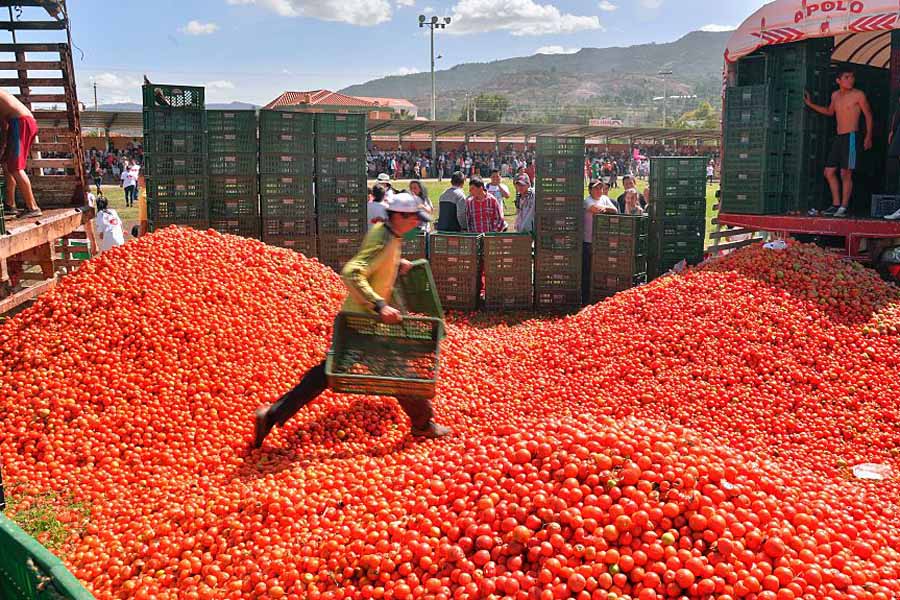
But it turns out the real action is La Tomatina in Bunol, near Valencia (Spain). Excitement builds as truckloads of ripe tomatoes are brought into town:
Then there is the greasing of a tall pole with lard; a ham is perched at the top of the pole. And then (since the pole is unclimbable), enthusiastic people pile their bodies up around the pole till someone can reach the top of the pole and cast down the ham, whereupon a signal cannon fires.
That is the signal for total mayhem to erupt – 20,000 people (you have to buy a ticket beforehand) hurling tomatoes at each other, until the whole town square is deep in squishy red pulp. Participants are asked to hand-squash each tomato before throwing it.
After an hour, a second cannon fires to signal cease firing. Local residents may hose you off, or you can go wash off in the river. (Tips include bringing a change of clothes, because you aren’t allowed on the train or bus with your gooey clothes). Afterward, the firetrucks come and hose down the town square. Reportedly, due to the annual rinsing with acidic tomato juices, the town streets appear remarkably clean. During the days leading up to the main event, there are local parades and tours and a paella cooking contest. (Paella is an amazing local rice-based dish, worth of a blog article of its own)
So if you want to do something memorable in Spain but you are too lazy to walk 500 miles on the Camino de Santiago pilgrimage, or you are too chicken to run in front of a crowd of angry bulls, put La Tomatina on your bucket list.
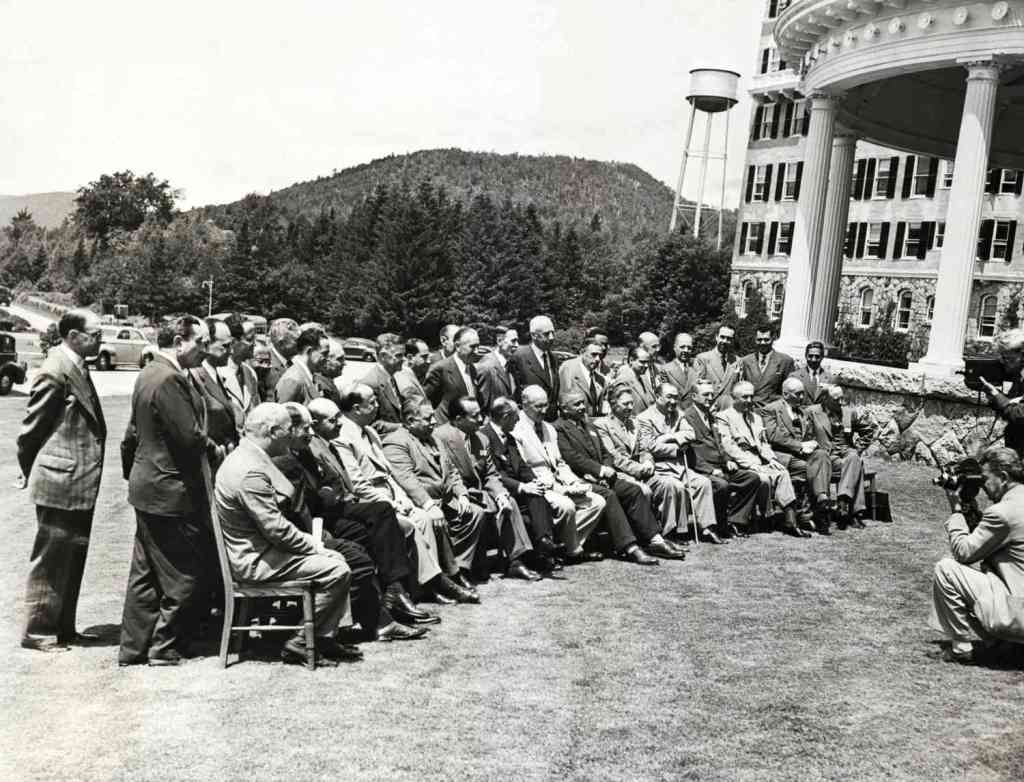
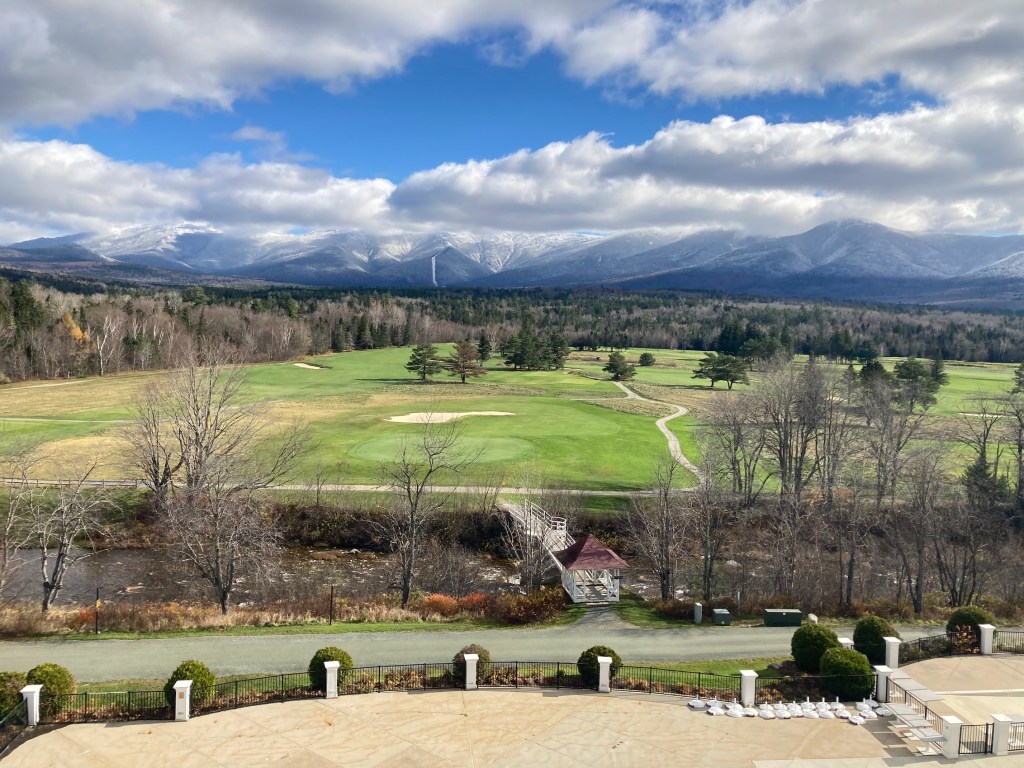
This week I was in Bretton Woods, New Hampshire. The Mount Washington Resort there is lovely on its own terms as a grand old hotel surrounded by mountains, but it is better known (at least among economists) as the site of the 1944 conference that gave us the International Monetary Fund, the World Bank, and the postwar international monetary system.
This got me thinking about what other destinations should top the list of sites for economics tourism. Adam Smith’s house in Scotland has to be on there. In the US I’ve been trying to visit all 12 Federal Reserve banks; they tend to have nice architecture as well as a Money Museum. You can stay at Milton and Rose Friedman’s cabin in Vermont, Capitaf. I’d like to go to Singapore for many reasons, but one is that they seem to listen to economists more than any other country; I’m not sure what places to visit within Singapore that best reflect that, though.
The places I’ve listed so far are somewhat inward looking to the economics profession; you could get a much bigger list by looking outward to the economy itself, doing “economic tourism” rather than “economics tourism”. Visit a port, a mine, or a factory (like Adam Smith visiting a pin factory and getting ideas for the Wealth of Nations); visit a stock exchange or a bazaar. Visit whatever country currently has the fastest economic growth, or the worst inflation.
Those are my ideas, but I’d love to hear yours: what are the best places for econ tourism?
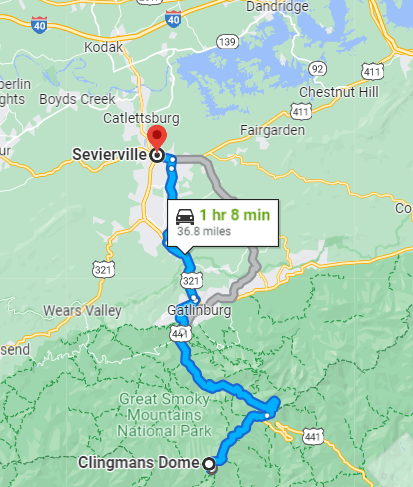
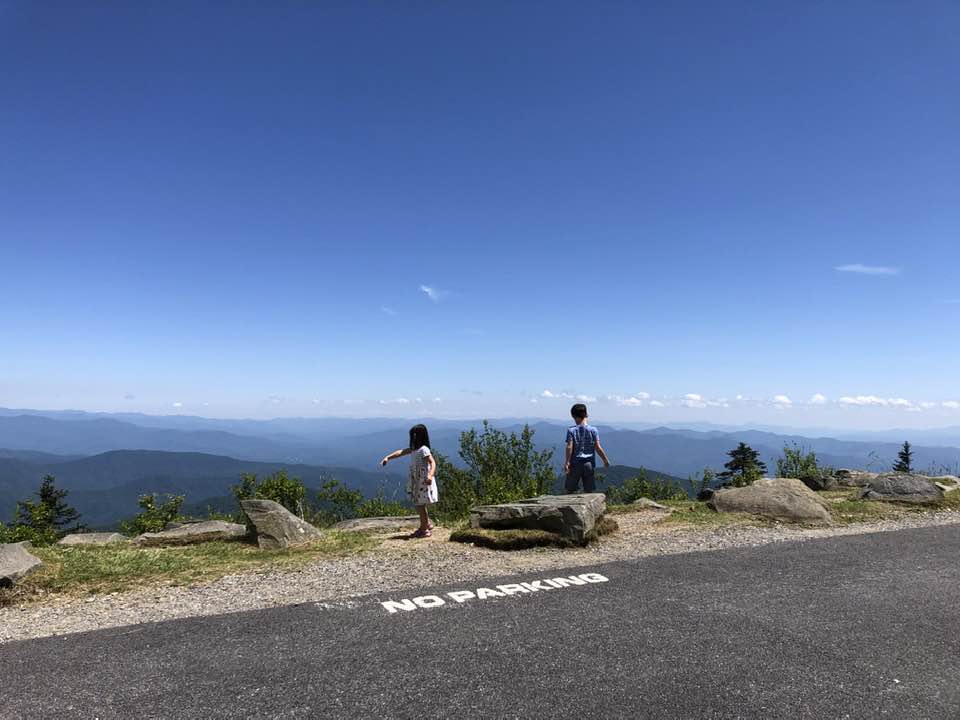
The area from Sevierville, TN to the peak of the Smoky Mountains is a popular destination for summer road trips.
Much of the American Southeast is too hot in July for hiking. The nice thing about the Great Smoky Mountains National Park is that you can keep driving up in elevation until you get to 70 degrees F or less.
The problem with the Smoky Mountains is that too many people want to go. The economist Donald Shoup has written about The High Cost of Free Parking. Entry to the national park is still free, however as of 2023 parking is paid. Good for them. The fee is very cheap. You can print a pass before you go or easily buy one on the way in.
The parking pass didn’t deter many people when we went in 2023. I recommend going early if you want to be able to park near a trailhead, or if you want to avoid a line getting into the Clingman’s Dome parking lot.
Our family has a running joke about “the pancake cabin people”. As we drive into the mountains in the morning, we pass parking lots full of cars outside of restaurants called pancake cabins. As long as you are up early enough to beat the pancake cabin people, you should be able to park where you want to.
There are more attractions in the national park than you could see in one day. The most dramatic view is at the top of Clingman’s Dome. The most historic educational sites are at Cades Cove. The best swimming (that I know of) is in the creek at Chimneys picnic area.
There are dramatic lookouts that you can drive right up to. Cades Cove is mostly a driving experience with lots of optional stops (closed to cars on Wednesdays).
With little kids in tow, it’s hard to make progress on the hikes. The map says just 2 miles to a waterfall. Sounds great. We make it 0.3 miles in. Then someone demands to be carried. Someone trips and breaks down crying. Our snacks are gone. We turn around and return to the car… it’s all good as long as you get excited about leaves and bugs. If you are in the stroller stage of life, don’t expect to get far on any hikes.
If you get a hotel within an hour of the national park on the Tennessee side, there is a lot to do. I might call it “the Orlando of the mountains.” Dollywood is darling at Christmas time.
Years ago, I sent out a note from Chattanooga, a few hours away in Tennessee. That’s another cute green place with hiking and restaurant options, on a smaller scale than the Smoky’s area. Their aquarium is fantastic. It’s neat how their “River building” starts by showing how small streams in the Smoky Mountains feed into the Tennessee River.
Say that you live in a metropolitan area and that everyone works downtown. If you leave early, then you get to work WAY early. If you leave late, then you get to work WAY late. What’s up with that? Let’s say that the closer people live to downtown, the proportionally deeper you work in downtown.
Odds are that you live somewhere in between super far away and somewhere super close. That means that when you arrive at work, there are people closer to and further from the city center also arriving at their jobs. They are your competition. Their mere existence adds congestion to the roads and slows your velocity. As you all make your way closer to the downtown area, the congestion increases and the velocity falls still further such that your slowest speed occurs as you approach work.
Last weekend fellow Temple University economics PhD Adam Ozimek hosted the inaugural #EconTwitterIRL conference. He managed to get 100+ people, including many big names, to come to his bowling alley / arcade in Lancaster, PA.
The overall demographic of Econ Twitter people appears to be youngish professionals, mostly male, surprisingly social and normal-looking (surprising to me because I retain the ’90s-era stereotype that people who write a lot online are nerds who don’t want to talk to anyone IRL).
Adam opened with a history of EconTwitter, which to him is not just about Twitter, but is anywhere where communities of people write about economics online. This starts with the comment sections of the earliest blogs, like Brad DeLong’s, in the early 2000’s. Then in the late 2000’s many commenters start their own blogs, like Karl Smith at Modeled Behavior. In the 2010’s Econ Twitter comes into its own. It may persist or a new forum might take over, but either way the discussion and community will live on.
While it was cool to see a live recording of Odd Lots, and a panel on innovation with MacArthur Genius Heidi Williams, my favorite panel was the one on immigration, because it saw the most serious disagreement. Garett Jones and Daniel Di Martino argued for reforms to the immigration system that would move it away from a focus on family reunification and toward a focus on skills and other indications (like country of origin) that immigrants would benefit the US economy. In contrast, Leah Boustan argued that the current system has worked well, including for assimilation and economic growth, and we should be wary of making big changes to it. Moderator Cardiff Garcia pointed out the oddity of the economists from George Mason and the Manhattan Institute arguing for a “socialist” system where the government determines what the economy needs when it comes to immigration, while the Princeton economist argues against. Garett Jones noted that the rest of his department at Mason disagree with him, but he’s glad to have the freedom to disagree.
While the panel saw intense disagreement about what the ideal system looks like, all panelists shared a frustration with parts of the current system that seem to pointlessly slow or prevent high-skill immigration. Some of this is bureaucracy slowing the process for immigrants who are legally allowed already. Some is politicians refusing to make the smallest, simplest, most common-sense fixes unless they are part of a comprehensive immigration reform that hits their big priority. The big priorities differ by party, but the commitment to holding simple fixes hostage is bipartisan.
Hopefully discussions like this can start to change things. That might sound naive or idealistic, but on an earlier panel Matt Yglesias noted that we should be both impressed and slightly scared of how aware Capitol Hill staffers are about the opinions of Econ Twitter.
Source. Got 2nd at trivia as part of team Acemoglu et al (actual Acemoglu not included).
The magic of all this is that you never know what can come from a post. You might make a friend, make an enemy, get a job, lose a job, influence public policy, get a job in the White House… even make (or lose) a million dollars. So we keep poasting, and once in a while see the results IRL.







 Economist Writing Every Day