The data I have seen indicates that if you don’t need to draw down your investment for twenty years or more, you may do well to put it all in stock funds and just leave it alone. For reasons discussed here the average investor will likely do better to buy an index fund like the S&P 500 rather than trying to pick individual stocks. The long term average return (including reinvested dividends) in the U.S. stock market has been about 10 % before adjusting for the effects of inflation. (All my remarks here pertain to U.S. investments; hopefully some aspects may be applicable to other countries).
However, particularly as you age, financial advisors typically counsel investors to allocate some portion of their portfolio to more-stable fixed-income securities that generate cash to spend and keep you from having to sell stocks during a market downturn. Historically, long-term investment grade bonds have been used to provide steady cash, and to serve as an asset which often went up if stock went down. Thus, a 60/40 stock/bond portfolio was considered prudent. That model has been less useful in recent years, since bond yields have been so low, and since long-term bonds sometimes fall along with stocks, e.g. if long-term interest rates rise.
Another driver now for allocating some savings into non-stock investments is that after the large run-up in stocks last few years, which has far exceeded gains in actual earnings, the market may well muddle along flatter in the coming decade. In regular stock investing, you are banking primarily on stock price appreciation – you are counting on someone else paying you (much) more for your shares some years hence than you paid for them. But what if the “greater fools” don’t materialize to buy your shares?
Also, the inflation genie has been let out of the bottle, and it may be tough to get inflation back under say 4%; investment grade bonds are yielding appreciably less than inflation these days, so you are losing money to buy regular bonds.
Finally, if your stock is cranking out say 8% cash dividends, and you are holding it for those dividends rather than for price appreciation, when the market crashes (and this particular stock goes down in price, along with everything), you can be blithe and unruffled. In fact, you can be mildly pleased if the price goes down since, if you are reinvesting the dividends, you can now buy more shares at the lower price. Trust me, this psychological benefit is important.
Some High Yielding Alternative Investments
In this blog over the coming weeks/months we will identify several classes of securities which generate stock-like returns (around 7-10 % returns, if the dividends are continually reinvested) via dividend distributions rather than through share price appreciation. These securities often have short-term volatility similar to stocks, so they should be treated in the portfolio as partly as stock-substitutes rather than as substitutes for stable high-quality bonds. However, the better classes of high yield investments maintain their share prices over a long (e.g. 5-year) period, similar to bonds, but with much higher yields.
We will discuss High-yield (“junk”) bonds , senior bank loans, preferred stocks, Real Estate Investment Trusts (REITs), Business Development Companies, Master Limited Partnerships, and selling options (put/calls) on stocks.
I’ll close today with three examples of these high yield securities, which I have happily held for many years. They yield 8-9%, and their share prices have held relatively steady over the past five years:
Cohen&Steers Total Return Realty Fund (RFI). Current yield: 8.0 %
Ares Capital (ARCC) Current yield: 8.1%
Eaton Vance Tax-Managed Buy-Write Opportunities Fund (ETV). Current yield: 8.8%
As we sit here with both historically low unemployment, but also a labor force participation rate that hasn’t yet recovered from covid, I expect that we will start to see workers lured back not just with the prospect of high wages, but the prospect of re-tracking their careers. I expect to see a bump in field and industry switching, as well an interest in educatonal programs that might enable such a switch. Since we’ve already wrung our hands over the fields (teaching, nursing, etc) that are mired in labor shortages, we should start thinking more about the opportunity to re-track their careers that workers are grabbing with both hands. And with that, I’d like to give my one piece of universal career and education advice: be an investment, not just an input, and never customer.
This works in a lot of ways. First, and this isn’t trivial, it will keep you out of scams and traps. They want to hire you, but you have buy $300 worth of training videos? Scam. You can start immediately, but you have to buy your sales stock from the partner who recruited you? Ponzi scam and trap. You’re admitted to the professional degree program, but you can’t find any evidence that recent placements are earning at least double the tuition immediately after graduating? Trap. Your incoming cohort seems wildly underprepared given your expectations for the program? Sorry to be the bearer of bad news, but you’re not there to bring presige to the school with your subsequent exploits. You’re there to write checks and wait for your degree in the mail. You’re not an employee or a protege, you’re not even a product. You’re a customer and, I promise, you’re not getting your money’s worth.
Avoiding drains on your wealth isn’t sufficient, of course. You’re trying to pay your bills and hopefully build a career. Well, if you wank into an office filled with uniform, impersonal and undecorated cubicles filled with nothing but recent graduates and temps, you should be on immediate alert. Decent chance you haven’t stepped on the first rung of a corporate ladder – you’re entered a mill that does the grunt work for the people actually on the ladder. Your job, on the other hand, will be to execute monotonous tasks until boredom or a loose labor market pushes you out the door, while a rotation of temps ensures that your exit proves esssentially unnoticeable for your employer. You’re not an team member, you’re barely an employee. You’re a commodified cog, one that they expect to wear out before any improvement in your capacities or value could possibly pay off.
What you want to be is an investment. Whether it’s school or an entry-level job, the most important thing to find is firm/school that has a stake in your long-term success, incentive to invest in your human capital, and a structure within which this investment can in you can reliably flourish. Easily advised, harder to pull off, especially as a job applicant on the outside. There are, however, signs and signals to look for.
A mixture of employee ages is a good sign that people are sticking around because they see a payoff to long-term employment. While a program of temp-to-hire can actually be a great sign, a constant rotation of temps to backfill in a perpetual exodus is a huge red flag. Training and education reimbursement programs? Great sign, doubly so if they come with built-in time off. It might seem counter-intuitive, but I consider it a better sign if the company requires continued post-training employment i.e. you have stick around for at least x years or pay the company back for the training. It might seem like a limitation on your career, but it’s also a really good sign that your employer anticipates significant value in the labor market for your training. They’re not just looking for good PR, they’re looking to protect their investment in you.
Training and education are great, but the absolute best signal that your employer views you as an investment remains dedicated mentorship. If your senior leadership is investing time and energy to prepare you for the next round, great. What you really want, however, is leadership investing in you to eventually replace them. Why is that such a positive signal? Because it means that they don’t see training you as a threat because they’re going to keep moving up too! It means that the firm invests in their employees up and down the ladder, and everyone is anticipating the continuedf acquistion of skills and progression in their careers. If, on the other hand, every bit of process knowledge is a secret fiefdom, every scrap of credit jealously fought over? That’s a sign of employees that feel stuck, desperate only to find an exit while clinging to job security like under-paying driftwood in a storm.
If you’re going to grad school for a doctorate, it’s easy to assess whether you’re an investment or a customer.
Are they paying you or are you paying them?
Is there a defined pattern of how people are trained, granted a degree, and eventually placed within the job market?
Is the program transparent about their students first job placements?
If you’re picking a PhD program, you should obviously go work with professors whose research excites you, but always on the understanding that they view you as an investment. Sure, they’ll get cheap labor our of you with regard to research and teaching assistance, but even those should be investments in your skill sets and experience. At the end of the day, good departments are eager, bordering on desperate, to brag about their former students. They are willing to pay you to go to school there because you will become a valued and hard-to-duplicate input in their research in the short run and a labor market star that further contributes to their own prestige in the long run.
Whatever step you are taking next in your career, especially if you are making a big sweeping change, make sure to find people who’s interests are aligned with investing in you, not just plugging you into their machine or selling you something. Remember, labor is an input, but that doesn’t mean you have to be an easily replaced and interchangeable commodity. Everybody wins if you become more valuable. Make sure you work and study somewhere smart enough to know that.
Rather than wade into the long running argument about how much of the value of education is in acquired skills versus the ability to signal ability or aptitude, let’s take a moment to appreciate the majesty of signaling in the wild. I hold the view that education has value far in excess of simply demonstrating to others that you can execute four years of tasks in a structured environment sufficient to warrant a degree. Make no mistake, however, I also firmly believe the labor market is constantly on the lookout for signals of high productivity employees that are entirely orthogonal to education and often values them more than most forms of broad training. To be honest, part of the reason I believe that education must have some training value is that the wage premium remains enormous, but the signal itself is actually kinda, well, generic. Sure, different degrees have different signals (i.e. did you dodge calculus?), but the fact remains that you really don’t learn all that much about a person from their simply having a degree.
If they worked the griddle at a Waffle House for a year? Now that’s a signal.
I’ll tell you straight up – I’d take a faculty job candidate with a PhD from State U and 12 months of Waffle House on their CV over someone who got an Ivy League PhD straight out of undergrad. And not just accept, I’d push hard for them. That person has seen. some. ahem, stuff, and they came out the other side a person that then went and finished their doctorate? That’s the stuff co-authoring dreams are built on.
There are plenty of attributes that certain lines of work leverage. Grit. Attention to detail. Follow through. Resilience. Calm. Creativity. Cleverness. Reliability. I could go on for a 100 more at least, but at some point it just becomes a thesaurus for “awesome person who can accomplish tasks and handle challenges that are hard to define in advance”. And those kinds of things are difficult to ascertain without a) observing them first hand over an extended period of time, or b) those attributes being vouched for by someone whom you trust implicitly, neither of which are options for the typically hiring process, unless you’re “hiring” a 10-time All Star that was once coached by the person who took a knife for you in 5th period study hall 20 years ago.
There are some occupations and life experiences, however, like an extended run paying your bills scattering and smothering the world’s best hash browns, that do manage to signal those incredibly valuable, but hard to credibly observe attributes with at least some degree of reliability. Here’s a few that come to my mind:
Restaurant. Back of House and Front of House are very different signals. Bonus points for BOH in a short order or quick serve setting, you’re basically getting a soldier without a specialization in violence. Any generic FOH experience, short of selling ice cream at a posh beach, is at least useful for stepping out of social bubbles.
Military, especially if they fulfilled their duty, but chose to change careers. This is a person who not only follows through, but can make independent decisions. Immune to sunk cost fallacies.
Flight Attendant. They are emotionally bulletproof.
Hotel. Problem solvers.
Peace Corps or missionary work. Committed and make good on promises.
Delivery (i.e. UPS or FedEx). Big tasks don’t overwhelm them.
Independent Record Label/Zine distributor/Band promoter Utterly unfazed by high risk endeavors, get lots of intrinsic value out of their own labor
Before I wrap up, let me tack on a few specific summer jobs that have signal value to me. I’ve never met anyone who worked construction as a summer job who wasn’t tireless and reliable. Everyone I ever knew who worked at a movie theatre is funny and interesting, though usually a bit introverted. Kids with paper routes grow up to be independent adults. Screenwriters and novelists who never got a foot in the door make good industry creatives. Anyone who’s done an open mic comedy night more than once is probably a good teacher.
What about you? Are there jobs on a resume that let you know something important about a person that you couldn’t learn any other way?
I’ve been a sports fan for as long as I can remember, but there are a handful of athletes I’ve manage to form deep admiration for despite never having the opportunity to watch them while they were still actively playing. The two at the very top are Bill Russell (basketball) and Johan Cruyff (soccer). Russell passed away last week at the age of 88. He was an important man whose deep committment to the Civil Rights Movement we are still growing in appreciation of, but I want to talk about his genius.
I mean genius in a far more literal sense than what we typically mean when referring to brilliant athletes or (ugh) “sports IQ”. What Bill Russell did on the basketball court was no less genius than what might be admired in chess or physics. I really believe that. There are a handful of team sports (basketball, soccer, hockey, etc) where the game involves enough independent agents interacting that real-time prediction elevates to a level of complexity that success within the game demands that a player either
Dominate through one or more overwhelming attributes
Wait for randomness to grant you an opportuntity to contribute
Forecast events to maximally pursue opportunities to succeed
A teenager playing basketball with younger, smaller children can dominate absent any particular insight into the game. Similarly, someone who has practiced shooting 15 foot jumpshots or knows how to skate can contribute to a game simply by repeatedly going to a handful of positions and waiting for the game to presnt an opportunity. Neither, however, is remotely sufficient to come within a mile of sports played at the highest amateur levels, let alone sports played professionally. The very greatest athletes in professional sports come to dominate their respective games through their possession of both overwhelming attributes (both natural and acquired) and genius for pattern-recognition and real-time, within-game forecasting. We spend far too much time goggling over former and, in doing so, subtly denigrating the brilliance of the latter.
Bill Russell saw the patterns at play within a basketball game. When he played defense he knew where the ball was going, what the relevant player’s options would be, and how he could not only deny them the chance to score, but to deny them in a specific manner that would lead to his own team scoring in the subsequent transition. When Johan Cruyff played soccer, he could make as many as 6 or 7 consequent moves into open spaces, each creating different options for his teammates that would eventually lead to a goal scoring opportunity emergent from the series of micro-interactions created by the space and gravity of his own actions. These moments were neither clairovoyance or instinct. Their dominance was a product of intelligence in the purest sense.
Stop calling it “Sports IQ”
Instead of saying Lebron or Sidney Crosby is a genius, people instead often remark that they have a high basketball or hockey IQ. It drives me crazy. Don’t get me wrong, I’m glad we’ve evolved from saying someone has great sport-specific “instincts”, which imply they are not even intellect-adjacent, but I don’t think we even need the sports-genre qualifiers. No one ever talks about a chemist or economist having field-specific intelligence, we just say they’re smart. You watch any fast-moving sport played at the highest level for a couple years, and you will come to appreciate that players are accomplishing feats of analysis under duress that are nothing short of incredible intellectual feats.
Funny enough, I think one of the contributors to our growing appreciation of the intellectual side of sports is video games. We knew chess players were really smart, but when we started programming computers to analyze millions of moves per second and it still took years for them to consistently beat the best humans, it probably raised our esteem for what chess players had achieved at the highest level.
Similarly, there is something about playing a game and controlling multiple players, transforming a team into a perfect hive mind of coordination granted by the top-down omniscience of their controlling deity that you appreciate what how perfect play might look. You participate in simulated perfection only to then subject yourself to the humbling limits of reality. Suddenly you are constrained by the information limitatons of a first-person view within the chaos of separate minds, moving at top speed (possibly on ice), while being hunted by an aggressive opposition (sometimes carrying lumber). And then it dawns on you that professionals produce an order within this caucophy of sweaty chaos that is only otherwise observable in a video game.
There are no doubt a host of reasons for this bias against crediting athletes with genius. First, racism. Nothing much more to say there other than, yeah, just straight-up racism and the penchant within sports commentary to de-intellectualize sports with the ascendancy of Black athletes in the 20th century.
Racism aside, I think there is also a particular bias against genius when it manifests in something hyper-specialized, particularly when the screening mechanisms are so intense that most of what gets observed is at the one in a million level (i.e. the 99.9999th percentile). At the highest level, professional sports are executed in a manner almost unrecognizable to how most observers might themselves have played or even observed first-hand, to the point of becoming unfamiliar, alien, and most importantly, unachievable. If something is intellectually unachievable, that may lower the relative estimation and status of the observer’s own intelligence. If, instead, what the athlete is demonstrating an innate proficiency for the specific physical task at hand, that’s just random, an anomaly made only relevant because of the peculiar game they play.
I’ll close with a manifestation of intelligence in sports that isn’t based in pattern-recognition or external complexity, but rather internal complexity. Simone Biles, in case you are not aware, is the greatest gymnast in history. To deny her standing in history is your prerogative, but even as a non-expert in gymnastics, allow me to assure you that you would be wrong. A moment that stuck with me in revealing her brilliance, ironically, was when she pulled herself from the previous Olympics. During the floor exercises and vault, Biles creates speed, vertical lift, shape, and multiple dimensions of body rotation. To organize a singular force diagram of her a physicist would require significant computational assistance or a whole bunch of math. Not only does Biles do this, she does it while her body is running, jumping, and rotating. She essentially tracks the problem in real time. What was amazing is that in the recent Olympics, still competing at an age considered well post-prime for gymnastics, she understood that she was not managing the physics problem with the reliablitiy and accuracy sufficient to perform her own routine. Could she have managed a set of simpler routines? Probably, but simpler ones had never been practiced. She confronted a dilemma: she had practiced routines that up until that moment no one else in the world could do but her, only now even she could not do them without presenting significant danger to herself and, in turn, no real help to her team. So what did she do on global television?
She withdrew from the Olympics. Which might be the single greatest moment of self-possession I’ve ever seen from an athlete. That probably counts as emotional intelligence, but I don’t actually know how that works and is a different post anyway.
There is real genius in professional sports. It’s time we started crediting them for it.
Earlier this week my co-blogger Mike had a really great post on work-from-home, and how we might turn former workspaces into new home spaces. It’s a really great idea, and an excellent example of a “second best” solution to the housing shortage.
I’d like to talk about a related but very different topic, which is the things we do in our homes. And for many working couples, that thing is raising children (and generally, keeping up the house).
If you spend much time on Twitter or Instagram, you’ve probably run across the account “Mom Life Comics.” It’s a very popular Instagram account, and lately some of the comics have been shared widely on Twitter (sometimes sympathetically, sometimes mockingly). The running theme of the topic, in short, is that moms carry much more of the “load” than dads do, both the physical load of doing stuff, and what’s sometimes called the “mental load” as well.
There’s a reason the comic is striking a chord with women: just ask any young mom today, especially a young mom that is also working. They have all felt this way at some point, and some of them probably feel this way all the time.
The idea is nothing new, of course. Sociologists have been using the term “invisible work” since at least the 1980s to describe the unseen, unpaid work that women do around the home. But the concept has, of course, been around for much longer. But how has the balance of work changed over time?
Subscribing to the “HousingTheory of Everything” is to confront the fact that a problem can 1) be important, 2) effect (nearly) everyone, 3) have an obvious and welfare improving policy solution, and 4) still be politically stuck. Whether it’s classic prisoner’s dilemmas or a more subtle transitional gains traps, the reality is that building housing has proven incredibly difficult because there is a group whose wealth is overly concentrated in the stock of housing they own (i.e. nearly every homeowner in the US) and who have every incentive to fight to prevent new housing from being built because restricting housing supply increase the value of their propterty.
That’s it. That’s the whole story, everything else is bookkeeping and tactical anecdotes. So how do we solve this problem? One way is to motivate large swaths of voters to push for reform, but there’s only the entire body of political theory and history telling you that’s easier said than done when the opposition is concentrated and organized.
The thing is, building more housing is the “first best” solution- it’s not the only solution. Should we increase the housing stock, lower prices, make the average person wealthier and more economically secure, reduce homelessness, and spend all of eternity celebrating the victory of common sense in the halls of Valhalla? Yes, of course. But that “first best” solution isn’t available in a lot of places (see the previous two paragraphs). Besides beating our heads against the wall in the hopes of victory one spoonful of brick at a time, what else can we do? We can go looking for second-best solutions, particularly ones where the political opposition is softer and less organized.
Converting office space to residential housing is a near Platonic-ideal second best solution. Why? Because it produces more housing, albeit with the costs of conversion and likely subperfect design. What makes it a dream second-best solution for our dilemma, however, is all of the opposition mechanisms it dodges:
There’s nothing remotely historic about most of these buildings.
The are structured in such a way that lend themselve to high-density housing (i.e. apartment and condo towers).
They’re predominantly in relatively dense urban and edge-city areas.
Whatever views or skylines they are obstructing are already obstructed!
There’s a built in interest group to push for the conversion (i.e. the building owners).
There’s no pre-existing tenant or tenants who’s losses can be highlighted at the expense of everyone else’s gain.
First and second best categorization are always a little squishy because they depend on what you include in the costs and benefits. Building new housing from scratch might seem obviously the best possible outcome, but once you factor in the political costs of zoning and approval, there’s going to be a lot of locales where building conversion is the far lower cost option. I’m very much team “work from home” and this is just one more reason you should join our merry band of robe and slipper-types. Hollow out the offices, convert the buildings to housing, and watch the urban landscape transform from gray and glass offices to a utopia of urban singles skipping from brunch to brunch until their kids are born and their metabolisms slows down.
Democracy is messy and there’s no changing that. While it makes for bad sloganeering and will never insulate you from getting slagged on twitter, the reality is that second best solutions are what move peaceful societies forward. We have a lot of coalitions to keep happy, they all want something for themselves, and nothing is free. We have to work with what we got.
And what we got is a bunch of office buildings that nobody wants to work in anymore. Let’s live in them!
…and then work from home in them? In what used to be the offices we didn’t want to work in?
Last week my post was on the definition of a recession and argued against using the “two quarters of declining GDP standard.” Little did I know that the very next day, the White House’s Council of Economic Advisors would write a blog post on this topic the very next day (essentially taking the same position as I did). The CEA post set off a long discussion on Twitter, which even spilled over into the national media.
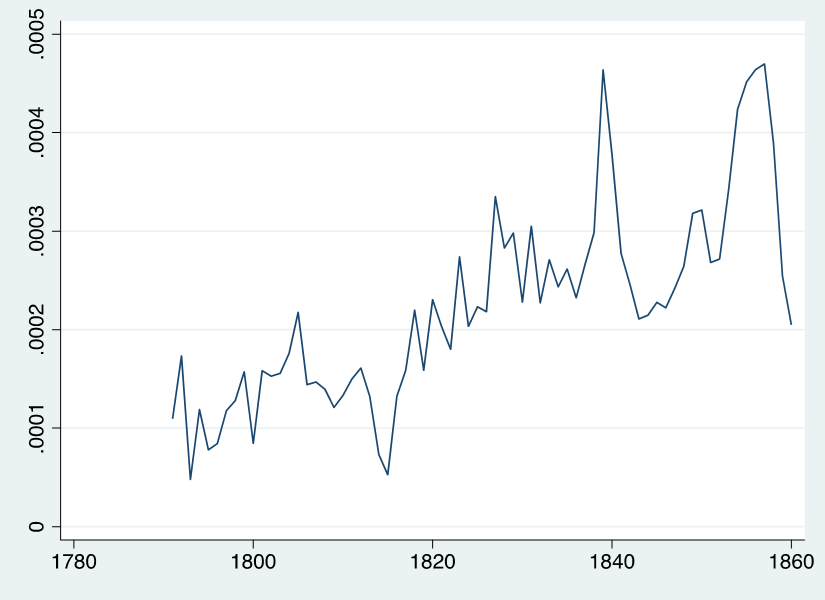
I don’t want to get into that debate here today. Instead, let’s look at the history of dating business cycles, specifically in the 19th century. Forget waiting a few months or even a year for an official NBER announcement: the first attempt to date business cycles was going back over 100 years! In going over this history, perhaps we can learn something about our current debates over recessions, but I think the history is interesting in its own right (it’s also a great example of how we can get better data and use it to answer important questions).
I’ll give a brief history here, but read this Romer and Romer conference paper to get an excellent, full history of the NBER’s business cycle dating. The NBER was essentially found as an institution to study business cycles. One of the first major publications was Willard Thorp’s Business Annals, published in 1926. It was groundbreaking study, which not only provided annual business cycle dates for the entire history of the US, it also did so for 16 other countries for roughly the same time period!
While such an undertaking was impressive, the methods used were pretty unsophisticated from the hindsight of almost 100 years later. First, these are annual estimates, not monthly or even quarterly. Monthly estimates would come later, first appearing in Burns and Mitchell’s 1946 volume Measuring Business Cycles. Those monthly estimates began in 1854, and there are the same ones you will find on the NBER website today, essentially unmodified by even a single month for the late 19th century.
But what of the first half of the 19th century? How did Thorp date recessions?
I can’t shake the idea that captured land value serves as the origin, or at least accelerant, of a great deal of the problems in the United States. What if the YIMBY vs NIMBY fight is just the most visable element of the core economic disease in America? A heads up, if you’re expected a deeply researched 5,000 word post that will YIMBY “pill” your most skeptical colleague, make your peace with disappointment now. But if you’re into policy failures and run-on sentences, you’re in for a good time.
I just can’t get over how often the examination of seemingly every subpar economic context (not immediately attributable to a pandemic or war) comes down to people X are geographically constrained, they need to be proximate to a specific physical location to produce or consume Y, and a huge amount of the economic surplus that would be created from any sort of exchange is captured by land/property owners because legal constraints on development have made the physical place in which an exchange happens THE short side of nearly every market that is pointed to as a failing institution.
Seriously, go through the list of everything that leaves critics of markets ready to burn capitalism (and its fostering society) to the ground. Wages are too low relative to rent. Rent is too high in the places that are near the jobs I want. Public schools aren’t good enough unless you’re willing to carry a mortage that would account for 70% of your take-home pay. Healthcare…eh, maybe not healthcare. Healthcare is crappy for its own bespoke and byzantine set of reasons.
I am a person with no shortage of bodily ailments because I chose to play lots of sports despite never being especially good at them. As a result, I am an avid consumer of physical therapy and therapeutic massage. I have had many conversations about the economics of these fields, and I am now 100% certain that the key to making a career at either, given a minimal level of competence, is not how good you are at your job, but your capacity and good fortune in solving your real estate problem. The entire Massage Envy empire appears to exist not based on greater competence in technique, training, or personnel. It exists solely to extract rents from employees because scale lets them solve the real estate problem (and probably pool liability risk, too). The single biggest thing an individual professional can do to increase their yearly income is not win an award for Therapist of the Year or get 5 stars on Yelp. It’s buying a house with a room they can use as a home office, where they can pay “rent” to themselves and take a tax deduction for the office.
I was once told a likely apocryphal story (that I can’t find on the internet, so it’s probably not true) that the then CEO of Starbucks declared “We make coffee, but we’re in the real estate business.” That their business had matured to the point where revenues could be projected with sufficient accuracy that the profitability had been reduced to identifying opportunities in the real estate market. I don’t know if that ever happened, but that still seems about right to me.
Housing costs hold a special place in how we view our own economic status and security going forward, in part because food costs have been reliably low for so long (knocks on all of the wood). When the rent goes up we feel worse off, not just because we have less disposable income today, but because it increases our expectations for future rent increases as well. We have lots of words for economic insecurity and desperation, but nothing quite makes your blood run cold like the prospect of being homeless, even for the briefest moment.
The phrase “paying your nut” is a lot less common these days. You usually only hear it from self-employed people who live off of a la carte incomes, either in entertainment, freelance, or contracting work. It refers to the minimum amount you have to earn in a month to avoid significant consequences, usually the aggregate of rent/mortgage, utilities, and debt payments. Economists talk about “nominal” and “real” incomes to account for the changes in prices people face. Sometimes there is discussion of “money illusion” where people living under inflation are fooled by higher take-home pay into thinking they’ve become richer. I’ve never been persuaded that nearly anyone suffers from money illusion, nor do I think folks track national price indices and growth statistics.
I think people just know whether it’s easier or harder to pay their nut, and the simplest version of that is the ratio of their take home pay to their rent. Paycheck divided by rent, full stop. If you follow this blog or Jeremy on twitter, you’ll know that one of the puzzles frequently revisited is why Americans are so pessimistic about the economic dynamics of the last 20 to 30 years, and why younger people seem terribly aggrieved about their relative economic status.
Is it harder for Homer Simpson to afford a mortgage than in the 1990s? And what does this tell us about the typical American household?
— Jeremy 'adjusted for inflation' Horpedahl 📈 (@jmhorp) February 23, 2022
So if generational income is fairly consistent and median home mortages account for a slightly declining fraction of median income, what gives? Well, it could all be one big economic mass hysteria, but I’ve got a simpler explanation: the ratio of rent to income to has skyrocketed in the places that young people want to live. Maybe I’m overprojecting my own lived experience, but when I was 25 I did not want to live in a rural area, the suburbs of a major city, or even the downtown of a minor city. I wanted to live in a proper big city. And for a young person, that means living in a small apartment, possibly with roommates, which is exactly the kind of housing places like California stopped building.
Why do so many young people seem pessimistic? Putting aside the absolute failure of politics to produce meaningful climate policy, the simplest explanation is that they have an unpleasant choice. They can live in the same places young people have always lived, only absent any possibility of savings and economic security. Or they can be dispersed from the cultural and economic capitals of our country, and try to build social networks without the benefits of the generational density, plethora of events, and dating markets that have been the hallmark of being a young person in the city since World War I (if not longer).
What will solve this? Policy? California has showed some glimmers of hope. Young people voting with their feet, moving to the shining middle-sized cities that are allowing for growth and affordable rents? Could be, but critical mass is real and growing into a proper metropolis takes decades. Work from home?
That’s interesting enough that I’ll write about it next week. I have thoughts and policy prescriptions, in case any major city is looking for a czar of housing policy (NB: I’m not qualified, but available).
Pablo Budassi has created a logarithmic map of the entire known universe, that shows the distances and relative sizes of objects above the earth’s surface. I think you will find it a worthwhile use of your 30 seconds of attention to click on the link below, scroll to the bottom to start down at the earth’s surface (the image quality at the link is much better than I can convey in these snips here):
And then scroll your way up and up, through planets and stars to galaxies (not every star and every galaxy is shown, of course) and galaxy clusters:
And out through galaxy superclusters, to the very edge of the observable universe:
I am awed by the sheer sizes of things compared to familiar earth-scale objects. We know that our observable universe has not existed forever; presumably whatever caused this vast universe is incomprehensibly vaster. [1]
I am also impressed that humans are able to figure all this out; it is not obvious to the naked eye. An enormous amount of collective brainpower over the years has gone into making instruments (including space-based telescopes) to collect data at many electromagnetic frequencies and to figure out what it all means.
Bonus: In case you haven’t seen them already, here is a link to compelling infrared images from the newly-deployed $10 billion Webb space telescope (your tax dollars at work):
[1] I don’t want to distract from the sheer visual enjoyment of this graphic with a controversial discussion of what is responsible for bringing our universe into existence. All I will say here is that it did not come from “nothing”, as a certain dishonest physicist is fond of claiming. See the “Thinking About the Existence and Attributes of God” section of Christian Apologetics Insights from David Geisler, Ray Ciervo, and Prem Isaac [2020 NCCA, 9], including footnotes 1 and 2, for a brief discussion of these issues, and implications for a nonmaterial sustainer of physical reality.
For those who were unaware, we are apparently a Severanceblog now, a trend made all the better since nobody else is talking about the show anymore. Like all high concept fiction, the show can be consumed as a metaphor, in this case usually as a metaphor for modern office work. While I consume more than my share of metaphors, I usually find speculating about the “true” underlying metaphor driving a piece of storytelling to be more fun than useful. Instead, let’s talk about what the central conceit of the show actually is, namely a return to explicit slavery. Not almost slavery. Not wage slavery. Not “I’d rather be playing Minecraft on Twitch than making pivot tables in Excel ” slavery.
Actual slavery. The hook, through a clever bit of science fiction, is that it is slavery through a channel that allows a person to enslave the only person that we can imagine the world allowing to pass as anything but grossly criminal: themselves. The person you are enslaving to toil on your behalf happens to be a partitioned-off portion of your own consciousness (known as an “innie”) who continues to operate within a now shared bodily meat sack while your “outie” consciousness goes into a apparent blacked-out stasis. The innie does all the work, while the outie reaps (nearly all) all of the material rewards.
One take away is that there are people so desperate to not have to go to their jobs that they will carve off 8 hours a day out of their own claim to existence, a full third of their life, grant independent sentience to that third, and then enslave it. Putting aside the moral repugnance of such a decision for a second, one can’t help but ponder the preferences being revealed by an individual paying such a price.
Never trust a “unified theory” of damn near anything. It’s usually bullshit from the first moment, a cheap trick for gaining attention while grotesquely overreaching for importance in what is either a relatively mundane insight or a bit of intellectual sleight of hand designed to misdirect the reader from a deep underlying fallacy.
Anyway..
The price we’re willing to pay to not do something we don’t like often reveals more about ourselves than the prices we pay for the things we do like. The cost we’re willing to inflict on others reveals it all the more.
One of my little mental tricks when trying to understand human behavior that I can’t quite grok is to swap out a “utiliity maximizing” model for a “disutility minimizing” model. Trying to understand why a person would enslave a portion of themselves within the framework of “what are they maximizing?” lends itself to complex speculation on dimensions of their lives we can’t observe. Flipping it around, however, and asking what they are minimizing is immediately more intuitive. Without getting too deep into spoilers, there’s clearly a motive to minimize the disutility of work itself. Of toil, tedium, and drudgery. Of being told what to do and doing what you are told.
The hypothesis of Severance is that people will create an enslaved conscious person and explicitly deny the humanity of that person if, in doing so, they can minimize their own disutility of work. The corporation that creates these institutions in this fictional world will probably turn out to be either decadently evil in pursuit of pure profit or banally evil in pursuing some sort of yet unseen greater good. Even if they have rich and tragic back stories, the middle management that keep the plantation functioning are morally wretched individuals who have chosen to enable slavery to preserve their own status quo. The corporation, the managers, these are the bad guys. The heavys. The bullys who gain from the suffering of others.
But they’re not the monsters. The only monsters in the world of Severance are the individuals who made a choice to create and enslave another person solely so they themselves might enjoy a life without toil or tedium.
The cost that you are willing inflict on another in an effort to minimize your own discomfort reveals a lot about you. Whether you’re a socialist preaching “solidarity”, an economist who knows that Smithian “sympathy” is the glue of modern society, or just someone who thinks that it all comes down to coping with the prisoner’s dilemma, how a person values the suffering of others is a defining attribute.
Which brings me to a question I think only the creaters of Severance can answer. Is the conceit of their show to show that people will enslave a portion of themselves because they deny the humanity of their creation? Or is it that an office job is so abhorrent that opportunity to offload that burden to another while keeping the rewards for themselves overcomes any sympathy they might have for the other?
This show isn’t a metaphor. It’s a model. In this sense, Severance may be the most misanthropic hypothesis of humanity in the economically developed world I’ve ever observed. That humans, freed of the disutility of possible starvation or annihilation, will take any opportunity to minimize their own discomfort, even at the cost of a third of their lives and moral rot that comes with the enslavement and denied humanity of another. Somewhere, in the deep dark noughaty core of this piece of fiction is the consideration that, freed from our need for one another, our antipathy for discomfort will birth an idle, half-drunk decadence that will lead us to literally eat away at ourselves.
Or maybe the creators just all had office jobs while they were trying to make it in hollywood, and they really, really hated them.