Reading Literacy Data

The story that I’ve heard is this:

            In the US, we care about education. We believe that all people should receive one, regardless of their family status. Therefore, states provide education directly.

There you have it. We provide education in the US so that everyone gets a more fair shake at education. We might disagree about the purpose of an education. Maybe it’s for improved job prospects, for a more informed citizenry, or for more unified values and experiences. One socially awkward answer is that state schools are, in part, a childcare service that permit parents to work. Except for these couple of reasons, school provision and compulsory education should, at the very least, increase literacy. That’s a low bar.

Given the above reasoning states began to pass compulsory school legislation. Massachusetts was first in 1852. Followed by DC and Vermont in the 1860s. Thirteen more adopted compulsory education legislation by 1880. By the year 1900, most states had compulsory schooling legislation on the books that was applicable to at least some age groups. See the figure. Thus, did the US achieve more equality, so goes the story.

The reasoning behind the story is sound. Without education of some sort, people will surely have less human capital. The vulnerability of the reasoning is that formal schooling is not the only form of education. A person who doesn’t attend school may help a parent at work or have a private tutor – or simply grow in a milieu of thoughtful exposure. Therefore, requiring that a child attend school may not improve human capital by a degree greater than what the child would have been doing otherwise. That’s an empirical matter.

The figure below illustrate the data for ‘white’ people and illustrates literacy between the ages of 20 and 30. Why that interval? At the lower end, we don’t have literacy data for people under the age of 20 in 1850 & 1860. On the higher end, any effects of compulsory schooling will only affect those who were children and subject to the law – older people are immune to compulsory schooling legislation.

The graph illustrates that state literacy rates were rising throughout the period. The main exception is 1870. Maybe the demands of the civil war caused children to work at home or otherwise and forego schooling. So the increase from 1870 to 1880 is more of a catch-up to a previous trend than anything else. While it’s true that several states passed compulsory schooling laws in the 1870s, that doesn’t explain the widespread literacy improvements across most states.

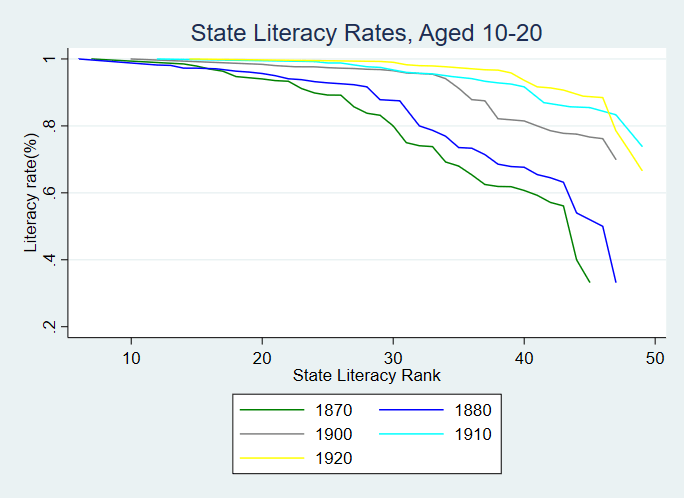
After 1860, we can examine the younger people who were subject to the schooling laws. The figure below for people ages 10-20 tells a similar story to the one above.

My biased reading of the data is that initial compulsory schooling laws had at least an ambiguous effect on the overall trend of improving literacy. I’ll delve deeper in future posts.

PS – The literacy data is from IPUMS.

PPS – The compulsory schooling law dates are allegedly from “Department of Education, National Center for Educational Statistics, Digest of Education Statistics, 2004.” But I couldn’t find the original source. Kudos to anyone in the comments who can find it.

Cryptocurrencies 3. Blockchain: The Ingenious Basis of Bitcoin

Most of our financial transactions are managed by centralized institutions like banks and credit card companies. We trust that these companies will properly manage transactions, so no one can spend the same dollar twice. In other words, if you have $300 in your checking account, you can’t use your debit card to buy a $300 message chair, and then quickly purchase a $300 patio furniture set before the first purchase clears.

Satoshi Nakamoto, the enigmatic inventor of Bitcoin, wanted to set up a digital currency which would not be controlled by or dependent on any central institution. Rather, there would be a big network of thousands of independent computing nodes, which collectively would record and vet financial transactions. A big problem he faced was how to prevent the sort of double-spending described above. With a decentralized system, it was possible that one node, or a couple of nodes in cahoots, could quickly enter two transactions which would spend the same chunk of digital currency twice, before the rest of the nodes could catch the error. And without a central authority, who would have the authority to correct such errors?  

Nakamoto’s solution was the blockchain. He defined and implemented it specifically for Bitcoin, but the concept is so elegant and powerful that hundreds of other digital coins were quickly set up also using blockchains. This in turn has spawned a whole multi-billion dollar “decentralized finance” industry around these blockchain based currencies.

Continue reading

Political Poverty is a Choice

Political drama was about to happen and then it didn’t. Across the country, deep and insightful thinkpieces were left unfinished, relegated to the folder for things writers hope will become future brilliance but definitely never will.

The Big Covid Stimulus Bill was about to fall short by a single vote, with Senator Joe Manchin (D-West Virginia) threatening to break against party lines. It was a disaster… until it wasn’t. A political catastrophe, evidence that the Democrats were a failed coalition once again humbled by their ruthless coordinated opposition… until it wasn’t.

So what was the source of this unforeseeable political miracle? Joe Biden’s long-running political strategy of asking people what they wanted, keeping promises, and not being a d*ck.

As much as I want to roll with three paragraphs of clever wordplay referencing stratagems and gambits, the obvious point to be made is that Biden has decades of political capital that the entire Democratic party is currently able to leverage. In contrast, the Republican Party is currently fronted by a Senator who has broken every political norm for short/medium run political gain, while bearing the brand of a career grifter who spent decades opting not to pay his contractors, employees, or lenders.

I’m not much for making forecasts or predictions, so here’s my predictive forecast for the Republican party: they don’t matter and won’t for years.

Make no mistake: their politics still matter a great deal. White ethno-nationalism has a real foothold in chunks of the electorate all over the country, evangelical Christians remains one of the most influential voting blocks, and the US system remains weighted towards the preferences of rural voters. Rather, what I mean is that the institution of the Republican Party no longer brings much to the political bargaining table. The party has spent down decades of political capital and no recourse to trust in their reputation to solve collective action problems. The bill has finally come due for their spendthrift and short-sighted culture. As much as it may hurt our sympathetic sensibilities, we owe it to them to let them learn from this experience and, after a few decades of trustworthy behavior and political saving, they should be able to pull their party up by their bootstraps.

In four years, two with control of all three branches, the GOP was never ever able to pass legislation as impactful on the US landscape as what the Democrats pulled off this week. The Republican party remains an efficient fundraising organizing and cultural brand for running a campaign, no doubt. There’s not going to be a third-party usurping of their status as one of the two dominant parties, at least not any time particularly soon. But as far as the legislative marketplace is concerned, the Republican party is dead broke.

Cryptocurrencies 2. How Hashing Puts the Crypto in “Cryptocurrency”

There are several conceptual pieces that are put together to make the working Bitcoin digital currency. The data which defines Bitcoin transactions is stored in a data structure called a blockchain.  A key feature of blockchains involves cryptographic “hashing”. That is the focus of today’s post.

A hash function is any function that can be used to map initial data of arbitrary size to fixed-size values. The initial data may be called the key or the message.  The values returned by a hash function are called hash values, hash codes, digests, or simply “hashes”. A common use for hashing in the past has been to do large-scale data storage and retrieval more efficiently, as described in Wikipedia. That link also discusses how some actual hashing calculations are done.

Here we will focus on cryptographic applications of hashing. For this purpose, hash functions are chosen which are for all practical purposes one-way. It is straightforward to start with the “message” and compute the hash. But it is not feasible to start with the hash and back-calculate the initial message, even if you know the algorithm used for the hash function. Typically the only way to find the message is to run a brute-force search of all possible inputs until you find a match to the output hash.

Continue reading

Date-onomics

This short spark plug of a book written in 2015 by author Jon Birger was hard to put down. The book is informative on the idea of “marriage markets” and makes the case that, “college and post-college hookup culture, the decline in marriage rates among college-educated women, and the dearth of marriage-material men willing to commit are all by-products of lopsided gender ratios and a massive undersupply of college educated men.” (p. 5)

Recall from an earlier blog post, when there are more women relative to men, women compete with each other and effectively lower their “asking price” (their share of the marital benefits). This also applies to dating markets too. If you’re having trouble seeing how sex ratios matter, consider this example from the book,

“Among undergrads at UNC there are 50 percent more women than men …” That is for every 40 men there are 60 women which means 3 women for every 2 men, “If you want to visualize what 3:2 looks like, imagine you’re back in college. Imagine it’s late at night, and you’re hanging out with friends in someone’s dorm room. Imagine everyone has had a few beers, the mood is flirty, and people are thinking about pairing off. Now imagine there are three women and two men.” 

Continue reading

Cryptocurrencies, 1: What Exactly Is Bitcoin?

Everybody knows that Bitcoin is a “digital currency”. But what does that really mean, and what is Bitcoin really good for? Who developed it? Turns out, oddly, that we don’t actually know. Can you buy a pizza with it? Turns out that perhaps the most famous pizza purchase of all time was made with Bitcoin.

Continue reading

Academia as tax shelter

A very brief story:

My advisor was Laurence Iannaccone, student of Gary Becker, seminal and in many ways founding contributor to the economic study of religion, now of Chapman University. His observation is a common one in academia, a point of pride for some even, though that varies greatly by discipline, as does their market options outside of the academy. And, yes, flexible work schedules, post-tenure job security, and sometimes picturesque campuses all should be counted towards the total compensation of those fortunate enough to secure a faculty appointment. But the power of the observation goes far beyond proper labor market accounting.

As I find so often to be the case, there is good sociology to be done, but the best first step in doing so is a little bit of economics. To wit:

The academy is, on average, considerably to the left of the population at large. Now this difference, mind you, is grossly exaggerated by your typical right-wing windbag who seems to think that universities begin and end in the English department, but the difference remains. So why would your typical economics, chemistry, or architecture professor tend to be left of the popular center? Well, if the median self-identified lefty got to choose the federal and state tax rates, what would they be? Ok, and how much of that will I have to pay out of my non-pecuniary income? Until they figure out how to tax the thrill of pursuing my own self-determined research agenda, not very much. Taxes are cheap when half of your compensation is non-pecuniary.

The academy is a club.

Scratch that.

The academy is a hierarchy of nested clubs. Which means that we often suffer from exclusionary FOMO akin to fourth tier English gentry trying to marry off five daughter in the early 19th century. Membership in those clubs– those famed research groups, donor-named centers, or even (god forbid) schools of thought — they become more than just sources of funding, workshop critique, and coauthor match-making sock hops. These clubs become the well springs from which ever increasing portions of our non-pecuniary income come from. They become our social networks, our friends, and even ,with a handful of co-authors you’ve gone into scientific battle alongside, a second family. The next time you see someone dig in their heels, seemingly denying the mounting evidence that they were on the wrong side of a scientific argument, don’t just blindly assume they are too stubborn and arrogant to acknowledge they might have been wrong. Consider how unfunded or, more importantly, how lonely they stand to be if they’re the first to give up the fight.

It’s why we covet tenure so much. Don’t get me wrong, everyone wants job security. But for most of us, the prospect of being laid off doesn’t necessarily include the possibility of being jettisoned from what you’ve slowly constructed as a separate parallel universe within which you have carefully curated the technical, educational, and social capital necessary to produce your career and life. If you get laid off from programming for Netflix, the next few weeks or months will be unpleasant, scary even. You may begin to doubt your ability or life choices. But that next job will come, and you will as often as not find yourself with a nearly identical life on the other side.

There are those in the academy though for whom this is all they’ve ever known. Bachelors, doctorate, tenure-track academic placement. Throw in a post-doc and that’s 20 years, and you’re entire adult life, in and around universities. Even if they’re from a field fortunate enough to have robust private sector options, how much will doubling your salary really soften the blow for such a person?

I say all of this now not as a critique of academia, or even to lead to prescriptions or advice. You want my advice? Fine, here: don’t go straight to grad school. Dip your toe in the real world, see how you like it. Come back in a few years with a little experience and distaste for office life. It’ll serve you well when your dissertation hits one of its many inevitable nadirs.

Rather, I invite you to consider this: what does the world start to look like when our utility comes less from the goods that we buy and the experiences we have, and more from the clubs we are members of? What does it look like when those clubs find newer and better ways to monitor our behavior and our expressed beliefs? What does it look like when the purging of membership rolls becomes a part of the culture of those clubs?
Education and Marriage

In class today we discuss education and marriage. While we see a general trend toward fewer and later marriages there are substantial differences across education. More educated men and women are marrying more than less educated men and women. They are also divorcing less. So highly educated people who are well-paid are combining their incomes and securing the benefits that come from marriage. Meanwhile less educated individuals are either not forming relationships (single parents) or forming relationships and living arrangements that are less durable (e.g. cohabitation). So on average there is either a low single income or two low but combined incomes. This is a topic that has been discussed substantially in news outlets. For example, here are articles from The Atlantic, Forbes, and Freakonomics.

You can imagine this has lead to substantial income inequality. For example, this study from a few years ago in the NBER reports that, “Data from the United States Census Bureau suggests there has been a rise in assortative mating….[I]f matching in 2005 between husbands and wives had been random, instead of the pattern observed in the data, then the Gini coefficient would have fallen from the observed 0.43 to 0.34, so that income inequality would be smaller.”

That assortative mating refers to people sorting into relationships with people like them. In this case, people with high education marrying people with high education. But, even for its coverage in the media, we probably do not discuss enough how rising income inequality is driven by patterns in marriage and divorce among those with high and low education.

Sunk Costs and The Sense of Self

My 3 year-old will scream. She will lay on the floor, thrash about, and make demands as an infant would if they could communicate and develop the motor control adequate to do so. It doesn’t matter whether she can remember the reason for her disposition – she will continue. My wife and I usually sense the situation. We could get angry and threaten punishments. Alternatively, we know that no amount of reasoning and attempts at persuasion will convert our daughter’s behavior into the sweet, desirable sort. We have found that smothering her with love works best. And when the demands of other children prevent such single-minded attention, we at least try to act lovingly toward her.

My wife is quite beside herself. Why is this happening? (Truth be told, it’s all my fault. It’s in the genes.) Sometimes we see the momentary consideration of a calmer world in our daughter’s face. Then, she rejects it like there is no goodness left in the world. To be clear: I see my daughter know that she can stop her comprehensive riot and instead enjoy some other activity, then definitively decline the opportunity. She has cognitive dissonance.

My child is not crazy. One might say that she is irrational. The entirety of her behavior up to that point is a sunk cost. She could just stop the outburst and feel better. But she doesn’t. Why the heck doesn’t she?

Continue reading

The Massive SolarWinds Hack: A Work of Art

With all the uproar around the election in December, the news of the SolarWinds data breach did not get the attention it deserved. Some well-resourced foreign organization, almost certainly in Russia, succeeded in infiltrating the data systems of an astounding 18,000 or more U.S. organizations. These included major federal agencies such as the Pentagon, the Department of Homeland Security, the State Department, the Department of Energy, the National Nuclear Security Administration, and the Treasury, and other big targets like Microsoft, Cisco, Intel, and Deloitte, and organizations like the California Department of State Hospitals, and Kent State University. Security watchdogs run out of adjectives (“11 out of 10”) in characterizing the magnitude of this hack.

At the same time, security experts cannot help admiring the sheer artistry of this exploit. Hackers themselves often view their codes as a work of art. According to one cybersecurity expert, “Programmers and hackers like to sign their work like artists…So they sign that code in various ways. Often, they’ll leave their initials or they’ll try to be cute and put some sort of cryptic message.” So how was this hack accomplished?

Continue reading