The customer is often wrong

There’s probably nothing more dangerous to an already successful business than giving customers what they say they want. This is not to say you can give customers something they don’t want, quite the opposite in fact. Rather, it’s to never deny the preeminence of revealed preferences.

People want things. They don’t always, however, enjoy how those preferences might be perceived by others (or by themselves). Customizing your consumption to fit the preferences that you would prefer to signal is not a luxury that we can often indulge, however. Basic instrumental needs have to come first. Once a good is already in a household’s portfolio of consumption, however, it is relatively low cost to signal alternative preferencs to peers, surveyers, or focus group organizers. If a producer were to take these signals as earnest, however, they could end up undermining the good already previously purchased and consumed, leading to a business catastrophe. “Trust people’s actions over words” is at least a cliche, if not an outright proverb. I’ll leave it to you to find its most archaic analogue.

I’ve been thinking about this a lot, and no, not in the context of political polling and the recent election, though I will grant the relevance. I’ve been thinking about it more when watching sports and consuming the news.

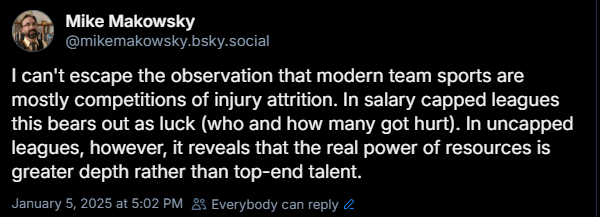
Soccer in the top leagues, particularly the English Premiere League (currently the best in the world) is in year 5 of a growing injury crisis. Most seasons the winner can be predicted based on total salary outlays. Not because of superior top line talent, however, but because they can afford 11 second string players of top quality to play when the starters are inevitably injured. This is largely because of a tragedy of the commons in international soccer, but it’s been massively exacerbated because the EPL responded to the perceived request from consumers that the sport become “more physical”. This amorphous physicality has been granted in the form of more lenient refereeing. The result of this has not been to increase the “fight in the game”, but to grant less talented players greater license in kicking and sliding through the legs of more talented players. I don’t know the full economics of modern sports, but I’m pretty sure fans don’t pay large ticket prices to see the best players in the world on the sidelines in high-end athleisure wear draped discreetly over a walking boot.

As for the news, I see a related, but not identical phenomena. Being a GenX-er, I spent a lot of time in heavy conversation during college bemoaning the impact of advertisers on media content. The “news as propaganda” bit is not a new concept, I assure you. What very, very few us would have guessed, however, is that Craigslist destroying the ad revenue of newspapers and the internet walking off with the customer base most interested in news as information source would lead television program producers untethered to the desires of their advertising sponsors, leaving them to create bespoke content for their new overlords: the consumer. As it turns out, what the remaining subset of customers most wants isn’t information or insight, it’s reaffirmation. We wanted advertisers out of content, but it turns out you got better news when the true customers were corporate overlords hawking sugar water and baggy clothes. People signaled that they wanted deep reporting, uncompromised integrity, and uncomfortable truths. And hey, more people than ever subscribe to The Economist. But it turns out most people just wanted confirmation bias.

Sure, by clicking on the link to this post you’ve signaled to me that you want a depth of insight you just can’t get anywhere on the internet. But I, enwisened scribe, know that what you really want is cliched aphorisms.

Be careful what you wish for.

Thanksgiving Meal Continues to Get Cheaper

Farm Bureau has released their annual data on the cost of a Thanksgiving meal. The headline is that this meal has declined, in nominal terms, for 2 years in a row — back-to-back years of roughly a 5 percent decline. That’s good news for consumers. But they note it’s not all good news, because the meal is still 19 percent higher than 2019, “which highlights the impact inflation has had on food prices – and farmers’ costs – since the pandemic.”

However, the news is even better than they say. If we compare the price of this meal to median earnings, it is actually cheaper than it was in 2019. It’s now the second most affordable Thanksgiving on record, and the only lower year was 2020 — an anomalous year for many reasons (prices fell, due to decreased demand, while median wages were artificially lifted by lower-wage workers losing their jobs).

As a percent of median weekly earnings for full-time workers, the Farm Bureau Thanksgiving meal will cost just 5 percent of weekly earnings (note: I use 3rd quarter earnings for each year, since it is the latest available for 2024). In 2020 it was only 4.7 percent, but other than that 2024 is lower than all other years for which we have data, which goes back to the mid-1980s, when it took 6-8 percent of earnings to buy this meal.

Last year I also said that this meal was the second cheapest ever — if you ignore the weird years of the pandemic. But now if you ignore those years, it is the most affordable it has ever been.

That’s something to be thankful for next week, but also every time you go to the grocery store. Since October 2019, average wages have increased more than prices at the grocery store — not by much, but still better than you might suspect (and yes, I have checked my receipts). If we go back to the 1980s, wages beat inflation by a much larger margin.

Working through work from home

A recent conversation with Sadhika Bagga and her research on labor reallocation got me thinking about remote work, about which there is no shortage of forecasts and opinions. Working from home has taken off. Working from home is failing. Working from home is here to stay. Working from home is already over.

Can they all be true? No, but also yes. At least, that’s where my thinking is at the moment. What all of the preceding pieces seem to do is acknowledge the benefits and costs of remote work while also emphasizing any one particular cost or benefit that generates their preferred lede.

Remote workforces bring lower labor efficiency (e.g. more distractions, less monitoring, more shirking) and greater labor flexibility (e.g. larger labor pools to select from, faster labor turnover) to a firm or industry. It gives firms the ability to pay employees in something other than money, such as schedule flexibility and locational choice, capturing some of the rents from those compensating wage differentials for themselves in the form of lower labor costs. It also means firing and hiring people with greater efficiency and lower costs when each subsequent wave of technological obsolescence hits, more effectively curating your labor force to fit the newest technological opportunities and needs.

How this story plays out will be bespoke to every firm, industry, and sector, but one broad trend I’m looking for is how industries separate by technological turnover. Industries differentiate by the historical rate of technological upheaval. Construction is different today than it was 25 years ago, but that amount of change is almost trivial compared to the televison entertainment industry. I expect that firms industries that reward “nimbleness” in the adoption of and adaption to new technologies will embrace work from home in far greater numbers. This will, in turn, shrink the “periodicity” of industry business cycles. Industires with high remote work labor forces will both more quickly collapse to a dominant set of firms when excludable technology gives them and advantage. They will also, however, more quickly reinflate to a more competitive landscape from new firm entry enter as remote work allows rivals to rapidly update their labor force to match the newest technological landscape. I expect applied micro work on remote work preferences and theoretic work on the consequences of search costs for competition to find each other atop the empire state building and yield the kind of policy recommendations that would make Nora Ephron proud.

This is just one of many broad trends to look for as remote work evolves. The complexity of interacting forces makes forecasting both a fool’s errand and palm reading. All of the forecasts will be internally logical, collectively incompatible, partially correct, and completely wrong.

Did Inflation Make the Median Voter Poorer?

A new essay by J. Zachary Mazlish answers the title question in the affirmative: yes, inflation made the median voter poorer. The post is data-heavy, with lots of charts and different ways of slicing the data, which is great! But since I am called out by name (or rather, my evil twin, Jeremy Horpendahl), I want to respond specifically to the claim about my data, but also I’ll make a few broader points.

Here’s the Tweet of mine that he links to:

https://twitter.com/jmhorp/status/1854548669317455894

Regular readers will recognize the chart in that Tweet comes from an EWED post from April 2024. Mazlich says that my chart and others like it are “misleading for understanding the election because a) they compare wages now versus January 2020, rather than January 2021.”

Fair enough, but if you read my Tweet you will see that I am specifically responding to an NPR story which said, “if you look at the difference between what… groceries cost in 2019 and what it costs today, and what wages looked like in 2019 and today, the gap is really gigantic.” So, they are specifically using 2019 as a baseline in that story, and my chart specifically used that as the baseline too! That’s why I thought that chart was relevant.

It’s true, of course, that if you want to understand median voter sentiment about the Biden administration, you should probably start the data at the beginning of the Biden administration. But I was responding to the more general claim people make, that they are worse off than in 2019.

With that clarification out of the way, what does Mazlich’s broader post say?

Continue reading

Don’t overthink it

If you’re trying to understand the US election outcome, this is the only graph you need:

I’m not saying “anti-incumbency” is everything. There are a lot of forces wrapped up within this graph. My unnuanced take is that that the pandemic hens came home to roost for incumbent parties. Every single bundle of pandemic policies, from the heaviest handed to the most laissez-faire, were characterized by inevitable trade-offs. People don’t like tradeoffs regardless of whether the bill is paid with a year of doubled fatalities, two years of tripled unemployment, or three years of quadrupled inflation. And that’s why I think incumbent parties, be it US Democrats or UK Tories, lost significant ground. If you want to parse it farther, you could argue US Republicans should be disappointed they didn’t win more given how well opposition parties performed elsewhere.

None of that will change the Take Economy, of course. Thousands of pundits, published or barstool, are all describing in exquisite detail exactly the manner in which this election is a referendum on how the Democrats handled exactly the issue they personally happen to care the most about. It doesn’t mean any one of their opinions is narrowly wrong. I’m sure there was a more perfect campaign to be run, if only because there always is and was.

National politics is rarely a referendum and it’s never just the will of the people. It’s a chaotic system. It’s the weather. We forecast the weather. We makes plans. We accomodate, mitigate, and celebrate. And yes, sometimes we just try to survive it. But we can’t control it.

It’s chaos, be kind.

Why Podcasts Succeeded in Gaining Influence Where MOOCs Failed

When MOOCs (Massive Open Online Courses) burst onto the education scene in the early 2010s, they were hailed as the future of learning. With the promise of democratizing education by providing free access to world-class courses from top universities.

Leading universities rushed to put their courses online, venture capital poured in, and platforms like Coursera and edX grew rapidly. Yet today, while MOOCs still exist, they’ve largely retreated to the margins of education. Meanwhile, long-form podcasts have emerged as a surprisingly powerful force in American intellectual life.

Is this ironic? I wanted to learn a bit about MOOCs while I took a walk before writing this blog post. I typed “MOOCs” into the Apple Podcasts search bar.

One of the first results was: John Cochrane on Education and MOOCs

I learned about MOOCs from Russ Roberts at a reasonable pace (when I listen to podcasts, I do it at 1x speed but I’m almost always doing something like driving or folding laundry).

I consider myself a lifelong learner. I buy and read books. Like hundreds of millions of people around the world, I like podcasts. I will attend lectures sometimes, especially if I personally know someone in the room. I did sit in classrooms for course credit throughout college and graduate school. I took extra classes that I did not need to graduate purely out of interest, and yet I have never once been tempted to sign up for a MOOC.

Enough introspection from me. My viral “tweet” this week was: “MOOCs never took off, as far as I can tell, and yet long-form podcasts are shaping the nation.”

Did MOOCs fail? Many millions of people signed up for MOOCs. A much smaller percentage of people completed MOOCs. Some users find MOOCs worth paying for.

However, if you listen to the podcast with John Cochrane in 2014, you can see the promise that MOOCs failed to live up to. The idea was that many people who did not have access to a “top quality” education would get one through MOOCs. Turns out that access is not the bottleneck.

Continue reading

Democracy is hard to forecast

Voting costs time and attention, arguably the only resources everyone is short on. The compensation is implicit, ephemeral, and uncertain. Never make the mistake of thinking you can predict exactly how much other people will behave when the price is subjective and wrapped in uncertainty.

A democracy is an endless cascade of institutions designed to pick winners. Those winners are themselves a product of the rules as much, if not more, than the preferences of voters. Rules will inevitably be gamed, sometimes in manners that seem unfair at best, antithetical to the ambitions of democracy at their worst. A good rule of thumb, however, is that the more unfair an outcome seems, the more fragile it is. A minority party that has gerrymandered voting districts to the hilt might have disproportionate power one day, but they are exactly one exogenous shock away from a electoral cascade event. Any political party is never more than one election away from the dustbin of history.

Polling is increasingly challenging and it’s hard not to feel like they are always fighting the last war. How do you find out what people want in a world where, as previously mentioned, time and attention are scarce? How do you poll people who won’t answer the phone and, even worse, those who do answer phone are decidedly different from those who do? Same thing for people on Facebook. Same thing for people at the mall. Same thing for anyone who uses one tool or media instead of another. It’s never been easier to learn about an exact subset of people, while never harder to learn about everyone.

The electoral college is an extremely dumb peculiar institution. Tuesday could be a tie or a two point differential, but the most likely outcome is a roughly 80 point blowout. The catch being that the blowout could go either way.

I voted (early) for Harris/Walz. I hope they win, but not sure I can say much else for sure. Democracy is hard.

Effort Transparency and Fairness Published at Public Choice

Please see my latest paper, out at Public Choice: Effort transparency and fairness

The published version is better, but you can find our old working paper at SSRN “Effort Transparency and Fairness

Abstract: We study how transparent information about effort impacts the allocation of earnings in a dictator game experiment. We manipulate information about the respective contributions to a joint endowment that a dictator can keep or share with a counterpart…

Employees within an organization are sensitive to whether they are being treated fairly. Greater organizational fairness is shown to improve job satisfaction, reduce employee turnover, and boost the organization’s reputation. To study how transparent information impacts fairness perceptions, we conduct a dictator game with a jointly earned endowment. 

The endowment is earned by completing a real effort task in the experiment, an analog to the labor employees contribute to employers. First, two players work independently to create a pool of money. Then, the subject assigned the role of the “dictator” allocates the final earnings between them.

In the transparent treatment, both dictators and recipients have access to complete information about their own effort levels and contributions, as well as those of their counterparts. In the non-transparent treatment, dictators have full information about the relative contributions of both players, but recipients do not know how much each person contributed to the endowment. The two treatments allow us to compare the behaviors of dictators who know they could be judged and held to reciprocity norms with dictators who do not face the same level of scrutiny.

*drumroll* results:

This graph shows the amount of money the dictators take from the recipient contribution, in cents.  There are two ways to look at this. Notice the spike next to zero. Most dictators do not take much from what their counterpart earned. They are *dictators*, meaning they could take everything. Most take almost nothing, regardless of the treatment. We interpret this to mean that they are acting out of a sense of fairness, and we apply a humanomics framework to explain this in the paper.

Also, there is significantly more taken in non-transparency. When the worker does not have good information on the meritocratic outcome, then some dictators feel like they can get away with taking more. Some of this happens through what we call “shading down” of the amount sent by the dictator under the cover of non-transparency.

There is more in the paper, but the last thing I’ll point out here is that the “worker” subjects (recipients) anticipate that this will happen. The recipients forecast that the dictator would take more under non-transparency. In our conclusion, we mention that, even though the dictator seems to be at an advantage in a non-transparent environment, the dictator still might choose a transparency policy if it affects which workers select into the team.

View and download your article*   This hyperlink is good for a limited number of free downloads of my paper with Demiral and Saglam, says Springer the publisher. Please don’t waste it, but if you want the article I might as well put it out there. I posted this on 11/2/2024, so there is no guarantee that the link will work for you.

Cite our article: Buchanan, J., Demiral, E.E. & Sağlam, Ü. Effort transparency and fairness. Public Choice (2024). https://doi.org/10.1007/s11127-024-01230-9

What if they’re listening?

It’s spooky season and I just received perhaps the spookiest of student emails. We all know that students never read the syllabus, only want to know what’s on the exam, and can’t be bothered to pay attention. But, and hear me out…what if they are listening?

I got this email yesterday. It might be my favorite student email ever, even if it is direct evidence that my stream of consciousness while lecturing, from the students’ perspectives, must border on surreal at times. I don’t know that much of it is actually funny, but it’s interesting to see what actually sticks in a student’s mind. Notes in curly brackets { } are edits and additions from me, with a few small redactions to ensure the anonymity of the student:


From: {NAME REDACTED}

Halloween is the time to celebrate the spooky things in life, and what is scarier than being perceived? I have taken it upon myself to write down some of the silly things you say in class throughout the month of October to celebrate the scariest time of the year. I have compiled them all here and I think you should be proud of your wit. I think they are funnier without context, so in the spirit of politics, I will be leaving it out. 

“I’m just a decomposing corpse here on stage.”

“The good thing about a recession is it’s not a vibes-based measure.”

“[Imagine] You’re wearing a suit, mens or pant….”

“We’re not making assumptions about shapes… yet.”

“Can you imagine the ad campaigns for the eight year old vote?!”

“[In reference to Jesse Ventura, one might even imagine little hearts scribbled in the margins] He’s perfect” {Note: This was not said in admiration of his politics, but rather his existence as Jesse Ventura}

“{Irrelevant 3rd party candidate} is the antichrist, that’s all I know. They kicked my dog and I want to throw them into the 4th layer of hell.” 

(with the most deadpan tone and expression) “Yippee, we’re fine, we’re free, we’re great.”

“There’s crooks, and then there’s crooks”

“What I’m saying is, we’re all becoming monsters.” (very on theme to be honest)

“I cannot tell the difference between parody and reality.” (uh oh)

“White gets 1, grey gets 0, and professor Makowsky goes into a quiet rage.” 

“Get an amish pretzel with amish butter on it, ya know. Love yourself.”

“Stay away from the swamps, there’s luggage there that wants to eat you.”

At the moment (updated 10/22/24)

I am part of the exodus from Twitter to Bluesky. I still maintain my Twitter account, but do not post there. I do, however, still scroll both of my feeds on occasion. I am more optimistic for the future of Bluesky for a variety of reasons, not least of which is simply that it is improving with each week. The mechanics are excellent, there is far less garbage/noise/bots, and I never feel like I am party to anything with nefarious ambitions in the long or short run. There is a problem though.

It’s still kind of… boring. The echo chamber feeling at Bluesky is stronger, born almost exclusively of the selection effects of first and second movers from Twitter. I am rarely surprised on Bluesky, I never feel terribly challenged in an exciting way, unless you count the more frequent posting of squishy academic policy affirmations. There’s plenty of (warranted) election anxiety, but there’s no oppositional forces. There’s no tension.

Which is not to say Twitter is providing any of that in spades. Quite to the contrary, it’s a shell of its former self. The heaviest posters with the biggest followings have found plenty of reasons to stay, but for every big follower account, there were hundreds of medium sized accounts that pushed and pulled the conversation in interesting directions, providing both traction and the occasional surprise. A large share of medium accounts have abandoned ship, some moving to Bluesky, but far more have just dropped out of the medium entirely (apologies for the homonyms). There are interesting people left on Twitter, but they are inundated with bots, trolls, and milquetoast careerists only hanging around because they fell ass backwards into a couple thousand followers and feel too capital committed to move elsewhere. A once rich and diverse intellectual stew has been watered down into a thin broth of increasingly questionable nutritional value. And like a lot of spicy foods, I know I used to complain about the heat while I was eating it, but damned if I don’t miss it all the same.

Bluesky has passed the proof of concept. It works. It has value. Now we just need that final cohort to make the leap and bring the heat.

UPDATE ADDENDUM (10/22/24)

So THAT happened. Most people who are going to read it have already read it, but I did want to add two notes for future reference, both of which I tacked onto bluesky threads.

  1. What I actually miss is the policy/econ/metrics nerds having esoteric discussion full of rivalry and verve. Yes, it was parallel to all kinds of trash, but it was sufficiently insulated. I have quite purposely come to Bluesky because Twitter is now full of nazis, bots, and nazi bots. I promise I don’t miss the nazis
  2. I’ll admit I didn’t expect the word “tension” to get parsed as “negative approbation” , trauma, horrific violence, or hate. I could blame this on the internet, but this is my fault. I’ve been around long enough I should have know better. There is a reason why I tend to write things that come off pre-emptively defensive or as if they are equivocating. I try to prevent misinterpretation, willful or earnest, of my words. I should have done a better job here.
  3. People are rightfully protective of Bluesky as a space separate from Twitter. That said, there are definitely a lot of trolls and bots already in place trying to turning any discourse into a hatefest.