New Website

Don’t worry, EWED is in the same place as always, but my personal website is moving.

Temple University has generously hosted my site long after my 2014 graduation. But next week they are moving to a more typical policy where alumni lose access to online university resources like web-hosting, email, and library datasets starting one year after graduation.

My new personal website is at jamesbaileyecon.com. Unless you just trying to learn more about me or my research, I think the big draws are the pages where I share cleaned-up datasets and ideas for research papers.

Housing Quality Has Improved Dramatically Since the 1980s — For the Poorest Households

A few weeks ago I wrote a post comparing housing costs in 1971 to today. I noted that while houses had gotten bigger, the major quality improvement for the median new home was the presence of air conditioning: a semi-luxury in 1971 (about 1/3 of new homes), to a standard feature in 2023. Even accounting for the presence of central air-conditioning and more square footage, I concluded that housing was about 17 percent more expensive in 2023 than 1971 (relative to wages).

However, if we consider the housing quality of the poorest Americans, the improvements go beyond air-conditioning and more square feet. A recent paper in the Journal of Public Economics titled “A Rising Tide Lifts All Homes? Housing Consumption Trends for Low-Income Households Since the 1980s” has important details on these improvements (ungated WP version). In addition to larger homes, there was “a marked improvement in housing quality, such as fewer sagging roofs, broken appliances, rodents, and peeling paint. The housing quality for low-income households improved across all 35 indicators we can measure.”

Overall, the number of poor American households living in “poor quality” housing was roughly cut in half from 1985 to 2021, from 39% to 16% among social safety net recipients, or from 30% to 12% for the bottom quintile. The 12-16% of poor households that still have poor quality housing is much more than we would like, but these are dramatic improvements over a period when many claim there was stagnation in the standard of living for poor Americans.

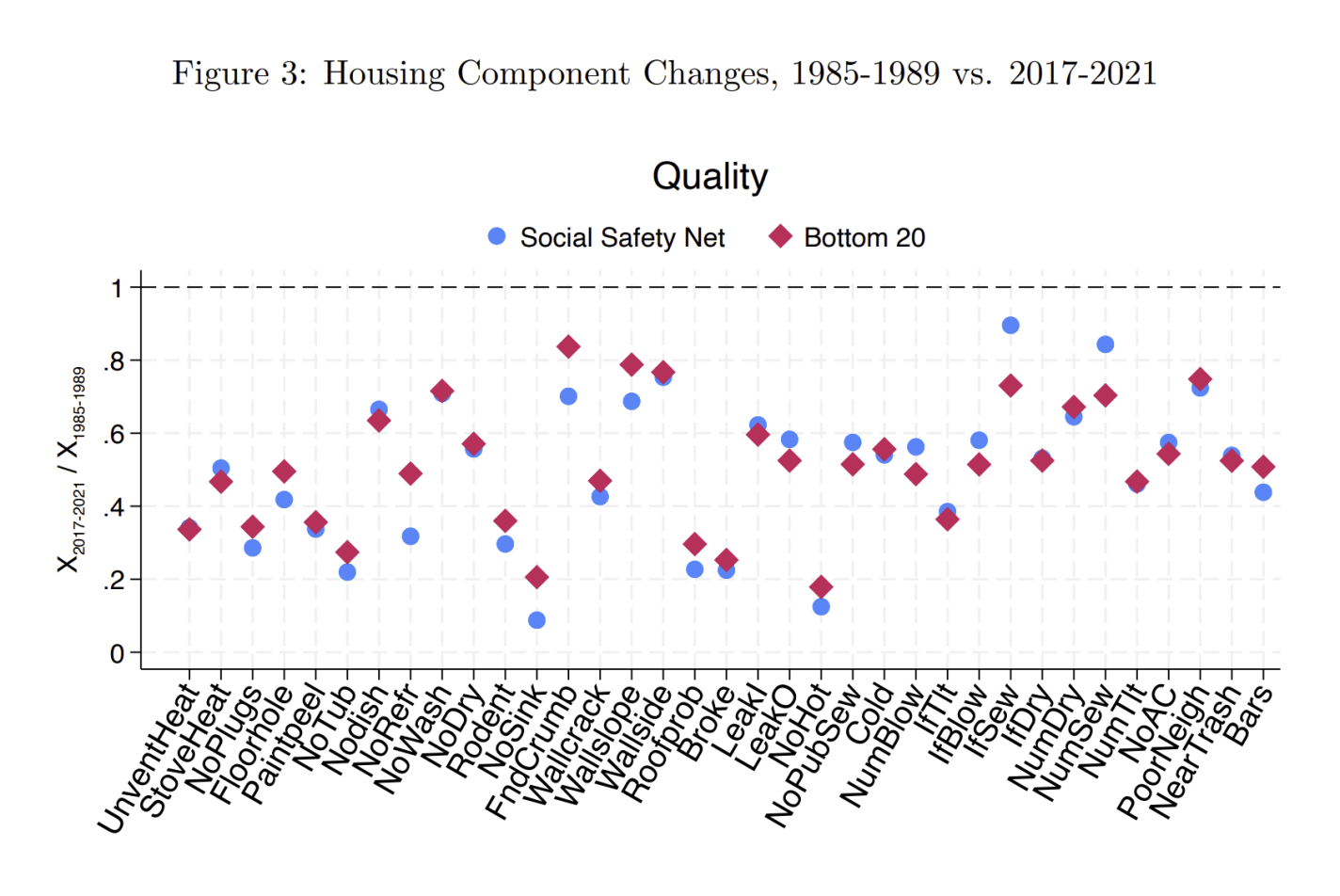
This figure from the paper shows the improvements for the different features:

For example, the number of households with no hot water was just 20% of what it was in the late 1980s. Some of the other major improvements are also related to plumbing and water, such as the number having no kitchen sink or no private bathtub/shower, but there was also a big decline in the presence of rodents in the house. All of the 35 indicators they looked at showed improvements, on average a 50% reduction in the number of households with these poor-quality components. This paper only uses data back to 1985, but almost certainly there would be even larger improvements if we used 1971 as the starting point.

While the median new home in 1971 had complete indoor plumbing, this was clearly not true for many poor households even through the 1980s. When we talk about the increasing cost of housing for the poorest Americans, much of that improvement does represent essential quality improvements — and not merely more square feet and air conditioning (though they did get these improvements too).

Beware the Impactful Gastro-Intestinal “Norovirus”

This is about something unpleasant which I never heard of before this month, but I am sharing in case readers may benefit from a bit of intel here.

In a family I know with two kids under five, it started with the youngest child after he was likely exposed to unclean water. He vomited once, and then was apparently fine. I may be a bit fuzzy on the timeline, but I think it was the next day that the father came down with symptoms. Besides violent emptying of the GI tract from both ends, he was flat in bed for over 24 hours, hardly able to move. This was initially blamed on food poisoning from a restaurant seafood meal, but by the following day, the mom was feeling weak and shortly succumbed, with similar effects.

A woman went over to help this family. She wore a N-95 type mask and washed her hands diligently. Within a few days, the full symptoms suddenly overtook her, as well.  But her husband never got it.  The older child in the original family seemed to have escaped, but a couple of days later he came down with similar symptoms, which lasted off and on for several days.

Most likely the culprit here was the “norovirus”. The virus is named after the city of Norwalk, Ohio, where an outbreak occurred in 1968. It bears the charming nickname, “the winter vomiting disease.” Although the effects of the virus are very unpleasant, fortunately they usually last only a couple of days, with full recovery being the norm.  The sufferer should acquire immunity to that strain of the virus for six months to two years. Some people may escape becoming symptomatic, based on the bacterial populations in their gut biome.

Since this is an economics blog, here are some quick stats. In the U.S. the norovirus is estimated to cause about 20 million illnesses a year and about half of all foodborne disease outbreaks. Norovirus causes some 900 deaths and 100,000 hospitalizations annually, mostly among adults aged 65 and older. It also leads to nearly 500,000 emergency department visits, mostly involving young children.

 A model of the worldwide economic burden of the disease found:

Globally, norovirus resulted in a total of $4.2 billion (95% UI: $3.2–5.7 billion) in direct health system costs and $60.3 billion (95% UI: $44.4–83.4 billion) in societal costs per year. Disease amongst children <5 years cost society $39.8 billion, compared to $20.4 billion for all other age groups combined. Costs per norovirus illness varied by both region and age and was highest among adults ≥55 years. Productivity losses represented 84–99% of total costs varying by region. While low and middle income countries and high income countries had similar disease incidence (10,148 vs. 9,935 illness per 100,000 persons), high income countries generated 62% of global health system costs.

Once it shows up in a family, it is hard to avoid. A reason is that you can be sickened by exposure to as few as ten viral particles, compared to billions that are expelled in a bodily fluid incidents. A doctor reported:

She once acquired a norovirus infection by simply using the same bathroom that had been used earlier in the day by a visiting in-law who was recovering from a recent bout with the stomach bug.  That’s because “people who have norovirus can shed the virus for up to two weeks after their symptoms are gone.”

In another case, a diner in a restaurant vomited on the floor. The mess was quickly cleaned up by staff, and other diners continued eating. In the next few days, 90% of the people at the same table as the sick person fell ill, along with 70% of the diners at an adjacent table, and 25% of the folks at a table across the room.

OK, that’s the bad news. How can we fight back? Lengthy handwashing with soap should help, along with quarantining as much as possible. It turns out that alcohol is not very good at killing this bug, so the usual hand sanitizers may be ineffective.  Better results can be had cleaning surfaces with a bleach-water solution.

The main care needed is hydration. From what I have read, most Gatorade-type sports drinks do provide needed electrolytes (e.g., sodium and potassium), but probably have more sugar that is optimal for this situation. Gatorade Zero has sucralose in place of sugar, if you are OK with that. Pedialyte is designed for rehydration after diarrhea, and has less sugar and more electrolytes than Gatorade. Avoid “Gatorade Water” – it is just water, with the tiniest “infusion” of sodium and potassium.

If you find yourself stricken, it is reportedly wise to have a wastebasket or other receptable at hand in the bathroom, in case you face urgent activity from both ends at once (trying to word this delicately).

Fun fact I learned researching this topic: if the GI tract has been emptied, best avoid dairy for 48 hours after symptoms stop. That allows lactose in the gut to build back up again.

I have never gone on an extended cruise, partly because I don’t think I could resist the frequent offerings of desserts and snacks. But reading of norovirus outbreaks on cruise ships has given me another reason to stay on terra firma.

A requested regression

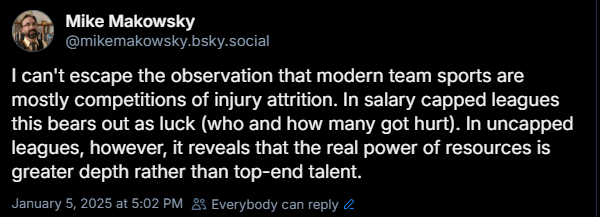
Please accept this as an admission of overcommittment, rather than laziness, but I posted something on bluesky and realized immediately afterwards that this can probably be easily tested.

If someone wants to take it upon themselves to regress wins over player-games lost to injury, I’d be most gracious. If they further wanted to interact that variable with total payroll expenditures (player payroll only, please), that would go further towards really testing the hypothesis. While I don’t tend to think there is much to be intuited from correlation coefficients, I would be curious to know how much the R-squared increases when you run a regression strictly over payroll and the lagged wins and then subsequently add player-games lost to injury to the independently variables. The delta on R-squared could be charted over time. There are other metrics that could be applied to try to control for overall talent, but real question is how accurately could you predict the final standings in a sports league if all you knew was player expenditures and injury luck, and if this has changed over time.

I’ll happily sit on a masters or undergraduate thesis committee for anyone who pursues this!

(Not sure there is enough meat on the bones for a PhD thesis, but happy to be proven wrong)

A Wartime Natural Experiment About Copyright

One of the hardest questions in copyright policy is: “What would have happened otherwise?” When Disney lobbies for longer copyright terms or academic publishers defend high subscription fees, we struggle to evaluate their claims because we can’t observe the counterfactual. What would happen to creativity and innovation if we shortened copyright terms or lowered prices?

This is what makes Biasi and Moser’s 2021 study in the American Economic Journal: Microeconomics valuable. They examine a rare “natural experiment” from World War II – the Book Republication Program (BRP) – which provides insights into how copyright affects the spread and use of knowledge.

In 1942, the U.S. government allowed American publishers to reprint German scientific books without seeking permission from German copyright holders (though royalties were still paid to the U.S. government). This created a test case: German books suddenly became cheaper, while similar Swiss scientific books (Switzerland being neutral in the war) maintained their original copyright protection and prices.

This setup lets us answer the counterfactual question. What happens when you maintain basic royalty payments but prevent monopoly pricing? The researchers compared the same book before and after the policy change, German books versus Swiss books, areas near libraries with these books versus those without, and usage by English-speaking scientists versus others. Such comprehensive comparison groups are rarely available in copyright research.

The authors report that when book prices fell by 10%, new research citing these books increased by 40%. The benefits spread beyond elite institutions, with new research clusters emerging wherever scientists gained access to these books. This does not appear to just be shifting citations from one source to another – there was genuine new knowledge creation, evidenced by increased patents and PhD production.

Such clean natural experiments in copyright policy are rare (there are a few laboratory experiments). Most changes come from lobbying (like the “Mickey Mouse Protection Act”) or technological disruption (like music streaming), making it hard to isolate the effects of copyright itself. The BRP provides uniquely clear evidence that moderate copyright protection – rather than maximum protection – might better serve innovation.

As we debate copyright terms and academic paywalls today, this historical accident of war gives us something valuable: empirical evidence about what happens when you find a middle ground between total copyright protection and unrestricted access.

Biasi, Barbara and Petra Moser. 2021. “Effects of Copyrights on Science: Evidence from the WWII Book Republication Program.” American Economic Journal: Microeconomics, 13 (4): 218–60.

¡Hedonic Frijoles! …And Televisions!

You may have seen on your social media recently that the price of TVs has fallen 98% since 2020. That’s certainly what the data from the BLS says. This would seem to imply that a one-thousand dollar TV in the year 2000 would now be priced at $20. While we have seen amazing things in the market for TVs, we’re not seeing $20 TVs.  One take away might be that the data is just wrong. But that data is always wrong. The question is how the data is wrong and whether it’s a problem.

The reason for the disagreement between the data and the price on the shelves is due to something called ‘Hedonic Adjustment’. The idea is that some goods have quality features that change over time, even if the price doesn’t change so much. In the case of TVs, we might see higher resolution, flatter screens, larger screen sizes, smart features, etc. TVs are not a stable set of qualities. They are a bundle of characteristics, and those characteristics have some wiggle room while still satisfying some sensible criteria for being a TV. In theory, every single good is a bundle of services that we value. The reason that the some CPI categories have fallen so much is not only because the price has fallen necessarily. Rather, the amount of services that we get from a TV has increased so that each dollar that we spend can purchase more of those TV features.

Continue reading for the gif.

Continue reading

Homicides in 2024 Were Down Significantly

The tragic act of terrorism in New Orleans early on New Year’s Day might seem like confirmation to many that crime, especially in big cities, is still at elevated levels from before the pandemic. But we have to be very careful with anecdotes, no matter how deadly and visible.

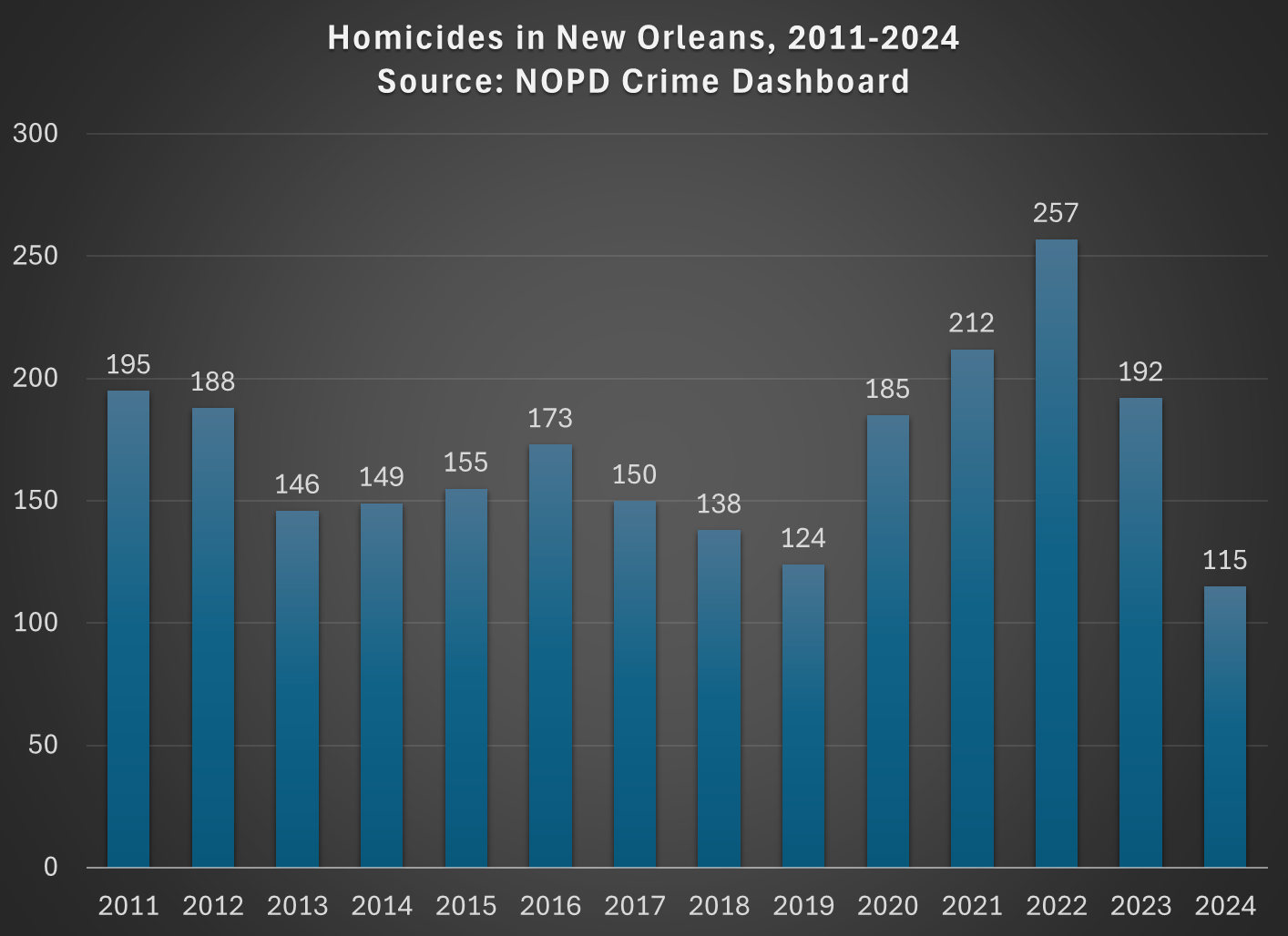
Using data from the New Orleans Police Department dashboard, which has been updated through December 31, 2024, we see that 2024 had the lowest number of homicides going back to 2011, which likely makes it one of the safest years on record in New Orleans:

New Orleans is not alone.

Using data from the Real Time Crime Index, we see that among the 10 largest cities in the US in their index, through the first 10 months of the 2024 (the most recent available for all these cities), homicides are down 16.9% compared to 2023.

Murders in these 10 largest cities are still about 5.6% above the first 10 months of 2019, but three of the 10 cities (Dallas, Philadelphia, and San Diego) are already below the first 10 months of 2019, by fairly significant margins (-13.7%, -26.2%, and -21.6%). Once we have all 12 months of data for these cities, I suspect that a few more will be back to 2019 levels.

Crime is indeed still a major social problem in much of the US, but we are getting back to 2019 levels of social problems — which is still bad, but violent crime is not high and rising, as many seem to believe based on very notable and horrific events.

(The 10 largest cities in the RT Crime Index are Chicago, Dallas, Houston, Las Vegas, Los Angeles, New York, Philadelphia, Phoenix, San Antonio, and San Diego.)

2024 in Books

Quick thoughts on what I read in 2024- though note that none of these were published in 2024, since almost all the best stuff is older. First some econ books I reviewed here this year:

Rockonomics– “Alan Kreuger’s 2019 book on the economics of popular music…. a well-written mix of economic theory, data, and interviews with well-known musicians, by an author who clearly loves music.”

We’ve Got You Covered– “Liran Einav and Amy Finkelstein are easily two of the best health economists of their generation.… while I don’t agree with all of their policy proposals, the book makes for an engaging, accurate, and easily readable introduction to the current US health care system.”

The Psychology of Money– “Morgan Housel’s Psychology of Money is not much like other personal finance books…. The book is not only pleasant to read, but at least for me exerts a calming effect I definitely do not normally associate with the finance genre, as if the subtext of ‘just be chill, be patient, follow the plan and everything will be alright’ is continually seeping into my brain.”

One Up on Wall Street– “Peter Lynch was one of the most successful investors of the 1970’s and 1980’s as the head of the Fidelity Magellan Fund. In 1989 he explained how he did it and why he thought retail investors could succeed with the same strategies”

Leave Me Alone and I’ll Make You Rich– “a 2020 book by Dierdre McCloskey and Art Carden…. attempts to sum up McCloskey’s trilogy of huge books on the ‘Bourgeois Virtues‘ in one short, relatively easy to read book”

Non-fiction I didn’t previously mention here:

The Simple Path to Wealth (JL Collins, 2016): the book is indeed simple, and its advice is indeed likely to leave you fairly wealthy in terms of money. One sentence summarizes it well: save a large portion of your income and invest it in VTSAX, and perhaps VBTLX. Easy to read, a bit like reading a series of blog posts, which is how much of the material originated. Good introduction to the lean-FIRE type mentality. But the book, like that mentality, is too frugal and debt-averse for my taste, and I say that as someone much more frugal and debt-averse than the average American.

The Great Reversal: How America Gave Up on Free Markets: Thomas Philippon argues that markets have been growing less competitive in America because of weakening antitrust enforcement, and that this has harmed consumers and productivity. He acknowledges that over-regulation can also harm competition, but clearly thinks antitrust is much more important; I think otherwise and didn’t find the book convincing. He sets European markets as an example for what America should aspire to, which means the book has aged poorly since its 2019 publication. It still of course has some value, and I may do a full review at some point.

The Storm Before the Storm: The Beginning of the End of the Roman Republic (Mike Duncan, 2017): Non-fiction but more exciting than most novels. A story of obvious importance to those who worry about modern republics teetering, but fresh compared to the much more famous events around Julius and Augustus Caesar and the ‘official’ fall of the Republic. Though arguably the Republic fell in the 80s BC, not the 40s- the book explains that Rome was taken over three times in this era by armies seeking political change.

Self-Help Is Like a Vaccine: Essays on Living Better: Nice collection of Brian Caplan blog posts on the subject.

Fiction:

Ivanhoe (Walter Scott, 1819): A particularly medieval telling of the Robin Hood tale, with a focus on the nobility and knights of England at that time. Chivalric romance, trial by combat, storming a castle. Highs are high but it needed an editor, could be cut by at least 1/3 without losing anything.

Kim (Rudyard Kipling, 1901): Three books in one, all excellent: a coming of age story, a spy thriller, and a portrait of the many different types of people and religions to be found in India around 1900. All wrapped together with beautiful English prose that makes heavy use of Indian loan words.

Final Thoughts:

Obviously I’m not Tyler Cowen reading a book a day, unless you count the kids books I read to my 1-year-old. But overall 2024 was a good year, better than I realized before I put this post together. Partly I credit the 1-year-old who wants to take my phone and computer but doesn’t mind when I have a book in my hands.

Red Lobster Out of Bankruptcy Proceedings, Set Up to Be Plundered Again by Private Equity

Red Lobster is a large, historic seafood restaurant chain operating in the U.S. and Canada. Last summer I wrote on how it got driven into bankruptcy: How an All-U-Can-Eat Special Driven by a Controlling Investor Pushed Red Lobster Over the Edge

Red Lobster used to be a pretty profitable business. Then in 2014 its owners sold it to a private equity firm called Golden Gate Capital. This private equity firm promptly plundered Red Lobster by selling its real estate out from under it, with those funds going to the PE firm. Instead of owning their own land and buildings, now the restaurants had to pay rent to landlords.  This put a permanent hurt on the restaurant chain’s profits. I don’t know this as fact, but because it is part of the usual PE playbook, I assume that the PE firm also made Red Lobster issue debt (bonds) so the PE firm could further plunder Red Lobster by having it pay “dividends” to its PE firm owners, using the money raised by issuing the bonds. After this glorious financial engineering, the private equity firm in 2019 sold a 49% stake to a company called Thai Union. Thai Union bought out the rest of Red Lobster ownership from Golden Gate in 2020.

Thai Union did a poor job managing the U.S. based restaurant chain, forcing cost-cutting measures that were counterproductive, and finally forcing a continual all-you-can-eat shrimp special, against the better judgment of on-the-ground Red Lobster management. That shrimp special made Red Lobster buy a lot of Thai Union’s shrimp, but led to large losses last year. The business had been suffering for a couple of years, with Covid shutdowns and competition from nimbler eateries, but the losses from the shrimp special sent it scurrying for bankruptcy protection back in May.

There are two main flavors of business bankruptcy. The direst form is Chapter 7, where the assets of the firm are sold off to meet obligations to creditors, and the firm goes out of business.

The more common form is Chapter 11, where the intent is to keep the business going (see Appendix). Somebody gets stiffed in the process, of course. Usually, common shareholders get almost nothing except maybe a reduced number of shares in the reorganized company. Preferred shareholders often get a few more shares. Unsecured bondholders may get 30-40 cents on the dollar as a settlement, or a reduced amount of bonds in the new company, or maybe stock shares. Sometimes the company will issue a new set of bonds which are “senior” to the old bonds, which reduces the value of old bonds. Other unsecured creditors like vendors may get something like 50 cents on the dollar.  

Secured creditors are higher up in the pecking order, and so often get higher recoveries. (The “covenant” for a bond or loan would specify if the loan is secured by, say, the value of the equipment in the restaurant).

Red Lobster restaurants have kept operating this year (2024), while creditors were kept at bay via the protection offered by the bankruptcy filing. As of September, Red Lobster emerged from the chapter 11 bankruptcy. A private equity group has taken over operations. They have injected some $60 million cash, which is actually not very much for this situation.

I was curious about what happened to Red Lobster’s creditors, such as vendors and bond holders. A first-level internet search, even with AI help, did not tell me how they fared as part of the settlement. I had read earlier this year that Red Lobster had something like $ 1 billion in debt, so I assume that a lot of bondholders got stiffed in this process.

In May the company announced that it had “ voluntarily filed for relief under Chapter 11 of the Bankruptcy Code in the United States Bankruptcy Court for the Middle District of Florida. The Company intends to use the proceedings to drive operational improvements, simplify the business through a reduction in locations, and pursue a sale of substantially all of its assets as a going concern…Red Lobster’s restaurants will remain open and operating as usual during the Chapter 11 process, continuing to be the world’s largest and most-loved seafood restaurant company. The Company has been working with vendors to ensure that operations are unaffected and has received a $100 million debtor-in-possession (“DIP”) financing commitment from its existing lenders.”

The “working with vendors” is an important piece here. When I peered at the official Red Lobster court bankruptcy website to try to glean more intel on the fate of the creditors, there was a list of leading “Unsecured Creditors”. These included Pepsico (supplying beverages) and Gordon Food Services, a major Canadian food supplier, as well as the owner of the store properties (Realty Income Corporation), which was presumably owed a lot of unpaid back rent.

Ironically, after one private equity firm plundered Red Lobster, then sold it to the hapless Thai Union (which ended up taking a $540 million write-down on their investment), the restaurant chain is now in the hands of yet another PE firm. I could not find definite information on the deal, but again we may assume that the PE firm got the creditors (bondholders, vendors, etc.) to accept “haircuts” on what they were owed, as opposed to getting almost nothing if Red Lobster went Chapter 7 and shut down. Thus, the new PE firm will start off with a relatively virgin company to plunder again.

My Brave AI search agrees with that assessment:

The company’s restructuring efforts may prioritize the interests of new investors and creditors over those of existing bondholders, potentially resulting in a less favorable outcome for bondholders… It is likely that the bondholders will be subject to a restructuring plan that may involve debt forgiveness, debt-for-equity swaps, or other arrangements that could result in a loss of principal or interest for the bondholders.

Side comment: If you, too, want to feed at the trough of private equity, there are a number of PE firms you can buy stock shares in so you can join in their profits. See 50% Endowment Returns Driven by Private Equity Investments: How Rich Universities Get Richer (But You Can, Too) .

APPENDIX: EXPLANATION OF CHAPTER 11 BANKRUPTCY

The text below is from the North Carolina bankruptcy law firm Stubbs Perdue:

Chapter 11 bankruptcy is a legal process that allows businesses to reorganize their debts and operations while continuing to operate. Unlike Chapter 7, which involves liquidating assets to pay off creditors, Chapter 11 aims to restructure a company’s obligations to improve financial stability and pave the way for future growth. Chapter 13, on the other hand, is typically reserved for individuals with a regular income, focusing on debt repayment plans.

Typical Chapter 11 Process

Chapter 11 process typically involves several key steps:

  • Filing the Petition: The process begins with the company filing a petition in bankruptcy court.
  • Developing a Reorganization Plan: The company works with its creditors to create a plan that outlines how it will restructure its debts and operations.
  • Negotiating with Creditors: The plan is subject to approval by the court and the creditors, who may negotiate the terms to protect their interests.

Throughout this process, the court plays a supervisory role to ensure fair treatment of all parties involved.
Blake Lively and disinformation tipping points

For those who missed the big story last week, it turns out that Blake Lively’s director and co-star, Justin Baldoni, feared that he was going to be publicly outed as an abuser and subsequently instructed his publicity team to start a preemptive disinformation campaign against her. The story is hot because the cache of subpoenaed text messages are the seeming definitition of “overwhelming evidence” and “receipts”, the victim is a prominent woman, and the activities in question are heinous. Which is all true, but I’m interested because 1) it seems to have really, honestly worked and 2) is was relatively cheap and easy, all to an extent that even surpised the alleged perpetrators.

We all know about Russian disinformation efforts at this point, but those are are the products of a government agency. They have enormous resources at their disposal. This internet campaign to pre-emptively attack and discredit a woman who is the (alleged) victim of gratuitous harassment was carried out by a small band of publicists, agents, and their team of assistants. This isn’t a billion dollar operation. This isn’t even a million dollar operation. This is a project carried out over cronuts and text messages by middle brow entertainment business aspirants looking to climb the ladder in between improving their scores at Orange Fitness.

What I’m saying is that disinformation scales faster and easier than I would have ever guessed and I don’t think I’m alone. A couple reddit threads, instagram and tik-tok posts, and tweets, all posted by accounts run and backpocketed by the publicity agency for precisely these purposes, and within hours the world has turned on a single human in a wave of disapprobation. A woman, you’ll recall, who had done absolutely nothing that would seemingly be able to give traction to public shaming.

This is a massive technology shift. If there is a final lesson to 2024, it’s we don’t know what’s real and what’s manufactured news. Worse still, those who would proclaim to be the least trusting are generally those that are the easiest to mislead, falling down endless rabbit holes of conspiracy theory and fabrication. Those conspiracy theories are fun to laugh at (and I suspect even more fun to believe with your whole heart), but I don’t think conspiracy theory falsehoods are the only plague going forward. It’s going to be joined by a growing trend of informational nihilism, an inabiilty to trust any news or information source.

It’s not that hard for me to imagine a swirling, vicious online discourse between left and right wingers, each fully enveloped in their cozy echo chambers of conspiracy and confirmation bias, while their more moderate (and numerous) peers simply drop out of the conversation entirely, unable to see the bits and bytes flying back and forth as anything more than unverifiable noise.

What happens to a democracy when the median voter believes in nothing?