ASSA 2024: Unrejected

Is this the year the world’s largest economics conference settles into its new normal? ASSA 2024 starts in San Antonio today.

Like most conferences, the Allied Social Science Association took a big hit during the pandemic. Unlike most other conferences, a big fraction of this hit appears to be permanent. Part of what made ASSA so popular was that it was the site of most 1st-round job interviews for economists, but the pandemic made this shift to remote interviews. The American Economic Association decided the job market was better that way, so they made the arrangement permanent.

This shrunk their conference by about half compared to pre-2020; overall I thought it was still fine last year, but that the transition creates a problem:

The big problem with attendance falling to 6k is that they’ve planned years worth of meetings with the assumption of 12k+ attendance. Getting one year further from Covid and dropping mask and vaccine mandates might help some, but the core issue is that 1st-round job interviews have gone remote and aren’t coming back. The best solution I can think of is raising the acceptance rate for papers, which in recent history has been well under 20%.

I suspect the AEA is starting to take my advice. Acceptance rates ticked up slightly in 2023 (from 7% to 9% for individual papers, and from 16% to 30% for complete sessions). They have yet to release full information on acceptance rates this year, but my own experience indicates that this summer they realized they had a problem. I got a rejection email in July that said:

We were able to accept less than one third of the more than 1,150 submissions for paper or poster sessions.

This was followed by something I’ve never seen from an economics conference before- a rejection of the rejection:

You have probably already received an email saying your paper which you submitted for the American Economic Association program at the meeting in San Antonio, TX in January 2024 was not accepted. However, the AEA has decided to select a few more papers for the poster session.

I am pleased to inform you that your paper entitled

Certificate of Need and Self-Employment


which you submitted for the American Economic Association program, has been selected to be part of the AEA’s poster session.

This sums up my relationship to the core of the profession nicely: I’m exactly on the margin of it. But this time, just barely on the right side of it, helping them fill up a newly-oversized hotel block.

The odds aren’t what they were in the mega-conference days before 2020, but I expect I’ll still see some of you in San Antonio.

The Shrinking Allied Social Science Association

For many decades the Allied Social Science Association (ASSA) meetings, anchored by the American Economic Association, have been by far the world’s largest gathering of economists each year, typically attracting well over ten thousand. But the meetings went virtual-only for the past two years, and when they finally return in-person in 2023 they will likely be substantially diminished.

Some of this is due to potentially one-off factors; some people don’t want to travel to Louisiana because of its state laws, some still want to avoid large conferences because of Covid, others want to avoid the ASSA’s response to Covid:

All registrants will be required to be vaccinated against COVID-19 and to have received at least one booster to attend the meeting…. High-quality masks (i.e., KN-95 or better) will be required in all indoor conference spaces.

But the AEA made one big, apparently permanent change that means it could be a long time before we see a meeting as big as January 2020’s in San Diego- they gave up the job market. Prior to Covid the vast majority of first-round interviews to be a full-time US economics professor took place at ASSA. Naturally interviews moved online during Covid, but surprisingly the AEA has asked that they stay online, and in fact has specifically asked schools NOT to schedule interviews during ASSAs. This removes a huge source of demand for the meetings- the ~1200 new PhDs looking for their first jobs, the thousands of people there to recruit them (each hiring school typically sends 2-4 interviewers), and everyone trying to switch jobs. This was THE big thing that made AEAs special, that other conferences didn’t really have.

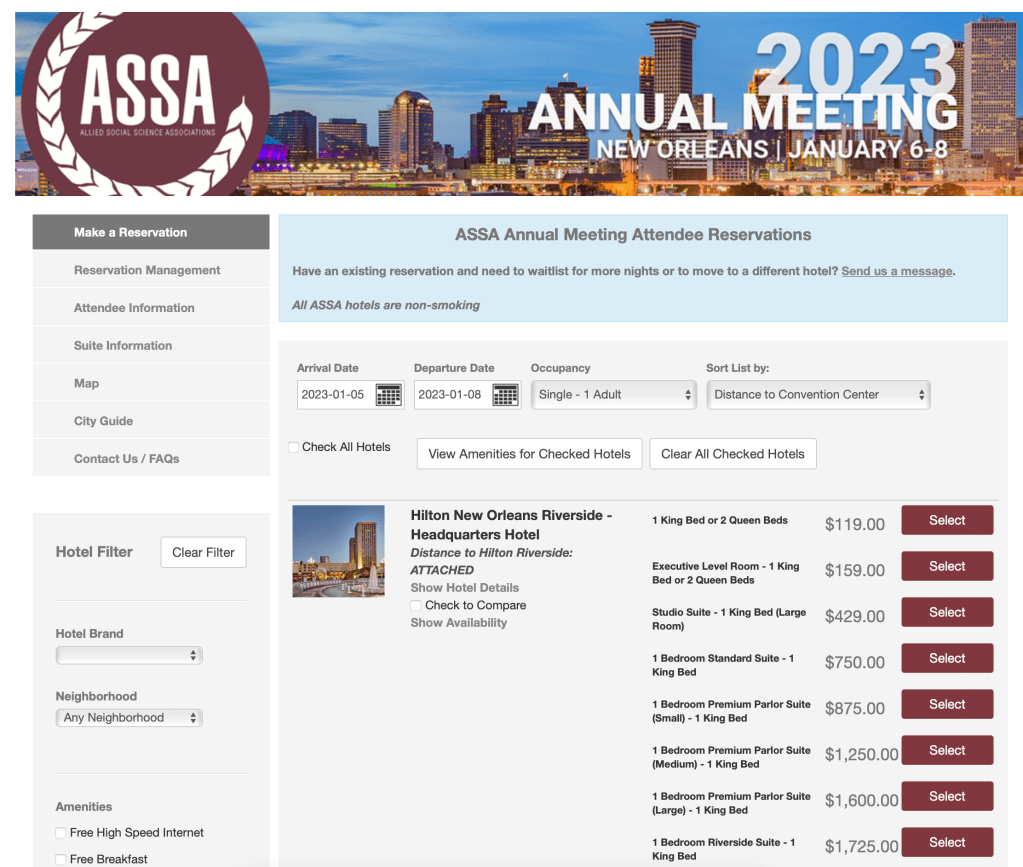
I’ll let everyone else debate whether this makes the job market better or worse; I’m agnostic there, but I’m sure it will shrink the conference. One silver lining to a smaller conference is that it is much easier to find a hotel room. Like usual I was waiting on the AEA website this Tuesday to book a hotel room on the first minute the AEA’s deeply discounted hotel blocks opened, because the good hotels tend to fill up near-instantly. But it appears this was unnecessary this year- two days later and even the headquarters hotel is still wide open:

I got the room I wanted at the Hotel Monteleone; I’ll be looking to grab a spot on the Carousel Bar, maybe see some of you there. I’ll present a poster at AEA, but mostly I’m just looking forward to spending real time in New Orleans for the first time since I moved away in 2017.

Yes, it rotates while you sit and drink

So I’m still looking forward even to a diminished AEA, but it does make me wonder- which other conferences will benefit most from AEA’s decline? I don’t know that anyone has put together the numbers for all the conferences enough to know what the 2nd-largest is, but my bet both for the 2nd-largest and most likely to benefit is the Southern Economic Association; I’ll be there too, in Ft. Lauderdale this November.