Joy on The Inductive Economy podcast

I got to be a guest of Vignesh Swaminathan who is based in Mumbai. It’s fun to have a deep conversation with someone on the other side of the world and share it with the whole internet (and the AI’s).

Apple podcast link: https://podcasts.apple.com/us/podcast/dr-joy-buchanan-on-understanding-economics-through/id1719744197?i=1000652541934

Blogpost with links and timestamps: https://www.inductive.in/p/dr-joy-buchanan-on-understanding

The first 10 minutes are about Tyler’s GOAT book. Vignesh asked me to name some influential economists who did not make Tyler’s list.

Around minute 12 we talk about the experimental economics methodology.

The middle (minute 15-42) is a discussion of the pipeline into tech and my Willingness to be Paid paper. He adds his perspective on tech jobs in India.

Around minute 42, Vignesh makes a switch over to the Barbie movie and then Oppenheimer. He observes that Oppenheimer is a “brand.” I speculate on careers in Barbieland. We recorded this before Christmas of ’23, right after everyone had seen these summer movies. Both movies ended up in the 2024 Oscars awards ceremony.

I predicted that people will eventually be able to create a custom movie from a verbal prompt, because of the AI content revolution. Here in Spring of ’24 that has already come true. Sora is shocking everyone and even caused Tyler Perry to halt a physical film studio expansion.

Around minute 55, we pivot to Hayek and competition, which leads to a postmortem on Google Plus (RIP).

1:05-1:16 features intellectual property and my IP experiment with Bart Wilson

Ended with rapid-fire and personal questions.

Skimming back through this conversation has me thinking about tech work. The market for IT workers and programmers has evolved since I first started the project that became “Willingness to be Paid: Who Trains for Tech Jobs?”

I like pointing people all the way back to this report on jobs from 1958. Learn to Code has been good advice for a long time, for the people who can tolerate the work. That does not mean it will be true forever, but I would argue that it is still true today.

Silicon Valley as a career might have peaked around 2021. It’s not going away, but it might not be growing anymore in terms of the number of talented people who can be absorbed there. (Might I suggest Huntsville instead?)

The WSJ recently ran a story “Tech Job Seekers Without AI Skills Face a New Reality: Lower Salaries and Fewer Roles”

The rise of artificial intelligence is affecting job seekers in tech who, accustomed to high paychecks and robust demand for their skills, are facing a new reality: Learn AI and don’t expect the same pay packages you were getting a few years ago.

Jobs in areas like telecommunications, corporate systems management and entry-level IT have declined in recent months, while roles in cybersecurity, AI and data science continue to rise, according to Janco’s data. The average total compensation for IT workers is about $100,000, making the position a target for continued cost-cutting.

One reason tech jobs are less attractive than some other professional paths is that the skillset changes. We mentioned this as a drawback in our policy paper. Computers are constantly changing. Vignesh and I discuss the issue of risk. I suggested that companies could pay less for talent if they were willing to offer packages that carry less risk of getting fired.

Nevertheless, tech still has decent job prospects. An unemployment rate of about 5% is about normal for work, even though tech had seen lower rates at the peak of demand. I do not know what programming as a career will look like in 10 years, but I’d say the same about screenwriting and live sports commentary. The LLMs are coming for everything or nothing or something in between.

I’ve been on tour (regionally) with our ChatGPT paper and getting opportunities to query different audiences about their LLM use. Last week I talked to a young man in our business school who is using ChatGPT to write SQL code at his job. I said in the podcast that I would still advise young people in Alabama to learn to code, even if they are not going to move to Silicon Valley. I think coding is more fun in the LLM-age or at least less miserable.
Maia on the Barbie movie

Where is my 600 words on the Barbie movie? I’m trying to get ready for the Fall semester, which includes two classes that I have never taught before. In the university slang, that would be “two new preps.” There is someone out there living my dream of dropping hot current cultural takes on schedule. I’m going to direct you over to Maia Mindel. Along with Adam Minter, she is someone I would love to meet.

Maia wrote this killer tweet:

The following are links to Maia’s posts:

The Economics of the Barbie Movie: She’s everything. He’s just Ken. (Maia has earned today’s post a parenting tag because she brings in the economics of motherhood.)

Life In Plastic Ain’t So Fantastic: The girlypop economics of Barbie “… she’s always been about being a young professional, living on her own, and hanging out with her friends and boyfriend (not husband) Ken”

Maia even did something relevant leading up to the release of the movie: House of the Mouse: Disney Princesses have only been an official thing for 18 years. Why?

For more economics of Barbie, Jeremy wrote “Barbie Dolls and Women’s Wages“. “… the gains for women in the labor market since the introduction of Barbie are large and worth celebrating.”

For more on film, I did list some thoughts and links for Oppenheimer.

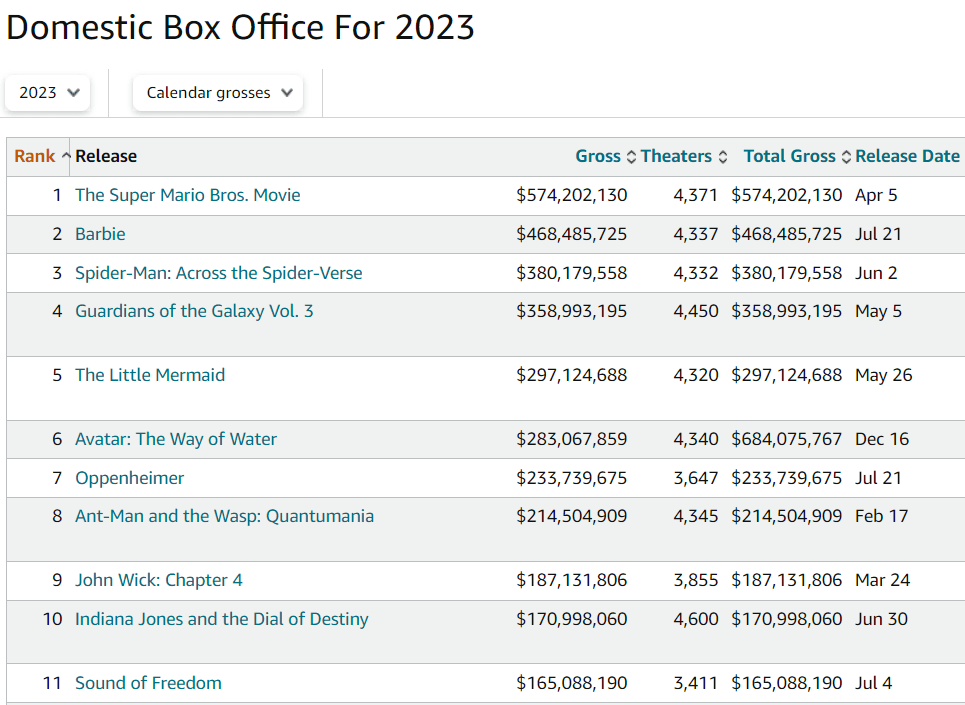
Here is the Box Office Mojo report on 2023 American theater sales, as of August 2023. In less than a month, Barbie reached #2! And Oppenheimer is doing well for a serious historical movie.

Barbie Dolls and Women’s Wages

I was reading “The Ultimate Guide to Barbie” the other day, and I noticed an interesting piece of data towards the end of the magazine: the original Barbie doll in 1959 retailed for $3. Today, according to the magazine, a Barbie costs around $14-19. And they further told us that adjusted for inflation, that $3 original Barbie is about $24 today.

I’m not sure exactly where they got that number. Using the BLS CPI tool, it’s more like $31.50. And while I appreciate the attempt to give us historical context, I think for the typical reader will still be a bit perplexed. What does it mean to say $3 in 1959 is equal to $24 (or $31.50) today? Well, it means that the price of Barbie dolls has risen more slowly than other goods and services (quality adjusted). But I think we can do better on the context.

Here’s my best attempt to give context:

The chart shows the number of minutes of work that the median woman would need to work to purchase a Barbie doll for her daughter. In 1959, it took almost 2 hours of work. Today, it takes only about a half hour (I’m using the lower range from the magazine, $14 for a Barbie today, although there are plenty of $10-11 Barbies on Amazon).

Another way of thinking about it: with the same amount of work, a working mother today could buy her daughter 3-4 times as many Barbies as her counterpart in 1959.

I deliberately used median female wages here to make another historical comparison. Women’s earnings have increased much more than men’s since 1959. Back then, median female earnings for full-time, year round workers was only 61% of male earnings. Today, it is close to 85%. True, that’s still not parity. And for those that know the history, you will also know that the closing of that gap has stagnated in recent years. But this is still some major progress during the Barbie Era.

Finally, as I have emphasized before, looking too much at the cost of one product over time has limits. What about other goods and services? A toy, even a well-known brand like Barbie, is a tradable good that can be manufactured anywhere in the world (it looks like Indonesia is where many Barbies are made today). So it wouldn’t be surprising that it has got cheaper over time. But what about all goods and services?

Here’s where inflation adjustments are most useful. Not for individual goods and services, but for looking at incomes over time. How much stuff can a given income purchase compared to the past? That’s what inflation adjustments are for. And this chart shows male and female median earnings in 1959 and 2023, with the 1959 figures adjusted to 2023 dollars using the PCE price index.

When we adjust for changes in all prices, not just Barbies, we can see that median female earnings have roughly doubled between 1959 and 2023. That’s not quite as robust as the “Barbie standard of living,” which allows you to purchase 3-4 times as many dolls. But 2 times as much stuff is pretty good. It’s especially good when compared with male earnings growth, which grew about 44 percent.

It should be obvious here that these are just the raw medians, not controlling for anything like education, experience, or occupational choice. Controlling for those will shrink the gap a bit more. But the gains for women in the labor market since the introduction of Barbie are large and worth celebrating.