When will housing prices fall?

US housing prices shot up during the pandemic. People spending all day at home wanted bigger houses, and the Fed fueled their demand with low interest rates. But home owners didn’t want to sell- the total number of homes on the market is less than half what it was a year ago. This combination of rising demand & falling supply has sent prices way up & cut the time homes spend on the market.

Contrary to popular belief, its actually rare for economists to make market forecasts and most of us aren’t especially well-equipped to do so- but I’m going to try anyway! I think home prices will almost certainly stop growing so quickly, and may actually fall, within two years.

Why? The end of the pandemic, the rise of new construction, and the end of low interest rates.

Continue reading

Covid Pandemic Diary Part 2

I pick up from my previous post in May 2020.

That tweet from early May captures some of the joys and frustrations of working from home with small children. It was hard to get work done. My career suffered. At the same time, in my case, there were happy moments. My kids got more time with me and also with each other. One reason I didn’t go crazy is that we could get outside and the weather was decent throughout “lockdown”.

Something that happened quietly is that two-income parents hired private nannies and never mentioned it on social media. I know there are lots of families who did not do that and had a hellish year trying to parent while working from home. In my case, daycare was back open in June with extra health precautions.

Late Spring was a time when it seemed like the United States might be the worst-performing country. Certain parts of Asia were models of efficiency and cooperation, by comparison.

Late May is when I breathlessly tweeted that I had purchased a box of masks. Finally, the supply caught up with demand. Masks became plentiful and cheap. That helped us find ways to be together without such a high chance of spreading germs.

July 2020 – My public school system (which had gone virtual in the Spring) announced that elementary parents would have a choice of in-person (with masks) or virtual for the Fall. Our schools have been open all year (with masks) and no major outbreaks.

High school and middle school students did more forced remote days than elementary-aged kids. I really appreciated the creativity and flexibility. Remote school is harder on younger kids (and parents of younger kids).

I emailed my city representative to ask for a drive-through testing site in our city. He said he would bring it up at the council meeting that night. Within two weeks, they had done it! This was incredible. I did not expect that because of one request this would suddenly just happen. I suppose there were enough people who wanted it already. It probably helped that city council elections were right around the corner and he could take credit for doing something helpful. Twice in 2020, I used my city hotline to get an appointment for a Covid test.  

In August, my university got ready to bring students back for some in-person classes, while also offering remote options for every class. The campus sprouted one-way walking stickers and masks were required everywhere.

Economists moved conferences online. On September 10, 2020 I stayed up a little late to catch one of my Chinese colleagues presenting at the ESA worldwide virtual conference. My daughter didn’t want to stay in bed, so I let her stare at the Zoom meeting for a bit.

I have said nothing so far about politics in 2020, the year of politics. The televised debate between President Trump and now-President Biden in September of 2020 was a stressful event for me. If we can’t even speak to each other, then no amount of good ideas will help us solve problems. That sad moment in American history made me more determined to maintain this blog as a place to talk about ideas.

The Fall of 2020 was when intellectual soldiers like Alex Tabarrok were alerting us to the fact that we could have vaccines if the government would let us. I was following that news and doing some signal-boosting. Some of my friends on social media announced that they were participating in vaccine trials – thanks!

My university offered rapid tests to employees at the end of the Fall semester. It almost felt like a miracle to be able to just know in 15 minutes if I was carrying Covid or not (yes, I know about the false negatives).

There were moments in peak-wave when local hospitals were full because of Covid. Alabama’s worst month as measured by deaths was January 2021. When Covid was spreading widely in December 2020, I believe a lot of people did not expect that vaccines would be available so soon in the future. On the margin, a few more people might have foregone holiday parties if they had known.

Vaccines became available to medical professionals around January 2021. That was exciting news, since we had all been feeling bad about the doctors and nurses treating infectious Covid patients.

Earlier than I expected, I was able to get the Pfizer vaccine because of my “educator” status in the state of Alabama. It is convenient that I live near UAB hospitals. They had the technology for cold storage and administering the Pfizer vaccine. It was a huge relief to get the vaccine while teaching in-person classes. Since I had been following vaccine news closely, it felt like a huge achievement.

There was a period of time when conversation among my neighbors and colleagues revolved around the vaccine. Water cooler talk was “which one did you get?” or “did you have side effects?”  People told stories about how a friend called to tell them that one place had extra doses at the end of the day. Even when it was technically reserved for old people only, some young people found connections. One of my students told me he wouldn’t be in class because he was going to drive 6 hours to another state to get a vaccine. I don’t want to make the system sound corrupt, because it largely was not. It’s just a fact that some places couldn’t distribute all of their doses to the people who were designated for them. It was better to get the leftovers into arms than waste them.

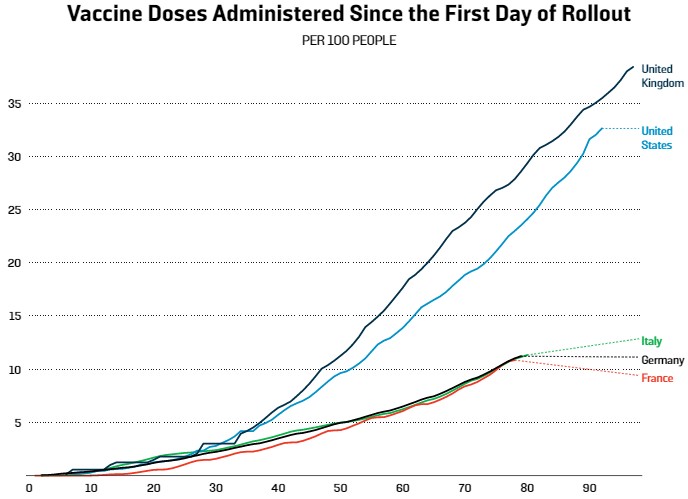
I treasured that energy, and I miss it. Now, in May 2021, after all the work that went into producing vaccines, Americans are refusing to show up for shots.

Covid Pandemic Diary Part 1

Last week on Twitter, a writer in France reached out for accurate information about what is going on the US right now with regard to vaccines.

This got me thinking about the value of narratives and true stories. I’m going to chronicle a few of the Covid events experienced by me personally. Myself and the adults in my family are fully vaccinated, so life is starting to feel normal again, even though I still wear masks in many public places. I’d like to write this down in case it is useful and so that I don’t forget it.

Continue reading

Blood Clots for You and Me

On April 13, 2021, CDC and FDA recommended a pause in the use of Johnson & Johnson’s Janssen COVID-19 Vaccine. When I first heard that the FDA was pausing the J&J vaccine because of less than 10 blood clots out of millions of patients, I thought I’d really get to the bottom of blood clots and blog about it. Other people (some of them are the kind of doctor that helps people) have already done a pretty good job in the past few days.

First, it is a tragedy that the vaccine is not being give to every male over 50 who wants it. Doing so would free up many thousands of other types of vaccines for young women.

Continue reading

Teaching Economics with COVID

In many of my blog posts I address either issues related to COVID or teaching economics. In this post, I want to combine the two. One thing economists of a certain age struggle to do is find examples to illustrate economic concepts which will actually connect with 18-22 year olds. The silver lining of the pandemic is that we now have an example that everyone is familiar with, and can be used to illustrate a host of economic concepts.

A great new book by Ryan Bourne, Economics in One Virus, really pushes this idea to the limit. He uses examples related to COVID to explain almost every single concept you would cover in a typical introductory economics course: cost-benefit analysis, thinking on the margin, the role of prices, market incentives, political incentives, externalities, moral hazard, public choice issues, and more.

Continue reading

Emily Oster on Vaccines in February 2021

My third post on Covid data heroes features Dr. Emily Oster. Emily is a mom. Lot’s of economists are moms, but few have incorporated it quite as much into their careers. Emily has written a book on pregnancy and a new one on what to do with the kids after they are born. She does a great job explaining scientific research in a way that is easy to understand.

Emily made a big push to collect data on schools and covid back when there was crippling uncertainty about how dangerous it is to let children go to school in person.

She has a great email newsletter and substack. Her latest post is called “Vaccines & Transmission Redux Redux”. In this post, she distills the latest research to give practical advice on when kids can see grandparents once the vaccines are out.

For a long time now, some families have been avoiding close contact with elderly relatives. When can we go back to normal?

Continue reading

Coase and COVID

Update: I added a comment on the post to clarify why I don’t think that having seniors stay at home is the correct Coasean solution. In short: social isolation has high costs!

Bryan Caplan has an interesting post on COVID and reciprocal externalities. Caplan starts off with the straightforward Coasean statement: “Yes, people who don’t wear masks impose negative externalities on others. But people who insist on masks impose negative externalities, too.”

For those not familiar with Coase’s 1960 article, one of his fundamental insights about property rights is that when property rights are not clearly defined, both parties can be imposing costs on one another. The externalities are reciprocal, not just in one direction. The efficient outcome, when bargaining is not possible, is to allocate the property right such that the “least cost avoider” is the one that adjusts their behavior. In other words, you allocate the property right to the party who would obtain the property right if bargaining were possible.

But Caplan uses this Coasean framework to come to the opposite conclusion that I would. Why?

Continue reading

Going back to the gym?

Who doesn’t want to be stronger? You can get on the floor and do 5 pushups right now. Did you do it? Probably not. (If you did, great work.) For most people, nothing is stopping you from getting strong, except yourself.

I just keep sitting around. Going to a gym and meeting with an instructor in person used to be a way around this problem. This takes our human foibles and makes them work to our advantage. The sunk cost fallacy can work for us.

If you bought a stock and it’s a loser, you should sell! Too many people keep holding and go down with the ship.

However, knowing themselves, many people also go to the gym and sign up for a class. Not wanting to walk away from their investment, they actually do the classes.

The WSJ reports that many gyms are closing after Covid-19 forced the customers out. The article describes the machines people have brought into their homes to replace gyms. The Peloton is a signature of the year 2020. The new trend brings a live human trainer into the process of exercising alone at home.

The new machines can collect data on the user. This data is transmitted to instructors and maybe even friends. Now, from the comfort of your own home, you can “sign up for a class” again.

Had Covid struck in 1980, people might have bought fitness machines for their basements and they might even have bought a VHS to pop in and exercise with. But they would have been missing the link to a human who knows where they are supposed to be, which apparently provides more motivation.

The market has loved Peloton and smart money seems to think it will continue to do well, even with a vaccine already rolling out.

Continue reading

Excess Mortality in 2020

My last post of 2020 tried to end the year on an optimistic note: the rapid innovation of a new vaccine was truly a marvel. But I also warned you that I would have a post in the new year talking about the deaths of 2020 during the pandemic. And here it is.

Throughout 2020, I have tried to keep up with the most recent data, not only on officially coded COVID-19 deaths, but also on other measures. An important one is known as excess mortality, which is an attempt to measure the number of deaths in a year that are above the normal level. Defining “normal” is sometimes challenging, but looking at deaths for recent years, especially if nothing unusual was happening, is one way to define normal. The team at Our World in Data has a nice essay explaining the concept of excess mortality.

One thing to remember about death data is that it is often reported with a lag. The CDC does a good job of regularly posting death data as it is reported, but these numbers can be unfortunately deceptive. For example, while the CDC has some death data reported through 51 weeks of 2020, but they note that death data can be delayed for 1-8 weeks, and some states report slower than others (for reasons that are not totally clear to me, North Carolina seems to be way behind in reporting, with very little data reporting after August).

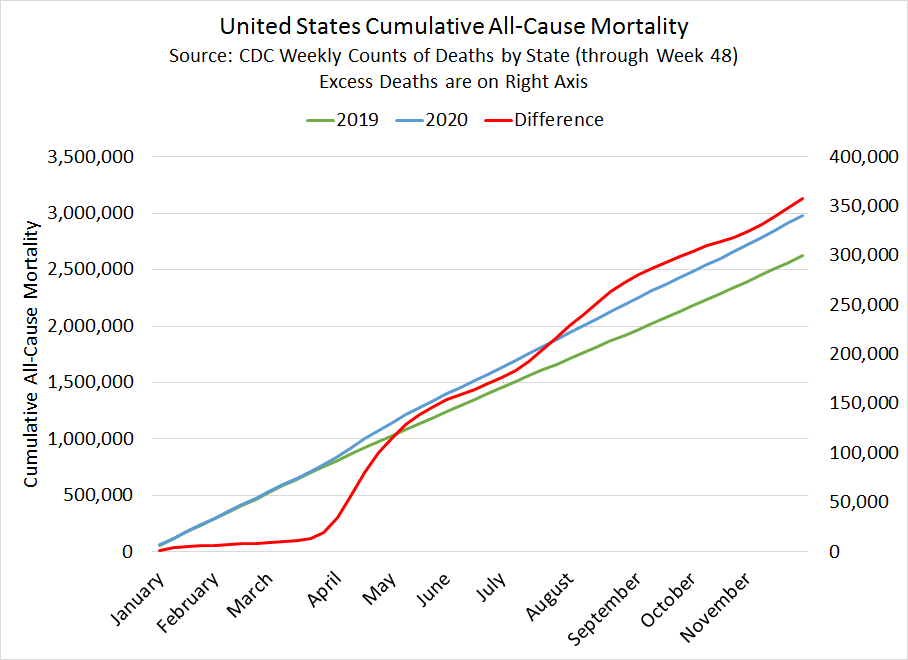
So there’s the caution. What can we do with this data? Since 2019 was a pretty “normal” year for deaths, we can compare the deaths in 2020 to the same weeks of data in 2019. In the chart at the right, I use the first 48 weeks of the year (through November), as this seems to be fairly complete data (but not 100% complete!). The red line in the chart shows excess deaths, the difference between 2019 and 2020 deaths. From this, we can see that there were over 357,000 excess deaths in 2020 in the first 11 months of the year, or about a 13.6% increase over the prior year.

Is 13.6% a large increase? In short, yes. It is very large. I’ll explain more below, but essentially this is the largest increase since the 1918 flu pandemic.

Continue reading