Portfolio Efficient Frontier Parabolics

Previously, I plotted the possible portfolio variances and returns that can result from different asset weights. I also plotted the efficient frontier, which is the set of possible portfolios that minimize the variance for each portfolio return.* In this post, I elaborate more on the efficient frontier (EF).

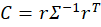
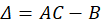
To begin, recall from the previous post the possible portfolio returns and variances.

From the above the definitions we can see that the portfolio return depends on the asset weights linearly and that the variance depends on the asset weights quadratically because the two w terms are multiplied. Since the portfolio return can be expressed as a function of the weights, this implies that the variance is also a quadratic function of returns. Therefore, every possible portfolio return-variance pair lies on a parabola. So, it follows that every pair along the efficient frontier also lies on a parabola. Not every pair lies on the same parabola, however – the efficient frontier can be composed on multiple parabolas!

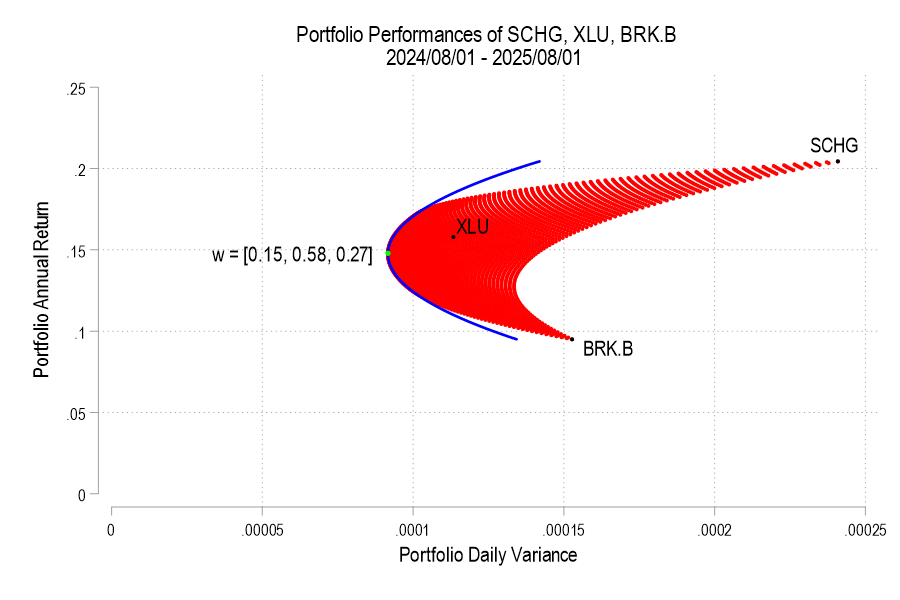
I’ll use the same 3 possible assets from the previous post, below is the image denoting the possible pairs, the EF set, and the variance-minimizing point.
One way to find the EF is to calculate every possible portfolio variance-return pair and then note the greatest return at each variance. That’s a discrete iterative process and it definitely works. One drawback is that as the number of assets can increase the number of possible weight combinations to an intractable number that makes iterative calculations too time consuming. So, we can instead just calculate the frontier parabolas directly. Below is the equation for a frontier parabola and the corresponding graph.
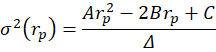
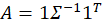
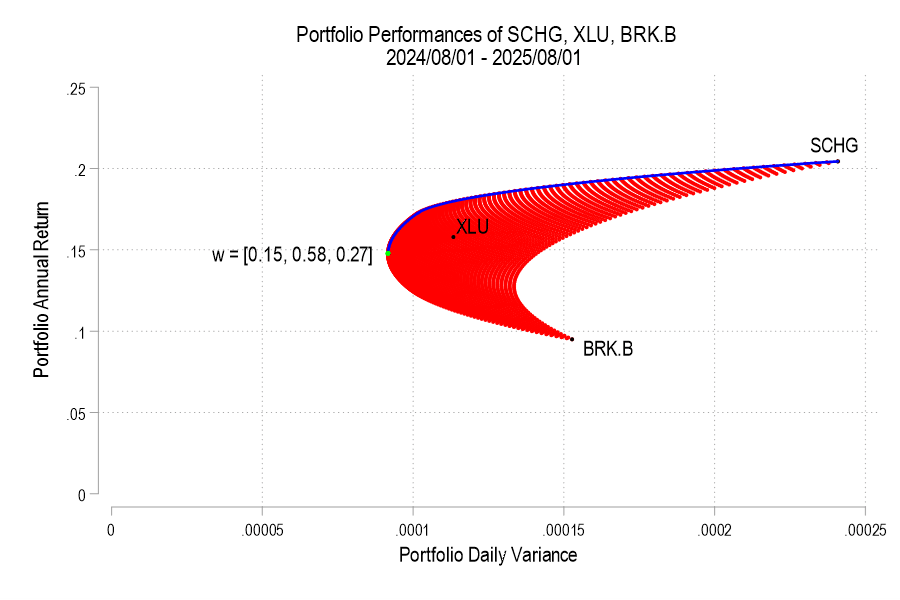
Notice that the above efficient frontier doesn’t appear quite right. First, most obviously, the portion below the variance-minimizing return is inapplicable – I’ve left it to better illustrate the parabola. Near the variance-minimizing point, the frontier fits very nicely. But once the return increases beyond a certain level, the frontier departs from the set of possible portfolio pairs. What gives? The answer is that the parabola is unconstrained by the weights summing to zero. After all, a parabola exists at the entire domain, not just the ones that are feasible for a portfolio. The implication is that the blue curve that extends beyond the possible set includes negative weights for one or more of the assets. What to do?

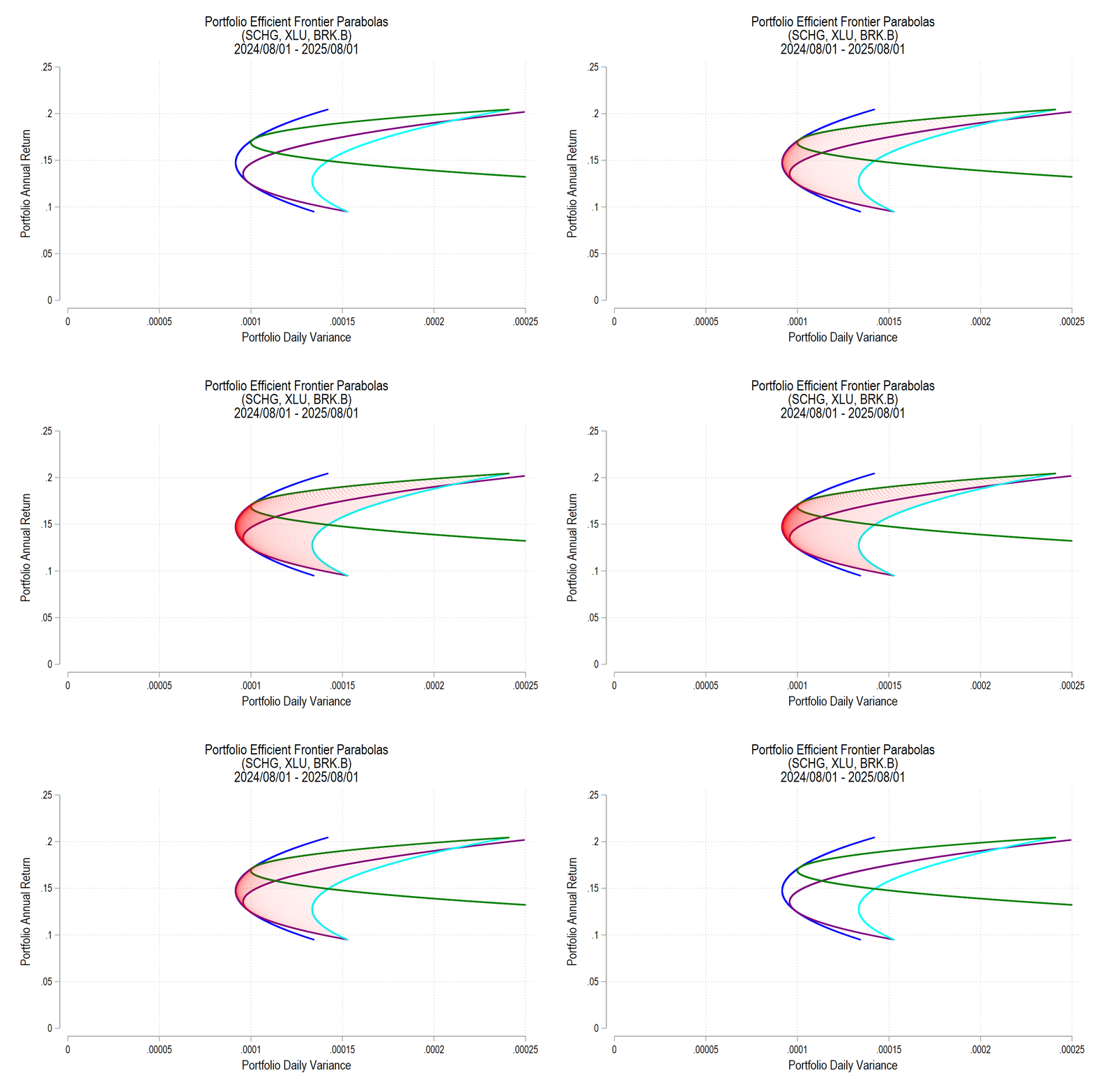
As we deduced earlier, each pair corresponds to a parabola. So, we just need to find the other parabolas on the frontier. The parabola that we found above includes the covariance matrix of all three assets, even when their weights are negative. The remaining possible parabolas include the covariance matrices of each pair of assets, exhausting the non-singular asset portfolios. The result is a total of four parabolas, pictured below.
Continue reading

Avoiding Intertemporal Idiosyncratic Risk

Hopefully by this time we all know about index funds. The idea is that by investing in a large, diversified portfolio, one can enjoy the average return across many assets and avoid their individual risk. Because assets are imperfectly correlated, they don’t always go up and down at the same time or in the same magnitude. The result is that one can avoid idiosyncratic risk – the risk that is specific to individual assets. It’s almost like a free lunch. A major caveat is that there is no way to diversify away the systemic risk – the risk that is common across all assets in the portfolio.

We can avoid the idiosyncratic risk among assets. But, we can also avoid idiosyncratic risk among times. Each moment has its own specific risks that are peculiar to it. Many people think of investing as a matter of timing the market. However, people who try to time the market are actively adopting the specific risks that are associated with the instant of their transaction. This idea seems obvious now that I’m writing it down. But I had a real-world investing experience that– though embarrassing in hindsight – taught me a heuristic for avoiding overconfidence and also drilled into my head the idea of diversifying across time.

I invested a lot into my preferred index fund this past year. I’d get a chunk of money, then I’d turn around and plow it into the fund. What with the Covid rebound, it was an exciting time. I started paying more attention to the fund’s performance, identifying patterns in variance and the magnitude of the irregularly timed and larger changes. In short, by paying attention and looking for patterns, I was fooling myself into believing that I understood the behavior of the fund price.

And it’s *so* embarrassing in hindsight. I’d see the value rise by $10 and then subsequently fall to a net increase of $5. I noticed it happening several times. I acted on it. I transferred funds to my broker, then waited for the seemingly regular decline. Cha-ching! Man, those premium returns felt good. Success!

Silly me. I thought that I understood something. I got another chunk of change that was destined for investing. I saw the $10 rise of my favorite fund and I placed a limit order, ensuring that I’d be ready when the $5 fall arrived. And I waited. A couple weeks passed. “NBD, cycles are irregular”, I told myself. A month passed. And like a guy waiting at the wrong bus stop, my bus never arrived. All the while, the fund price was ultimately going up. I was wrong about the behavior of the fund. Not only did I fail to enjoy the premium of the extra $5 per share. I also missed what turned out to be a $10 per share gain that I would have had if I had simply thrown in my money in the first place, inattentive to the fund’s performance.

Reevaluation

I hate making bad decisions. I can live with myself when I make the right decision and it doesn’t pan out. But if I set myself up for failure through my own discretion, then it hurts me at a deep level. What was my error? Overconfidence is the answer. But why did it hurt me?

Continue reading