The French magazine L’Express is widely read as magazines go. I was asked to give comments on fast fashion. An interview with me has been published in French at
Idées: Alors que Shein provoque une controverse nationale en France, l’économiste américaine invite à un regard nuancé sur la fast fashion, rappelant que le trop-plein de vêtements est un problème très récent dans l’histoire humaine.
Ideas: While Shein is causing a national controversy in France, the American economist urges a more nuanced view of fast fashion, reminding us that the overabundance of clothing is a very recent problem in human history.
I enjoyed talking with their reporter Thomas Mahler (kindly for me, in English). He informed me that French politicians are proposing to ban Shein from the country, meanwhile millions of people in France shop through Shein regularly.
Ms. Armas Perez has written a current summary of the fast fashion landscape, including quotes from professors like me and industry executives.
Here’s one quote about me:
Joy Buchanan, an associate professor of Quantitative Analysis and Economics at Samford University, expanded on this idea: “Fast fashion is partly just a sign of a richer world. We can all have more of everything, including customized clothes.” In a world where clothing is cheaper than ever, the desire to reinvent oneself through fashion isn’t just encouraged—it’s expected. “Now that T-shirts are so cheap to make, it’s not surprising that people print them up for a single club event with little thought about the financial or environmental cost. Financially speaking, shirts are almost as disposable as plastic forks,” said Buchanan.
About the publication: The Politic is Yale’s undergraduate journal of politics and culture since 1947. The way people end up finding me to comment on this issue is my original piece for Cato from 2023.
An Al Jazeera talk show called The Steam asked me to join a discussion on fast fashion as the contrarian or as “the economist.” The found me because of the my article “Fast Fashion, Global Trade, and Sustainable Abundance”
Katia Osei – lead researcher and bioengineer, Or Foundation
Joy Buchanan – associate professor, Samford University
I am a small part of the 25-minute show. You can hear me from about minute 9:20 to 11:35 and then at the end from 23:30 to 24:45.
The points I made are that “fast” fashion has a good side for consumers, even though people are worried about the environmental impact of clothing waste. I got a few seconds to talk about my ideas for solutions which include labels about clothing durability and AI help with sorting. At the end I said that, as people become more aware of the downsides of fast fashion, we could stop putting social expectations on each other to wear a new outfit to every party and buy a custom shirt for every club event.
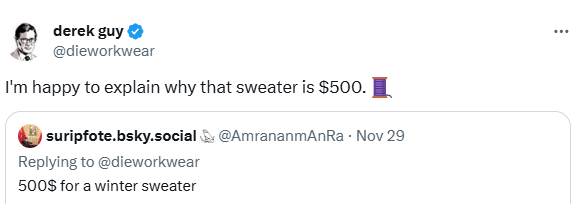
If you spend any time on Twitter/X, you must know the suit guy, Derek. Given my interest in the economics of fast fashion, I read his new thread about expensive craft sweaters.
He explains that some clothes on this earth are still made by hand. Artisan sweaters cost a lot because of the labor. Supporting that art or tradition is fine, if you have $500 on hand.
The comments on the thread are interesting as well. (Caveat, a good number of anonymous accounts are trolls bent on your destruction – read accordingly always.)
One comment, presumably by an amateur knitter in a rich country: “As a knitter, I know how much work would go into hand making sweaters like these. That’s not even taking into account the cost of a good wool yarn. If anything, they are underpriced.”
Not a lot of people want to spend $500 on a sweater. I really loved this reply about thrift stores. We don’t all have to buy the sweater new.
My related posts on fast fashion (a.k.a. factory-made sweaters cost $5):
Cato Globalization book out in paperback – my most optimistic take on this is that AI will facilitate the sharing part of the sharing economy, which will help justify the cost of high-quality new garments.
Imagine trying to explain the world today to a person who time traveled forward from 300 years ago. How could someone who lived in France in the year 1600 understand our modern problems?
Person from the Past: So, how is it with 8 billion people?
Me Today: It’s bad. We have too many clothes.
PftP: Right. With 8 billion you wouldn’t have enough clothes for everyone.
MT: Too many.
PftP: Not enough?
MT: I said we have TOO MANY clothes. Not even the poorest people in the world want them. Shirts pile up on the beaches and pollute the ocean.
PftP: …
My article highlights the fact that we live in an era of unprecedented clothing abundance. First, that was not always true.
Most of human history has been characterized by privation and low‐productivity toil. As one American sharecropper exclaimed in John Steinbeck’s Depression‐era novel The Grapes of Wrath, “We got no clothes, torn an’ ragged. If all the neighbors weren’t the same, we’d be ashamed to go to meeting.”
The United Nations Economic Commission for Europe called the fashion industry an “environmental and social emergency” because clothing production has roughly doubled since the year 2000. Their main concerns are fast fashion’s environmental impact and working conditions.
Some of my article is a response to the critics of modern low-cost mass production.
Thirdly, I explain how we could keep most of the benefits of cheap clothes with less litter in the environment. The item I am most optimistic about is using our new artificial intelligence tools to re-sort the world’s junk. We would produce and throw away fewer clothes if we had a better system for rearranging the stock of goods that we already have. The problem I see today is that I have “perfectly good” clothes in my house that I don’t really want; however, attention and time are so scarce that no one will pay me for them. Even if I donate them, I worry that half will end up in the trash. Someone on this earth could use them but identifying that someone and making the trade still has high prohibitively high transaction costs. Very smart AI could come to my house and scan my stuff and pay me for it because very smart AI could get it to someone with a positive value for it.
Every sentence in this article is fascinating, since I have been writing about fast fashion.* Anything I put in quote form comes from The Guardian.
The word “revolution” in the title of this article is minor clickbait. Perhaps it would be more accurate to say: “Clothes repaired in workshop, 19 people employed” That wouldn’t get any clicks. However, I am an idealist, and I am going to stay a bit on board with the revolution. I, too, have pondered and grieved over the amount of waste heading into landfills. There could be some kind of revolution ahead, whether it is of the repair type or not.
The communal garden and bespoke textile art lend a creative startup feel, and the slogan “repair is the new cool” appears everywhere. But what’s happening here is far from ordinary startup stuff. At United Repair Centre (URC), newcomers to the Netherlands from across the world, many of them former refugees, are using their tailoring skills to mend clothes on behalf of some of the world’s biggest brands.
Immigrants are sewing, but no Dickensian horrors here. This place “has a laid-back Dutch vibe.”
Ambrose, who greets me, mans the front desk. He’s a 20-year-old Palestinian fashion fan, who was born in Syria and lived in Abu Dhabi before moving to the Netherlands in May; he is working in parallel with studying for a fashion and design diploma. Ambrose started at URC in May and loves it: the way he gets to work in collaboration with the tailors, giving advice and learning from their years of experience. “It’s really easy, fun, chill … “
Repair might be cool, but is it new? Consider Jo March from “Little Women” who was an American bouncing around between rich and poor status in the 1860s. American GPD per capita in 1860s was less than $3,000. That would be considered very poor today. Since manufactured goods were expensive and Jo March had a low opportunity cost of time, she spent lots of time mending clothes. Her passion was writing but she had no choice – that was how she contributed to her household production. Very few families at that time, even in the upper class, could afford to regularly buy new clothes from a shop.
Don Boudreaux explained that even modern rich people “recycle” clothes when it’s in one’s selfish interest. Washing and “re-use” of clothes, typically, is beneficial enough to outweigh the cost of maintaining and storing them. Sometimes we go above and beyond by donating them or maintaining them specifically because we are trying not to “waste” something, but that comes at an individual cost to us.
The author of the article writes:
I take a taxi from the station to URC because I’m running late, but I’m taken aback when en route the driver points out the many conveniently located stations and tram stops I could use for my return journey.
This is a perfect encapsulation of why rich people do not repair clothes. They are zipping around to high-productivity work meetings. The opportunity cost of time has gone up. Taking the bus is costly in terms of time, the scarcest resource of the rich.
Where I see hope for the repair “revolution” is in artificial intelligence (AI). AI can make up for our scarce time and attention. If AI can make repairs less costly in terms of time, then rich people might do it. If it doesn’t make economic sense, then it won’t scale the way the author is hoping.
Currently, the “revolution” is employing 19 people full-time. By the year 2027, all they are hoping for is to expand to 140 tailors. Hardly a revolution on the jobs front. But that’s the hopeful scenario. If it’s labor-intensive, then it won’t work. (See my ADAMSMITHWORKS post on cloth production and labor.)
Is repair reaching a tipping point?
There’s one unlikely scenario in which expensive repairs will get paid for. What rich people resoundingly want is kitchen renovations and new clothes, partly because it confers status. Could it become cool to live with those outdated cabinets and wear that repaired Patagonia vest for the next two decades? … could it? Vision: “Wow. I see that you guys have outdated ugly countertops. Nice. You resisted the desire to renovate your kitchen even though it’s within your budget.”
Even changing status markers are unlikely to tip the scale in the case of broken equipment or torn clothes. AI might allow us to repair a refrigerator instead of trash it.
URC tracks repairs using software initially developed by Patagonia, which it has built on and uses for the other brands involved.
There it is. Software makes the dream work.
Shein and the like are out there, churning out, in dizzying volumes, fast fashion that can’t be repaired.
In my conversations with Americans, many do not know what “fast fashion” is. That’s fast fashion. The 19-140 tailors are currently no match for Shein.
There isn’t always much common language – operational manager Hans says they resort to Google Translate quite a bit – but there’s plenty of laughter.
The AI, again! We are living in the globalized AI-powered future.
Lastly, the article was brought to my attention on Twitter (X) by Bronwyn Williams and Anna Gat.
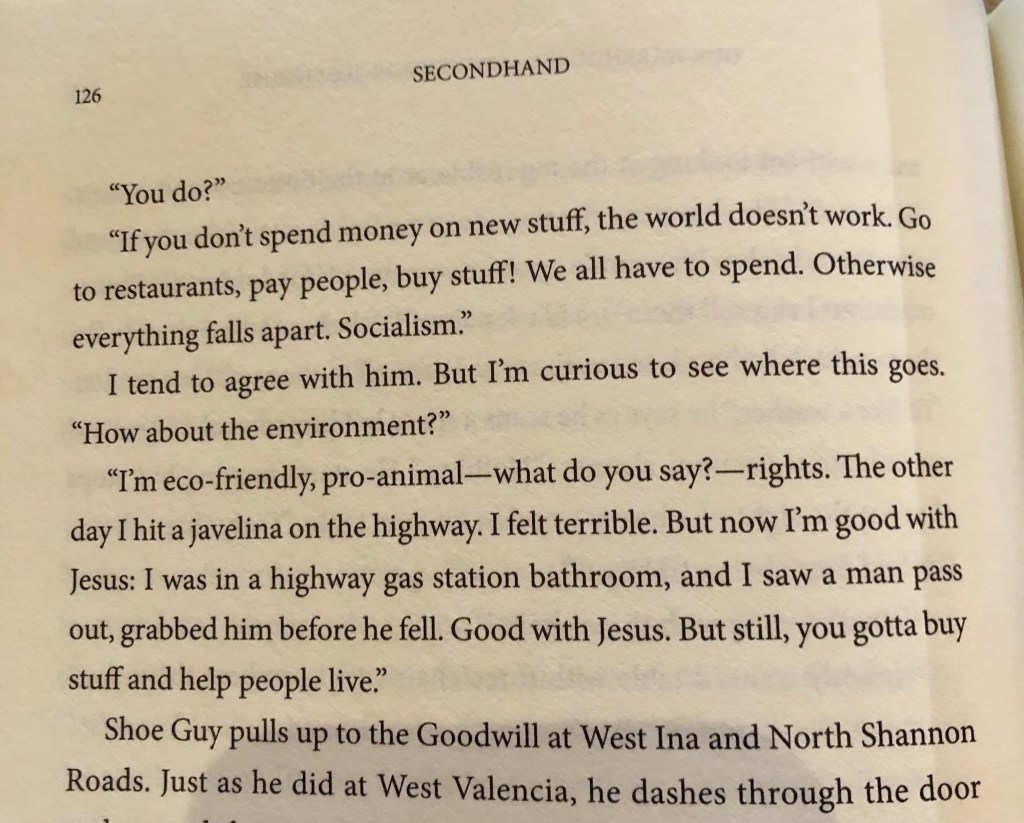
Secondhand: Travels in the New Global Garage Sale is a great book in my summer stack on fast fashion. I have always been interested in the combination problem-blessing of too much stuff. Adam Minter explains perfectly what many of us have been curious about.
Secondhand is America-centric, but he also travels to Japan to observe a country that is ahead of us both in terms of the demographic crisis and the mechanisms for handling old stuff. The reports from Africa are very interesting.
I have been wondering what is happening with Goodwill and with recycling in general. What hope do we really have of keeping goods out of the landfill? What should I do with a shirt my kid has grown out of? (The lady at work I used to give clothes to now runs away at the sight of me. I gave her too many bags.)
The Goodwill collection center near me looks cluttered and weird. After reading Secondhand, I’m more optimistic about dropping off bags there.
The barrier to sorting the used goods of the rich world is the scarcity of time and attention. This paragraph about a used book seller in Japan is heart-breaking:
It’s a thirty-year-old hardback novel, and the edition is rare. If it were at a traditional bookstore, it’s command a premium price. But Bookoff is about volume, and there’s a problem: not only does it lack a barcode, but it lacks an ISBN… “So there’s no way to price it in Bookoff’s system,” Kominato says. With a grimace, he gently places it on top of the books filling the recycling cage and steps away. (pg 40)
At least the book will get recycled into new paper, and the reality is that it was providing negative value as clutter in someone’s home.
Back in America, Minter describes what happens to donated goods at Goodwill in detail. Sometimes high-quality clothes are identified, but it is hard to get a good price for them. Some customers expect to pay less than $5 for a shirt, no matter what.
Customers are all about price, not quality…They won’t buy a $6.99 shirt that will last. If that’s the option, they’ll buy a $2.99 shirt from Walmart. (pg 57)
Some consumers are in the habit of treating clothes almost like disposable goods instead of durable assets. They won’t pay for quality. Going out and getting a new replacement shirt costs less than lunch.
I don’t want to give away too much, since you will want to go get the book yourself. Here’s the funniest page:
Lastly, I’ll share a personal win. I know that I’ll need a school backpack for my youngest in August. I went to a local rummage sale and went to the backpack section. I found one that is good enough (some scuffs but plenty of sparkles). I’m happy about keeping this sparkly pink backpack out of the landfill for a few more years. I walked out of the sale with a load of gear that cost a total of $10. Next, I went to a coffee shop to work where I also spent $10. Used textiles and books are dirt cheap.
I don’t agree with Elizabeth L. Cline on everything, but she’s written a reasonable book for Americans today. The Conscious Closet has some good advice for everyone.
A decade ago, Cline wrote Overdressed: The Shockingly High Cost of Cheap Fashion which investigated the environmental toll of clothes and the labor controversies. Since then, she has been working on what consumers can do differently.
Not every American household has practical knowledge of laundry and sewing anymore. Cline offers suggestions on how to economically maintain clothes longer by making sensible home repairs or washing them less. (Don’t wash a pair of jeans after just one wear. I don’t.) The Conscious Closet came out in 2019, so it’s up-to-date concerning chemicals and certifications and websites that operate today.
The way we wash and dry our clothes uses a lot of water and energy. If a person was looking for a way to lower their environmental footprint, then a marginal reduction of laundry loads might be a relatively easy way to do it. Since almost every American has an electric dryer, we have lost the tacit knowledge of how to air dry clothes. She gives the practical reminder, for example, that dark color clothes will fade if exposed to extended sunlight.
I feel like Cline could be even more conscious about the opportunity cost of time. She does explicitly acknowledge that in her chapter about re-selling your unwanted clothes.



 Economist Writing Every Day