How Americans Can Thank the World

Dear World,

Thank you for the heritage of philosophical and scientific ideas, preserved through an international effort over thousands of years. Thank you for coming to study at American universities in this century, and for staying to teach.

Thank you all for buying into our heroes. What is Star Wars without a global audience? Your enthusiasm transforms our characters into shared legends. Thank you for cheering on Harrison Ford and Will Smith. Thank you for feeling the joys and heartbreaks of Taylor Swift, Luke Combs and Beyoncé. Thank you for sending us Lord of the Rings, Howl’s Moving Castle, and Squid Game.

Video games unite us all. Thanks for Elden Ring from Japan, and Minecraft, which started in Sweden before it was acquired by Microsoft. It helps us be more creative when the world buys U.S.-made games like Call of Duty and Fortnite.

Merci France, for helping us in our war of independence and giving us the Statue of Liberty. (And for printing my cartoon.)

Thank you to England, for the inheritance of a system of limited government, whose principles of common law, parliamentary tradition, and constitutional rights became the foundation upon which we built our republic.

Thank you, world, for listening to our national anthem at the Olympics. For training with us and competing against us in feats of endurance and collectively celebrating as humans have recently broken so many records of performance. Congrats to Eliud Kipchoge and Katie Ledecky.

Thank you for believing in the American Dream. The wealth enjoyed by average Americans today would not be possible without globalization.

Thank you for seeing good in us and trusting our soldiers and businesses.

Thank you for trading with us. Thanks for keeping the modern F-150 truck affordable.  Quality is better today, because it’s more powerful with stronger engines and still gets better gas mileage while being safer. Part of what keeps the price down is getting so many component parts through imports from places like Mexico and Asia.

Thank you for sharing your genuine thoughts on our social media platforms. Thank you for making the World Wide Web worldwide, starting with http://info.cern.ch.

Thailand, thank you for welcoming my college friends who do not speak your language. You gave them a break from the monotony of their local landscapes. What would our Instagram be without you, and Iceland and Ecuador? The generosity with which you welcome travelers enriches not just our photo albums, but our perspectives.

We are who we are because of you.
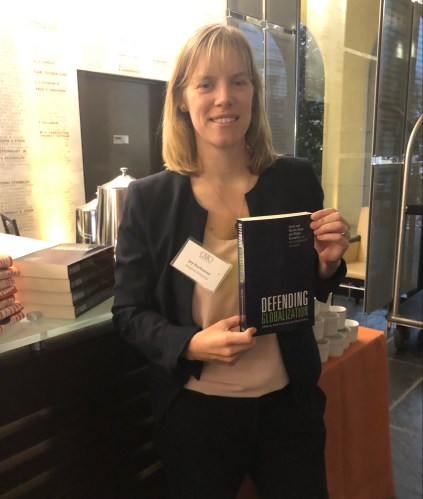
Cato Globalization book out in paperback

A new book is out with chapters by me, Deirdre McCloskey, and others.

Book Title: Defending Globalization: Facts and Myths about the Global Economy and Its Fundamental Humanity

The COVID-19 pandemic, war in Ukraine, simmering US-China tensions, and rising global populism have led to globalization facing renewed attention-and criticism-from politicians and pundits across the political spectrum. Like any market phenomenon, the free movement of people, things, money, and ideas across natural or political borders is imperfect and often disruptive. But it has also produced undeniable benefits-for the United States and the world-that no other system can match. And it’s been going on since the dawn of recorded history.

The original essays compiled in this volume offer a diverse range of perspectives on globalization-what it is, what it has produced, what its alternatives are, and what people think about it-and offer a strong, proactive case for more global integration in the years ahead. Covering the basic economic and political ideas and historical facts underlying globalization, rebutting the most common arguments against globalization today, and educating readers on the intersection of globalization and our societies and cultures-from where we live to what clothes we wear and what foods we eat-Defending Globalization demonstrates the essential humanity of international trade and migration, and why the United States and the rest of the world need more of it.

You can read a summary, in a previous EWED blog post, of my chapter on fashion, previously posted on the Cato website as Fast Fashion, Global Trade, and Sustainable Abundance.

It takes all of us to be rich. We need “a great multitude that no one could count, from every nation, tribe, people and language,” so to speak.

Two years ago, on Twitter, I summarized my contribution as follows, in the form of a dialogue:

Person from the Past: “So, how is it with 8 billion people?”

Me Today: “It’s bad. We have too many clothes.”

Person from the Past: “Right. With 8 billion you wouldn’t have enough clothes for everyone.”

Me Today: “Too many.”

I made it to the book launch event in D.C. near the Capitol.

Some people still have not heard of “fast fashion.” Maybe you heard it here first: New legislation is likely coming to regulate the clothing industry. It might start at the state level, in progressive places like California or Seattle. Demands include making information about supply chains more transparent and taxing the clothing companies in order to pay for trash disposal. For example, you can read about the New York Fashion Act. Similar to the way the food companies have to provide clear information about calories, clothing retailers might have to provide more information about chemicals, labor, and disposal issues.

Plastic fibers making new clothing cheap. I sometimes hate the flood of cheap products that American families are drowning in. Plastic products are so cheap to stamp out and give to kids. Some days you’ll find me grumpy about the latest bag of plastic swag and candy my kids came home with. There are some negative externalities to consuming tons of plastic items and tossing them out.

It’s a privilege to have this problem. Perhaps we are overindulging in clothing abundance and need some modern solutions to modern problems. We also need to figure out how to stop getting obese off of food abundance. (Hello, Ozempic.) But let’s still be grateful for the abundance, on this Thanksgiving week. My controversial take is that it’s good for the cost of clothing to be low. We don’t want to regress. We don’t want to make clothing scarce again.

If you were to want to cite my work on fashion and globalization, then you could use something like this:

Buchanan, Joy. “Fast Fashion, Global Trade, and Sustainable Abundance” (2024) In S. Lincicome, & C. Packard (Eds.), Defending Globalization: Facts and Myths about the Global Economy and Its Fundamental Humanity, Cato Institute, (pp. 367 – 380).

The re-Americanization of the American Economic Association Meetings

According to a chart circulating this week, attendance at the AEA winter meeting exceeded 13,000 economists at the peak. I had some job interviews at Chicago in 2017, and I spoke on a panel at San Diego in 2020. Chicago was freezing cold. San Diego was lovely in January. Cold or not, probably every economist on the job market showed up in person to those conferences. There are harrowing stories of people who missed job interviews because of snow and cancelled flights.

In 2020 (just before Covid) I wrote:

A privilege of being in this profession is the chance to meet people from around the world. At my lunch table currently there are people from Chile and Southern China to my right and Kansas and Hong Kong to my left. #ASSA2020

It is (or was) a huge win for the US to be the meeting place. Now that job interviews have moved to Zoom, attendance has fallen by more than half. I assume that the attendees here in 2024 skew more America-based.

A European economist predicts attendance in 2024 will fall even lower because “the interview stage of the market has moved online, and at a random date between October and January. No point in flying to ASSA, especially if you are a candidate based in Europe hoping for a job in Europe”

Instead of asking why the economics job market unraveled, maybe we should be surprised that it was ever so centralized. People really did travel from all over the world to an American city in January to interview for almost every serious job available in the economics profession.

Small points:

  • I’ve seen several people complain that it’s a bad time of year. For me, it’s a good time of year. Since I do a lot of teaching, it’s good to have a conference that happens before my teaching starts.
  • I was happy to see that childcare is available here (for a fee).
  • I talked to a job market candidate who was trying to weigh a tenure-track job offer from a teaching school against the possible offer of a postdoc. He would prefer the postdoc. Because of the new system, job offers come in sequence. He risks losing the teaching offer before he finds out if he will get the postdoc offer in writing. In the old days, candidates would have been more likely to know what their best option was going to be.
  • The online JOE job board still serves for coordination. It is still administered by the AEA for jobs globally.
  • James provided evidence that the AEA will start letting more people get on the program to present research. (By contrast, the Southern Economic Association meeting has actually increased in attendance since Covid. They allow accept more people to present research on the program.)
  • When my grad school research group went out for lunch, I was sometimes the only American at the table. I loved it. I’m grateful that those brilliant people came here to start their careers.