No Tech Workers or No Tech Jobs?

Several recent tweets(xeets) about tech talent re-ignited the conversation about native-born STEM workers and American policy. For the Very Online, Christmas 2024 was about the H-1B Elon tweets.
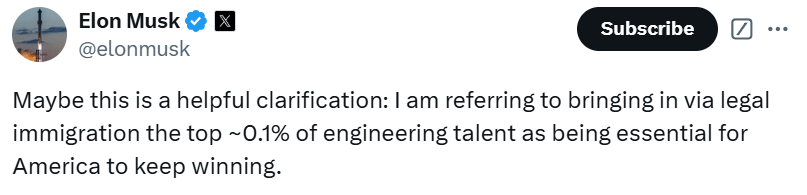
Elon Musk implies that “elite” engineering talent cannot be found among Americans. Do Americans need to import talent?

What would it take to home grow elite engineering talent? Some people interpreted this Vivek tweet to mean that American kids need to be shut away into cram schools.

The reason top tech companies often hire foreign-born & first-generation engineers over “native” Americans isn’t because of an innate American IQ deficit (a lazy & wrong explanation). A key part of it comes down to the c-word: culture. Tough questions demand tough answers & if we’re really serious about fixing the problem, we have to confront the TRUTH:

Our American culture has venerated mediocrity over excellence for way too long (at least since the 90s and likely longer). That doesn’t start in college, it starts YOUNG. A culture that celebrates the prom queen over the math olympiad champ, or the jock over the valedictorian, will not produce the best engineers.

– Vivek tweet on Dec. 26, 2024

My (Joy’s) opinion is that American culture could change on the margin to grow better talent (and specifically tech talent) resulting in a more competitive adult labor force. This need not come at the expense of all leisure. College students should spend 10 more hours a week studying, which would still leave time for socializing. Elementary school kids could spend 7 more hours a week reading and still have time for TV or sports.

I’ve said in several places that younger kids should read complex books before the age of 9 instead of placing a heavy focus on STEM skills. Narratives like The Hobbit are perfect for this. Short fables are great for younger kids.  

The flip side of this, which creates the puzzle, is: Why does it feel difficult to get a job in tech? Why do we see headlines like “Laid-off techies face ‘sense of impending doom’ with job cuts at highest since dot-com crash” (2024)

Which is it? Is there a glut of engineering talent in America? Are young men who trained for tech frustrated that employers bring in foreign talent to undercut wages? Is there no talent here? Are H-1B’s a national security necessity to make up the deficit of quantity?

Previously, I wrote an experimental paper called “Willingness to be Paid: Who Trains for Tech Jobs?” to explore what might push college students toward computer programming. To the extent I found evidence that preferences matter, culture could indeed have some impact on the seemingly more impersonal forces of supply and demand.

For a more updated perspective, I asked two friends with domain-specific knowledge in American tech hiring for comments. I appreciate their rapid responses. My slowness, not theirs, explains this post coming out weeks after the discourse has moved on. Note that there are differences between the “engineers” whom Elon has in mind in the tweet below versus the broader software engineering world.

Software Engineer John Vandivier responds:

Continue reading

Effort Transparency and Fairness Published at Public Choice

Please see my latest paper, out at Public Choice: Effort transparency and fairness

The published version is better, but you can find our old working paper at SSRN “Effort Transparency and Fairness

Abstract: We study how transparent information about effort impacts the allocation of earnings in a dictator game experiment. We manipulate information about the respective contributions to a joint endowment that a dictator can keep or share with a counterpart…

Employees within an organization are sensitive to whether they are being treated fairly. Greater organizational fairness is shown to improve job satisfaction, reduce employee turnover, and boost the organization’s reputation. To study how transparent information impacts fairness perceptions, we conduct a dictator game with a jointly earned endowment. 

The endowment is earned by completing a real effort task in the experiment, an analog to the labor employees contribute to employers. First, two players work independently to create a pool of money. Then, the subject assigned the role of the “dictator” allocates the final earnings between them.

In the transparent treatment, both dictators and recipients have access to complete information about their own effort levels and contributions, as well as those of their counterparts. In the non-transparent treatment, dictators have full information about the relative contributions of both players, but recipients do not know how much each person contributed to the endowment. The two treatments allow us to compare the behaviors of dictators who know they could be judged and held to reciprocity norms with dictators who do not face the same level of scrutiny.

*drumroll* results:

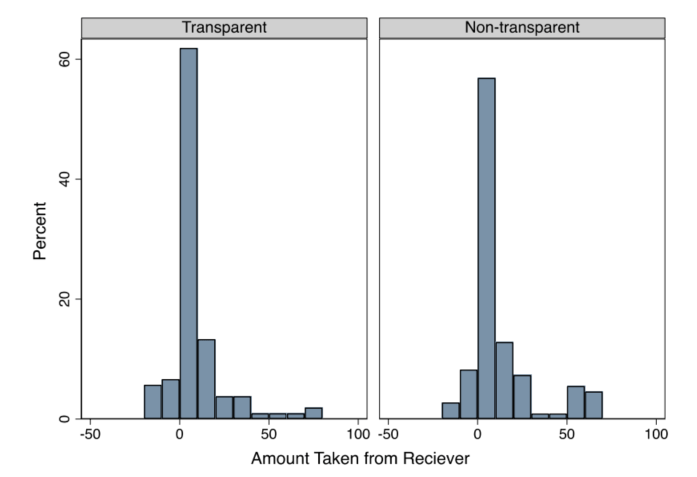
This graph shows the amount of money the dictators take from the recipient contribution, in cents.  There are two ways to look at this. Notice the spike next to zero. Most dictators do not take much from what their counterpart earned. They are *dictators*, meaning they could take everything. Most take almost nothing, regardless of the treatment. We interpret this to mean that they are acting out of a sense of fairness, and we apply a humanomics framework to explain this in the paper.

Also, there is significantly more taken in non-transparency. When the worker does not have good information on the meritocratic outcome, then some dictators feel like they can get away with taking more. Some of this happens through what we call “shading down” of the amount sent by the dictator under the cover of non-transparency.

There is more in the paper, but the last thing I’ll point out here is that the “worker” subjects (recipients) anticipate that this will happen. The recipients forecast that the dictator would take more under non-transparency. In our conclusion, we mention that, even though the dictator seems to be at an advantage in a non-transparent environment, the dictator still might choose a transparency policy if it affects which workers select into the team.

View and download your article*   This hyperlink is good for a limited number of free downloads of my paper with Demiral and Saglam, says Springer the publisher. Please don’t waste it, but if you want the article I might as well put it out there. I posted this on 11/2/2024, so there is no guarantee that the link will work for you.

Cite our article: Buchanan, J., Demiral, E.E. & Sağlam, Ü. Effort transparency and fairness. Public Choice (2024). https://doi.org/10.1007/s11127-024-01230-9

Slow Adjustment in Tech Labor for CGO Research

The CGO published a policy paper I wrote with Henry Kronk.

The Slow Adjustment in Tech Labor: Why Do High-Paying Tech Jobs Go Unfilled?

Executive Summary

The United States technology industry continues to struggle to recruit new talent. According to the US Bureau of Labor Statistics, the number of people employed in technology is not increasing quickly. 

Tech jobs pay well and don’t have the drawbacks of some other in-demand jobs, such as the travel schedule of a truck driver or the physically taxing labor required in oil fields.

Tech jobs are sometimes touted as a guarantee of having a comfortable and rewarding career, but the reality is not that simple.

Economics suggests that high wages would eliminate labor shortages, but that’s not the case in tech work. Why?

In this paper, authors Joy Buchanan and Henry Kronk propose a set of factors that have been overlooked and apply broadly to the tech sector. 

Individuals with high-status tech jobs report burnout, anxiety, depression, and other mental health issues at higher rates than the general population. They also have to deal with the constant threat of becoming obsolete. Because technology changes so quickly, they must constantly work to update their skills in order to remain competitive.  

The authors offer several recommendations for tech companies, educators, and policymakers:

  • Political and community leaders can provide more accurate messaging such as communicating clearer expectations about the difficulties of entering the tech workforce. 
  • The tech industry could benefit from improvements in computer education. The authors cite a need for more pre-college exposure to computer occupations as well as a need to add communication skills to computer science curriculums.
  • Teachers, parents, and tech companies can all find ways to inform young people at an age-appropriate level about opportunities. Computer science is abstract and hard to understand. Young people who have some exposure to computer science through a class or camp are more likely to become CS majors in college. 
  • Company leaders can improve their recruitment and development strategies to reflect the labor market realities including paying enough to compensate employees for the mental challenges of demanding technical work and alleviating their own talent shortages by investing in training and education. 
  • Tech companies may be able to attract more women and minorities by improving their scheduling and management practices.

Henry and I examined public data and the existing literature to get a better understanding of the current state of knowledge on this issue. I hope our paper can be helpful, however we partly just highlight how many questions still exist about tech and talent.

My recent paper in Labour Economics, Willingness to be Paid: Who Trains for Tech Jobs?, was designed to add new data to address these questions.

Gen Z on The Great Resignation

Even though a housing price crash is often reported on as a crisis, it benefits first time homebuyers. Do the college seniors in 2021, likewise, see this “labor shortage” as a wonderful opportunity and stroke of luck for them personally? They overwhelmingly think of themselves as sellers of labor, not employers.*

Sometimes Samford students write for EWED if I felt like there was something that I and readers could learn from their perspective. This is accounting major Rachel Brinkley:

As a 21-year-old senior in college, the workforce is a confusing place. On the one hand, “The Great Resignation” is creating millions of jobs across America. It is a very encouraging time to be graduating college, as it appears that most of my peers and I will have no issues finding employment. Employers are currently struggling to compete in terms of compensation and benefits offered. I am majoring in accounting, and everyone that I have spoken to in my major has had at least one compensation increase since accepting their position. None of us have worked even one day on the job. This competition between employers creates favorable bargaining power for those entering the workforce, while putting a strain on employers.

While I may have confidence in my employment status after graduation, I will be starting at an entry level position for a firm that has a relatively structured promotional process. Like most large accounting firms, the promotions within the firm are based on the number of years spent working at the firm. There may be a few exceptions to the standard promotional pace, but I am not very optimistic about climbing the corporate ladder any faster than I would under more typical economic conditions. This is due, in part, to the fact that the best jobs are hard to come by. At a large accounting firm, the structured promotional process limits the number of the most sought-after jobs.

This circumstance leads me to ask how it is possible to obtain a top job when competition for those positions seems to be increasing. We read “Deep Work” for class, and I think about the author’s advice. We will need to continue learning new skills to make it into top positions.

Are my students running through the halls celebrating the current state of the labor market? Maybe they should be, but they are not, especially if their focus is on what Rachel called “top jobs”. Some jobs, almost by definition, are limited because they are top-of-the-pyramid or “tournament” positions.

My current Fall students pointed out that they feel better than the last two batches of students graduating into a closed-down Covid world. Many of our previous students got hired virtually and I don’t know at what point if at all they have had in-person interactions with work colleagues.

*The truth is more complex in a large diverse economy. Even though I don’t think of myself as en employer, I am concerned that there will be no one to operate my upcoming flight to a conference. The airline I rely on has had to cancel hundereds of flights in the past week over labor issues.