Queens 2060: Where Upzoning Matters Most

Most US cities make it hard for housing supply to meet demand because of rules that prevent large apartment buildings. Usually cities do this with zoning rules that limit the number of homes per parcel, often to as low as 1. New York City relies more on rules about Floor Area Ratio (the ratio of the floor area to the area of the parcel). But how binding are these rules? If we relaxed or repealed them, how much new construction would we see, and where would we see it?

MIT PhD student Vincent Rollet has calculated this for New York City:

I build a dynamic general equilibrium model of the supply and demand of floorspace in a city , which I estimate using a novel parcel-level panel dataset of land use and zoning in New York City. I validate the model using quasi-experimental variation from recent zoning reforms and use it to simulate the effects of zoning changes on construction and prices.

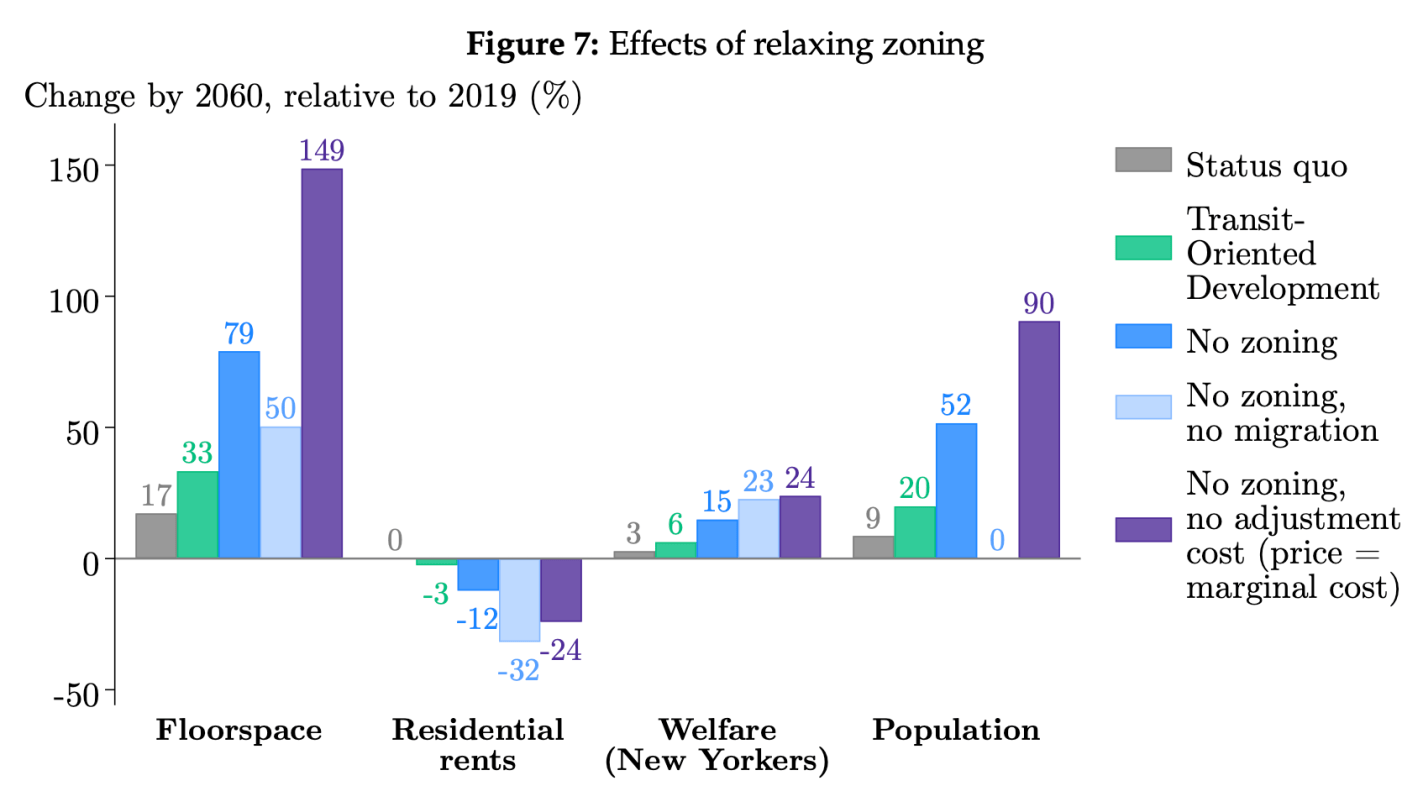
He finds that eliminating these rules in NYC would lead to a construction boom, with a 79% increase in the amount of floor space available by 2060. This would allow many more people to live in New York, with a 52% increase in population; but many of the benefits would go to existing NYC residents, with more floor space per person and modestly lower rents leading to higher wellbeing:
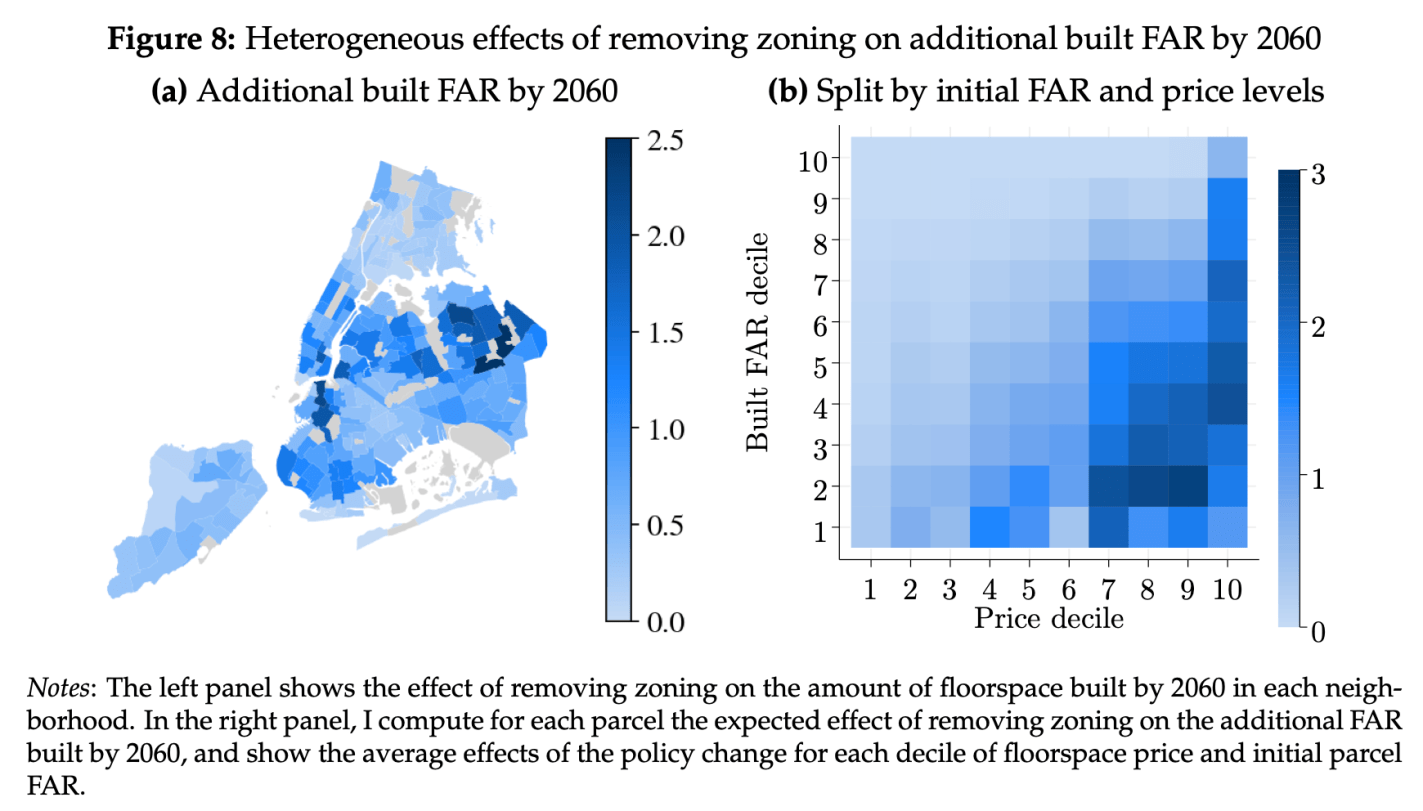
Where exactly would we see the building boom? Not Manhattan, but Brooklyn and Queens. The intuition is that zoning is most binding in places where housing prices are currently high but where the buildings are currently small; this is where there is the biggest incentive to tear down existing buildings and build taller if you are allowed to.
What Proportion of Journalists Live in NYC?

Michael’s post this week on the dangers of high-status, low wage jobs opened by citing this tweet:

Michael presents a fascinating model that applies well beyond journalism. But when his post went viral, some commenters asked how accurate Josh Barro’s claim about half of young journalists living in Brooklyn was. Clearly Michael’s post doesn’t depend on it being true, and I’m not even sure Barro meant it literally, but it got me wondering- just what proportion of all young journalists do live in NYC?

For a first pass, we can look at the BLS Occupational Employment and Wage Statistics for the category “News Analysts, Reporters, and Journalists“. Their latest data (May 2020) shows 41,580 workers employed in those occupations nationwide. It also shows that the NYC metro has by far the most journalists with 5,940, more than twice as many as the second place metro (DC). This implies that 14.2% of all journalists in America live in the NYC metro. Since only 6% of all Americans live in the NYC metro, journalists are clearly clustering there, though clearly well over half of journalists still live elsewhere.

But, this doesn’t quite get at Barro’s claim, which is about journalists under 40 concentrating in Brooklyn. I don’t know of any data source that would let me really test the Brooklyn part, but I can get at the under-40 claim using Microdata from the American Community Survey, which also zooms us in a bit closer to Brooklyn since it tells us who is in NYC proper (not just the metro area).

The 2019 ACS shows that 10% of all “news analysts, reporters, and journalists” are in NYC proper, rising to 14% if I only consider journalists under 40 years old. This is quite concentrated (only 2.5% of all Americans live in NYC proper), but still a lot less that half of all journalists.

As Michael suggested, the vast majority of young NYC journalists are white (77%) with a college degree (91%), though English was only their second most common major after Communications.

The data confirm the last part of Michael’s post quite well- as journalists get older they are likely to move out of NYC and switch to more lucrative fields like PR. Only 5% of all “public relations specialists” are in NYC.