Chocolate Prices Will Shoot Up

I write about various topics, usually with at least some loose connection to economics. Sometimes these are fairly macro issues, other times there are specific, actionable observations. For instance, back in March of 2021, we inferred from the critical shortages of semiconductors that car manufacturing would be severely crimped, likely leading to big price increases in cars.  Our post “Chip Shortages Shutting Down Auto Assembly Lines; Buy Your Car Now Or Else” came out just in time (red arrow below) to alert the readership here:
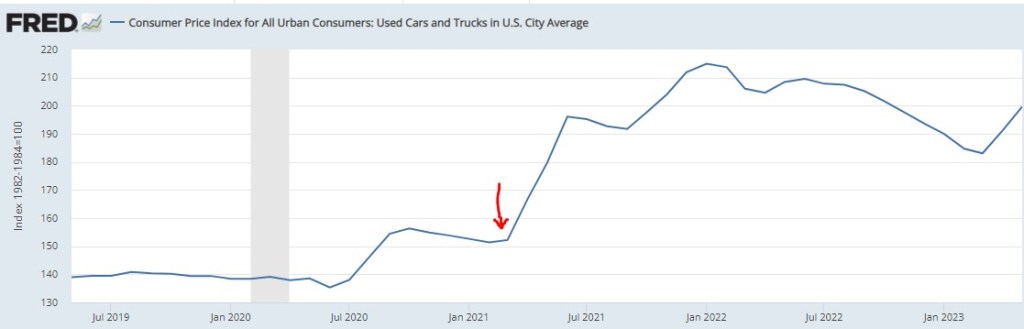
https://fred.stlouisfed.org/series/CUSR0000SETA02 – – Consumer Price Index for All Urban Consumers: Used Cars and Trucks in U.S. City Average

Chocolate Prices

But now, a price increase of more ubiquitous import looms. Most of us were not in the market for cars in March of 2021, but some 81% of us eat chocolate, with the average American consuming about 9.5 pounds a year. Indeed, 50% “cannot live without it every day.”

And so, it is with a heavy heart that I bring warning of a rise in the price of chocolate. Back in pandemic lockdown, I was bored and speculated a few bucks in cocoa futures, as tracked by the NIB exchange traded fund. My shares went up, and then down, and I sold out to limit losses (which was a good move at the time), and moved onto other investments.

Imagine my surprise when I randomly checked on NIB this week and saw the price ramp-up in the past few months:
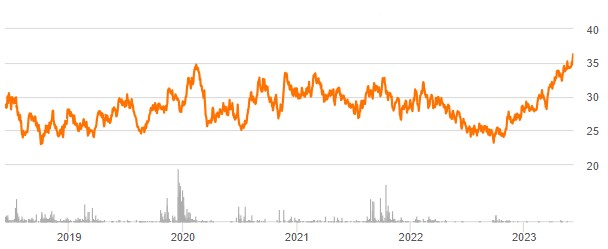
Source: Seeking Alpha

A quick internet search led to a CNBC article which confirmed my worst fears:

“The cocoa market has experienced a remarkable surge in prices … This season marks the second consecutive deficit, with cocoa ending stocks expected to dwindle to unusually low levels,” S&P Global Commodity Insights’ Principal Research Analyst Sergey Chetvertakov told CNBC in an email.

…Chetvertakov added that the arrival of the El Niño weather phenomenon is forecast to bring lower than average rainfall and powerful Harmattan winds to West Africa where cocoa is largely grown. Côte d’Ivoire and Ghana account for more than 60% of the world’s cocoa production

The price of cocoa will feed into the price of consumer chocolate products, especially dark chocolate which has more actual cocoa content. And the price of sweets generally will rise on the back of sugar prices, which stand at 11-year highs, driven again largely by weather.

There is still time to stock up ahead of the hoarders…
How Many Semiconductor Chips Are There in a Car?

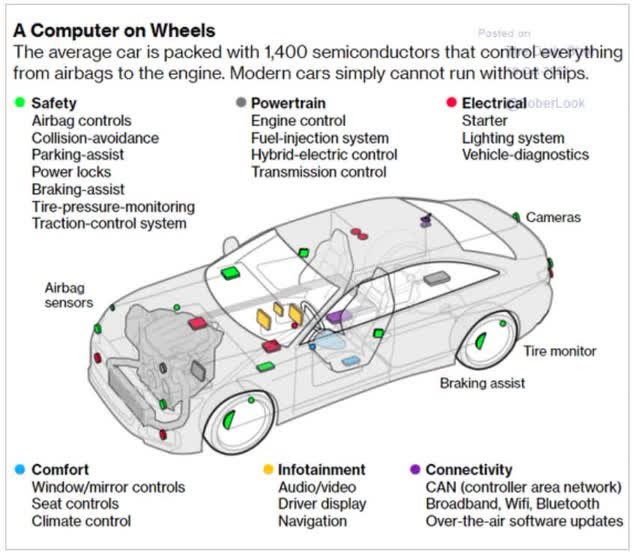
I recently read a statement that there is something like 1400 individual semiconductor chips in a typical modern car.  I wondered, “Can that be correct?”   1400 is a lot of anything.  I have torn apart whole PCs and found only a few dozen chips.

Chips in cars have big economic significance. As called out on a post back in March, COVID shutdowns of semiconductor plants and other factors meant a shortage of critical chips for cars. This has led to extensive shutdowns of car and truck assembly lines in 2021, affecting employment and auto maker profits.  It is estimated that the world lost 11.3 million units of production in 2021 due to the chip shortage, and may lose another 7 million units in 2022.

But back to 1400  chips…I did not find the One True Pronouncement of chips in cars (a promising N Y Times article lay tantalizingly behind a paywall). But I found a number of statements that corroborated that order of magnitude, and also fleshed out the many uses for such chips.

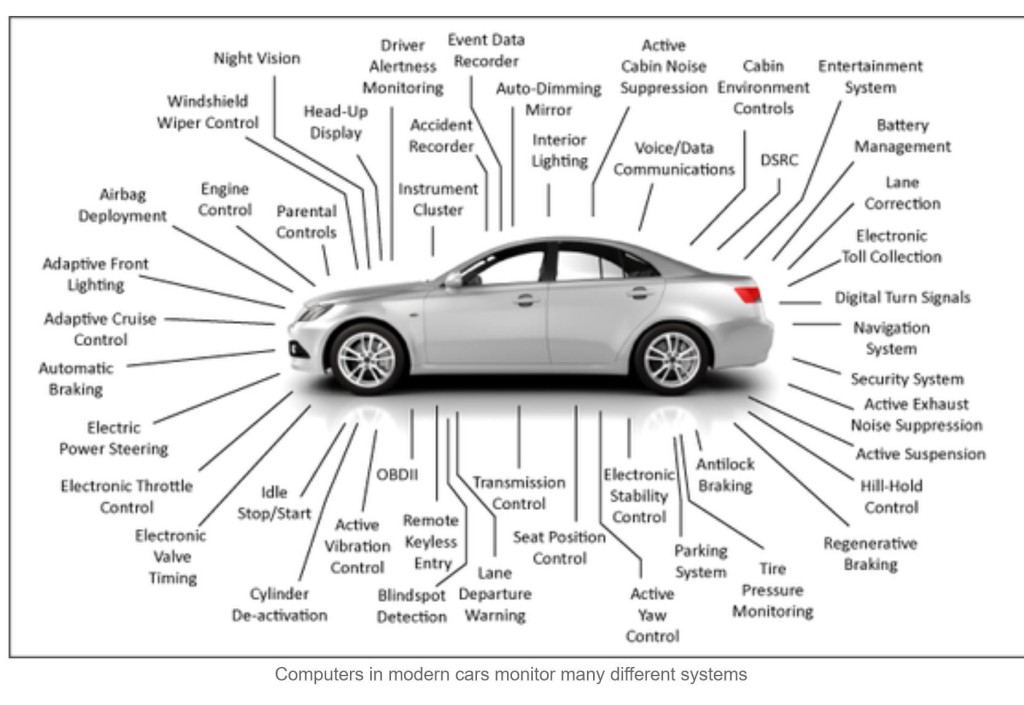
This picture is worth maybe 1400 words:

Source

Here is an even more detailed diagram (sorry, hard to read):

Source

Cars and trucks have something like 100 distinct electronics modules, and each module has multiple chips. Wiring in cars is expensive and vulnerable, so it is better to distribute the information processing rather than run a bunch of wires back to one central processor.

The chip supply situation should sort itself out by 2024, if all goes well. Meanwhile, electronics has become the tail that wags the automotive dog – – electronics have gone from being just 18% of a car’s cost in 2000, to being 40% of its cost in 2020 , and projected to be 45% by 2030:

Chip Shortages Shutting Down Auto Assembly Lines; Buy Your Car Now Or Else

Global supply chains and just in time inventory work great – – until they don’t. Every car these days is a rolling computer, with semiconductors in every vehicle. No chips, no cars. For various reasons, there is a big worldwide shortfall in the chips needed for cars and trucks, which is causing auto assembly lines to shut down for extended periods. Car prices are already rising in response.

Chip production as a whole was slowed down this past year because of Covid effects at the factories. More importantly, chip production was switched away from automobiles to lighter consumer products. Auto assembly lines were curtailed due to the virus, resulting in reduced demand for those specific chips in 2020. The thinking among chip makers was that in the midst of a deadly pandemic, consumers would be sitting home ordering goodies from Amazon or Alibaba, rather than cruising car dealers or spending on travel. Indeed, U. S. spending on durable goods exploded in 2020, fueled in part by generous unemployment and stimulus payments, and this has soaked up existing chip production.

However, car buying has come back earlier than expected. Chip manufacturing is a lengthy process, taking some 26 weeks from start to finish. Chip makers are scrambling to add new capacity and to reconfigure their manufacturing lines for autos, but this shortage will not resolve until later in the year.

Continue reading