Is Tesla Stock Grossly Overpriced?

One of the more polarizing topics in investing is the valuation of Tesla stock. Its peers among the Magnificent 7 big tech leaders sport price/earnings ratios mainly in the 30s. Those are high numbers, but growth stocks deserve high P/Es. A way to normalize for expected growth of earnings is to look at the Price/Earnings/Growth (PEG) ratio. This number is usually 1.5-2.0 for a well-regarded company. Anything much over 2 is considered overvalued.

Tesla’s forward P/E of about 270 is nearly ten times higher than peers. Its anticipated growth rate does not seem to justify this astronomical valuation, since its PEG of around 4-10 (depending on assumptions) is way higher than normal. This seems to be a case of the CEO’s personal charisma dazzling shareholders. There is always a new “story” coming out to keep the momentum going.

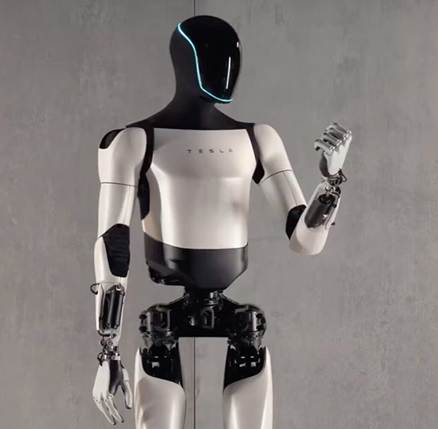
Tesla’s main actual business is selling cars, electric cars. It has done a pretty good job at this over the past decade, supported by massive government subsidies. With the phasing out of these subsidies by the U.S. and some other governments, and increasing competition from other electric carmakers, it seems unlikely that this business will grow exponentially. Ditto for its smallish ($10 billion revenue) business line of supplying large batteries for electric power storage. But to Tesla fans, that doesn’t really matter. Tesla is valued, not as a car company, but as an AI startup venture. Just over the horizon are driverless robo-taxis (whose full deployment keeps getting pushed back), and humanoid Optimus robots. The total addressable market numbers being bandied about for the robots are in the trillions of dollars.
Source: Wikipedia

From Musk’s latest conference call:

Optimus is Tesla’s bipedal humanoid robot that’s in development but not yet commercially deployed. Musk has previously said the robots will be so sophisticated that they can serve as factory workers or babysitters….“Optimus will be an incredible surgeon,” Musk said on Wednesday. He said that with Optimus and self driving, “you can actually create a world where there is no poverty, where everyone has access to the finest medical care.”

Given the state of Artificial General Intelligence, I remain skeptical that such a robot will be deployed in large numbers within the next five years. It is of course a mind-bending exercise to imagine a world where $50,000 robots could do anything humans can do. Would that be a world where there is “no poverty”, or a world where there is no wealth (apart from the robot owners)? Would there be a populist groundswell to nationalize the robots in order to socialize the android bounty? But I digress.

On the Seeking Alpha website, one can find various bearish articles with the self-explanatory titles of, for instance, Tesla: The Dream Factory On Wall Street, Tesla: Rallying On Robotaxi Hopium, and Tesla: Paying Software Multiples For A Car Business – Strong Sell . There are also bullish pieces, e.g. herehere, and here.

Musk’s personal interaction with shares has propped up their value. He purchased about $1 billion in TSLA shares in September. This is chicken feed relative to its market cap and his net worth, but it apparently wowed TSLA fans, and popped the share price. What seems even more inexplicable is the favorable response to a proposed $1 trillion (!!) pay package for Elon. For him to be awarded this amount, Tesla under his watch would have to achieve hefty boosts both in physical production and in stock market capitalization. But… said package would be highly dilutive (like 12%) to existing shareholders, so, rationally they should give it thumbs down. However, it seems likely that said shareholders are so convinced of Musk’s value that they will approve this pay package on Nov 6, since he has hinted he might leave if he doesn’t get it.

Such is the Musk mystique that shareholders seem to feel that giving him an even greater stake in Tesla than he already has  will cause hundreds of billions of dollars of earnings appear from thin air. From the chatter I read from Wall Street professionals, they view all this as ridiculous magical thinking, yet they do not dare place bets against the Musk fanbase: the short interest in TSLA stock is only a modest 2.2%. Tesla is grossly overvalued, but it will likely remain that way as long as Elon remains and keeps spinning grand visions of the future.

What Markets Expect From A Trump Presidency

Last week I laid out my own expectations for what economic policy would look like in a Trump or Harris presidency. Now after yesterday’s market reaction, we can infer what market participants as a whole expect by roughly doubling the size of yesterday’s market moves. Prediction markets had a 50-60% change of Trump winning as of Tuesday morning’s market close, which moved to a 99+% chance by Wednesday morning. Look at how other markets moved over the same time, multiply it by 2-2.5x, and you get the expected effect of a Trump presidency relative to a Harris presidency. So what do we see?

Stocks Up Overall: S&P 500 up 2%, Dow up 3%, Russell 2000 (small caps) up 6%. My guess this is mostly about avoiding tax increases- the odds that most of the Tax Cuts and Jobs Act gets renewed when it expires in 2025 just went way up. Lower corporate taxes boost corporate earnings directly, while lower taxes on households mean that they have more money to spend on their stocks and their products. Lower regulation and looser antitrust rules are also likely to boost corporate earnings.

Bond Prices Down (Yields Up): 10yr Treasury yields rose from 4.29% to 4.4%. This is the flip side of the tax cuts- they need to be paid for, and markets expect they will be paid for through deficits rather than cutting spending. The government will issue more bonds to borrow the money, lowering the value of existing bonds.

Dollar Up: The US dollar is up 2% against a basket of foreign currencies. I think this is mostly about the expected tariffs. People like the sound of the phrase “strong dollar” but it isn’t necessarily a good thing; it makes it cheaper to vacation abroad, but makes it harder to export, even before we consider potential retaliatory tariffs.

Crypto Way Up: Bitcoin went up 7% overnight, Ethereum is now 15% up since Tuesday. Crypto exchange Coinbase was up 31%. Markets anticipate friendlier regulation of crypto, along with a potential ‘strategic Bitcoin reserve’.

Single Stock Moves: Private prison stocks are up 30%+. Tesla is up 15%, mostly due to Elon Musk’s ties to Trump, but also due to tariffs. Foreign car companies were way down on the expectation of tariffs- Mercedes-Benz down 8%, BMW down 10%, Honda down 8%.

Sector Moves: Steel stocks are up on the expectation of tariffs, while solar stocks (which can’t catch a break, doing poorly under Biden despite big subsidies and big revenue increases) were down 12% in the expectation of falling subsidies. Bank stocks did especially well, with one bank ETF up 12%. This gives us one hint on what to me is now the biggest question about the second Trump administration- who will staff it? I could see Trump appointing free-market types, or wall-streeters in the mold of Steve Mnuchin, or dirigiste nationalist conservatives in the JD Vance / Heritage Foundation mold, or an eclectic mix of political backers like Elon Musk and RFK Jr, or a combination of all of the above. The fact that bank stocks are way up tells me that markets expect the free-marketers and/or the Wall-Street types to mostly win out.

Just Ask Prediction Markets: If you want to know what markets expect from a Presidency, you can do what I just did, look at moves the big traditional markets like stocks and bonds and try to guess what is driving them. But increasingly you can skip this step and just ask prediction markets directly- the same markets that just had a very good election night. Kalshi now has markets on both who Trump will nominate to cabinet posts, as well as the fate of specific policies like ‘no tax on tips

It won’t be liberals that kill the Cybertruck

The rise of large pickup trucks and SUVs in the US is generally tied to the implicit subsidy borne of their exemption from Corporate Average Fuel Economy (CAFE) standards. The seemingly ever-growing scale of these vehicles has produced a perfect example of negative externalities in the form of increased risk to other drivers, cyclists, and pedestrians (yes, a pedestrian is in danger from any vehicle, but the decreased maneuverability from greater carriage remains relevant).

This particular negative externality is not wholly uninternalized by large truck drivers, however. They pay higher premiums to the insurance companies that must cover the payouts to negligent and catastrophic loss of life when their customers are found at fault in collisions. Without the internalizing of these externalities through civil cases, trucks would likely be even larger and more dangerous.

Which brings me to the Cybertruck. I don’t care for it as a vehicle for a variety of reasons, but I similarly don’t care for Lamborghinis. My tastes are irrelevant. What is relevant is that it is made out of 30-times cold-rolled steel, a design choice I believe reflects its ambition to appeal as a sort of post-apocalyptic survivor’s vehicle that can literally physically dominate other vehicles.

This is likely to be a very, very expensive choice.

It will probably take a while for the insurance market to internalize the externality, but as the number of Cybertrucks on the street increase, so will the number of collisions and, in turn, fatalities. Fatal accidents are high variance, high cost events that loom large in the vision of insurers. The actuaries will crunch the numbers and premiums will increase. And not just because of short term increases in fatalities. Insurance companies are in the forecasting business as well. If they anticipate that courts may respond to a vehicle whose makeup makes it a disproportionate threat to others on the road by tilting the scales of fault towards their drivers, then its entirely possible that there remains no feasible premium that remains profitable. There’s a reason Jackie Chan can’t get life insurance.

What happens when a $90k, 6,800 pound steel battering ram requires that it’s drivers be self-insured? What happens in states that don’t allow drivers to self-insure? Even if there remains a small number of companies that offer “exotic” vehicle insurance, the premiums will turn push prospective ownership further up the demand curve, turning the Cybertruck into the kind of road oddity you see every few years. I have seen a Lotus Exos exactly once.

It won’t be liberals that kill the Cybertruck. Hell, if they manage to repeal the CAFE exemption it’ll be the single biggest boost a giant EV truck could hope for. No, it’s going to be the market that kills the Cybertruck.

Tesla and Data Privacy

Samford business school student A.K. Vance writes:

As technology and data have become more prevalent in our daily lives, concern about privacy grows. Governments and countries now worry about “commercial espionage” on citizens. In a recent Wall Street Journal article, Trefor Moss discusses the implications of the ability for companies like Tesla to collect data on its consumers. China is currently attempting to restrict its citizens’ access to Tesla cars which have the capability to track and collect data on its owner. The Chinese government cites the fear that data including images which can be taken by the cars will be sold or given to the American government. Beijing has gone so far as to restrict the use of Tesla cars “by military personnel or employees of some state-owned companies”. Elon Musk has publicly stated that no data will be released to the United States or any other nation. The results of selling or giving such data or information to other governments could lead to many negative effects for Tesla and could cause a huge loss of Tesla’s business. In the last year, China made up a quarter of Tesla car sales. If Tesla did use their data capabilities to collect and give information to the United States government, they would risk losing a huge market for their product. Musk goes on to claim that such a violation of privacy could lead to a “shut down everywhere which is a very strong incentive for us [Tesla] to be very confidential”.

Related concerns over the Chinese application, TikTok, led to an attempt to ban the application in the United States due to its potential of collecting data on American citizens which could be used by the Chinese government to spy. As products become more integrated into the internet, privacy concerns may affect international trade. Companies might have a private incentive to protect customers, but that might not be sufficient. Legislation is still catching up to the changes in technology and new capacity to track individuals via “commercial espionage”.