Its Nobel Prize season- the economics prize will be announced Monday, while most prizes are announced this week. My favorite so far is the Medicine prize being awarded to Svante Pääbo “for his discoveries concerning the genomes of extinct hominins and human evolution”. He figured out how to sequence DNA from Neanderthal remains despite the fact that they were 40,000 years old.
As recently as 2010 it was controversial to suggest that Neanderthals might have mixed with humans, until Pääbo’s DNA definitively settled the debate, showing that “Neanderthals and Homo sapiens interbred during their millennia of coexistence. In modern day humans with European or Asian descent, approximately 1-4% of the genome originates from the Neanderthals”
While the Neanderthal genome settled an existing controversy, Pääbo’s other big discovery came entirely unlooked for. The Nobel Foundation explains:
In 2008, a 40,000-year-old fragment from a finger bone was discovered in the Denisova cave in the southern part of Siberia. The bone contained exceptionally well-preserved DNA, which Pääbo’s team sequenced. The results caused a sensation: the DNA sequence was unique when compared to all known sequences from Neanderthals and present-day humans. Pääbo had discovered a previously unknown hominin, which was given the name Denisova. Comparisons with sequences from contemporary humans from different parts of the world showed that gene flow had also occurred between Denisova and Homo sapiens. This relationship was first seen in populations in Melanesia and other parts of South East Asia, where individuals carry up to 6% Denisova DNA.
Pääbo’s discoveries have generated new understanding of our evolutionary history. At the time when Homo sapiens migrated out of Africa, at least two extinct hominin populations inhabited Eurasia. Neanderthals lived in western Eurasia, whereas Denisovans populated the eastern parts of the continent. During the expansionof Homo sapiens outside Africa and their migration east, they not only encountered and interbred with Neanderthals, but also with Denisovans
The same techniques that enabled these discoveries have been applied much more widely throughout the field of Paleogenomics, which continues to rewrite what we thought we knew about history and pre-history. The field has been advancing so quickly over the last decade that its hard to keep up with it. I’ve found the best introduction to be David Reich’s Who We Are and How We Got Here, though again the field is moving so fast that a 2018 book is already a bit out of date. Razib Khan is always writing about the latest updates at Unsupervized Learning. If you haven’t kept up with this stuff since school, this post and diagram give a quick introduction to how much our understanding of human origins has recently changed:
I have previously wrote about living standards in Ireland, and how GDP per capita overstates typical incomes because of a lot of foreign investment.
This is not to say that foreign investment is bad — to the contrary! But standard income statistics, such as GDP, aren’t particularly useful for a country like Ireland.
Norway has a similar challenge with national income statistics, but a different reason: Oil. Norway has a very large supply of oil revenues relative to the size of the rest of its economy, and oil revenues are counted in GDP. But those oil revenues don’t necessarily translate into higher household income or consumption.
Using World Bank data, Norway appears to be very rich: GDP per capita in nominal terms was about $90,000 in 2021. Compare that with $70,000 in the US, which is a very rich country itself. Sounds extremely wealthy!
Of course, by that same statistic, average income in Ireland is $100,000. But after making all the proper adjustments, as we saw in my prior post, Ireland is right around the EU average in terms of what individuals and households actually consume.
The ups and downs of the U.S. stock market are largely driven by the degree to which the Federal Reserve makes easy money available. After (ridiculously) insisting for most of 2021 that inflation was merely “transitory”, chairman Powell has finally put on his big boy pants and started to attack the problem by raising short term interest rates, and (only now) starting to reduce the Fed’s holdings of bonds. Massive buying of bonds is termed “Quantitative Easing” (QE), and its opposite is known as “quantitative tightening” or QT. QT can be accomplished by outright sales of bonds into the open market, or (as the Fed is doing) simply letting bonds mature and not replacing them with purchases of new bonds.
The specter of Fed tightening drove stock prices down all year, to a low in June. Then a new mantra began to circulate on Wall Street, that the Fed would relent at the first sign of economic slowdown, and hence would “pivot” back to easy money (low interest rate) policies. Stocks enjoyed 15% rise until stern speeches from the Fed in August convinced the Street that the Fed was going to stay the course until inflation is broken, and so stocks slumped back down to their June lows. Other major central banks like the European Central Bank and the Bank of England have likewise pledged tighter money policies in order to curb inflation.
However, stocks had a short-lived rally last Wednesday, when the Bank of England intervened in the markets by buying up long-term bonds. Aha, the central banks are caving at last! QE is back!!
It turns out that the reason the BOE intervened was not because of tight money conditions affecting general employment and income. Rather, there was a specific, technical reason. Many pension funds in the UK had entered into so-called “liability-driven investments” (LDIs), which involve interest rate swap agreements. I won’t try to explain the mechanical details of these beyond showing one figure:
In a stable world, these instruments allow pension funds to take money that they would have invested in boring, stable, low-interest bonds, and allocate it to (hopefully) higher-yielding investments such as stocks. But there is a huge catch, involving posting collateral, which in turn involves margin calls if the market price of long term bonds declines (as always happens when long-term interest rates go up).
The world has become less stable in the past six months, particularly since the Russian invasion of Ukraine. UK finances are shaky in the base case, and a proposal by the new prime minister for an unfunded tax cut that would exacerbate the budget deficit pushed the markets over the edge. Yields on British government bonds (“gilts”) surged, which would have triggered forced disastrous selling of assets (margin calls) by the pension funds at ever-lower prices. This death spiral would have imperiled the solvency of these nationally-important funds. See here and here for more explanations.
…according to Cardano Investment’s Kerrin Rosenberg, most UK pension funds “would have been wiped out” were it not for the bond buying.
“If there was no intervention today, gilt yields could have gone up to 7% to 8% from 4.5% this morning and in that situation around 90% of UK pension funds would have run out of collateral,” Rosenberg told The Financial Times.
Will other central banks be forced to abandon money-tightening because of imperiled pension funds? The consensus seems to be probably not. The UK funds had a relatively high exposure to these derivatives, and British finances are in worse shape than most other major economies. That said, this is a cautionary example of the vulnerabilities of cleverly engineered financial instruments. In the end, there is no free lunch.
A NYC councilman has proposed a reward system for civilian-provided evidence of parking violations. The revenue motivations are obvious, but the consequences are far easier to speculate upon than confidently predict. I’m usually reluctant to make policy forecasts, but in this one case it is probably fair to say I am unusuallyqualified. So how’s this going to play out?
Well, first of all, this is a relatively narrow set of bounties that promise a person 25% of the resulting $175 ticket for providing evidence of an illegally blocked bike lane, sidewalk, or school entrance (five minutes of googling did not yield insight into any associated fees that might be applied on top of the fine). Not only is it relatively specific in its aims, it’s also not unprecedented: rewards for NYC citizens who report illegally idling vehicles “generated 12,267 reports in 2021… netting the city $2.3 million and $724,293” for the reporting citizens. Which is to say that relatively modest rewards appear to be more than sufficient to get New Yorkers to snitch on each other, and the institutions appear to be more than comfortable issuing fines based on a civilian-provided evidence. Ninety-two percent of the idling vehicle reports lead to a fine being issued (though not necessarily paid), each generating a $87.50 bounty for the reporting party. One man has reportedly earned $125,000 from reporting idling vehicle.
For a bounty to be earned “a citizen needs to submit a time- and date-stamped video taken during the time of observation that shows the commercial truck or bus continuously idling for more than three minutes,… needs to contain the license plate and the company information [and] the sound of the idling engine needs to be clearly heard”. Given those standards, the 92% issuance rate is perhaps less surprising. It only takes a little reflection for $87.50 is seem a pretty healthy bounty. If we consider that affordablity of modern digital equipment (i.e. your phone) and video editing software (often bundled free with your phone or computer), opportunistic enforcement seems more than sufficiently incentivized.
But what about more than opportunistic enforcement? There is the very real possibility that private enforcement could scale, and not in the way a city would at least purport to hope. If we may recap the context in question:
There is an unending supply of vehicles
low cost carried video equipment
low cost video editing software
Individuals with a high material reward for submitting evidence sufficient to receive a reward
A city whose revenue needs provide it every incentive to be entirely credulous of any evidence provided
A relatively high cost (if only in time spent) of challenging a violation
Revenue incentives distort police discretion. While it may feel like this bounty system is outsourcing the work to civilians, but what it’s really doing is moving the discretionary moment institutionally downstream to the court system that must now adjudicate the quality of the evidence provided. I expect the chain of command within a court system to be no less effective at channeling budget incentives down their own hierarchies of supervision and reporting.
Okay, I’ve laid out enough bread crumbs leading from incentives to potentially unintended consquences. What do I think will happen when this and other similar civilian traffic law bounties go into effect?
Non-trivial revenue will be generated, which will accelerate contagion to other municipalities
Violation issuance rates will be >85% (comparable to anti-idling laws)
Violent confrontations will occur around people who appear to be taking videos with their phones. Many of these people will just be taking selfies.
Most violation reporters will be one-offs, but a small number will make a very large number of reports (i.e. the distribution will be long-tailed).
These “super-reporters” will focus on hot spots where pick-up/drop-offs are inconvenient. Some will use long range microphones to avoid conflict.
Some super-reporters will be credibly accused of submitting videos with edited sound.
This will hurt ride share drivers more than anyone else, lowering their supply, while simultaneously reducing passenger convenience and reducing demand. The net price effect is uncertain, but I expect that the supply effect will dominate.
I expect that other cities will introduce civilian bounty systems unless there is a news-worthy spike in violent interactions around traffic-snitching accusations. Most municipal governments are strapped for cash at the moment, especially those who saw their traffic enforcement revenues plummet during lockdowns.
Lastly, I would only remind you that revenue-motivated law enforcement always has social consequences. Anyone who has ever lived under an HOA has had to deal with busy-bodies operating with a low opportunity cost of time and an eagerness to exert power in the smallest of fiefdoms. Bounties systems may end up creating exactly the institutional structure needed to increase the social footprint and subsidize the lifestyle of the most annoying person you know.
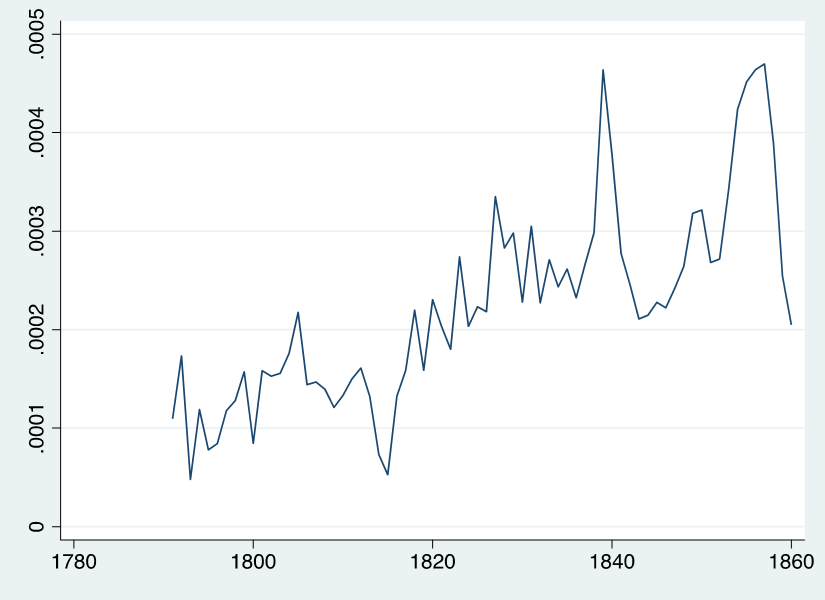
I have been working the last two weeks on a revise and resubmit for a journal article regarding the provision of lighthouses in antebellum America (1790-1860). This is in relation with other works I am doing or have already done (see here, here, here, and here) with respect to the provision of public goods by states or markets (i.e., remember that lighthouses were/are a frequent textbook example of public goods). In the process of doing the revisions, I assembled data on all expenditures by the Lighthouse Establishment and Lighthouse Board to 1860. This includes appropriations for new constructions, salaries of keepers, provisions for operation and maintenance expenditures. I divided these expenditures by GDP to yield the graph below.
There is not a ton to say about this here on this blog except the following three interrelated comments. First notice that the scale means that lighthouse spending to GDP is always less than 0.05% of GDP. That is small. Second, notice that the trend is up over time. It goes from 0.01% to a bit than 0.05% in peak years. These first two comments matter because you would expect the small share to grow smaller over time. Why? Remember the definition of public goods — non-rivalrous and non-excludable. The first part of that definition implies that you take the sum of marginal benefits at any quantity for everyone in a society to arrive at the societal benefit of an extra unit of public goods. If the marginal cost of providing the public good is zero, is constant or is only increasing at a slow pace, this means that adding an extra person would add more to the benefits than the cost. Phrased differently, this means that we should expect lighthouse spending to fall or stay constant as a share of GDP. This is because GDP goes up when more people are added (and the benefits of the public good scale up with extra people) while costs do not increase as much. Ergo, the trend in the graph below should fall.
Figure 1: Lighthouse Spending in America Divided by GDP, 1791 to 1860
I am pleased to announce that my paper “Willingness to be Paid: Who Trains for Tech Jobs?” has been accepted at Labour Economics.
Having a larger high-skill workforce increases productivity, so it is useful to understand how workers self-select into high-paying technology (tech) jobs. This study examines how workers decide whether or not to pursue tech, through an experiment in which subjects are offered a short programming job. I will highlight some results on gender and preferences in this post.
Most of the subjects in the experiment are college students. They started by filling out a survey that took less than 15 minutes. They could indicate whether or not they would like an invitation for returning again to do computer programming.
Subjects indicate whether they would like an invitation to return to do a one-hour computer programming job for $15, $25, $35, …, or $85.[1]This is presented as 9 discrete options, such as:
“I would like an invitation to do the programming task if I will be paid $15, $25, $35, $45, $55, $65, $75 or $85.”,
or,
“I would like an invitation to do the programming task if I will be paid $85. If I draw a $15, $25, $35, $45, $55, $65 or $75 then I will not receive an invitation.”,
and the last choice is
“I would not like to receive an invitation for the programming task.”
Ex-ante, would you expect a gender gap in the results? In 2021, there was only 1 female employee working in a tech role at Google for every 3 male tech employees. Many technical or IT roles exhibit a gender gap.
To find a gender gap in this experiment would mean female subjects reject the programming follow-up job or at least they would have a different reservation wage. In economics, the reservation wage is the lowest wage an employee would accept to continue doing their job. I might have observed that women were willing to program but would reject the low wage levels. If that had occurred, then the implication would be that there are more men available to do the programming job for any given wage level.
However, the male and female participants behaved in very similar ways. There was no significant difference in reservation wages or in the choice to reject the follow-up invitation to program. The average reservation wage for the initial experiment was very close to $25 for both males and females. A small number of male subjects said they did not want to be invited back at even the highest wage level. In the initial experiment, 5% of males and 6% of females refused the programming job.
The experiment was run in 3 different ways, partly to test the robustness of this (lack of) gender effect. About 100 more subjects were recruited online through Prolific to observe a non-traditional subject pool. Details are in the paper.
Ex-ante, given the obvious gender gap in tech companies, there were several reasons to expect a gender gap in the experiment, even on a college campus. Ex-post, readers might decide that I left something out of the design that would have generated a gender gap. This experiment involves a short-term individual task. Maybe the team culture or the length of the commitment is what deters women from tech jobs. I hope that my experiment is a template that researchers can build on. Maybe even a small change in the format would cause us to observe a gender gap. If that can be established, then that would be a major contribution to an important puzzle.
For the decisions that involved financial incentives, I observed no significant gender gaps in the study. However, subjects answered other questions and there are gender gaps for some of the self-reported answers. It was much more likely that women would answer “Yes” to the question
If you were to take a job in a tech field, do you expect that you would face discrimination or harassment?
I observed that women said they were less confident if you just asked them if they are “confident”. However, when I did an incentivized belief elicitation about performance on a programming quiz, women appear quite similar to men.
Since wages are high for tech jobs, why aren’t more people pursing them? The answer to that question is complex. It does not all boil down to subjective preferences for technical tasks, however in my results enjoyment is one of the few variables that was significant.
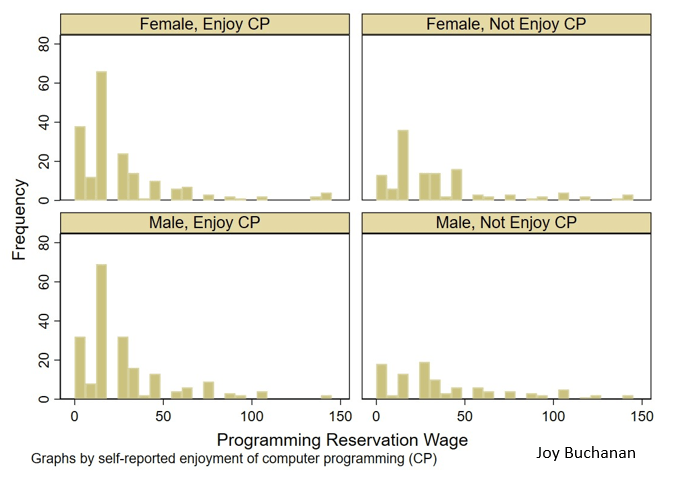
People who say they enjoy programming are significantly more likely to do it at any given wage level, in this experiment.
Fig. 3 Histogram of reservation wage for programming job, by reported enjoyment of computer programming (CP) and gender, pooling all treatments and samples
Figure 3 from the paper shows the reservation wage of participates from all three waves. Subjects who say that they enjoy programming usually pick a reservation wage at or near the lowest possible level. This pattern is quite similar whether you are considering males or females.
Interestingly, enjoyment mattered more than some of the other factors that I though would predict willingness to participate. About half of subjects said they had taken a class that taught them some coding, but that factor did not predict their behavior in the experiment. Enjoyment or subjective preferences seemed to matter more than training. To my knowledge, policy makers talk a lot about training and very little about these subjective factors. I hope my experiment helps us understand what is happening when people self-select into tech. Later, I will write another blog about the treatment manipulation and results, and perhaps I will have the official link to the article by then.
Buchanan, Joy. “Willingness to be Paid: Who Trains for Tech Jobs.” Labour Economics.
[1] We use a quasi-BDM to obtain a view of the labor supply curve at many different wages. The data is not as granulated as that which a traditional Becker-DeGroot-Marschak (BDM) mechanism obtains, but it is easy for subjects to understand. The BDM, while being theoretically appropriate for this purpose, has come under suspicion for being difficult for inexperienced subjects to understand (Cason and Plott, 2014). We follow Bartling et al. (2015) and use a discrete version.



 Economist Writing Every Day