Two Types of News: Elections vs Crashes

Some events are like elections: it was obvious that some big political news would break on Election Day, we just had to wait to find out what exactly would happen. Others are like market crashes: you might know in principle they’re a thing that can happen, but you don’t really expect any particular day to be the day one happens, so they seem to come out of the blue. As it turns out, for one of the largest crypto exchanges the day of the crash also happened to be Election Day.

FTX.com is facing a bank run sparked by competitor Binance tanking the price of the token that backed some of their assets. Customers are having issues withdrawing their money, Binance has withdrawn its offer to bail out FTX by taking them over, and bankruptcy seems likely. Supposedly this doesn’t affect Americans using FTX US, but I’d be nervous about any funds I had there, or indeed with funds in any centralized crypto exchange or stablecoin (Tether and even USDC seem to be having issues holding their pegs). All this was especially shocking because many considered FTX founder Sam Bankman-Fried one of the most trustworthy people in the often sketchy world of crypto. He was always meeting with US regulators and lawmakers, and seems not to be motivated by greed; he had already begun to give away his fortune at scale.

After any surprising event like this, some people claim it was actually obvious and they saw it coming (despite usually never having said so beforehand), while others start looking back for warning signs they missed. The most interesting one is something that shocked me when I first heard it March, but I never considered the risk it implied for FTX until the crash:

Going forward, red flags to watch out for seem to be topping a list of youngest billionaires (as Elizabeth Holmes also did) and buying naming rights to a stadium.

In contrast to this crash, the election happened right when we all expected, and at least largely how I expected. Like markets, I underestimated Democrats a bit; polls overall were impressively accurate this year, though they of course missed on some particular races. Votes are still being counted, and as of now we don’t even know for sure which party will control Congress (PredictIt currently gives Democrats a 90% chance in the Senate and a 20% chance in the House). But here are some early attempts to assess forecast accuracy. As I said, some polls were quite good:

Some polls weren’t so good, which means its important to weight better pollsters more heavily when you aggregate them. Some attempts at that were also quite good:

Oddly, some no money (Metaculus) / play money (Manifold Markets) forecasting sites seem to have done better than the real-money prediction sites:

But Who Will Build the Roads? 19th Century Edition

In the United States and much of the developed world today, most roads are publicly provided, i.e., they are built and operated by governments. This is not exclusively true, as many private toll roads exist, but the vast majority of roads are owned and operated by governments. Must it be this way?

A recent working paper by Alan Rosevear, Dan Bogart, and Leigh Shaw-Taylor looks at a very important case study: Britain in the 19th century. Britain is important because they were the leading economy in the world at the time, at the forefront of the Industrial Revolution. How were roads built and improved in England and Wales at this time? Here’s what the authors have to say in the abstract:

“non-profit organizations, known as turnpike trusts, built more new roads by attracting private investors and capable surveyors. We also show the Government Mail Road had the highest quality. Nevertheless, most turnpike trust roads were good quality, indicating their practical achievements.”

In the conclusion of the paper, they further add:

“Our analysis demonstrates that turnpike trusts were responsible for building 4,000 miles of new, good quality road in England and Wales, much of it between 1810 and 1838. On a directly comparable basis, the not-for-profit trusts built thirty times the mileage than had been built with direct Government funding during the early 1800s.”

To be clear, this paper is not a completely new discovery. It was already well-known that private companies built roads in Britain, as the authors make clear in their literature review. Similarly, there were many private turnpikes and toll roads in the US in the 19th century, as summarized in an encyclopedia entry by Klein and Majewski.

The Rosevear et al. paper adds new important details. First, they document the extent of private road building and improvements in the 19th century. Second, they show that these roads were generally of good quality, or at least they were of good quality for the time. Prior research had not documented these facts, thus making this a very important advance in our understanding of this time period. But perhaps more importantly, we see the possibility that many more roads today could be privately built and funded with user fee, especially considering that we are much, much wealthier today than 19th century Britain, we have more extensive and functional capital markets for raising the funds, etc.

The Sins of TikTok, Part 1: Extreme Privacy Theft by China-Based Company

Social media apps are nosy by nature; it is no secret that their main business model is to snoop out information about you, the user, and package and sell that information to advertisers who can target you. But there is one wildly popular app which goes beyond the norms of intrusiveness and privacy invasion AND is targeted largely at children and adolescents AND is based in China and thus is subject to Big Brother’s request for any and all data. That app is TikTok.

To avoid a bunch of re-wording, I will largely share excerpts from “ The Privacy Risks of TikTok – Why This Invasive App is So Dangerous “ by Priscilla Sherman at VPNOverview. Other articles echo her concerns with TikTok:

TikTok is an extremely popular social media video app owned by the Chinese tech company ByteDance. On TikTok, users can create and share short-form videos using a variety of filters and effects. The platform is full of dancing, comedy, and other entertaining videos….

Several agencies and news outlets are now sounding the alarm and reporting on the many problems that have surfaced. ByteDance claims to want to break away from its Chinese background in order to serve a global audience and says it will never share data with the Chinese government. This claim, however, seems impossible now that new security laws have been introduced in Hong Kong.

TikTok’s user base mostly consists of children and adolescents, which many consider to be vulnerable groups. This is a main reason for different authorities to express their worries. However, it isn’t just the youth that might be in danger from TikTok. From December 2019 onwards, U.S. military personnel were no longer allowed to use TikTok, as the app was considered a ‘cyber threat’…

[Hacker group] Anonymous has published a video listing the many dangers of TikTok. They quote a source that has done extensive research on TikTok: “Calling it an advertising platform is an understatement. TikTok is essentially malware that is targeting children. Don’t use TikTok. Don’t let your friends and family use it. Delete TikTok now […] If you know someone that is using it, explain to them that it is essentially malware operated by the Chinese government running a massive spying operation.”

These claims fit in with the recent developments surrounding TikTok. For example, Apple researchers announced that TikTok deliberately spies on users.

Claims keep piling up, showing that TikTok is a very invasive application that poses a substantial privacy risk. It seems that the data collection at TikTok goes much further than other social platforms such as Facebook or Instagram. This is surprising, since both of these companies have already faced backlash for the way they’ve dealt with user privacy. TikTok seems to collect data on a much larger scale than other social media platforms do. This, combined with TikTok’s origins makes it quite plausible that the Chinese government has insight into all of this collected data…..

Research from a German data protection website has revealed that TikTok installs browser trackers on your device. These track all your activities on the internet. According to ByteDance, these trackers were put in place to recognize and prevent “malicious browser behavior”. However, they also enable TikTok to use fingerprinting techniques, which give users a unique ID. This enables TikTok to link data to user profiles in a very targeted way.

Unfortunately, this happens with a great disregard of privacy – perhaps intentionally so. The German researchers indicate, for example, that IP addresses aren’t anonymized when TikTok uses Google Analytics, meaning your online behavior is directly linked to your IP address. An IP address provides information about your location and, indirectly, about your identity…

A user on Reddit used reverse engineering to figure out more about TikTok. Anonymous quoted the results in the video we mentioned earlier. The Reddit user discovered that TikTok collects all kinds of information:

  • Your smartphone’s hardware (CPU type, hardware IDs, screen size, dpi, memory usage, storage space, etc.);
  • Other apps installed on your device;
  • Network information (IP, local IP, your router’s MAC address, your device’s MAC address, the name of your Wi-Fi network);
  • Whether your device was rooted/jailbroken;
  • Location data, through an option that’s turned on automatically when you give a post a location tag (only happens on some versions of TikTok);

Additionally, the app creates a local proxy server on your device, which is officially used for “transcoding media”. However, this is done without any form of authentication, making it susceptible to misuse….

We asked investigative journalist and writer Maria Genova about her vision on TikTok. … Genova says: There’s a reason several countries have banned it. It’s unbelievable how much information an app like that pulls from your phone”…

TikTok needs access to your camera and microphone in order to work properly… However, there aren’t any specifications explaining how exactly these permissions are used. Therefore, TikTok could theoretically record conversations and sounds using your microphone, even when you aren’t filming a TikTok video.

We could go on and on with the technical details here, but you get the point. The fact that “IP addresses aren’t anonymized“ is really a big, bad deal. The article concludes:

The current findings and concerns surrounding TikTok are reason enough for us [the staff at VPNOverview] to remove the app from our devices. Whether TikTok’s main target group – young people between 14 and 25 – is sensitive to the privacy concerns that have come to light, remains to be seen.

Indeed.

One more quote , from Brendan Carr of the U.S. Federal Communications Commission (FCC), regarding the reliability of TikTok’s claims that they do not share data with the Chinese government:

“China has a national security law that compels every entity within its jurisdiction to aid its espionage and what they view as their national security efforts,” Carr said earlier this year, alluding to the fact that Chinese companies must make all the data they collect available to the Chinese Communist Party (CCP).

Stay tuned for Part 2, dealing with some larger market ramifications of TikTok’s evasion of  Apple and Android privacy protections.

~ ~ ~ ~ ~ ~ ~ ~ ~ ~ ~ ~ ~ ~ ~ ~ ~ ~ ~

This just in from BuzzFeed (added to original post here):

“Leaked Audio From 80 Internal TikTok Meetings Shows That US User Data Has Been Repeatedly Accessed From China”

For years, TikTok has responded to data privacy concerns by promising that information gathered about users in the United States is stored in the United States, rather than China, where ByteDance, the video platform’s parent company, is located. But according to leaked audio from more than 80 internal TikTok meetings, China-based employees of ByteDance have repeatedly accessed nonpublic data about US TikTok users — exactly the type of behavior that inspired former president Donald Trump to threaten to ban the app in the United States.

The recordings, which were reviewed by BuzzFeed News, contain 14 statements from nine different TikTok employees indicating that engineers in China had access to US data between September 2021 and January 2022, at the very least. Despite a TikTok executive’s sworn testimony in an October 2021 Senate hearing that a “world-renowned, US-based security team” decides who gets access to this data, nine statements by eight different employees describe situations where US employees had to turn to their colleagues in China to determine how US user data was flowing. US staff did not have permission or knowledge of how to access the data on their own, according to the tapes.

“Everything is seen in China,” said a member of TikTok’s Trust and Safety department in a September 2021 meeting.

On Elon, Twitter, and updating priors

I am not interested in ad hominem attacks, being a part of an internet mob, or signaling group affliation by attacking the internet’s “main character” of the day. But a significant determinant of our (hopefully always evolving) world views are how we feel about individuals who are prominent in the discourse, endowed with political power, and influential in markets. Not necessarily because we want to align or distance our selves from them as markers on a political mapping, but because at the core of our sensibilities are what we believe to be the optimal constraints and opportunities that shape the wielding of power.

<invokes best middle-aged-dude-from-a-midwestern-city-with-a-mustache accent>

Which brings me to this friggin’ guy:

My beliefs regarding Elon Musk, a man I have never met nor heard speak in person, as of twelve months ago could be summarized as such:
  1. Made prescient investment in PayPal. Could be luck, but it took some real insight to see the merits of PayPal over other transactions start-ups at the time, so he’s probably a very keen observer of nascent tech companies and talent.
  2. Tesla was run with a deep understanding that the cars would get the attention, but the money was to be made in battery innovation while circumventing the autodealers lobby and their fully-entrenched protections against market entrants. Clever.
  3. He’s excellent at getting attention, even if it isn’t always positive attention. Not sure he knows the difference. Not sure it matters.
  4. Obsessive workaholic, possibly to the point of some mild self-destructive tendencies. Decent chance he leverages prescription amphetamines when his body and mind can’t hold onto a task as long as his ego would prefer.
  5. Funnier than most people think he is. Not as funny as he thinks he is.*
  6. Highly likely (>98%) to be very, very smart. Likely (>75%) to be an excellent engineer. Highly likely (<98%) to be an excellent pitchman.

Since then I’ve listened to people call him dumb, malevolent, and childish. I mostly disregarded those as “social media ideas”, the kind of only lightly-considered opinions that are fun to have, grant you the light dopamine drip of both feeling superior to a famous billionaire while also implicitly reminding listeners that any deficiency in your own status is at least in part a product of the unfairness and stupidity of the world. It all struck me as kind of silly and deeply unconsidered. To this point – if we accept the premise that Elon Musk is a malevolent person, then we also have to accept that the market incentives combined with targeted government subsidies harnessed the powers of a smart, dedicated, malevolent person towards the creation and management of a company that measurably reduced the amount of carbon in the atmosphere. Are there a 100 people on the planet who can be credited with a greater impact mitigating global climate change? Are the fiercest critics of Elon Musk also willing to stipulate that the (neoliberal? new liberal?) melding of markets and governance can manipulate horribly selfish people to dedicate their lives to producing massive public goods?

So yeah, my estimation was pretty strong. Then he he decided to buy Twitter. That, and his subsequent public statements, have forced my periodic reconsideration.

First, while owning Twitter could certainly be considered the stewardship of a valuable public good, it seems unlikely to be a good investment relative to the price paid. Maybe more importantly, it seems outside his comparative advantage as an investor. It’s not a moonshot and there is no engineering marvel behind the customer-facing product. It is big and already expensive, so even if it plays out incredibly well over the next ten years, it yields, what, a 15% annual return?

Second, if there’s going to be a political victory, it’s not going to happy via lobbying or creative circumvention. It will always come back to free speech, which means if a conflict happens it will be settled in the courts over many, many years. Patience and constitutional nuance do not strike me as in his comparative advantage.

It might not matter that he is getting a lot bad attenion, but it does seem like he is getting, and engaging with, too much attention. How much of his bandwidth is actually left for the other companies he ostensibly runs?

He’s saying a lot of weird stuff. Or maybe the weird fraction of his public persona is just getting a greater share of the attention. I can’t tell.

If he’s not building something or re-engineering something, he must be selling something. What is he selling? The only thing I can come up with is that he’s selling himself, just not to me. Who’s he selling himself to?

My updated beliefs, as of 11-6-2022:

  1. He’s probably a very keen observer of nascent tech companies and talent, but has become distracted from that comparative advantage by ego and age.
  2. Tesla was run with an eye towards engineering, subsidy, and sales opportunities, but that has left him overconfident in his ability to manufacture an engineering opportunity by dint of his own interest in something.
  3. He’s still excellent at getting attention, even if it is polarizing attention that will have negative effects on how large swaths of the population feel about him. He’s acting more like a politician than an executive.
  4. Obsessive, and not just about work.
  5. He’s still funnier than most people think he is, but his sense of humor is becoming meaner. Some people like cruelty and their admiration comes with consequences.
  6. Likely (>85%) to be very, very smart, but there is a growing probability (<15%) that what he is actually exceptional at is taking credit where brilliance has occurred. I’ve met a non-trivial number of people in my life who were good at “playing the part” of the genius, full of quirks and big statements and bad hair, whose real gift was standing in front of other people’s contributions. Of course, there is a certain sales and political genius in manufacturing the appearance of deep foresight.

Now that I’ve impugned (probabilistically, at leat) the capacities of a highly accomplished individual who has never done any personal harm to me or been (to my knowledge) ever accused of anything explicitly destructive, I should at least note why. I think it is important to make a regular practice of reconsidering our heroes and villains in the public sphere. It’s just good political hygiene. The sheer quantity of narratives we consume, particularly the infovores among us, is simply too much to continually process without constructing heuristic reductions of public figures: genius engineer, corrupt monster, generous savior, doddering fool, etc. And, to be clear, I think those heuristic models are probably necessary just to stay mentally afloat, but if we’re going to do that we need to update those models regularly.

I used to think Elon Musk was a tech genius whose confidence was earned and of limited consequence. Now I think he’s a tech very-smart-guy whose overconfidence has yielded an investment decision with potentiallly disasterous consequences for both his own wealth and the broader discourse in our country. Who knows what I’ll think of him next week or if I’ll even think of him at all? Maybe Elon will save an island of puppies while a genius he casually fired resurrects Tumblr into the pivotal social media of a new American golden age. We’ll have so much to reconsider!

*To be fair, neither am I.

EWED Recommends Gifts 2022

Every year I request posts about stuff the writers actually use. My logic is that a great wave of stuff-buying is coming, so let’s try to highlight the good items and reduce holiday waste.

For Children

James recommends buying a whole bounce house. It might seem like something you could only afford to rent once a year, but the price of buying one you can use at home is now less than $300. In a big room, you can even do this indoors. Be the Christmas hero. Check on the space requirements.

I recommend two games that help kids learn to read. These are a great complement to Kindergarten or 1st-grade reading assignments. With enough confidence, you can convince kids that these games are toys and not “a book?”.

Sight Word Swat

Zingo sight words

SPOT IT is a card game that takes up almost zero space in the house or car. No reading or numeracy required and yet fun for adults!

Phantom Toll Booth A book for school-aged kids.

Little Tikes Easy Store Picnic Table with Umbrella, Scott says it’s worth the price if you have young kids around the house. Let them do messy food or activities there.

Food

Sounds like a good gift for adults who like to cook. Scott found a relatively affordable Black Rice.

Office to Garden

Compressed gas for computer maintenance. See Scott’s explanation on PC care.

Velcro Cut to Length – Zachary suggests: “Do you have a phone charger beside your bed that keeps falling on the ground? Just Velcro it to the nightstand lamp and it will stay exactly where you want it.”

Minute Soil is better than the dirt you have. This makes growing plants more fun and easier. Sounds like a great gift to wrap up for someone who likes gardening.

Set for Life

I agree with Zachary that cordless men’s hair clippers are a great investment.  

Barge All Purpose TF Cement Rubber – Praise from Scott: “Unlike most “superglues”, it will work on rough or porous surfaces, including situations like leather where flexibility is needed.”

Qwix Mix windshield – Windshield wiper fluid concentrate that is easy to store at home for when you need it.

Stoner Car Care 91154 10-Ounce Tarminator Tar, Sap, and Asphalt Remover Safe on Automotive Paint and Chrome on Cars, Trucks, RVs, Motorcycles, and Boats

Lastly, Mike has some correct life advice. Give yourself what your future self would want. For example, if you enjoy video games but don’t exercise enough, then try setting up an exercise bike right in front of your video games. That way you’ll get your cardio in and not have regrets the next week.

Must-Have Practical Gifts

My wife and I have different preferences for the kind of gifts that we like to receive. She likes earrings, flowers, massages, and electronics. I like hand tools, power tools, and any other item that makes domestic life more efficient. I can really appreciate a nice new pair of dockers or a button-down.

If you have a dad, husband, or anyone else in your life who appreciates practical gifts, then this list is for you. Below are four gift ideas that are sure to make the practical person in your life very happy – even if they may not be what you would want to receive. I’ve personally vetted all of the below items, so I can attest to the satisfaction that they are sure to provide that hard-to-shop-for person.

1)  Custom Length Velcro

Is your life in disarray? Are your cords and chargers in disarray? Then look no further. Nothing compares to the knowledge that the nest of cords behind your wall unit is no more. Use Velcro to bind and truncate your computer cords and your kitchen appliance cords. Do you have a drawer or box full of tangled extras? Velcro is nice because you can cut it to your custom length and reuse it with minimal loss of life. You can also use it in electrical applications or in the cabin of your vehicle. Do you have a phone charger beside your bed that keeps falling on the ground? Just Velcro it to the nightstand lamp and it will stay exactly where you want it. AND, because it’s reusable, you can easily remove it and keep the cords in your luggage nice and compact.

2) Minute Soil

Growing stuff is hard. But flowers, greenery, or even vegetables are nice. Yes, I’m basically recommending that you give someone dirt. But it’s awesome dirt. There’s this stuff called coconut coir. It’s coconut fiber that’s been compressed into a small disc or brick that’s ideal for shipping and delivery. Just add water and you’ve got some fancy dirt just waiting for an application. Coconut coir is all plant-based material, drains well, and it’s easy to store. You may not think of dirt as something that has a shelf life, but regular potting soil can definitely grow some unsavory things if you let it sit for long enough. Coconut coir is the solution to all of your spur of the moment small-scale horticultural endeavors.

3) Qwix Mix

Shipping items to our homes has been a game changer for shopping. But home delivery is not sensible for low priced heavy items like some liquids. My family was frequently running out of windshield wiper fluid and we’d end up stopping at a grocery store and overpaying. But no more! Qwix Mix is a windshield wiper fluid concentrate. Just an ounce in addition to a gallon of water saves us unplanned trips, high prices, and the storage cost of purchasing gallons of fluid ahead of time. I can’t vouch for the de-icing formulation, but the southern climate formula does exactly what it’s supposed to do.

4) Ufree Hair Clippers

Since the Covid recession, many of us have taken up our hand at cutting hair at home. For a while, we were borrowing a neighbor’s clippers. They were loud and had a short cord. But I’ve since purchased Ufree clippers and they are so much more convenient. They’re quiet, cordless, charge with a USB cord, and have a battery level display. But the battery lasts so long that you don’t even need to think about it. This kit comes with a beard trimmer, several guards, and a cape (throw the cape away, it’s bad). The clippers are metal and have some heft to them. Several colors are available – they come in black, silver, and gold finishes. But how can one not choose the gold ones?

That’s my list of great gifts for practical people. IDK your gift limit, but if you buy all 4 of these gifts you’ll spend about $100. That might leave room left over for stocking stuffers and chocolate.

(We’re not paid for any of these recommendations. But using our links is always helpful.)

A Dragonfly’s View of Election Day 2022

This is my last post before the US midterm elections on Tuesday, so I’ll leave you with a prediction for what’s coming.

Who is the best predictor of elections? Nate Silver at FiveThirtyEight has had a pretty good run since 2008 using weighted polls. Ray Fair, an economics professor at Yale has a venerable and well-credentialed model based on fundamentals. I typically favor prediction markets, because they incorporate a wide range of views weighted by how willing people are to put their money where their mouth is, and traders are able to incorporate other sources of information (including predictors like FiveThirtyEight). But which prediction market should we trust? There are now many large prediction markets, and the odds often differ substantially between them.

When there are many reasonable ways of answering a question or looking at a problem, it can be hard to choose which is best. Often the best answer is not to choose- instead, take all the reasonable answers and average them. Dan Gardner and Philip Tetlock call this approach Dragonfly Eye forecasting, since dragonfly’s eyes see through many lenses. So what does the dragonfly see here?

Lets start with the US House, since everyone covers it.

  • FiveThirtyEight’s latest forecast shows that Republicans have an 85% chance of taking the House; it shows a range of possible outcomes, but on average predicts that Republicans win the popular vote by 4.3% and take 231 House seats (substantially over the 218 needed for a majority)
  • The Fair Model predicts that Democrats will win 46.6% of the two-party vote share (leaving Republicans with 53.4%). This has Republicans winning the popular vote by 6.8%, a moderately bigger margin than FiveThirtyEight. The reasoning is interesting; the economy is roughly neutral since “the negative inflation effect almost exactly offsets the positive output effect”, so this is mainly from the typical negative effect of having an incumbent party in the White House.
  • Prediction markets: PredictIt currently gives Republicans a 90% chance to take the House. Polymarket gives them 87%. Insight Prediction also gives them 87%. Kalshi doesn’t have a standard market on this, but their contest (free to enter, 100k prize) predicts 232 Republican seats.

Its a bit tricky to average all these since they don’t all report on the same outcome in the same way. But the overall picture is clear: Republicans are likely to do well in the House, with an ~87% chance to win a majority, expected to win the popular vote by ~5.55% and take ~232 seats.

The Senate is closer to a coin flip and harder to evaluate.

  • FiveThirtyEight gives Republicans a 53% chance to win a majority (51+ seats for them; Democrats effectively win if the Senate stays 50-50 since a Democratic Vice President breaks ties for at least 2 more years). The most likely seat counts are 50-50 or 51-49, but confidence intervals are pretty wide and 54-46 either direction isn’t ruled out.
  • The Fair Model doesn’t make Senate predictions, only House and Presidential predictions.
  • Prediction markets: PredictIt gives Republicans a 70% chance to win a Senate majority, probably with 52-54 seats. PolyMarket gives Republicans a 65% chance, as does Insight Prediction. Kalshi predicts 53 Republican seats.

Overall we see a much higher variance of predictions in the Senate; a 17pp gap between the highest (70%) and lowest (53%) estimates of Republican chances, vs just a 5pp gap for the House (90% to 85%). This shows up with the seat counts too; everyone agrees there’s a substantial chance Republicans lose the Senate, but if they do win, it will probably be by more than one seat. The average estimate is ~52 Republican seats. FiveThirtyEight and PredictIt agree that the closest Senate races will be Georgia, Pennsylvania, Arizona, Nevada, and New Hampshire (though they rank order them differently), so those are the races to watch.

Forecasts for governors aren’t as comprehensive, but FiveThirtyEight predicts we’ll get about 28 Republican (22 Democratic) governors, while PredictIt expects 31+ Republicans; I’ll split the difference at 30. Everyone agrees that Oregon is surprisingly competitive because of an independent drawing Democratic votes. The biggest difference I see is on New York, where PredictIt gives Republican challenger Lee Zeldin a real chance (26%) but FiveThirtyEight doesn’t (3%).

Overall forecast: moderate red wave, Republicans take the House and most governorships, probably the Senate too. But if they lose anything it is almost certainly the Senate.

These forecasts seem about right to me. Democrats are weighed down by an unpopular (-11) President and the highest inflation in 40 years. This would lead to a huge red wave, but Republicans have their own weaknesses; an unpopular former President lurking in the background, and the Supreme Court making a big unpopular change voters blame them for. This shrinks the red wave, but I don’t think its enough to eliminate it. The effect of Roe repeal is fading with time, and the unpopular Biden is more salient than the unpopular Trump; Biden is the one in office and is more prominent in media coverage. Facebook and recently-acquired Twitter may be doing Republicans a favor by keeping Trump banned through Election day. But if he drags Republicans down anywhere, it will be the Senate, where candidate quality (not just party affiliation) is crucial and his endorsements pushed some weak/weird/extreme candidates through primaries. We’ll also see this “extremist” Trump effect (abetted by cynical Democratic donations to extreme-right candidates) dragging down Republicans in some key governor’s races like Pennsylvania, where Democrats are now 90/10 favorites..

What’s Killing Men Ages 18-39?

The all-cause mortality rate in 2021 for men in the US ages 18-39 was about 40% higher than the average of 2018 and 2019. That’s a huge increase, especially for a group that is not in the high-risk category for COVID-19. What’s causing it?

Some have suggested that heart disease deaths, perhaps induced by the COVID vaccines, is the cause. This is not just a fringe internet theory by anonymous Twitter accounts. The Surgeon General of Florida has said this is true.

What do the data say? The first thing we can look at is heart disease deaths for men ages 18-39.

The data I’m using is from the CDC WONDER database. This database aggregates data from US states, using a standardized system of reporting deaths. The most important thing to know is that in this database, each death can one have one underlying cause, and this is indicated on the death certificate. Deaths can also have multiple contributing causes (and most deaths do), and the database allows you to search for those too. But for this analysis, I’m only looking at the underlying cause.

Here’s the heart disease death data for men ages 18-39, presented two different ways. First the trailing 12-month average. Don’t focus too much on that dip at the end, since the most recent data is incomplete. Instead, notice three things. First, there was a clear increase in heart disease deaths. Second, that rise began in mid-2020, well before the introduction of vaccines. Third, once vaccines started being administered to this age group in Spring 2021, the number of deaths leveled off (though it didn’t return to pre-pandemic levels).

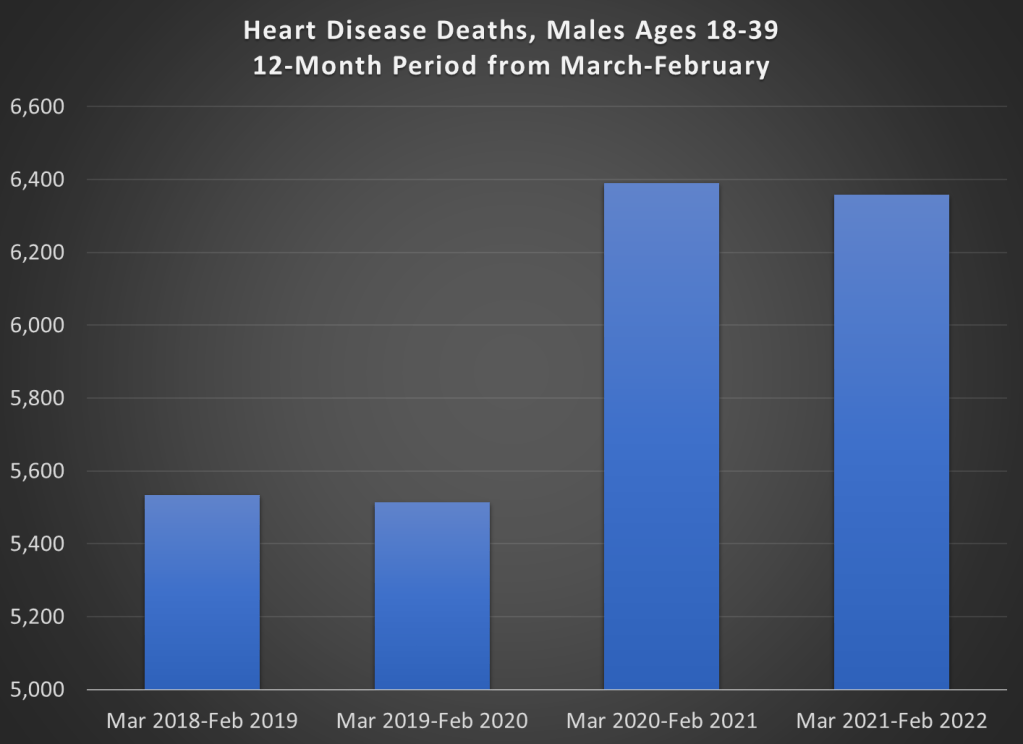
Here’s another way of looking at the data: 12-month time periods, rather than a trailing average. I created 12-month time periods starting in March and ending in February of the following year. I’ve also truncated the y-axis to show more detail, not to trick you. But don’t be tricked! The deaths are up 2-3%, not a more than doubling as the chart appears to show.

We can see in the chart above that the rise in heart disease deaths for young males completely preceded the vaccination period. Something changed, for sure, but the change wasn’t the introduction of vaccines. Heart disease deaths (by underlying cause) are only up 2-3%, while overall deaths are up around 40%.

So, to repeat the title question, what is killing these young men?

Continue reading

How to Magnetize a Screwdriver (So It Holds onto a Screw)

This is an economics blog; here is a life hack that can save you some money, and maybe time.  It can be really helpful to have your screwdriver magnetized, so a screw will stick to it. This past weekend I helped someone repair a microwave door, and for re-assembly I had to get a screw into its hole, where its hole was recessed in a narrow space where I could not have held the screw with my fingers whilst starting it with the screwdriver. So it was very helpful to just stick the screw on the end of the tool, and (carefully) insert the tip of the screw into its threaded hole and just start turning. Likewise, it was helpful in disassembly to be able to draw a screw out with the magnetized tip.

You can go buy a set of magnetized screwdrivers from Amazon. But these get mixed reviews and of course cost money and shipping delay and now you have more screwdrivers to store. A comment in one of the Amazon reviews clued me in that you can easily magnetize a screwdriver which you already have. Here is how:

( 1 ) Start with a strong magnet – – maybe a single magnet that you happen to have, or make a stack of say five medium sized disk refrigerator magnets. Techies can remove magnets from an old speaker or hard drive.

( 2 ) Using only one end (pole) of your magnet, draw it along the  screwdriver shaft, from the top or middle out to the end, always in the same direction. Do this maybe four times, then rotate the screwdriver a quarter turn, then make another four strokes, and so on for all four sides of the screwdriver. You’re done.

I did this, and it worked great. A couple of further comments – – first, if there is no rubbery coating on your magnet and you don’t want to scratch up the finish on your screwdriver, you could put a single layer of  masking tape or painters tape on the part of the magnet that is scraping along the screwdriver. Second, the hard steel of the screwdriver is not a great permanent magnet. You might need to do this again in a year, and you will never get a really strong magnetic effect (this may be why there were some complaints on Amazon). Also, if you give the screwdriver some sharp taps (or drop it on concrete floor), it can rescramble the magnetic domains and lose  magnetic orientation in the steel, so again you’d have to repeat the treatment.

You can also magnetize a screwdriver by wrapping a coil of insulated wire around it, and hooking the wire up to a battery. Also, you can make the screwdriver magnetic temporarily by sticking a disk magnet on the shaft.

I suppose you could bring your magnet to your friend’s house and process his or her favorite screwdriver next time you go over for some other reason. Or you could make magnetized screwdrivers for gifts.

Some references:

https://www.wikihow.com/Magnetize-a-Screwdriver

https://www.instructables.com/How-to-Magnetize-a-Screwdriver-at-Home/

Bonus hack: How to Sanitize Face Masks

Now we are back to being able to buy KN95 and (even better) KF94 face masks, if a mask gets too breathed in, we can just throw it out and get a new one. But if for some reason (a new pandemic apocalypse like 2020?) you need to disinfect a face mask, there are ways.

Most flu and coronaviruses cannot live indefinitely on a dry surface. So one approach is simply to put each mask in its own dry paper bag (to prevent contact with more virus particles) and leave in a dry, preferably warm place for 3 days.

If you are in a hurry, apparently heating for 60 minutes at  the oven at 70°C (158°F) will also do the trick.

Reference: https://smartairfilters.com/en/blog/disinfect-clean-n95-mask-virus-coronavirus/

Harness your compulsions

Every year the writers on this blog each recommend a product or gift. My recommendation for gifts to others remains the same: buy them two hours. But what about yourself?

My advice for you is this: what are the things you are compelled to do that runs against the preferences of your past and future selves? Make that list in your head or on paper. Okay, now make a second list of the things your past and future selves wish that present you would do more often? Great.

Are there activities on that list that you can bundle together into a single activity?

For example, and directly from my personal life, I am a middle-aged man who can get wrapped up in video games to the detriment of the rest of his life. I’m pretty sure that 10 hours in a given week would never make the grade of “video game addiction”, where whole lives are left to erode into dust while a soul spends every waking our gaming. But 10 hours is really costly in my current life.

Like, I don’t know, very nearly every middle-aged American, I should exercise more. We all know this, that’s why we pay for memberships in gyms we never use and buy exercise equipment that finds greater use drying our clothes.

Rather than purge my house of video games, I have instead located them strategically in a room with no chairs save an exercise bike and no TV save a one in an elevated position. I have two choices: I can either stand while I play or sit on the bike. Once on the bike, I have two choices: I can pedal or sit there stewing in my own sloth.

I bike 3-4 hours a week now.

Now, let’s be clear. I’m not telling you to buy a Playstation, TV, wallmount, and an exercise bike as the solution to your deficiency of exercise.* That’s a pretty privleged set of advice to give, especially the presumption you have the living space for all of that. What I am saying, however, is that if you already have a video game system that you know you use too much and an exercise bike you know you use too little, you may find a benefit in bundling the two together in a manner that your future self cannot easily un-bundle. [Sidenote: if you’re only short the bike, stationary bikes are (relative to my expectations), shockingly cheap. If you’re short on space, get one that folds so you can lean it against a wall while you are not using it.]

We all have our compulsions, the activities we can’t resist. Most of us also have the beneficial activities that we know will improve our lives, we can’t just through that initial inertia. Bundle them together. Draw in your sketchbook at an easel set up where you watch crappy reality TV. Keep the good whiskey and glasses wehre you write your weekly blog entries. Rack up 100 hours of Civilization 6 while doing those lying on a yoga mat doing those boring exercises your physical therapist prescribed.

Managing ourselves is often a tug of war between who we wish we wanted to be and who we actually want to be. If there is an opportunity to align the two a little better, that’s worth investing in. Now if you any of you know of a way I can harness my tragi-comic addiction to Cheetos into greater research productivity and physical strength, I’m all ears.

*I’m also not not telling you to buy those exact things.