What Should a Businessman Be Willing to Die For?

The late Dallas Willard, a professor at USC, wrote on a variety of subjects touching on moral philosophy. In 2006 he addressed the topic, “The Business of Business”. He noted that the spontaneous, obvious answer today to the question, “What is business (manufacturing, commerce) for?”  would be: “The business of business is to make money for those who are engaged in it.”

But there is a tension here. Willard notes that that is NOT how businessmen/professionals present their raison d’etre : 

“No business or other profession that advertises its ‘services’ announces to the public that it is there for the purpose of enriching itself or those involved in it. With one accord they all say their purpose is service, not serve-us. I have never met “professionals” who would tell their clients that they were there just for their own self-interest.”

This ambiguity in the role of businessmen/women (or “merchants”, as they used to be called) is not new. Willard reaches back to the writings of John Ruskin who remarked in 1860, “The fact is that people never have had clearly explained to them the true functions of a merchant with respect to other people.” Ruskin went on to place what we today call “business” among the  “Five great intellectual professions” necessary to the life of “every civilized nation.” With respect to the nation:

“The Soldier’s profession is to defend it.

The Pastor’s to teach it.

The Physician’s, to keep it in health.

The Lawyer’s to enforce justice in it

The Merchant’s to provide for it.”

Ruskin added: “And the duty of all these men is, on due occasion, to die for it.” The soldier to die “rather than leave his post in battle,” the physician “rather than leave his post in plague,” the pastor “rather than teach falsehood,” the lawyer “rather than countenance injustice.” (Indeed!)

But what of the merchant? What is it that the merchant (businessman) would die for rather than do?

Well, the main function of the merchant or manufacturer in Ruskin’s view is to provide for the community, not simply make money for him/herself:

It is no more his function to get profit for himself out of that provision than it is a clergyman’s function to get his stipend. The stipend is a due and necessary adjunct, but not the object of his life, if he be a true clergyman, any more than his fee (or honorarium) is the object of life to a true physician. Neither is his fee the object of life to a true merchant. All three, if true men, have a work to be done irrespective of fee…. That is to say, he has to understand to their very root the qualities of the thing he deals in, and the means of obtaining or producing it; and he has to apply all his sagacity and energy to the producing or obtaining it in perfect state, and distributing it at the cheapest possible price where it is most needed.

Ruskin also noted that since the merchant has direct control over those who work for him, “…it becomes his duty, not only to be always considering how to produce what he sells in the purest and cheapest forms, but how to make the various employments involved in the production or transference of it most beneficial to the men employed.”

Furthermore, if the enterprise falls on hard times, it is the duty of the CEO (or other top management) to share fully in the hardships suffered by the other employees: “As the captain of a ship is duty-bound to be the last to leave the ship in disaster,…so the manufacturer, in any commercial crisis or distress, is bound to take the suffering of it with his men, and even to take more of it for himself than he allows his men to feel; as a father would in a famine, shipwreck, or battle, sacrifice himself for his son.”

In a similar vein, activist lawyer and later Supreme Court Justice Louis Brandeis in 1912 said at a Brown University commencement address:

The recognized professions…definitely reject the size of financial return as the measure of success. They select as their test, excellence of performance in the broadest sense—and include, among other things, advance in particular occupation and service to the community. These are the basis of all worthy reputations in the recognized professions. In them a large income is the ordinary incident of success; but he who exaggerates the value of the incident is apt to fail of real success…In the field of modern business, so rich in opportunity for the exercise of man’s finest and most varied mental faculties and moral qualities, mere money-making cannot be regarded as the legitimate end.    

Willard drily remarked, “Texts by Ruskin and by Brandeis, along with similar ones, are not popular references in our schools of business today.” My own personal observations are that the nobility of the management and entrepreneurs seems to scale somewhat inversely with the size and age of the enterprise. It gets tricky to start assessing degrees of moral rectitude here, because in classical exchange theory, any voluntary transaction (buying/selling goods, agreement to work for certain wages) brings benefits to both parties, and to society as a whole, quite apart from any conscious intent of altruism.

At large end of the scale, we see CEOs who drive big companies into the ground and then waltz away with multimillion dollar golden parachutes; no sharing of the employees’ hardships at all.

And for many Wall Street dealmakers, it truly is all about the money: float a couple billions in junk bonds, take control of some company, force the company to pay you fees, load the company with your crappy debt, and walk away with a cool billion or so. Or take a short position in a publicly traded company, publish a bogus report (“short attack”) alleging horrible malfeasance at the company, driving share prices down, close out your short position at a huge profit, and move on to the next victim. These seem to be purely predatory actions, taking advantage of the system to make a buck with no clear redeeming social value.

At the other end of the scale, the (often youngish) folks starting a new software firm, the  idealistic couple chucking fast city life to try to make a go of a coffee house or BnB in a small town, the plumber with an associate, all of these I think are very serious about providing the public with a good product/service, and may tend to take care of their employees and also to put a lot of their own personal skin (savings, a lot of extra time) in the game to get these enterprises going. The younger Henry Ford famously fought to pay his employees high wages, over the objections of company shareholders, who wanted more profits to accrue to them. I know personally two men in the greater Trenton, NJ area who (as an expression of their religious values)  intentionally conduct computer-related businesses such that they can provide employment to disadvantaged local young men.

Maybe when an enterprise gets large enough that, to management, its employees and its customers become numbers rather than individual people is the point where the transition to pure greed as the fundamental motive occurs, even if it proves prudent in support of profits to maintain policies and communications which promote the welfare of customers and employees.
On EJMR, status competitions, and tapeworms

The EJMR paper presentation dropped at the NBER summer meetings. If you were a 90s kid who loved hacker movies, you were not disappointed. Some are worried it’s an exercise in doxxing (it isn’t). What I think is worth a bit more reflection is the “big reveal” that EJMR toxic posters were not limited to the periphery of the profession. Quite to the contrary, large swaths were matched to the IP addresses of elite universities. Besides disabusing people of the notion that toxic behavior and ideas might decrease with prestige, accomplishment, or intelligence, I think it serves as a healthy reminder that 1) Any anonymous message board will devolve into a cesspool if left unmoderated (see Law, Gresham’s) and, 2) Any status game can devolve into a negative sum game if left unmoderated.

Academia is a status tournament

From a purely careerist standpoint, academia is a long run status tournament built around rankings and tiers. It starts from the moment you apply to graduate schools, hoping to get into the highest ranked school. Some are admitted, some are not. Those admitted are sorted across tiers of schools. Once in a school there is the (sometimes true) perception that students are internally ranked, sorting to faculty advisors, projects, and data access. Some graduate, some leave early with a masters degree, some leave with nothing. Those who graduate are sorted into academic and non-academic jobs. Those that are pushed by the faculty on to the academic market sort into better and worse schools. The best prospects are swapped across the best schools (it’s generally uncouth to hire your own students, at least immediately). Once they are established in tenure track positions, the tournament continues in its least compressed, but also most heightened form, as scholars conduct research, write papers, tour seminars, apply to workshops and conferences, submit to journals, apply for grants and fellowships, and generally fight their way towards tenure. Tenure, to be noted, is a stage of this tournament, but it’s not the end (the end happens at funerals and Nobel Prize ceremonies.)

You aren’t tenured by your department. You’re tenured by the profession.” – academic proverb

The tournament is subtle and unrelenting. For those who seek to climb the ladder or remain on top, the strategies are more varied than you might expect. It is, point of fact, not all about research productivity, scholarly contributions, and intellectual advancements. It’s also about public goods, including data curation, lab management, feedback on other people’s research, journal editing, idea sharing, even referee reports. From the most cyncical careerist point of view, however, it remains a status game, which means what matters at the end of the day is not how good you are, but how good other people think you are. Or how good people think other people think you are. Or how good…you get the k-level reasoning idea.

Can you see where the trouble seeps into this tweedy swamp of ambition and ego? The inherent subjectivity of it. The biases some of us have, the biases all of us have. The dark arts of manipulating image, conversation, and public opinion. The herding around ideas. The bureaucratic and scholarly gamesmanship that can hold back one paper and elevate another. Every story your paranoid lizard brain can dream up explaining why a node in the tournament decision tree turned against you and in another’s favor.

Which brings me back to EJMR.

I’ll make a statement you don’t have to believe: I expected the worst behavior to be at the good schools. Why? Because they are embroiled in the most ruthless, unforgiving level of the tournament, and most of them are losing. That’s not a hypothesis, that’s just a mathematical reality. For every 25 students in a top PhD program, I’d guess 10-12 end up in academia. Of those, 6-10 are at an R1. Of those, 1-2 are in a top school. Of those, maybe 1 gets tenure at said top school.

From the perspective of the most competitive souls, that’s 96% who are losers. Not in the absolute sense, but in the “at some stage of the game someone else was chosen over them” sense. In the relative, zero-sum, status seeking sense. That doesn’t mean 96% of academics are angry, but it does make for a large pool of potentially angry people. People who, in a moment of weakness, might feed that dark tapeworm of the soul whose only sustenance is the denigration and suffering of people they envy. That desperate willingness to believe the only reason you didn’t “win” is because your competitors were vile and dishonorable? That’s a tapeworm buffet.

The dark tapeworm is an emotional parasite, isolated and lonely in it’s host. EJMR, in its toxic final form, allowed thousands of depressed, angry tapeworms to find community and feed each other. To affirm the belief festering within each of them that they were cheated. That they would have gotten the job, published, admitted, invited, tenure. That they would have won just one more round, and risen just one more level, if it wasn’t for them. The cheaters.

It’s not surprising that the targets of EJMR hate were disproportionately (but not exclusively) women and people of color. I’m not going to tour you through the misogny and racism on EJMR, but I will note that it’s a good reminder that intelligence isn’t the prophylactic against grotesque beliefs and behavior that you might hope it is. Quite the contrary, it’s almost (almost) heartwarming to see that status envy and anger turn everyone into the same monsters, looking to attack and blame the same people, whether you’re an unemployed trucker in Arkansas worried about making rent or a 5th year PhD student at Harvard nervously managing the shame of having to settle for an industry job that starts at $190k a year.

Returing to the thesis of this post, let’s not forget that tournaments are perfectly fine. They can even be positive sum games. A golf tournament only has one winner, but the more honorable the competitors are, the more they collectively raise the status and opportunities of others in their tournament, the higher the quality of their collective product, which means a bigger prize pool for everyone. There’s a reason the prize money isn’t winner-take-all: they know that a certain amount of cooperation amongst competitors is necessary for the tournament as a whole to thrive.

And that’s why this paper is important. Beyond shining a light on grotesque and dangerous behavior, it’s a wake-up call that the status tournament in academic economics is out of control and veering into negative sum territory. EJMR got a foothold because students and faculty had questions nobody felt they could ask or answer without anonymity. A secret curriculum. A gnawing, desperate fear that you don’t understand the rules. How do I get in the NBER? Can I use the same data as another student? Can I renege on a job if a better one is offered? Does journal X count for tenure? EJMR thrived and achieved critical mass. But that critical mass, combined with anonymity and the abandoning of content moderation, became a breeding ground for emotional tapeworms and here we are.

So how do we kill it off? Well, we can go after the most aggressive and disgusting posters on the website, but that feels a bit like attacking a forest fire with a fire extinguisher. In the long run, I suspect the solutions will be public goods. Not unlike undermining the labor supply of a terrorist group by supplying clean water and healthcare, I think the profession needs to start providing the public goods that were the original EJMR lifespring. Journal submission records. Hiring decision transparency (i.e. when a job is filled or still considering candidates). Invitation, acceptance, and rejection statuses in real time. Repositories of course notes and slides. A hidden curriculum made visible.

And, yes, an anonymous message board (or a identified board with a special anonymous section), but with strict content moderation. We know it can be done. You don’t see any of the same filth on statalist or the economics subreddit. We have professional associations, including the AEA, whose sole purpose is to provide public goods. I’m not going to dissuade anyone, particularly those attacked, from going after EJMR operators or posters through legal channels. But it we want to rip it out of the earth, root and vine, I see no better way than to beat it in the marketplace. And in doing so, we might even smooth over the rough edges of the status tournament we’re trying to build lives and careers in.

Because maybe the collective production of new knowledge at the bleeding edge of economics could even be a positive sum game?

Success in starting

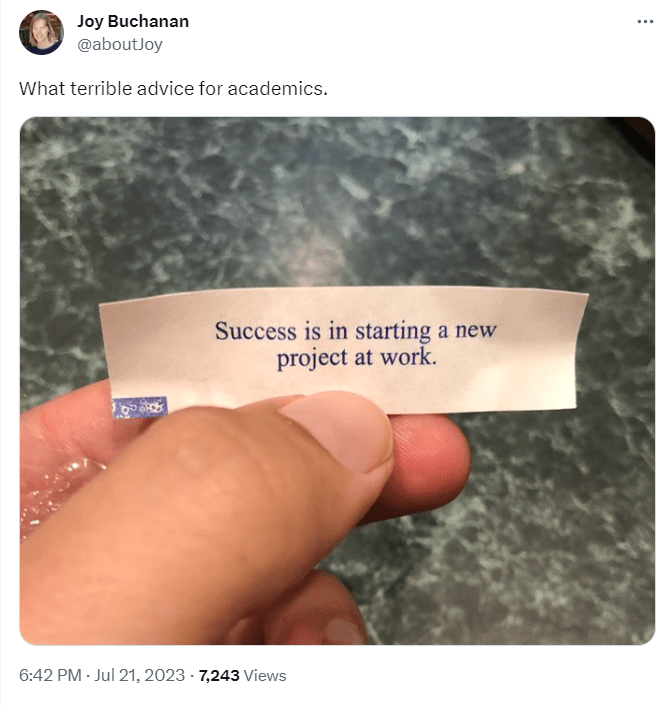
At a Chinese restaurant, I got a fortune that said, “Success is in starting a new project at work.” It struck me as very funny, and it resonates with other people on Twitter.

Starting a new project at work does not translate to success in academia. The danger is usually in starting too many projects and finishing too few.

Starting a new research project, whether alone or with coauthors, is exciting. You fall in love with a new idea.

The hard part is sticking with that idea until the very end of the publication process. This is more comparable to staying married. The project will see you at your worst, and you will discover that the project is not as wonderful as it seemed initially. You might end up re-writing the manuscript several times, years after the initial infatuation has worn off.

Academics do need to start projects. It is important to start the right projects. A reason to not start too many projects is to preserve time for the best work. A downside to being overloaded is that you might have to say no to a new project when an actual good opportunity comes along.

In my post on the Beatles documentary Get Back, I observed the way that the bandmates start new songs together. It reminded me of coauthors convincing each other to start a new project.

Their creative process resembles co-authoring a research paper. When Paul is working out a song and humming through places he hasn’t worked the lyrics out yet, that reminds me of the early drafts of a paper. You don’t have to have the whole Introduction written. The hook of a song is a bit like the main result of a research paper. Persuading yourself and your coauthor that you have a project worth finishing is the first step. Coauthors have unspoken agreements on how the project is going to proceed. The tacit knowledge of the collaborative process is one of the most important things you can learn in graduate school.

Darwyyn Deyo wrote several posts for us on the research process, including: “The Research Process: Identifying the Ideas that Motivate You

Greg Mankiw’s career advice intersects with starting projects:

Advice for new junior faculty (2007)

My Rules of Thumb (1996)

This quote from Rules of Thumb was surprising: “None of this is part of a grand plan. At any moment, I work on whatever then interests me most. Coming up with ideas is the hardest and least controllable part of the research process. It is somewhat easier if you have broad interests.” He goes on to say: “I sometimes fear that because I work in so many different areas, each line of work is more superficial than it otherwise would be. Careful choice of co-authors can solve this problem to some extent, but not completely.”

He really refutes my fortune cookie with this line, “Deciding which research projects to pursue is the most difficult problem I face in allocating my time.” Success is about starting the right projects and no others.

Smoky Mountains Tourism

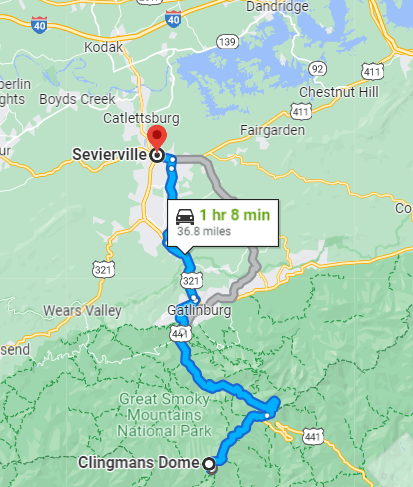
The area from Sevierville, TN to the peak of the Smoky Mountains is a popular destination for summer road trips.

Much of the American Southeast is too hot in July for hiking. The nice thing about the Great Smoky Mountains National Park is that you can keep driving up in elevation until you get to 70 degrees F or less.

The problem with the Smoky Mountains is that too many people want to go. The economist Donald Shoup has written about The High Cost of Free Parking. Entry to the national park is still free, however as of 2023 parking is paid. Good for them. The fee is very cheap. You can print a pass before you go or easily buy one on the way in.

The parking pass didn’t deter many people when we went in 2023. I recommend going early if you want to be able to park near a trailhead, or if you want to avoid a line getting into the Clingman’s Dome parking lot.

Our family has a running joke about “the pancake cabin people”. As we drive into the mountains in the morning, we pass parking lots full of cars outside of restaurants called pancake cabins. As long as you are up early enough to beat the pancake cabin people, you should be able to park where you want to.

There are more attractions in the national park than you could see in one day. The most dramatic view is at the top of Clingman’s Dome. The most historic educational sites are at Cades Cove. The best swimming (that I know of) is in the creek at Chimneys picnic area.

There are dramatic lookouts that you can drive right up to. Cades Cove is mostly a driving experience with lots of optional stops (closed to cars on Wednesdays).

With little kids in tow, it’s hard to make progress on the hikes. The map says just 2 miles to a waterfall. Sounds great. We make it 0.3 miles in. Then someone demands to be carried. Someone trips and breaks down crying. Our snacks are gone. We turn around and return to the car… it’s all good as long as you get excited about leaves and bugs. If you are in the stroller stage of life, don’t expect to get far on any hikes.

If you get a hotel within an hour of the national park on the Tennessee side, there is a lot to do. I might call it “the Orlando of the mountains.” Dollywood is darling at Christmas time.

Years ago, I sent out a note from Chattanooga, a few hours away in Tennessee. That’s another cute green place with hiking and restaurant options, on a smaller scale than the Smoky’s area. Their aquarium is fantastic. It’s neat how their “River building” starts by showing how small streams in the Smoky Mountains feed into the Tennessee River.

Prohibition Reversals

We have all heard of the prohibition era. Popularly, it refers to the period from 1920-1933 during which it was illegal to sell, transport, and import alcohol in the US. National prohibition was enacted by the 18th amendment and repealed by the 21st amendment. That’s the basic picture.

But did you know that there were state alcohol prohibitions prior to the national one? In fact, there were 3 major waves of state alcohol prohibitions. The first was in the 1850s, the 2nd was in the 1880s, and then the 3rd preceded the 18th amendment. The image below illustrates the number of states that had statewide dry policies. You can see the first two waves and then the tsunami just prior to 1920.

Continue reading

13th Time’s A Charm: Finally Grant Funded

I just found out I’ll be receiving a Course Buyout Grant from the Institute for Humane Studies. It will allow me to teach less next year in order to focus on my research on how Certificate of Need laws affect health care workers.

I’m happy about this because I think this research is valuable and time is my main constraint on doing it (especially doing it quickly enough to inform ongoing policy debates in several states). But I’m also happy because I finally got what I consider to be a “true” grant after many rejections.

I’ve received research funding many times before (e.g. Center for Open Science funding for replications), but it was always relatively small amounts that went directly to me. True grants tend to be larger and to be paid directly to the university. That’s the case with the course buyout grant, which essentially pays the university enough that they can hire someone else to teach my class.

I may have lost count but I’m pretty sure this was the 13th “true grant” I have applied for, and the 1st I will actually receive. Academics have to get used to rejection, since we need to publish and decent journals tend to reject 80%+ of the articles they receive. But for some reason I’ve found grants much harder even than that. From some combination of skill, luck, and targeting lower-tier journals than perhaps I could/should, my acceptance rate for journal articles is probably nearing 50%. I expected this to translate over to grants but it absolutely did not, they seem to be a much different ballgame, one I’m still figuring out.

I’d like to share some of those past misses, both to let junior people see the bumpy road behind success (like a CV of failures), and to try to extract lessons from an admittedly small sample. These proposals were not funded, and probably weren’t even close:

  • Peterson Foundation US 2050
  • MacArthur Foundation 100 & Change
  • RI INBRE (2x)
  • National Institute for Health Care Management (1x, waiting to hear but probably about to be 2x)
  • Kauffman Knowledge Challenge
  • Economic Security Project
  • Emergent Ventures
  • FTX Future Fund (sometimes rejection is a blessing in disguise)
  • Smith Richardson Foundation
  • AHRQ

What did these failures of mine all have in common? Me, of course. This is not just a truism; in most of these cases I was applying for major grants solo as an assistant professor without previous funding. The usual advice is to work your way up with smaller grants or, preferably, as the collaborator of a senior professor with lots of previous funding who knows how things work. I knew that would be smart but I’ve tended to be at institutions without senior people in similar fields; almost all my research has either been solo or coauthored with students or assistant professors. Even my PhD advisor was a brand-new assistant professor when we started working together. I had good reasons for ignoring the usual advice to work with well-known seniors, and it has mostly served me well, but grants seem to be the exception.

Twice, I think I did come close on grant proposals, and both times it involved help from seniors at other institutions who had lots of previous funding. At one foundation that funds a lot of social science, my senior coauthor and I got glowing external reviews, but the internal committee rejected us on the grounds that we could do the project without their funding. They were right in the sense that we did do project anyway with no funding; it got published and even won a best paper award. But with their funding we would have done it faster and better and they would have gotten credit for it.

I do think it is smart for funders to consider whether the research would happen anyway without them, or whether their funding really improves things. But I think it is rare for funders to actually do this, and taking this rejection as advice probably led me to more rejections. I tried to propose bigger, more ambitious projects that needed expensive data so it was clear that I really needed the funding; but for most funders this probably made things worse. I have since heard several times that people who get lots of funding from major funders like NIH tend to submit proposals for research they have essentially already finished; that is why their proposals can look so thorough, credible, and polished. They then use the funding to work on their next project (and next proposal) instead of what they said it was for. That seems sketchy to me, but it’s certainly ethical to turn the proposal dial back somewhat toward “obviously achievable for me” from “ambitious and expensive”, and that’s what I’ve done more recently.

The other time I came close was with an R03 proposal to the Agency for Healthcare Research and Quality. First I got a not-close rejection, as I mentioned in the big list, where my proposal was “not discussed”. But AHRQ allows resubmission. At the prompting of my (excellent) grants office, I got feedback on the proposal from two kind seniors at other schools who get lots of funding. I rewrote the proposal based on their comments plus the rejection comments (which were actually quite detailed despite it being “not discussed”) and resubmitted it. This went way better- the resubmission got discussed with an impact score of 30 and a percentile of 17. Lower scores are better for AHRQ/NIH so this was pretty good, good enough that it might have been funded in a normal year, but 2019 was a bad year for government funding (though through some weird quirk I never actually got rejected; 4 years later their system still says “pending council review”). Again, the key to getting close was getting detailed feedback from people who know what they are talking about.

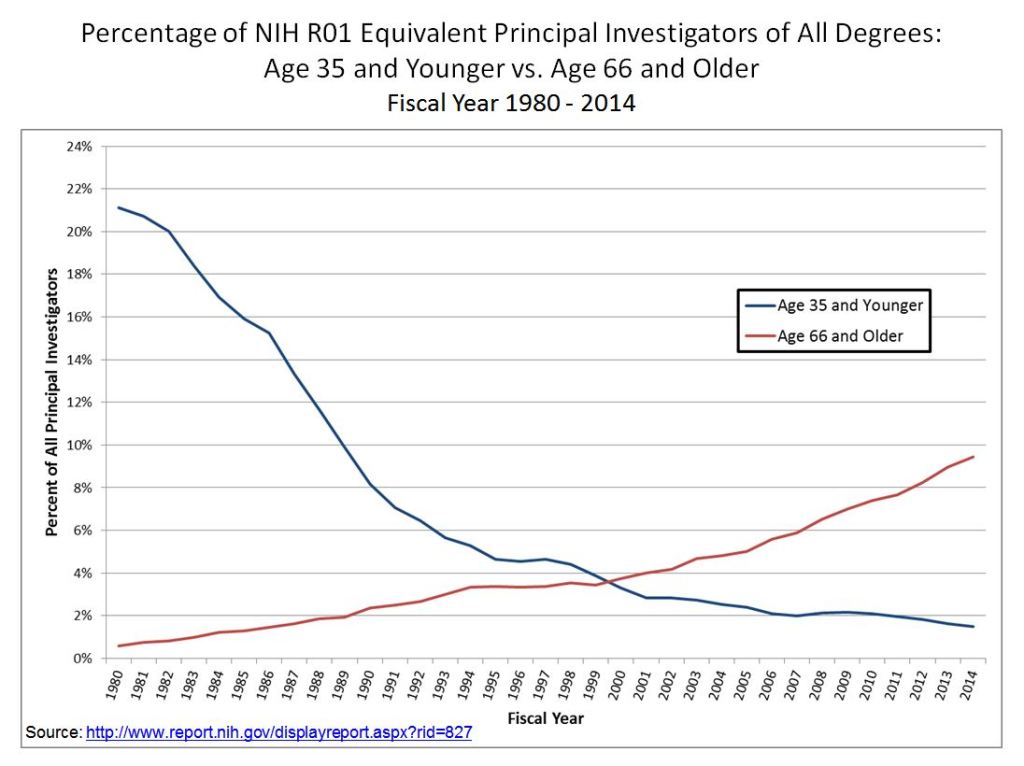
Of course, it also helps to get to know people at the funders and to become more senior yourself. It’s not surprising that my first major grant is coming from IHS given that I’ve been involved with them in all sorts of ways since going to a Liberty & Society seminar way back in 2009. Most funding goes to more senior people who have more connections, knowledge, and proven experience. This is extreme at perhaps the largest funder of research, the National Institutes of Health, where less than 2% of funded principal researchers are under age 36.

This may be the real secret for winning grants- just get older. My 12 rejections all came when I was younger than 36, while my first acceptance came less than a month after my 36th birthday.

In all seriousness, thanks to the Institute for Humane Studies, and I hope that a year from now I’ll be writing here about the great work that came out of this. For everyone with a growing pile of rejections, maybe the 13th time will be the charm for you too.

The Rate of Inflation is Falling, But Prices are Still Rising (And So are Wages)

The latest CPI-U price data shows that the rate of inflation in the US has slowed significantly to just 3% in the past 12 months. That’s a huge improvement from the peak last June, when the annual rate of inflation was over 9%. Still, prices as a whole aren’t falling, and they clearly aren’t anywhere near where they were before the pandemic: using the CPI-U, prices are up over 17% since January 2020.

Lately I’ve heard many people asking a good question: will prices ever get back down to where they were? Usually they mean pre-pandemic prices, though sometimes they refer to a particular point-in-time (such as the start of Biden’s presidency). The only correct answer is “we don’t know,” but I think a likely answer for many goods and services is “no.” For many reasons, the nominal prices of most goods and services rise over time. Though this is not true for everything, of course (newer technologies are one example we often see).

But what about specific goods that we buy frequently? Will we ever see gasoline consistently below $3 per gallon again? Will we ever see milk consistently below $4 per gallon again? What about eggs and bread? And indeed, these prices are well above January 2020 levels: 23% higher for milk, 43% for bread, 45% for gasoline, and a whopping 52% for eggs. For the price data, I am using this convenient data on common food and energy goods from BLS.

For some of these items, I do think you might someday see prices fall back to levels consumers were used to from the recent past, since food and energy prices tend to be volatile. For others, though maybe not. But I think we as consumers can become overly focused on staples that we buy frequently and can easily recall the price in our heads. For example, while eggs, bread, and milk are items that we buy frequently (including being the staples of stocking up before a storm), in total these constitute just 0.6% of average consumer spending.

If instead of those 3 staples, your mind naturally anchors on produce prices, the trends look different: oranges are up 23%, but bananas are only up 10%, and tomatoes are, in fact, down 14% since January 2020. But again, these items are less than 0.5% of total consumer spending. Ideally, we shouldn’t anchor on any one subset of goods when doing a good analysis, even if it is natural for us to do so in our lives as consumers.

This is where the benefit of a price index, like the CPI-U, comes in.

Continue reading

Audio Visual Stimulation: Pulses of Light and Sound To Shape Your Brain Waves To Help You Sleep, Relax, Be More Alert, Less Depressed, Etc., Etc.

Many of us desire at times to overcome insomnia, anxiety, brain fog, depression, or some other mental/emotional hindrance. Some common interventions include healthy lifestyle changes like better diet, drink more fluids, and exercise (all of which we should just do anyway), and more expensive therapies such as counseling or doctor-prescribed pharmaceuticals. These all have their places, but (in keeping with an economics blog) I’d like to call attention to another treatment modality which seems quite cost-effective and harmless*.

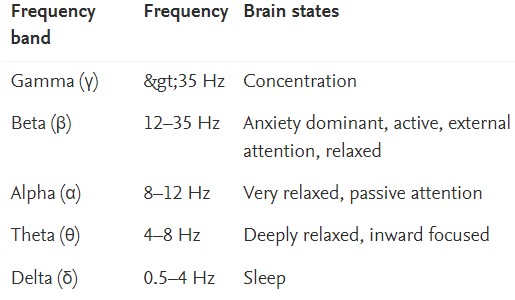
It has been known for decades that the electrochemical activity in our brains occurs in measurable waves. “Alpha waves” are pretty well known as a state associated with calm attention, and can be attained by meditation. These waves operate at a frequency of about 10 cycles per second, or 10 Hertz (Hz). Deeper meditation and sleep are associated  with slower frequencies, while intense attention and problem-solving thought operate at faster speeds.

Source: Abhang, et al.

Ideally, your brain would automatically generate the right waves for the situation you are in, and for the most part it does. However, for some folks, their brains don’t make the most effective waves much of the time, and even for more normal folks, it can be helpful to tweak it now and then.

Ways To Shape Your Brainwaves

There are three main avenues for you to manipulate your brainwaves. These are indirect methods, neurofeedback/biofeedback, and direct stimulation. Some indirect ways are to practice various types of mindfulness or meditation, which usually move you towards alpha waves, or intense exercise can lead to alpha in the subsequent rest session.

A direct route, which involves training yourself, is to don some sort of device on your head that measures brainwaves or a correlate such as cerebral blood-flow or heartbeat, and feeds back to let you know what your brain state is. It turns out that humans (without being to explain how) are able to learn to shift their brain states if they are given feedback on whether they are getting closer or further from some desired target. Consumer devices are available in the $400-$1400 price range that can do this with varying degrees of sophistication and requiring various degrees of training and effort. More extensive and targeted training of specific frequencies in particular spots in the brain is done in the offices of neurofeedback clinicians, often as an adjunct to talk therapy. The neurofeedback can calm the animal-level fear/panic/emotional noise, such that the client can relate therapeutically with the counselor. This can be very helpful to address specific pathologies including depression (and here), anxiety,  PTSD , reactive attachment disorder,  and maybe even autism, but naturally it is expensive to go through a course of say ten sessions with a highly trained professional. Unfortunately, you cannot count on routine coverage by insurance.

Direct Audio-Visual Stimulation

A less-expensive way to achieve a desired brainwave state is to present yourself with (say) 10 Hz stimulation of light and sound. The theory is that your brain waves become
“entrained” along with these external stimuli. Hence the name audio-visual stimulation or audio-visual entrainment (AVE).

There are many YouTube videos claiming to have embedded alpha or other frequencies. These videos often have many comments from appreciative users claiming calming or other effects, so they are certainly worth a try. The price is right. However, research studies cast doubt on whether sound alone is very effective at creating specific brainwaves. Light stimulation has been shown to evoke e.g., alpha waves.

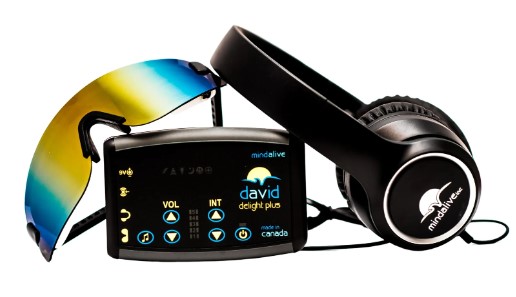
What has been shown to work well are systems where you don headphones for the sound and lightweight “goggles” (thin opaque glasses with LEDs on the inside).  Studies have shown this to help with ADD, anxiety, depression, and migraines. Perhaps the most widely produced AVE devices are the “DAVID” models from MindAlive.  MindAlive is headed by David Siever, who has spearheaded numerous studies of AVE.

MindAlive “DAVID” AVE System

The AVE devices can quickly move you into desired brain states, in the comfort of your home, for just a modest (~ $400) up front cost. You can use them with your eyes open or closed. They are perhaps more usable for children and seniors than the neurofeedback modalities, where the client has to engage with some feedback and learn to make their brainwaves go where they should. [1] With AVE, you just sit back and relax and let the sound and light carry you along. However, AVE is something of a blunt instrument, stimulating the auditory and visual and linked centers in the brain, whereas regular neurofeedback can train say two specific spots in the brain to two different specific frequencies, and has more enduring effects.

My Experience with AVE

I have owned a DAVID for many years. I and my family members have used it off and on, when we happened to feel a need for it. We all find that straight down the middle 10 Hz alpha sessions make us feel just plain good, positive, calm, etc. This can help cure anxiety (mind too fast, hard to focus) or sluggishness (mind too slow). It only takes about ten minutes exposure to the 10 Hz to get us in “the zone.” [2] On most mornings, when I wake up feeling OK anyway, I don’t bother with it. But it is good to have it around as needed. We find the feeling from an AVE session sticks with us for a number of hours.

AVE has been shown to help with seasonal asset disorder (SAD). That makes sense because SAD is about light deprivation. I had a bit of SAD when we lived in a house with few windows, and tried my DAVID for that. It did help, but it turned out to be more satisfactory and less bother to just use a big bright sunlamp at the breakfast table.

We find the slower AVE sessions useful to combat occasional insomnia (where mind is anxious or racing) and even to help with pain. A month ago I had some serious pain from an injury, that was so bad I could not sleep. These slow programs (3.5-7 Hz) did help to divert and relax my brain and help me get to sleep.  Again, the effects can be enduring. If we have used a really slow, say 3.5 Hz, program to knock us out at night, we often are sluggish the next morning, so we reset our brains with some 10 Hz alpha. For sleep, I usually prefer a 7-7.8 Hz protocol that does nicely slow and relax my brain, but does not leave me groggy in the morning.

The literature and the operator’s manual recommend slightly faster waves, e.g. 14 Hz “beta” waves as a normal morning waker-upper, like a cup of coffee. These faster “Brain Brightening” protocols have shown benefits for seniors. My family does not necessarily find 14 Hz enjoyable. It sometimes feels feels tiring.

One the other hand, the 14 Hz protocol can sometimes be quite helpful as a pick-me-up. Early one winter, I was feeling sluggish and low, not wanting to get out and exercise, and was nearly ten pounds over my normal weight. It probably had something to do with an extended road trip (stress, food) plus Thanksgiving (food) and the reduced sunlight hours, including daylight savings time ending, plus a stretch of cloudy/rainy weather. I did use a sun lamp to get more photons into my head, but that didn’t cut it. I decided to push myself and use the 14 Hz flashing lights, instead of the comfy 10 Hz, to get more of an activation. It actually worked out well. Three mornings in a row with the 14 Hz, and I felt “reset” to a more energetic, optimistic me. So score one for beta waves.

A couple of us have experimented even faster programs, around 18-20 Hz. That gave an unpleasant buzz, which persisted. I think if I had to drive a truck all night, it might be useful for keeping me awake and alert. After these high frequency sessions I soon used the 10 Hz program to reset to my nice smooth alpha. It is nice to know that if I go too high or low on an entrainment session, I can always recover by using the 10 Hz alpha session [3].

At any rate, I am a satisfied customer and I think this is a cost-effective treatment modality for amateurs to use, or for therapists to prescribe.

* If someone is susceptible to seizures, they should avoid any device like this with repetitive flashing lights.

ENDNOTES

[ 1 ] There is a newer, less-studied technique called LENS that kind of bridges between classical neurofeedback and AVE and trans-cranial magnetic stimulation (TMS). “Transcranial” means the stimulation is from coils outside your skull. Straight TMS is approved by the FDA for treatment of major depressive disorder (MDD), obsessive-compulsive disorder (OCD), migraines, and smoking cessation. With LENS, the brain waves are monitored with electrodes, and this information is used to shape special synchronized electromagnetic stimulation of the brain (from outside the scalp). This stimulation is keyed to the existing brainwaves, which may make it particularly effective, e.g. for reducing anxiety and helping with PTSD and traumatic brain injury (e.g., from military explosion exposure). This LENS technique is also called direct neurofeedback, in contrast to the standard neurofeedback, where the client must actively muster the altered brainwaves via training.

[ 2 ] Many of the canned protocols in the DAVID devices begin with about ten minutes of transitional sound and light pulses. These “dissociation” segments are intended to help users transition from their starting brain states and move to the final target frequencies. But we find these segments to be an unnecessary waste of time. We fire up a program, do something else for 8-9 minutes, and then don the headphone and glasses and dive right into the desired frequency, with only 1-2 minutes of dissociation.

One other user tip is that there is some virtue in starting with the lights a little dim (which I do by either playing with the Intensity setting, or by holding the goggles an inch away from my face), and by tapering down the brightness at the end of a session as you reenter the real world. With the David, you can push a pair of buttons to have it automatically ramp down light and sound intensity over the course of a minute or so.

[ 3 ] There is some evidence that super-fast AVE, at 40 Hz, stimulates cerebral bloodflow which can do marvelous things with the brain, such as mitigate Alzheimer’s degeneration.

Some things are expensive because the value of human life has never been higher

I don’t know if Team Transitory (in which I count myself, though I included Fed intervention in my expectations) gets to take home the final prize regarding inflation. Certainly the timeline was imperfect. It’s good that we’re debating who and what gets credit for a soft landing, though, since it means that Covid recovery policies haven’t likely mired us in a decade of heavy inflation (let alone hyperinflation). No, that doesn’t mean that the last round of payments wasn’t a net welfare loss, but let’s do our best to be sympathetic to the possibility that one-too-many is preferable to one-too-few when trying to bubblewrap your economy through the worst global pandemic in a century.

I bring this up because we will no doubt continue to suffer through “If inflation is under control, why is _____ so expensive” takes for a few year. I look forward to entirely ignoring these takes, with the occasional link back to this post when the commenter is sufficiently thoughtful (or annoying) to engage. And I just want to remind everyone that a lot of goods and services continue to steadily rise in price, not just because of the opportunity cost of labor (i.e. Baumol’s disease), but because of the opportunity cost of death.

We value human life more than at any previous point in human history (I haven’t consulted actuarial tables, or even googled it, but remain confident this is true). There are a lot of things we used to produce cheaply by throwing labor at the problem until it was built or everyone was dead (see Giza, the Pyramids of). You don’t have to go back nearly so far to appreciate the phenomenon.

Have you ever seen The French Connection? It has the single greatest car chase in history. It’s amazing. How did they do it? By not giving a damn about anyone or anything, including the actors in the cars and the unknowing civilians on the street. The film with arguably the greatest long-form stunt set-piece was produced for a total of $1.8 million (12.8 in 2023 dollars). Not that scene, mind you, the whole movie. It was cheap in dollars, but they had to put hundreds of people at risk to do it. Just because a miracle occurred and no one died doesn’t mean it was enormously expensive in turns of human risk (including unconsented risk).

Did you see John Wick 4? It has the best chase scene I’ve seen since the French Connection (at the Arc de Triomphe in Paris, no less). Priscillia Page, without question my single favorite film writer going these days, interviewed the director, and brilliant action movie obsessive that she is, got him to discuss in extensive detail the months of planning, the small city of professionals, and the enormous investment that went into mitigating risk at every possible turn for just that scene. All in service of John Wick driving the wrong way on the world’s most famous roundabout and then running through traffic. John Wick 4 cost $100 million to film precisely because it places so much value on every human being directly and indirectly involved.

Does anyone seriously believe movies are more expensive because of decades of inflation? Of course not. We know, at some level that the products have become more costly to produce and that that is reflected in the price facing consumers. I remain an unrepentant YIMBY who thinks that the key to the future of the US economy is lowering the costs of rebuilding our infrastructure, but we would do well to remember that the dollar costs of the past are no longer attainable because we are (gratefully) no longer comfortable throwing human suffering at a problem instead of money. This doesn’t let us off the hook from permitting, NIMBY, and public union gridlock, but we would do well endure rising costs with a bit more alacrity.

Technological innovation means the total cost of most things has gone down. That total cost includes dollars and physical risk. Our willingness to tolerate physical risk has gone down so much that, even in our world of technological miracles, there are some products that the dollar cost we are left with has gone up. But that’s not inflation. Or even a problem. It’s literally the best thing about living in the modern world.

Secondhand by Adam Minter

Secondhand: Travels in the New Global Garage Sale is a great book in my summer stack on fast fashion. I have always been interested in the combination problem-blessing of too much stuff. Adam Minter explains perfectly what many of us have been curious about.

Secondhand is America-centric, but he also travels to Japan to observe a country that is ahead of us both in terms of the demographic crisis and the mechanisms for handling old stuff. The reports from Africa are very interesting.

I have been wondering what is happening with Goodwill and with recycling in general. What hope do we really have of keeping goods out of the landfill? What should I do with a shirt my kid has grown out of? (The lady at work I used to give clothes to now runs away at the sight of me. I gave her too many bags.)

The Goodwill collection center near me looks cluttered and weird. After reading Secondhand, I’m more optimistic about dropping off bags there.

The barrier to sorting the used goods of the rich world is the scarcity of time and attention. This paragraph about a used book seller in Japan is heart-breaking:

It’s a thirty-year-old hardback novel, and the edition is rare. If it were at a traditional bookstore, it’s command a premium price. But Bookoff is about volume, and there’s a problem: not only does it lack a barcode, but it lacks an ISBN… “So there’s no way to price it in Bookoff’s system,” Kominato says. With a grimace, he gently places it on top of the books filling the recycling cage and steps away. (pg 40)

At least the book will get recycled into new paper, and the reality is that it was providing negative value as clutter in someone’s home.

Back in America, Minter describes what happens to donated goods at Goodwill in detail. Sometimes high-quality clothes are identified, but it is hard to get a good price for them. Some customers expect to pay less than $5 for a shirt, no matter what.

Customers are all about price, not quality…They won’t buy a $6.99 shirt that will last.  If that’s the option, they’ll buy a $2.99 shirt from Walmart. (pg 57)

Some consumers are in the habit of treating clothes almost like disposable goods instead of durable assets. They won’t pay for quality. Going out and getting a new replacement shirt costs less than lunch.

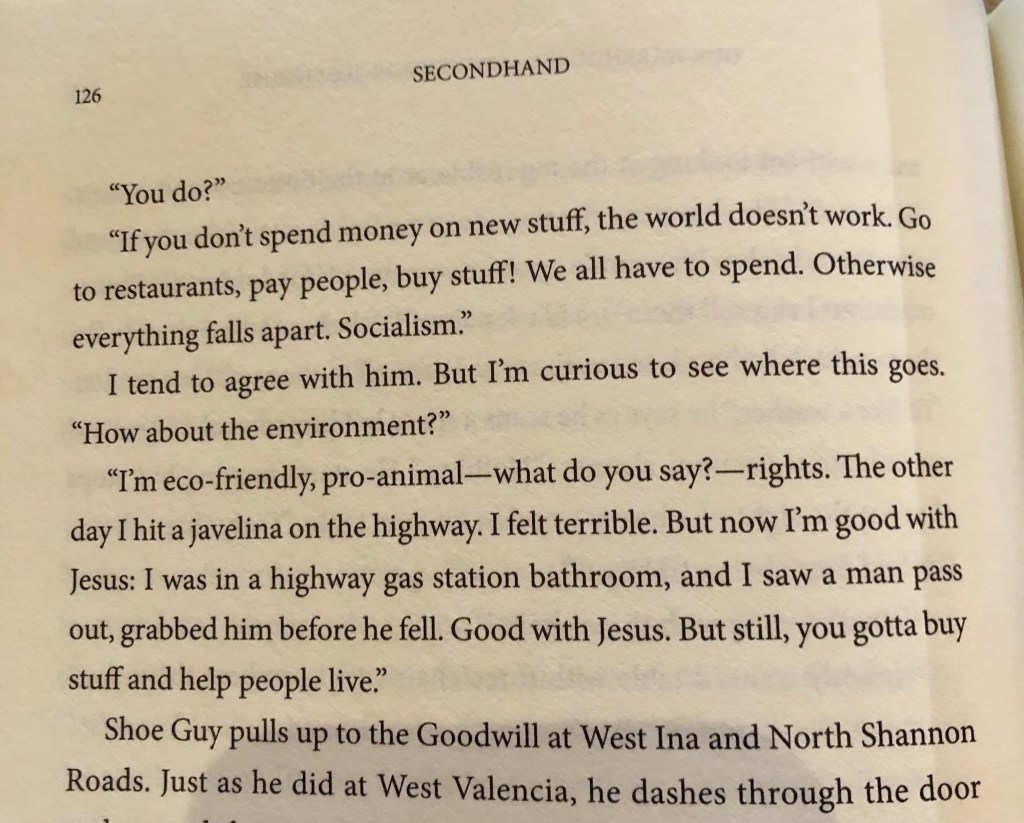
I don’t want to give away too much, since you will want to go get the book yourself. Here’s the funniest page:

Lastly, I’ll share a personal win. I know that I’ll need a school backpack for my youngest in August. I went to a local rummage sale and went to the backpack section. I found one that is good enough (some scuffs but plenty of sparkles). I’m happy about keeping this sparkly pink backpack out of the landfill for a few more years. I walked out of the sale with a load of gear that cost a total of $10. Next, I went to a coffee shop to work where I also spent $10. Used textiles and books are dirt cheap.