When I was in high school I remember talking about video game consumption. Yes, an Xbox was more than two hundred dollars, but one could enjoy the next hour of that video game play at a cost of almost zero. Video games lowered the marginal cost and increased the marginal utility of what is measured as leisure. Similarly, the 20th century was the time of mass production. Labor-saving devices and a deluge of goods pervaded. Remember servants? That’s a pre-20th century technology. Domestic work in another person’s house was very popular in the 1800s. Less so as the 20th century progressed. Now we devices that save on both labor and physical resources. Software helps us surpass the historical limits of moving physical objects in the real world.
There’s something that I think about a lot and I’ve been thinking about it for 20 years. It’s simple and not comprehensive, but I still think that it makes sense.
- Labor is highly regulated and costly.
- Physical capital is less regulated than labor.
- Software and writing more generally is less regulated than physical capital.
I think that just about anyone would agree with the above. Labor is regulated by health and safety standards, “human resource” concerns, legal compliance and preemption, environmental impact, and transportation infrastructure, etc. It’s expensive to employ someone, and it’s especially expensive to have them employ their physical labor.
Physical capital regulation is much lighter. Yes, there are concerns about intellectual property infringement and environmental impacts. But a lot of the liability and regulation of physical capital comes from its physical proximity to people. The handrails, metal signs, brightly colored paint, and noise and exhaust limits mostly exist because there are often people nearby. The fewer people in a factory or near a constructions site, the fewer regulations that are applicable.
Software and the written word are almost the wild west by comparison. Yes, there are copyright concerns, but the 1st amendment in the USA permits a huge span for freedom of expression and ideas. Code never physically hurts anyone. It needs physical capital or a willing laborer to make that happen. Code also helps to communicate information, greatly assisting in the coordination problem that firms face. And of course, communication can happen at an extremely low marginal cost in comparison to capital and labor.
We can also think about the consumption side. Producing labor to provide services is expensive and can take 14-24 years from birth. Producing physical goods can happen much faster and the growth in productivity is not limited by the growth in laborers. Code takes the same idea and multiplies it by a million. We can mass produce tools and paperweights by inputting more resources. But after the initial creation, we can duplicate code to every person and computer in the world at an extremely low marginal cost.
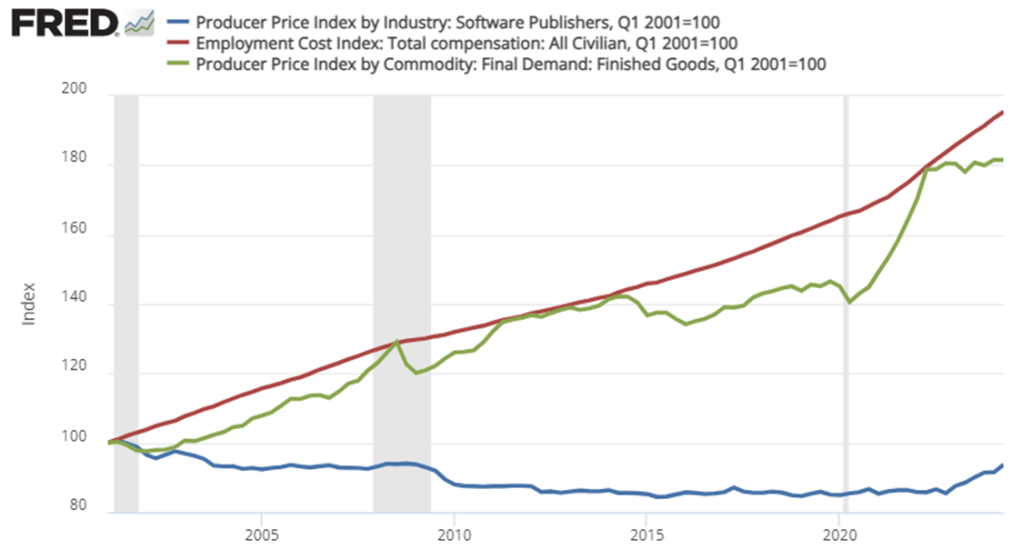
What should we see in the ‘real world’ if the above story is right. Services provided by labor would be expensive, physical goods would be less expensive than labor, and software would be the least expensive (I’m thinking about marginal costs). Below is the producer price index (PPI) for software, the PPI for finished goods, and the employee total compensation index. It reflects the story above.
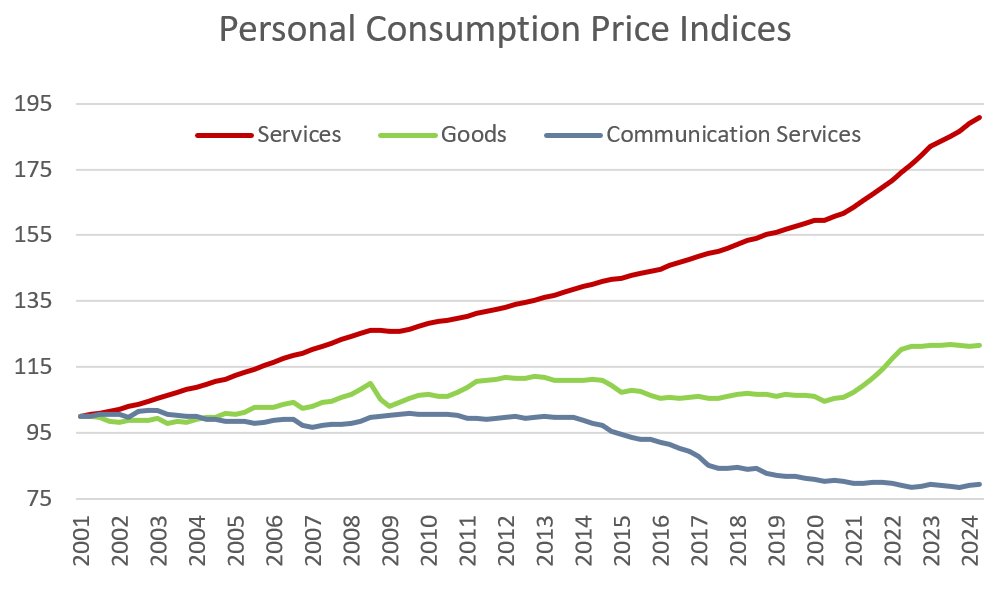
We can look at the national accounts and see a similar story. Software is a little tricky just because it’s included in the production process of plenty of other services and goods. Below is personal consumption price index for goods, services, and communication services in particular (which is only sort of a proxy for software). It tells the same story.
Further, software output would far outstrip physical goods consumption, and service consumption. What we can’t say is whether we’d spend more or less money on these three categories (for price elasticity reasons). The below graph reflects all of the discussion above. People are consuming what is easier to produce.
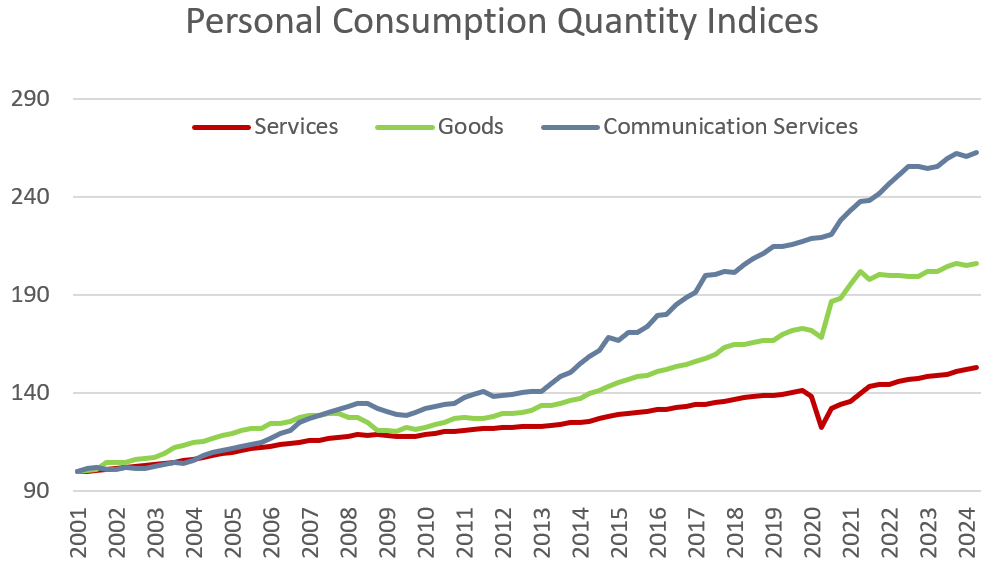
My personal interpretation of the data and my personal experience is that investment goes to where the productivity is and consumption goes to where the lower cost is (adjusting for quality). Regulations, while not the only factor of productivity, certainly affect the costs that producers face and the prices that consumer see.
 Economist Writing Every Day