What is vision insurance good for?

The answer sure seems to be “nothing”. I just went for an eye exam for the first time since Covid and realized that I’ve been wasting my money by paying for vision insurance.

The problem isn’t the eye exam- that went fine, and was covered fine with a $35 copay. But it was covered by my health insurance, not my vision insurance. So what is the vision insurance good for, if it doesn’t cover eye exams?

The answer is supposed to be “glasses”. It is supposed to cover frames up to $150 with a $0 copay, and basic lenses with a $25 copay, from in-network providers. That sounds ok- but there are two problems.

One is that almost none of the in-network providers (like Glasses dot com or Target optical) appear to actually offer lenses where the $25 copay applies; instead the minimum lens price is at least $85.

The second problem is that the premiums are high enough that even if I use them to get $25 glasses (which I eventually found I could through LensCrafters), it wouldn’t be worth it. They don’t sound high at first, which is how I got suckered into signing up for this scam in the first place. It’s just $5/month for single coverage; that sounds like nothing, especially for an employer benefit. It is a rounding error compared to health insurance premiums, and it comes out of pre-tax money. A small waste, but still a waste. Why?

Glasses are just so cheap if you can avoid the monopoly retailers and get them somewhere like Zenni. Zenni will sell you perfectly functional (and IMHO good-looking) prescription eyeglasses for $16. Their frames start at $6.95, lenses at $3.95, and shipping at $4.95. Catch a sale, or order enough to get free shipping, and you could actually get glasses for well under $16.

Or you can do what I did- order glasses from Zenni with premium options that pushed them up to $50- and find it is still cheaper than using the insurance I already paid for to get the cheapest pair available at most of their in-network retailers. The cheapest possible deal with insurance would be to pay $60/year in premiums, get glasses as often as the insurance allows so as not to waste the benefit (every 12 months- much more often than I find necessary), find frames listed under $150 to get for $0 copay, and find an in-network provider that actually offers lenses for the $25 copay. In this best-case scenario you are still paying $85 per pair of glasses. Given that the $60 in premiums came from pre-tax money, perhaps you can argue that it was really more like $40 in real money; but you can also buy glasses from a competitive retailer like Zenni using pre-tax money from an HSA or FSA.

So as far as I can tell, vision insurance really is useless. I certainly decided not to use it for my latest pair of glasses even though I had already paid years of premiums; Zenni was still much cheaper for a comparable product. I’m dropping vision insurance now that open enrollment is here. My take-home pay will be going up, and EyeMed will stop getting my money for nothing.

Is there anyone vision insurance makes sense for? I think it could makes sense for someone who really wants brand name glasses, or for someone who really wants to get their glasses in-person at the optometrist, and wants new glasses every year. For everyone else, run the numbers for your own plan, but I suspect you would also be better off just buying glasses directly.

Disclaimer: This post is not sponsored & doesn’t use affiliate links; Zenni is the best option I currently know of, but I’d be happy to hear of other competitive retailers you think are better, or an argument for when vision insurance is actually useful.
The Cumulative Effect of Small Changes in Economic Growth

A recent post from the blogger (Substacker?) Cremieux called Rich Country, Poor Country showed how small differences in economic growth add up over time. Because he used nominal GDP growth rates, I don’t think that post is exactly the right way to analyze the question, but I still think it’s a very important one. So in this post I will offer, not necessarily a critique of that post, but perhaps a better way of looking at the data.

For the data, I will use the Maddison Project Database, which attempts to create comparable GDP per capita estimates for countries going back as far as possible… for some, back thousands of years, but for most countries at least the last 100 years. And the estimates are stated in modern, purchasing power adjusted dollars, so they should be roughly comparable over time (if you think these estimates are a bit ambitious, please note that they are scaled back significantly from Angus Maddison’s original data, which had an estimate for every country going back to the year 1 AD). The most recent year in the data is currently 2022, so if I slip up in this post and say “today,” I mean 2022, or roughly today in the long sweep of history.

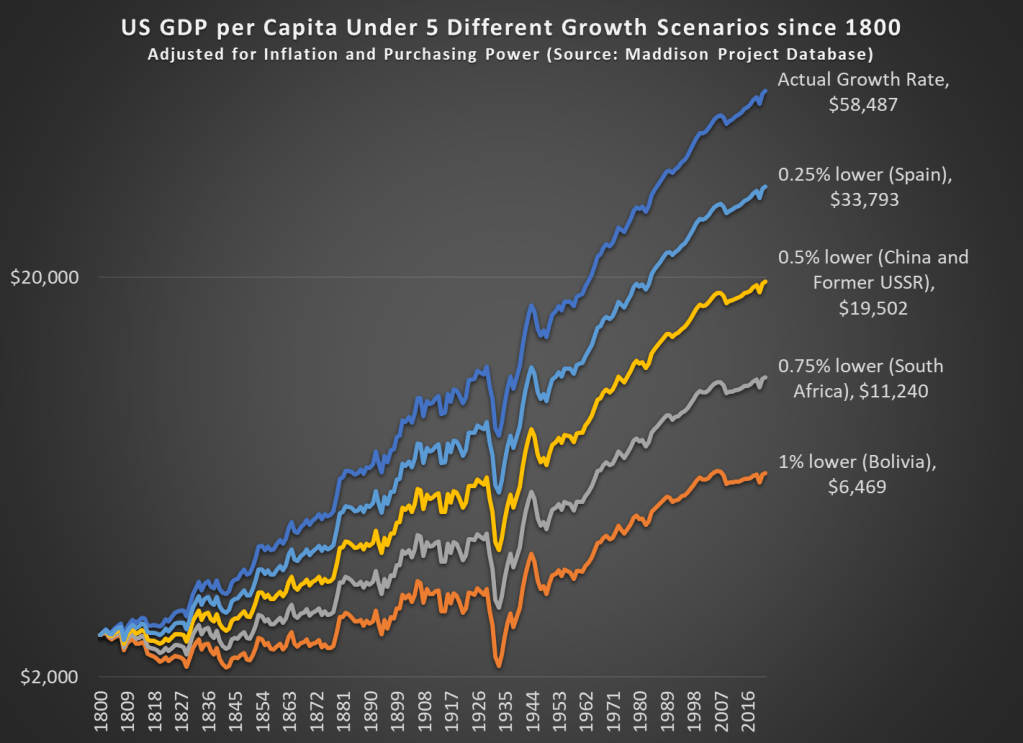
Like Cremieux’s post, I am interested in how much slightly lower economic growth rates can add up over time. Or even not so slightly lower growth rates, like 1 percentage point less per year — this is a huge number, because the compound annual average growth rate for the US from 1800 to 2022 is 1.42%. So let’s look at the data way back to 1800 (the first year the MPD gives us continuous annual estimates for the US) to see how changes in growth rates affect long-term growth.

It probably won’t surprise you that if our 1.42% growth rate had been 1 percentage point lower, the US would be much poorer today, but to put a precise number on it, we would be about where Bolivia is today (that is, ranked 116th out of the 169 countries in the MP Database). Note: I’m using a logarithmic scale, both so it’s easier to see the differences and because this is standard for showing long-run growth rates.

What is very interesting, I think, is that if our growth rate had been just 0.25 percentage points lower per year since 1800, we would be about where Spain is. Now, Spain is certainly a fine, modern developed country (they rank 34th of the 169 MPD countries). But Spain’s growth has not been spectacular lately. Average income in Spain is almost half of the US today (purchasing power adjusted!), which is another way to say that just 0.25 percentage points lower over 222 years reduces your growth rate by half.

That’s the power of economic growth.

And if our growth rate had been 0.5 percentage points lower, we’d be about where the big former Communist countries are today (both China and the former countries of the USSR are about equal today — about 1/3 of the income of the US).

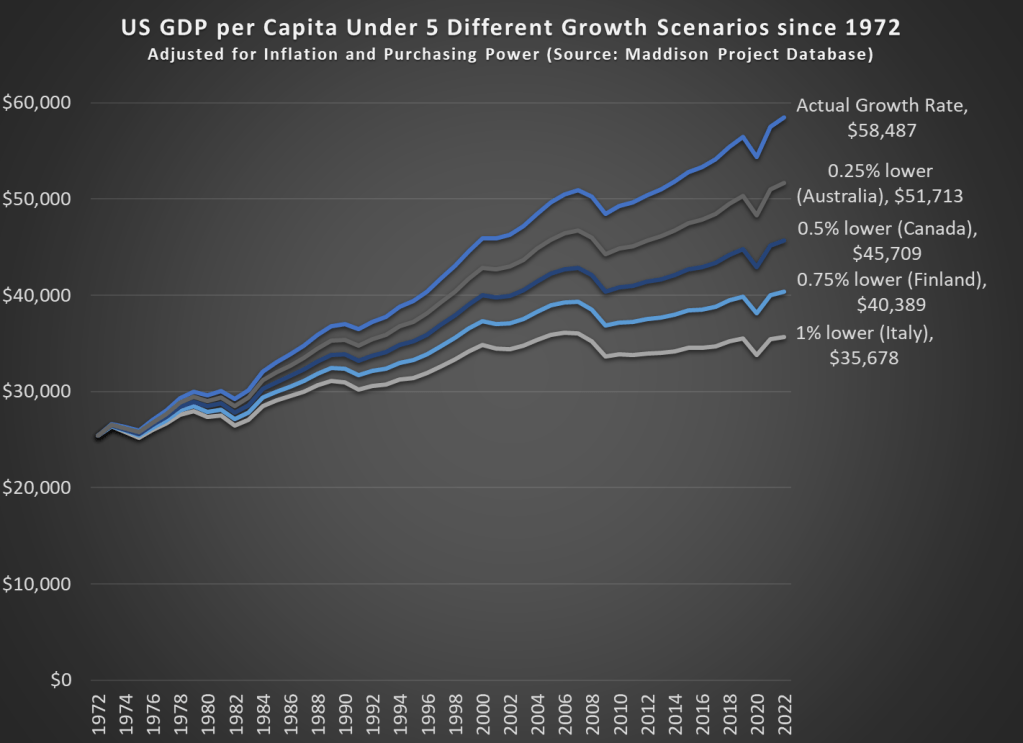
What if we perform the same analysis for a shorter time horizon? If we go back 50 years to 1972, the effects are not quite as dramatic, but still visible.

Our cumulative annual growth rate since 1972 has been a bit higher than the long-run average, around 1.68%. Under these four alternative growth scenarios since 1972, the comparable countries don’t sound so bad. It probably wouldn’t be a huge deal if we were only at Australia’s level, losing just about a decade of economic growth. But it would be a huge failure if we were only at Italy’s current level of development. Under that 1 percentage point lower growth scenario, we would have had no net growth since about year 2000, which has roughly been the case for Italy.

All of these alternative scenarios show the power of economic growth to add up over time, but they do so in pessimistic way: what if growth had been slower. What if we look at the opposite: what if growth had been faster over some time horizon. Sticking with the 1972 medium-run example, if real growth rates had been 1 percentage point higher, our income today would be almost double what it actually is, about $95,000 compared with the current $58,000 (the MPD data is stated in 2011 dollars, so that sounds lower than it actually is now: over $80,000).

What if we went back even further? If our economic growth rate since 1800 had been 1 percentage point higher every year, our average income in 2022 would be an astonishing $517,000 — almost 10 times what it actually was in 2022. That’s a dizzying number to think about, and maybe that’s not a realistic alternative scenario.

But what if it had only been 0.25 percentage points higher since 1800 — that probably is a world that was possible. In that case, GDP per capita would be about double what it actually was in 2022, at over $100,000 (again, stated in 2011 dollars).

Charles Hugh Smith: Six Reasons the Global Economy Is Toast

If you are feeling OK about the world after a nice Labor Day weekend, I can fix that. How about six reasons why global economic growth will slow to a crawl, courtesy of perma-bear Charles Hugh Smith?

Smith is recognized as an earnest, good-willed alternative economic thinker. His OfTwoMinds blog and other publications bring out many valid facts and factors. He has been extrapolating from those factors to global financial collapse for well over fifteen years now, growing out of the imminent peak oil movement of circa 2007 vintage and the scary 2008-2009 financial crisis. Obviously, he has continually underestimated the resilience of the national and global systems, especially the ability of our finance and banking folks at keeping the debt plates spinning, and our ability to harness practical technology (e.g. fracking for oil production). Smith recommends preparing to become more self-reliant: we should learn more practical skills, and prepare to barter with local folks if the money system freezes up.

For now, I will let him speak for himself, and leave it to the readers here to ponder countervailing factors. From August 11, 2024, we have his article titled, These Six Drivers Are Gone, and That’s Why the Global Economy Is Toast:

The six one-offs that drove growth and pulled the global economy out of bubble-bust recessions for the past 30 years have all reversed or dissipated. Absent these one-off drivers, the global economy is stumbling off the cliff into a deep recession without any replacement drivers. Colloquially speaking, the global economy is toast.

Here are the six one-offs that won’t be coming back:

1) China’s industrialization.

2) Growth-positive demographics.

3) Low interest rates.

4) Low debt levels.

5) Low inflation.

6) Tech productivity boom.

( 1 ) Cutting to the chase, China bailed the world out of the last three recessions triggered by credit-asset bubbles popping: the Asian Contagion of 1997-98, the dot-com bubble and pop of 2000-02, and the Global Financial Crisis of 2008-09. In each case, China’s high growth and massive issuance of stimulus and credit (a.k.a. China’s Credit Impulse) acted as catalysts to restart global expansion.

The boost phase of picking low-hanging fruit via rapid industrialization boosting mercantilist exports and building tens of millions of housing units is over. Even in 2000 when I first visited China, there were signs of overproduction / demand saturation: TV production in China in 2000 had overwhelmed global and domestic demand: everyone in China already had a TV, so what to do with the millions of TVs still being churned out?

China’s model of economic development that worked so brilliantly in the boost phase, when all the low-hanging fruit could be so easily picked, no longer works at the top of the S-Curve. Having reached the saturation-decline phase of the S-Curve, these policies have led to an extreme concentration of household wealth in real estate. Those who favored investing in China’s stock market have suffered major losses.

( 2 ) Demographics

Where China’s workforce was growing during the boost phase, now the demographic picture has darkened: China’s workforce is shrinking, the population of elderly retirees is soaring, and so the cost burdens of supporting a burgeoning cohort of retirees will have to be funded by a shrinking workforce who will have less to spend / invest as a result.

This is a global phenomenon, and there are no quick and easy solutions. Skilled labor will become increasingly scarce and able to demand higher wages regardless of any other factors, and that will be a long-term source of inflation. Governments will have to borrow more–and probably raise taxes as well–to fund soaring pension and healthcare costs for retirees. This will bleed off other social spending and investment.

( 3 ) The era of zero-interest rates and unlimited government borrowing has ended. As Japan has shown, even at ludicrously low rates of 1%, interest payments on skyrocketing government debt eventually consume virtually all tax revenues. Higher rates will accelerate this dynamic, pushing government finances to the wall as interest on sovereign debt crowds out all other spending. As taxes rise, households are left with less disposable income to spend on consumption, leading to stagnation.

( 4 ) At the start of the cycle, global debt levels (government and private-sector) were low. Now they are high. The boost phase of debt expansion and debt-funded spending is over, and we’re in the stagnation-decline phase where adding debt generates diminishing returns.

( 5 ) The era of low inflation has also ended for multiple reasons. Exporting nations’ wages have risen sharply, pushing their costs higher, and as noted, skilled labor in developed economies can demand higher wages as this labor cannot be automated or offshored. Offshoring is reversing to onshoring, raising production costs and diverting investment from asset bubbles to the real world.

Higher costs of resource extraction, transport and refining will push inflation higher. So will rampant money-printing to “boost consumption.”

( 6 ) The tech productivity boom was also a one-off. Economists were puzzled in the early 1990s by the stagnation of productivity despite the tremendous investments made in personal and corporate computers, a boom launched in the mid-1980s with Apple’s Macintosh and desktop publishing, and Microsoft’s Mac-clone Windows operating system.

By the mid-1990s, productivity was finally rising and the emergence of the Internet as “the vital 4%” triggered the adoption of the 20% which then led to 80% getting online combined with distributed computing to generate a true revolution in sharing, connectivity and economic potential.

The buzz around AI holds that an equivalent boom is now starting that will generate a glorious “Roaring 20s” of trillions booked in new profits and skyrocketing productivity as white-collar work and jobs are automated into oblivion.

There are two problems with this story:

1) The projections are based more on wishful thinking than real-world dynamics.

2) If the projections come true and tens of millions of white-collar jobs disappear forever, there is no replacement sector to employ the tens of millions of unemployed workers.

In the previous cycles of industrialization and post-industrialization, agricultural workers shifted to factory work, and then factory workers shifted to services and office work. There is no equivalent place to shift tens of millions of unemployed office workers,as AI is a dragon that eats its own tail: AI can perform many programming tasks so it won’t need millions of human coders.

As for profits, as I explained in There’s Just One Problem: AI Isn’t Intelligent, and That’s a Systemic Risk, everyone will have the same AI tools and so whatever those tools generate will be overproduced and therefore of little value: there is no pricing power when the world is awash in AI-generated content, bots, etc., other than the pricing power offered by monopoly, addiction and fraud–all extreme negatives for humanity and the global economy.

Either way it goes–AI is a money-pit of grandiose expectations that will generate marginal returns, or it wipes out much of the middle class while generating little profit–AI will not be the miraculous source of millions of new high-paying jobs and astounding profits.

(End of Smith excerpt; emphases mainly his)

~ ~ ~ ~ ~ ~ ~ ~ ~ ~ ~ ~ ~ ~ ~ ~ ~

Have a nice day…

Happy Labor Day, here’s a prediction

Rather than engage in meaningful labor on this hallowed day, I will instead make a prediction: if a significant tax on unrealized capital gains is introduced, the following markets will enjoy increased prices:

  1. Art
  2. Accountants

Now, what will define the art in question is beyond me, but I imagine unrealized gains from art will be easier to quantify if the art in question exists as anything more than one of a kind, so I expect definitively “one-of-a-kind” pieces i.e. classics will experience the lion share of increased demand.

As for accountants, the demand for training in how to properly ledger assets to remain outside the bounds of quantifiable equity assets will prove a boon to anyone with an accounting degree. Accounting talent for establishing loan collateral two degrees removed from equity will similarly grow in value.

I have additional predictions, but putting them forth under my name and defending them in a public forum would require a meaningful amount of labor, which I am not willing to provide today.