The Top 1 Percent Paid a Lot of Taxes in 2021

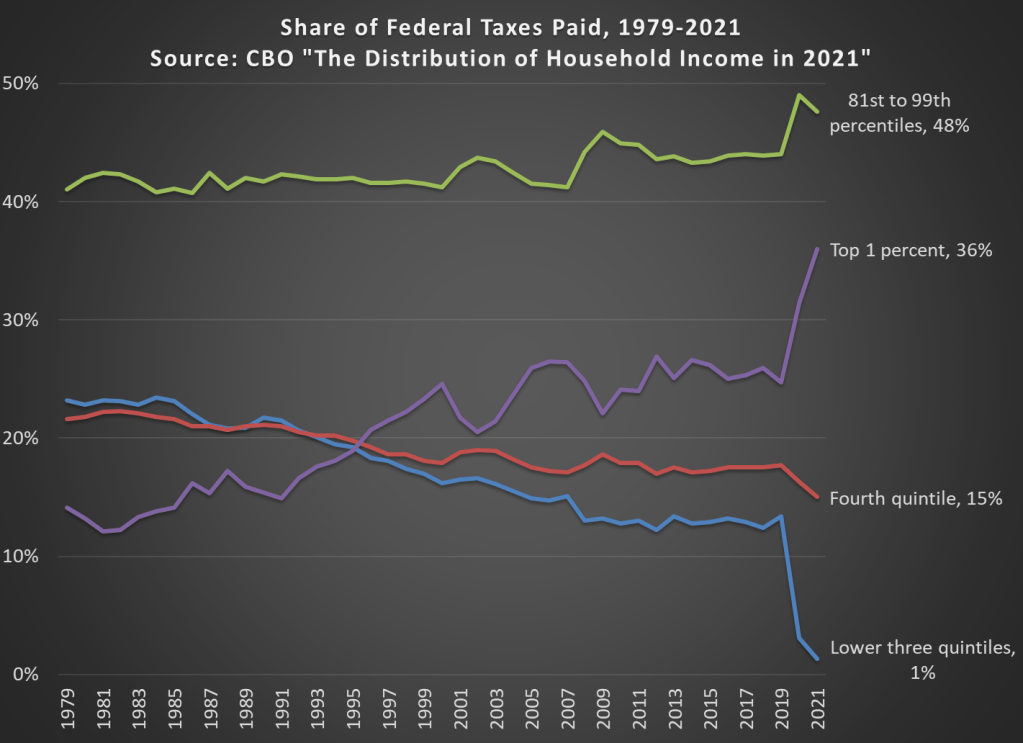
In 2021 the top 1 percent of taxpayers in the United States paid 36 percent of all federal taxes (they have 21.1 percent of income). This figure had been below 20 percent until the mid-1990s, and as recently as 2019 it was just 24.7 percent (they had 15.9 percent of the income that year).

The data comes from the latest CBO report on “The Distribution of Household Income in 2021.”

The increase is primarily due to a large number of high-income households realizing capital gains in 2021. With all the talk lately of potentially taxing unrealized capital gains, it’s important to note that we do tax realized gains, and these change a lot from year to year. Another contributing factor is that the share of the bottom 60 percent of households only paid 1 percent of federal taxes in 2021, a big drop from 2019 due to a big increase in temporary refundable tax credits.

Easter Island Ecological Collapse Debunked

Jared Diamond is a polymath (biochemistry, physiology, ornithology, ecology; MacArthur Genius Grant; etc.) perhaps best known for his Guns, Germs and Steel (1997). In that book (which I read) he proposed that shared learnings and practices across the vast Eurasian continent led to optimized food crops and agricultural practices for Eurasian peoples, which in turn led to dense, stratified societies where technical development could progress. This included Chinese and other Asian societies, not just Europeans. This enabled large military forces equipped with formidable weapons, that could dominate non-Eurasian peoples when they came in contact. The rest is history.

In another popular book (which I also read), Collapse: How Societies Choose to Fail or Succeed (2005), Diamond presented explanations for the collapse or (relative) failure of a number of modern and historical societies. These included the Norse settlers in Greenland, the Maya of Central America, and Easter Island.

Easter Island, known as Rapa Nui by its natives, is the most isolated inhabited landmass on Earth. It lies some 2200 miles west of Chile and 1200 miles east of Pitcairn Island (think: mutiny on the Bounty). The first European contacts were brief visits by various ships in the early 1700’s.  At that point, there appeared to be several thousand inhabitants, and no large trees. It seems that Polynesian settlers arrived on the island around 1200 A.D., though perhaps as early as 800. The pollen record and carbon-14 dating showed that large palm trees were present on the island, but disappeared around 1650.

Easter Island is perhaps best known for its many large (20-30 ft high) stone carvings called moai:

Image: Wikipedia

Scholars have supposed that a large, hierarchical society was needed to produce the some 1000 moai observed on Easter Island.  These statues were later deliberately toppled, for reasons unknown.

Following the suggestions of some early anthropologists, Diamond spun a riveting apocalyptic tale of overpopulation and stupidity: supposedly the population grew to some 15,000 souls, mindlessly chopping down all the trees to transport and erect the huge stone carvings.  This deforestation, together with exhaustion of nutrients in the soil, led to a downward spiral in the welfare of the community: no trees = soil erosion and water runoff and no edible nuts;  no wood= no boats = few fish. Shifts in trade winds or climate were also implicated. Tribal warfare, class struggle and cannibalism erupted, with mass deaths through violence and starvation, all before the Europeans showed up. The account of internecine conflict was supported by the natives’ oral traditions.  This whole story arc was taken to be a parable for our times: if you mess with your ecosystem, society may not stand the strain.

Perhaps jealous of upstart Jared Diamond’s success, some fifteen authors from the professional anthropology guild ganged up and published an attack volume titled Questioning Collapse in 2009. They disputed many of Diamond’s assertions, including his Easter Island collapse scenario.

Results from the past several years have swung the consensus firmly against the ecocide collapse theory. For instance, a carbon-14 dating study of bone and wood artifacts by DiNapoli, et al.  indicated a steady growth in population up until European contact in the early 1700s. The same conclusion was reached in a recent study by  J. Víctor Moreno-Mayar et al., using DNA measurement from native genomes dating between 1670 and 1950. Also, it seems from mariners’ reports that toppling of the statues did not begin until after European contact. The loss of the trees is now attributed mainly to the Polynesian rats brought with the natives; the rats eat the palm seeds.

What actually did the natives in was a series of raids by Peruvian slave-traders in 1862. They abducted about half of the 3000 inhabitants, including the leaders and cultural carriers. After a public outcry o\in 1865 by the bishop of Tahiti, the embarrassed Peruvian government repatriated the surviving slaves, but they carried back a smallpox infection which killed off most of the rest. “1868 saw the entire social order of Easter Island collapse, there were no more standing Moai statues… In 1877, only 110 impoverished and disheartened inhabitants remained.” Ouch. So, the social order did collapse, but not from climate change or ecological stupidity.

In 1888, Chile took over Easter Island as a protectorate, shielding the inhabitants from further slaver attacks. That began a fitful recovery for the Rapa Nui people, who as of 2017 numbered 3,512. This is roughly the population prior to European contact.

Notes from Greg Mankiw podcast

Good job to Jon Hartley to get the conversation going. All indented quotes are from Mankiw in the podcast.

Some history for those of us who write about sticky wages and prices.

But it was that idea that real wages weren’t countercyclical, that said, you have to start thinking about not only sticky wages, I have to start thinking about sticky prices.

And if I’m gonna start thinking about sticky prices, you have to have firms that are not competitive, that are price setters, not price takers. Because if you’re going to think about the incentives that firms have to adjust prices, you can’t have them being price takers. And it was that that got me to write my small menu cost paper…

There is a lot more on that topic in the transcript, for those who are interested.

How do we feel about big models?

I think people were getting a little tired of these big models because they were large, non intuitive. They seemed very black boxy, so you didn’t really know what was happening in them.

Haha. Here comes ChatGPT. ‘Leeroy Jenkins’ and all that.

One thing I’ll say about being Chair of the Council, which I did from 2003 to 2005. And I worked harder those two years than any two years of my life, by far, because the days are long. In the Bush administration, every day started with the 7:30 AM staff meeting in the Roosevelt room, which is the conference room right next to the Oval office.

In all my years at Harvard, I’ve been in Harvard almost 40 years, nobody’s ever called a 07:30 AM meeting. While I was at the White House, every day it was at 7:30 AM meeting. It’s not like you take off early at the end of the day, you work long hours at the end of the day too.

So they’re are very, very long days. I left my family behind in Boston, my wife was a saint and took care of my three small kids. And I basically moved into a hotel just a few blocks from the White House…

Note the saints lurking behind the intellectual contributions. With falling fertility all over the world, it raises the question of who watches the three small kids? Something I am pondering this week is that I’m glad I didn’t try to homeschool my kids this semester. I support others who make that choice, but it wouldn’t have been good for us.

Human Capital is Technologically Contingent

The seminal paper in the theory of human capital by Paul Romer. In it, he recognizes different types of human capital such as physical skills, educational skills, work experience, etc. Subsequent macro papers in the literature often just clumped together some measures of human capital as if it was a single substance. There were a lot of cross-country RGDP per capita comparison papers that included determinants like ‘years of schooling’, ‘IQ’, and the like.

But more recent papers have been more detailed. For example, the average biological difference between men and women concerning brawn has been shown to be a determinant of occupational choice. If we believe that comparative advantage is true, then occupational sorting by human capital is the theoretical outcome. That’s exactly what we see in the data.

Similarly, my own forthcoming paper on the 19th century US deaf population illustrates that people who had less sensitive or absent ability to hear engaged in fewer management and commercial occupations, or were less commonly in industries that required strong verbal skills (on average).

Clearly, there are different types of human capital and they matter differently for different jobs. Technology also changes what skills are necessary to boot. This post shares some thoughts about how to think about human capital and technology. The easiest way to illustrate the points is with a simplified example.

Continue reading

The Economics of Taylor Swift

Cowen’s 2nd Law states that there is a literature on everything. I would certainly expect there to be a literature on the best-selling musician in the world. And of course there is; Google Scholar returns 23,500 results for “Taylor Swift”, and we’ve done 5 posts here at EWED. But surprisingly, searching EconLit returns nothing, suggesting there are currently no published economics papers on Taylor Swift, though searching “Taylor” and “Swift” separately reveals hundreds of articles about the Taylor Rule and the SWIFT payment system. Google Scholar does report some economics working papers about her, but the opportunity to be the first to publish on Taylor Swift in an economics journal (and likely get many media interview requests as a result) is still out there.

Swift presents a variety of angles that could be worthy of a paper; re-recording her masters forcopyright reasons, her efforts to channel concert tickets to loyal fans over re-sellers, or her sheer macroeconomic impact. I’ve added a note about this to my ideas page (where I share many other paper ideas).

In the mean time, I’ll be giving a short talk on the Economics of Taylor Swift at 7pm Eastern on Monday, September 16th, as part of a larger online panel. The event is aimed at Providence College alumni, but I believe anyone can register here.

Update 10/25/24: A recording of the event is here, and a recording of a followup interview I did with local TV is here.

Better Off Than 4 Years Ago? Median Family Income Edition

Are you better off than you were four years ago? That question was asked at the Presidential debate last night. But more importantly, we also got a massive amount of new data on income and poverty from Census yesterday. That data allows us to make that just that comparison, although somewhat imperfectly.

The Census data is excellent and detailed, but it’s annual data, meaning that the release yesterday only goes through 2023. We won’t have 2024 data for another year. Such is the nature of good data. (Note: I’ve tried to address this same question with more real-time data, such as average wages). Still, it’s a useful comparison to make. It’s especially useful right now because the new 2023 data on income are (for most categories) the highest ever with one exception: 4 years ago, in 2019.

A reasonable read of the data on income (whether we use households, families, or persons) is that in 2023 the median American was no better off than in 2019, after adjusting for inflation. In fact, they were probably slightly worse off. I fully expect this will no longer be true when we have 2024 data: it will certainly be above 4 years prior (2020) and likely above 2019 too (more on this below). But we can’t say that for sure right now.

So let’s do a comparison of “are you better off than 4 years ago” for recent Presidents that were up for reelection (treating 2024 as a reelection year for Biden-Harris too), using the 4-year comparison that would have been available at the time using real median family income. Notice that this data would be off by one year, but it’s what would have been known at the time of the election.

Continue reading

How Many People Think the Earth is Flat, and Doesn’t Move?

Most of us have read or heard references to flat-earthers. I have always assumed they are some tiny tongue-in-cheek group which is just playing out an elaborate joke on the rest of us. The Greeks figured out by 300 A.D. that the earth was round, and this tidbit was incorporated into medieval scholarship, so there has never been much religious or traditional impetus for a flat earth. I was therefore a bit surprised to learn that flat earth beliefs are very serious to many folks, and that such beliefs seem to be on the rise.

From Wikipedia:

In 2020, it was reported that based on polling by Datafolha, 7% of Brazilians believed in a flat Earth. A 2018 YouGov poll found that around 4% of the population of the United States believed in flat Earth while the POLES 2021 Survey found around 10% of the United States population believed that the Earth is flat. A 2019 YouGov survey found that around 3% of British people supported flat Earth.

Digging into that 2018 YouGov poll finds that 2% of Americans resolutely say the earth is flat, but many others who lean towards a round earth are not quite sure. Flat-earthism is more prevalent in Millennials than in older folks, only 66% of Millennials firmly believe the earth is round :

While an overwhelming majority of Americans (84%) believe that the Earth is round, at least 5% of the public say they used to believe that but now have their doubts.
Flat earthers find traction in their beliefs among a younger generation of Americans. Young millennials, ages 18 to 24, are likelier than any other age group to say they believe the Earth is flat (4%).

Apparently, a YouTube channel launched in 2015 by real-life pinball wizard Mark Sargent (“…a competitive video game player, winning one virtual pinball tournament”), which has amassed over two million views, has played a role in popularizing flat earth beliefs. In his brand of geography, the center of the earth-disk is roughly the North Pole, and the edge of the earth-disk lies in what we normally think of the extreme south, and is surrounded by an ice-wall. Several basketball players (Kyrie Irving, Wilson Chandler, Draymond Green) and a rapper (B.o.B) have come out in favor of flatness. The NASA conspiracy of a round earth is crumbling…

 I think some of this flat-earth polling is just ignorance, especially those who are not sure. But there are those who “have their reasons”, often citing various (pseudo) scientific arguments to support their beliefs:

Research by Carlos Diaz Ruiz and Tomas Nilsson on the arguments that flat Earthers wield, shows three factions, each one subscribing to its own set of beliefs.

The first faction subscribes to a faith-based conflict in which atheists use science to suppress the Christian faith. … their arguments use the Scripture – word-by-word – to support an argument that enables God to really exist.

The second faction believes in an overarching conspiracy for knowledge suppression. Building upon the premise that knowledge is power, the flat Earth conspiracy argues that a shadowy group of “elites” control knowledge to remain in power. In their view, lying about the fundamental nature of the Earth primes the population to believe a host of other conspiracies. …

The third faction believes that knowledge is personal and experiential. They are dismissive of knowledge that comes from authoritative sources, especially book knowledge

Belief in geocentricity (i.e., that the earth is stationary and the sun goes around the earth) is even more widespread than belief in a flat earth. From Wikipedia:

According to a report released in 2014 by the National Science Foundation, 26% of Americans surveyed believe that the Sun revolves around the Earth.  Morris Berman quotes a 2006 survey that show currently some 20% of the U.S. population believe that the Sun goes around the Earth (geocentricism) rather than the Earth goes around the Sun (heliocentricism), while a further 9% claimed not to know. Polls conducted by Gallup in the 1990s found that 16% of Germans, 18% of Americans and 19% of Britons hold that the Sun revolves around the Earth.  A study conducted in 2005 by Jon D. Miller of Northwestern University, an expert in the public understanding of science and technology,  found that about 20%, or one in five, of American adults believe that the Sun orbits the Earth.  According to 2011 VTSIOM poll, 32% of Russians believe that the Sun orbits the Earth.

Geocentrism seems particularly driven by religious concerns, although I think the polls also heavily reflect plain ignorance. There are passages in the Bible which, if taken literally, seem to mandate a stationary earth and a moving sun. The Roman Catholic church has tiptoed away from its condemnation of Galileo four hundred years ago, and essentially accepted his contention that such passages were never intended to be taken literally. Nevertheless, Catholic layman Robert Sungenis has vigorous argued for geocentricity and Bible literalism, publishing books such as Galileo Was Wrong. On the fundamentalist Protestant side, there is the Association for Biblical Astronomy, with its web site www.geocentricity.com, and apologist Dean Davis.They make arguments to dismiss the usual scientific conclusions on this matter, e.g., that according to relativity, it could be true that the earth is stationary and the entire universe is spinning around the earth.

Geocentricity is somewhat poignant for me, because a good friend of mine from college later became deeply attached to it, to the point that he rejected my thinking as apostate when I disagreed. He was a bright guy and an Ivy League graduate. Which just goes to show that fringe beliefs can have unexpected appeal.

You’re doing it now

This speech is still the best advice for anyone in the academic or artistic line of work.

https://thecomicscomic.com/2015/07/23/dana-goulds-just-for-laughs-keynote-address-of-2015-youre-doing-it-now/

If audio doesn’t work for you at the moment, here’s a transcript:

This post might seem lazy. Because it is. But it’s also a measure of my accumulated wisdom. Not so much that I’ve perfectly internalized the wisdom of this piece in my bodhisattva-like personification of enlightenment. Rather, it is a demonstration of my wisdom because I have written and posted it in lieu of an anger-filled rant about the horrors of politicians pandering to their base in which I imply vast swaths of humanity are less-than-perfect people. Nope. Don’t need it. This is better. Listen to what Dana has to say and think about how it applies to your career.

Rote Education has a Purpose

A tweet that got over 2 million views and 2500 likes:

https://x.com/ianmcorbin1/status/1831353564246979017

“Why do our students (even the ones paying a jillion dollars!) *want* to skip their lessons?”

“You give us work fit for machines. You want rote answers.”

He asks why students want to cheat and what is wrong with education. Why did this tweet take off? This is obvious.

I’m not of the opinion that education is entirely signaling (see Bryan Caplan). However, anyone can see that education is partly signaling. It’s difficult to get good grades. Good grades is a noisy signal of excellence. Students want to cheat so that they can obtain the good grades and signal to employers that they are excellent. There is nothing mysterious about that.

Part of a professor’s job is to make it hard to cheat and costly if you are caught.

Now we get to the “rote answers” part. How is a professor who has over 100 students every semester supposed to monitor the students’ performance and make it hard to cheat and be fair to every student? The “rote answers” part is a technology called the multiple-choice test with auto or semi-auto (e.g. Scantron machine) grading. Multiple choice tests serve an important role in our society, and they aren’t going anywhere.

A professor who has only 10 students per semester could give personalized assignments and grade oral exams and be an Oxford tutor for the students hand-written essays or whatnot. However, that kind of education would be extremely expensive/exclusive and does not scale.

Readers are more scarce than writers. AI’s can read now. The implications that will have for education and assessment have yet to be seen.

The Consumingest States of 2023

This post is quick and simple. We all know that states have different land areas and different populations. We also know that different states produce different amounts of output. We have a pretty good sense for which are the ‘big’ states since these things often go hand-in-hand. But what about household spending on consumption? It’s easy to imagine that some states produce plenty but then invest the proceeds. So, which states consume the most relative to their income?

The map above illustrates which states consume more of their income. There’s not much correlation geographically. But, among the ‘big’ states (Texas, California, New York, Illinois), the consumption per GDP is below the average of 67%. Can we make sense of this? As it turns, out more productive states also tend to have a higher per capita output. So, those higher GDP states also have richer populations on average. And, sensibly, those richer populations have lower marginal propensities to consume. They save more. But this is just spit-balling.

Continue reading