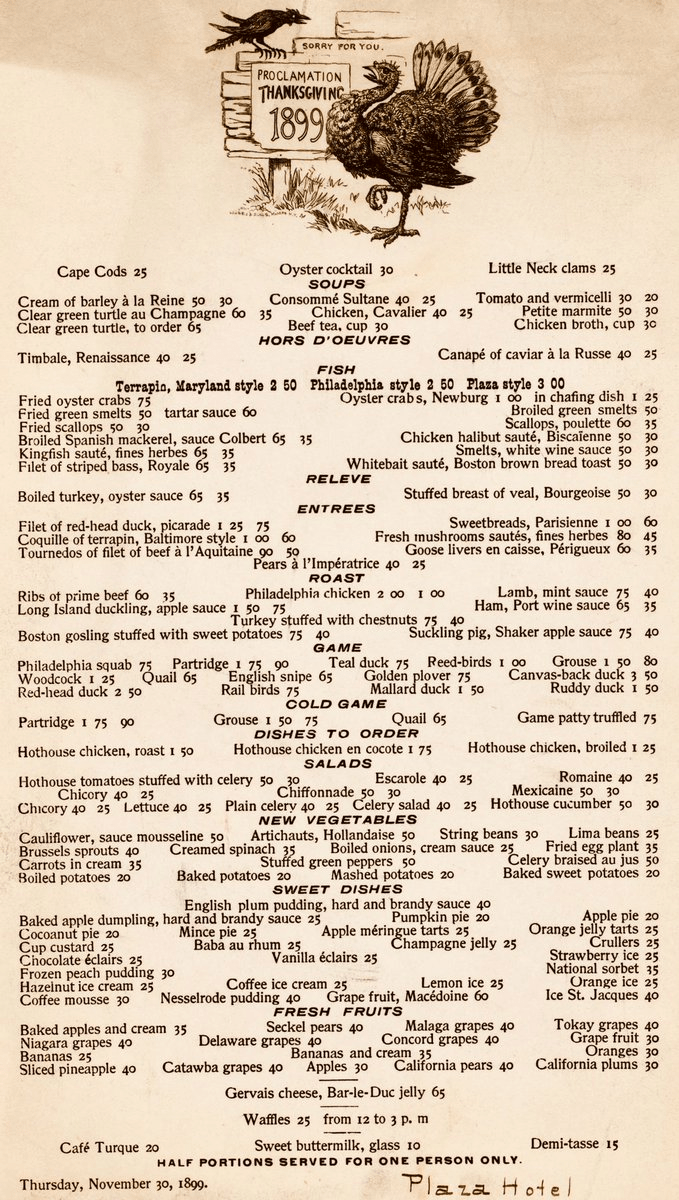
When you see prices from the past, especially the distant past, your normal reaction is perhaps one of envy or nostalgia. Take for example the Thanksgiving menu from the Plaza Hotel in New York in 1899. As you browse the menu, note that the prices are in cents, not dollars.
The most expensive items on the menu are only a few dollars, while many items can be had for around 50 cents. But hopefully your nostalgia will soon fade when you recall that wages were probably lower back then.
But how much lower?
According to data from MeasuringWorth.com (an excellent resource affiliated with the Economic History Association), the average wage for production workers in manufacturing was 13 cents per hour in 1899. From this we can immediately see that a dish such as Ribs of Prime Beef (60 cents) would take about 4.5 hours of work for a production worker to purchase.
How can we compare these prices and wages from 1899 to today?
For the average hourly wage of manufacturing production workers, BLS has a series which should be directly comparable, which shows that manufacturing workers today earn a little over $28 per hour. In other words, that’s about 217 times as much per hour. This factor of 217 is important, and it is superior to your initial reaction, which is to adjust those prices for inflation. MeasuringWorth.com also has a historical CPI series, which we can use to calculate that prices in the economy, on average, are about 39 times higher today than in 1899.
Note here an important point: wages increased much more than prices since 1899.
Given that CPI increase, you may be tempted to multiply the prices in the 1899 menu by 39 and see how that compares to prices today for similar items. But don’t do that! It tells you nothing about affordability (all it tells you is if the price of that particular item increased faster or slower than the general price level). As a first approximation, to make those prices relatable to us today, you should actually multiply them by 217 to get a sense of how affordable they are.
For another approach, let’s try to find a comparable menu today.
Conveniently, the Plaza Hotel of 2024 also offers a Thanksgiving dinner. It is offered as a buffet, rather than the 1899 à la carte menu, but it will still be useful for our comparison. That buffet today will cost you an eye-popping $315 per adult. They haven’t posted the menu yet this year, but the 2023 menu included a turkey and ham carving station, seafood on ice, sushi, soups, salads, entrees, and desserts.
To earn the $315 for this fabulous meal would take about 11 hours of work at the average wage — just about a day and a half of earnings. How much would 11 hours of work earn a manufacturing worker in 1899? One dollar and forty-five cents.
This $1.45 figure from 1899 is the relevant number for us to think about when looking at that menu. What could you buy with that? If you are willing to go with one of the cheaper, 60-cent entrees, perhaps you could put together a meal for $1.45. But not if you want a big Thanksgiving feast. If you put together a meal of turtle soup (60 cents), fried oyster crabs (75 cents), turkey stuffed with chestnuts (75 cents), hothouse tomato salad (50 cents), sweet potatoes (20 cents) and pumpkin pie for dessert (20 cents), your meal is going to run you $3. That’s going to take you 23 hours at the average wage in 1899 — or twice as many hours as the buffet in 2024. In other words, the cost of the Plaza Hotel Thanksgiving Meal has fallen by half since 1899.
Now you might rightly object that only falling by 50 percent over 125 years isn’t that much of a decline. We would expect much bigger gains! But keep in mind this is a served meal at the Plaza Hotel in NYC. Today this is almost certainly one of the most extravagant Thanksgiving meals you can find in the US. Farm Bureau calculates that you can serve a Thanksgiving meal at home for under $6 per person in 2024 — a far cry from $315 at the Plaza. And as I showed last week, that Thanksgiving meal, relative to wages, is nearly the cheapest it has been in decades, as far back as we have consistent data (mid-1980s).
So this Thanksgiving, let’s be thankful that, if you really wanted to, you could enjoy an extravagant meal at one of the most famous hotels in the world for less than our distant ancestors paid. Even better, you can enjoy a traditional meal at home with your family for about 5 percent of your weekly earnings.
 Economist Writing Every Day
It sounds like that 6 dollar figure for the home cooked meal ignores the (opportunity) cost of labour? Didn’t your post establish.that labour costs per hour have increased much faster than inflation?
LikeLike