A Modern-Day Pirate Seeks to Recover Up to Ten Billion Dollars of Gold from Republic Shipwreck Off Nantucket

Arrrr, me hearties! What think ye of a venture to raise a gigantic hoard of sunken treasure?

The story begins with the last voyage of RMS Republic. This was a luxurious passenger steamship of the White Star Line, which sailed between Europe and America.

Wikipedia

Republic was a large vessel (15,000 tons displacement) for her day, and was known as the “Millionaires’ Ship” for the number of wealthy Americans who sailed back and forth on her. A number of such magnates were aboard on her last voyage. In January, 1909 Republic left New York City with  passengers and crew, bound for Gibraltar and Mediterranean ports. In thick fog off the island of Nantucket, Republic was rammed amidships by the Italian liner Florida. Florida’s bow was crumpled back, but she stayed afloat. The damage to Republic was fatal. The engine rooms flooded, the ship began to list, and it was clear that the passengers needed to be evacuated.

Using the new-fangled Marconi “wireless” apparatus, a CQD distress signal was broadcast by radio operator Jack Binns. This was the first wireless transmission that resulted in a major life-saving marine rescue. (Binns had to scramble and improvise to get this done, since his apparatus had been damaged and the ship’s power was lost as a result of the collision, so he was a technology nerd turned hero, duly lauded by a ticker-tape parade). It was hard for other ships to locate Republic in the fog, but eventually nearly all the passengers and crew from Republic and from the damaged Florida were safely transferred to other ships.

As was the custom of the time, she did not carry enough lifeboats to hold all the passengers, but only enough to ferry them to some other ship; it was assumed that on the busy Atlantic route there would always be other large ships around.  (That scheme played out well with the Republic, but when sister White Star liner Titanic sank four years later, the dearth of lifeboats helped doom some 1,500 people to a watery grave.) Despite efforts to save her, Republic went down stern-first on January 24. She was the largest ship ever to sink at the time.  There were reports at the time that she was carrying some $3 million (1909 dollars) of gold, which went down with the ship. That would translate to hundreds of millions of dollars today for that gold.

But wait, there’s more, maybe much more. Enter a modern-day pirate, Martin Bayerle:

Vineyard Gazette

Bayerle looks like a pirate, sporting a genuine eyepatch covering an eye lost in an explosives accident. He killed a man who was fooling around with his wife, which seems like a piratical thing to do, and he is after a ship’s gold.   His salvage enterprise is even formally described in legal court papers as “modern day pirates”. 

His company, Martha’s Vineyard Scuba Headquarters, Inc. (“MVSHQ”), acquired salvage rights to the wreck of the Republic. In 2013 he published a book, The Tsar’s Treasure, detailing his thesis that Republic carried far more gold than was publicly acknowledged. He notes that there was no formal inquiry regarding the sinking of Republic, which was highly unusual and is suggestive of a cover-up. Cover-up of what?

Well, Europe at the time was a tinder box of potential conflict, which did in fact erupt five years later in World War I.  Czarist Russia was a key part of the European military equation. Britain was counting on Russia to help contain the emerging militaristic Germany. Russia had incurred huge debts in its disastrous war with Japan in 1905. Russia was about to issue a new round of bonds in 1909, to roll over its debt from 1905. It was critical that that bond issuance would go forward.


Bayerle believes that a large amount of gold was stashed in the hold of the Republic, destined for European banks, to support the Russian bonds of 1909. The revelation that that gold was lost would have jeopardized this crucial financial transaction, perhaps leading to Russia’s collapse, which is something Britain could not afford. Hence, the cover-up. Bayerle estimates that the value of this trove is up to $10 billion in today’s money. Shiver me timbers!

This geopolitical speculation, together with stories of failed previous salvage attempts on Republic, all make for a rollicking yarn. Is it for real? Nobody knows, but Bayerle is offering investors a chance at a slice of the booty. If you are inclined to “Dare to dream the impossible” (per the website), you have the opportunity to invest in his Lords of Treasure enterprise as they make a dive on the site this summer.


I don’t happen to have that much risk appetite, but it should be an interesting story to follow.

UPDATE

According to the June 2025 Lords of Fortune Newletter, salvage operations originally slated for 2025 are being put off till 2026, as funding is still being developed. We note the technical challenge of picking through hundreds of tons of steel plate and girders, deep underwater, in search of a smallish volume of gold. On the other hand, Capt. Bayerle’s recent researches suggest the gold trove may be even larger than earlier estimated, up to some $30 billion. So high risk meets high reward here. It seems ironic that VC’s will throw say $300 million into dubious tech unicorns or the latest crap-coin, but eschew a pretty sure bet of at least breaking even here (if only the lowest estimates of the Republic gold pan out) with a good shot at 10X-ing their investment. We will stay tuned.
Walking around DC

I’m here to discuss women in the criminal justice system as part of the ongoing BRIDGE series organized by Arnold Ventures. DC remains one of my very favorite cities, one I lived in and around for decades. I arrived with some trepidation, of course, now that the federal government is attempting to “occupy” it while deploying National guard troops (“some armed”) while ICE agents execute their own specific combination of random assault sprinkled in with some light kidnapping. I wasn’t quite sure whether I should expect military vehicles on every other street or just the odd rented van with masked men claiming to be ICE agents pouring out.

What I’ve seen so far is mostly…nothing. I don’t me DC seems normal, not in the slightest. I mean the streets feel emptier. There’s far too few tourists for mid-August. There were families on the steps of the museums, but normally they’d be swarmed. I’m sure to some degree I’m layering my own sensitivies on the scene, but I really do think it is far quieter than it normally is. Than it should be.

Tonight I’m going to head to U street to visit an old friend, have a drink, catch up. I’ve done this a million times, in this exact neighborhood, for going on 20 years. That this time, with a cheap tinny authoritarian claiming to clean up crime while DC is experiencing the lowest rate of violent crime of my lifetime, that this is the only time I’ve really had any sense of insecurity, that something bad could happen around me, is some of a grossest irony I’ve ever experienced first hand.

Anyway, it’s always nice to come home, no matter how hard some are trying to take feeling away.

Podcast to understand modern coupling challenges

As marriage rates decline nationally, Esther Perel’s “Where Should We Begin?” offers more than dating advice. These episodes are recordings of real couples or single people today who explain why they are struggling to find relationship success. It provides an anthropological study of why coupling is challenging in the 21st century.

Each couple’s struggle with intimacy and commitment reflects broader questions about what it means to build a life together in an age of individualism. “Where Should We Begin?” doesn’t offer easy solutions to the coupling crisis, but it does helps us understand the deeper currents shaping modern love. Especially now that she has branched out to non-romantic friendship topics this year, almost anyone can find an episode here that might help them navigate one of their own personal problems as if they had the world’s leading relationship therapist on hand.

One of Perel’s points is that modern couples are drowning under expectations that previous generations never faced. Partners are expected to be best friends, passionate lovers, co-parents, financial partners, emotional support systems, and personal growth catalysts all at once. Perel points out that they’re asking their relationship to fulfill needs that used to be met by entire communities.

One episode I listened to is “I Can’t Love You the Way You Want Me To” Description: Their relationship is on the edge. They’re grappling with communication issues and the emotional scars from their past. And they’re trapped. Trapped in an endless cycle of blame, defensiveness, and attack.

As someone who grew up on the periphery of Philadelphia, I was interested in their specific fight. The man said that Philly sports fans are trash. The woman defended the honor of Philly with specific examples, and now they hate each other. Honestly sounds like my high school.

The 2018 Tariffs in Many Graphs

Did president Trump’s first term tariffs, enacted in 2018, increase manufacturing employment or even just manufacturing output? Let’s set the stage.

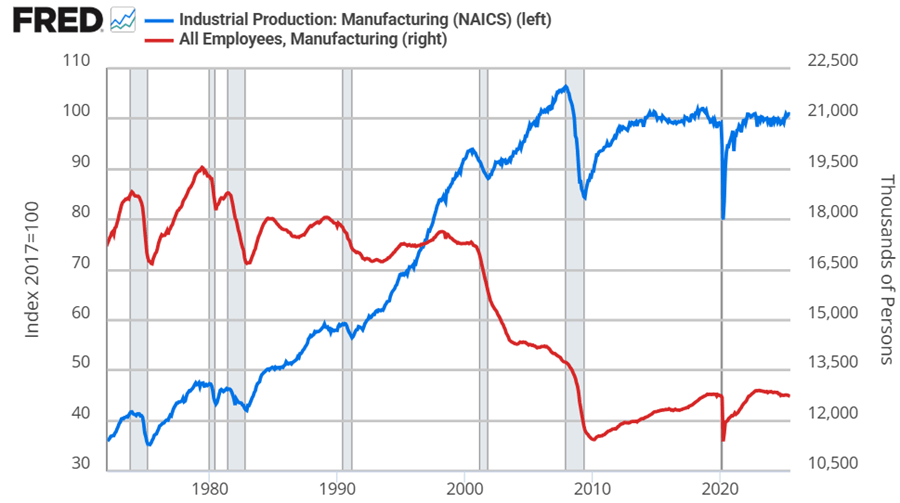
Manufacturing employment was at its peak in 1979 at 19.6 million. That number declined to 18m by the 1980s, 17.3m in the 1990s. By 2010, the statistics bottom out at 11.4m. Since then, there has been a rise and plateau to about 12.8m if we omit the pandemic.

Historically, economists weren’t too worried about the transition to services for a while. After all, despite falling employment in manufacturing, output continued to rise through 2007. But, after the financial crisis, output has been flat since 2014, again, if we omit the pandemic. Since manufacturing employment has since risen by 5% through 2025, that reflects falling productivity per worker. That’s not comforting to either economists or to people who want more things “Made in the USA”.

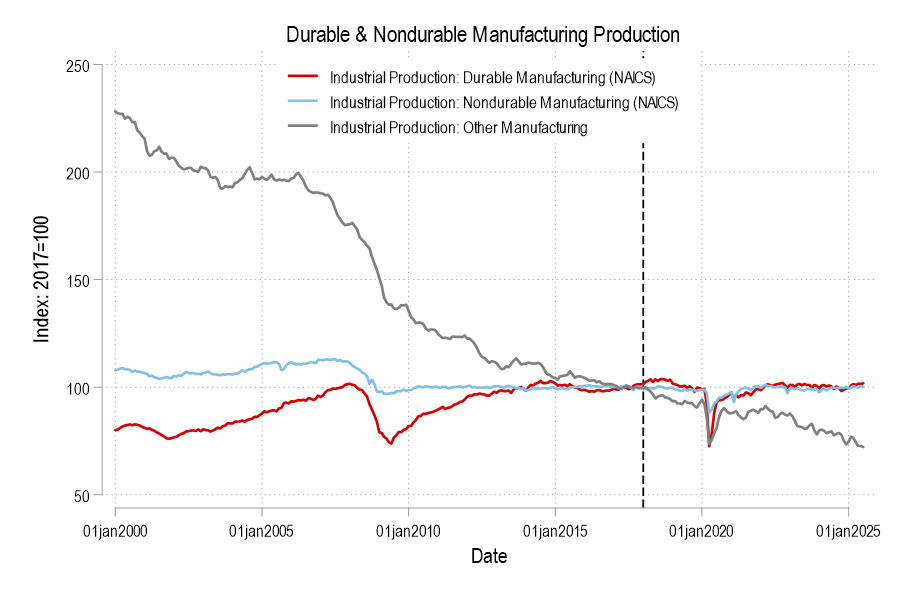
Looking at the graphs, there’s no long term bump from the 2018 tariffs in either employment or output. If you squint, then maybe you can argue that there was a year-long bump in both – but that’s really charitable. But let’s not commit the fallacy of composition. What about the categories of manufacturing? After all, the 2018 tariffs were targeted at solar panels, washing machines, and steel. Smaller or less exciting tariffs followed.

Breaking it down into the major manufacturing categories of durables, nondurables, and ‘other’ (which includes printed material and minimally processed wood products),  only durable manufacturing output briefly got a bump in 2018. But we can break it down further.

Continue reading

Why I Started Grading Attendance

I’ve taught college classes since 2010, but I never graded attendance directly until this year. I thought that students are adults who can make their own choices about where to spend their time, and if they could do well on my tests and assignments without spending much time in class, more power to them.

But I got tired of seeing students miss a lot of class, then fail by getting poor grades on the tests and assignments, or scramble for the last few weeks to avoid failing. Explaining the importance of attendance didn’t seem to help, so I finally turned to the economist’s solution- incentives. This Spring I tried grading attendance in one class, and this successful experiment plus the growth of AI mean I plan to grade attendance in all classes from now on.

The Benefits:

  • Get to know student’s names faster
  • Students feel rewarded for showing up
  • Students show up more, bringing more energy to the room
  • Students show up more, so they learn more and do better on other assignments
  • Physically showing up is one thing I can be sure the AI isn’t doing for them, it will be a while before humanoid robots are that good

The Costs That Turned Out Not to Be Big Deals

  • I thought students would dislike me policing their whereabouts and give me lower course evaluations (which is part of why I waited for tenure to try this). But my Spring evals were at least as high as usual, with none mentioning the attendance policy. When I asked students in a different class about this, most said they wished I would grade attendance if it meant less weight on exams.
  • I thought tracking attendance would be burdensome, but it turns out my main course software (Canvas) already has an attendance-tracking tool built in that lets you just click on names in a seating chart each day and enters grades automatically. It is certainly less burdensome than grading most assignments.

I still had some students disappear for a while due to personal issues; sometimes even the strongest grade incentives aren’t enough to get people to class. But overall I can’t believe I waited this long. I’m currently putting attendance as 10-15% of the course grade, but I dream about someday running a discussion-based class like a Liberty Fund seminar, doing a 100% attendance/participation grade, and not having to grade anything.

Initial Jobs Reports from BLS are Very Good At Identifying Downturns in the Labor Market

Yesterday I showed that BLS jobs reports from the CES aren’t getting worse over time, if we judge them by how much they are later revised. In fact, they are much better than decades past, with the last 20 years or so standing out as much better than the past.

Today I want to address a related but separate topic: are the initial jobs reports good at telling us when a downturn in the labor market is beginning? This is actually the strongest argument for releasing this survey data in a timely manner, even though the data often goes through significant revisions later. The report typically comes out the first Friday of a new month, so it is very current data. Given that the likely new BLS Commissioner has signaled he prefers the more accurate quarterly release, even though it is 7-9 months after the fact, it is useful to ask if these initial reports have any value in telling us when labor market declines (and recessions) are beginning.

That’s right: you are getting two posts from me this week, on essentially the same topic. Because it’s very important right now.

The short answer: the report is very good for the purpose of identifying downturns, especially the start of the downturns. Let’s walk through the past few recessions.

Continue reading

BLS Has Been Getting Better at Estimating Jobs, and They are Not More Favorable to Democrats

You’ve probably heard a lot about BLS data recently (or at least more than usual) with Trump firing the BLS Commissioner after a bad monthly revision to the nonfarm payroll jobs figures. But this didn’t come out of the blue, as there was plenty of criticism of the jobs numbers during the Biden term as well, mostly coming from the political right.

The two main criticisms leveled at the BLS, in my reading of it are:

  1. The BLS is getting worse at estimating jobs numbers over time, leading to larger revisions
  2. The revisions are done in a way that is favorable to Democrats

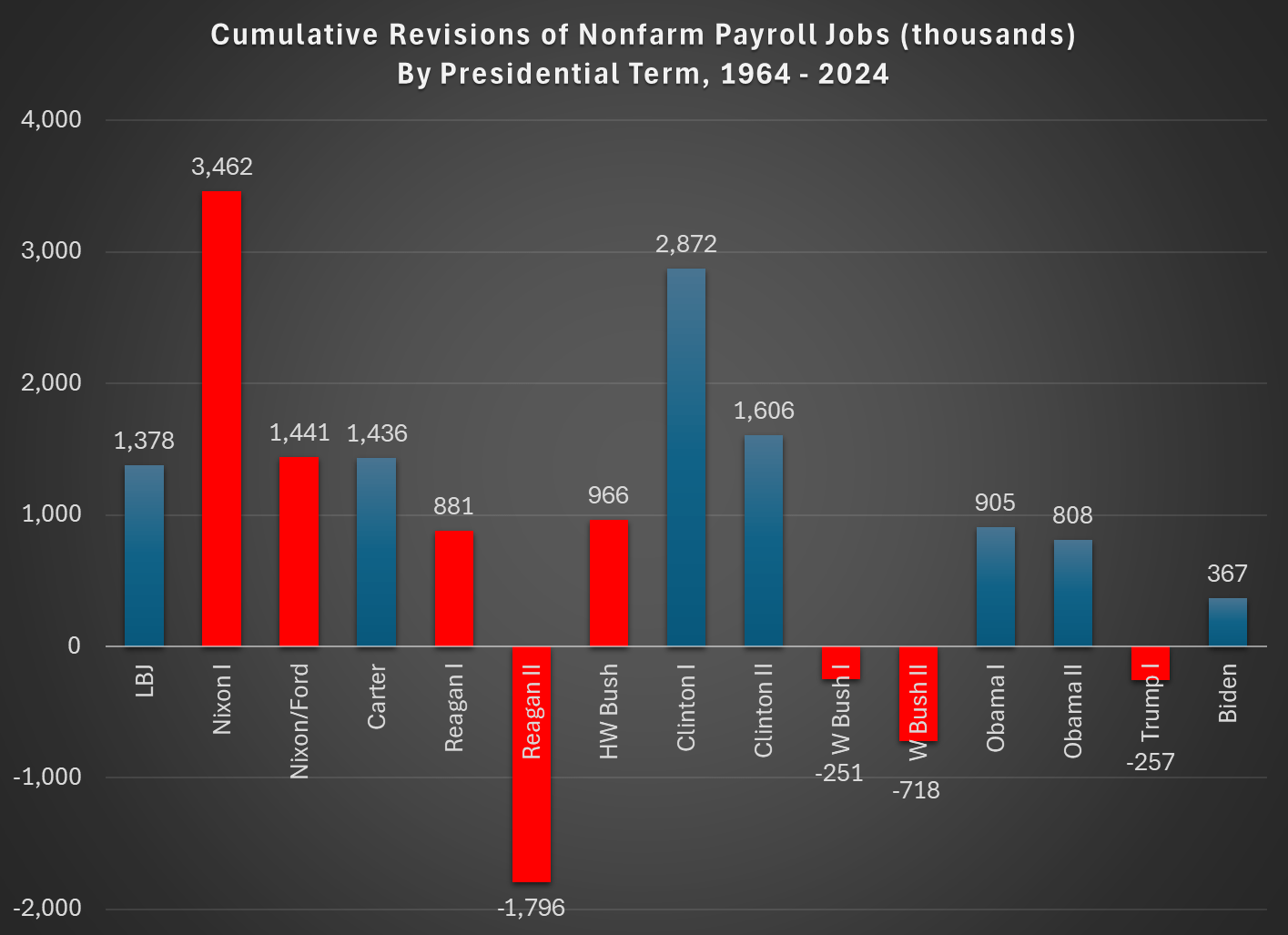
I think both of those claims can be analyzed with the following chart, which also shows those claims to be incorrect:

Continue reading

Are Managed Futures Funds Worth Including In Your Portfolio?

Back in February, 2023 I wrote an enthusiastic plug for including managed futures funds in an investment portfolio. That was based on several observations. First, bonds have become often positively correlated with stocks, so the traditional 60/40 stock/bond portfolio provides less hedging or diversification than earlier. Second, during the long grinding bear market of Jan-Oct 2022, managed futures funds shot up, nicely hedging stocks. Third, I had only recently discovered managed futures, so they were for me a shiny new toy.

Managed futures funds hold both long and short positions in futures contracts for a variety of commodities (e.g., oil, gas, metals, cattle), stocks (e.g., domestic vs. international) and other financial instruments (domestic and foreign bonds, currencies, interest rates, etc.). Fund managers usually base their positioning on momentum or trend-following. Historical data shows that if a commodity moves up steadily for, say, a month, there is greater than 50% odds that it will continue moving up for some additional time.  If the fund’s positioning is correct, it makes money the next week or month. If it is incorrect, the fund loses money.

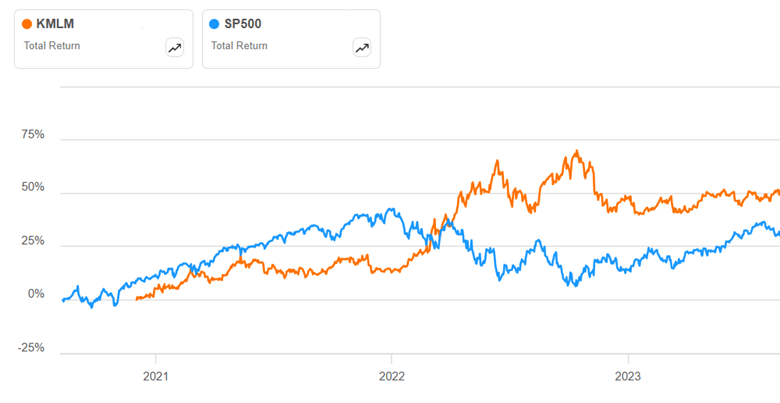
Historically, a good managed futures fund will trade fairly flat or slightly up during a stock bull phase, then step up to give positive return during a stock bear market, to counter the drop in equities prices. We can see below how that worked for managed future (MF) ETF KMLM around 2022. It rose slowly in 2021, then fell back at the end of the year. However, in Jan-Oct 2022 while stocks (and bonds) were painfully grinding down to a 22% loss, KMLM ripped higher by a huge 40%. That seems like a great hedge:

KMLM quickly gave back those gains, for reasons we will discuss. But if you had been consistently rebalancing your portfolio, you would have captured much of those gains.

This sort of performance is why some advisors recommend moving much of your non-stock holdings out of bonds and into managed futures. What’s not to like here?

It turns out that MF funds struggle if there are not fairly long, strong trends in commodity prices. If trends reverse quickly, and then reverse again, then the fund’s positions will lose money over and over. We can see this in the above plot. The story for most of 2022 was interest rates going up and up and up. MF funds were rock stars as they rode that trend for many months. But there was a surprising break in futures trends in November, 2022, as markets suddenly started pricing in an early Fed pivot towards easing in 2023, and so interest rates rose, and bonds and the U.S. dollar tumbled. All the managed futures funds took a sharp hit Nov-Dec 2022. KMLM then went roughly flat for 2023; other MF funds fared worse.

So far, so good. However, it seems like there has been a sea change in futures markets. Before around 2010 or so, there is reason to believe that much of the futures price action was driven by the underlying commodities themselves. For instance, cattle or soybean producers wanted to protect themselves against changes in cattle or soy prices, and so they would buy or sell futures to lock in prices say eight months out. In these situations, there would naturally and normally be months-long trends in futures prices. Wall Street took the other side of those trades. But now it seems to me (can’t give proof reference) that it’s speculators on both sides of the trades, leading to trade algos constantly trying to outguess each other and higher volatility.

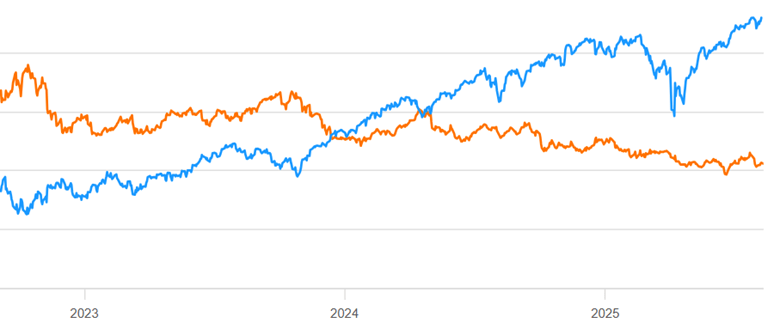
For whatever reason, normal trend-following MF has been a bad business for the past 2 years. Here is a continuation of the chart above, showing mid Aug 2023- mid Aug 2025 for KMLM (orange line) compared to S&P 500 stocks (blue line):

The scale is not shown here, but KMLM lost some 30% of its value during that time period. That is NOT the kind of hedge you want to hold.

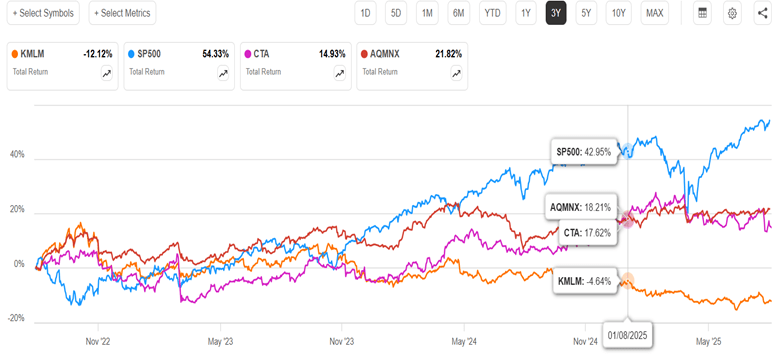
So, should we forget about MF funds? It turns out that not all MF funds perform the same. My informal research suggests that most MF funds have performed similar to KMLM in the past two years (=abysmally). Since my 2023 article, though, (a) an improved MF ETF (CTA) has appeared, and (b) I became aware of a superior MF fund (AQMNX) of the old-style (non-ETF) mutual fund format. Below is a 3-year chart of KMLM, SP500, and the ETF CTA and the mutual fund AQMNX:

We can see that both the new contenders are up instead of down in the past three years, and both were uncorrelated enough to SP500 to cushion the big Feb-April stock drawdown this year. They handily outperformed bonds (e.g. BND, not shown) during this time period.

There are fundamental reasons why those two funds would behave differently than plain vanilla trend-following KMLM. CTA adds a factor called carry (which I will not try to define) to its algo, and also takes large concentrated bets. AQMNX draws on the very sophisticated quantitative resources of the AQM fund family. It also takes long/short bets on equities (e.g. S&P 500 index), which are not in KMLM.  AQMNX is not available through all brokerages (it is at Fidelity).

As the months roll by and plain stocks soar effortlessly up and up, it may seem pointless to consider any portfolio hedges. But for those who value diversification, these two funds may merit consider consideration. (As usual, nothing here should be considered advice to buy or sell any security).

The economics of damned lies

Economists have become almost comically skeptical of estimated effects. A researcher estimating the effect of X on Y has always had to consider the bias and efficiency of their estimator, where bias is the result of unconsidered or unobserved forces pulling your estimated effect in one particular direction away from the truth (too positive or too negative), and efficiency is the overall noisiness of the estimate, where a less efficient estimater provides too large a range of possible effect sizes.

Under the umbrella of efficiency were concerns about random measurement error – the basic and unavoidable difficulties in accurately recording the the underlying “true” value. Filed under “everywhere and always”, measurement error is often simply the cost of doing business, while nonetheless limiting the precision which the world can be known and, in turn, the precision with which decision making or policy can be calibrated.

Coping with bias has been in many ways the story of empirical economics and the “credibiilty revolution” of the last 25 years. It’s why “identitication strategy” is the fourth slide of almost any microeconomics presentation, why the econometrics of every great applied economics working paper is seemingly obsolete before it finds itself in print, and why there is a genuine possibility I will retire with a half dozen ulcers before I finish this blog post. Economists make themselves crazy thinking, strategizing, and internalizing criticism about the potential bias in their estimates. Selection bias, omitted variable bias, reverse causality, and even observer bias lurk in the shadows of our minds. To be an expert in causal inference is to anticipate and guard against myriad sources of bias in your empirical analysis. For many living economists, however, there is a new bogeyman.

Systemic measurement error.

Sounds banal enough. And if you’re a chemist, it is. The gauge is consistently measuring every temperature too high, mass too low, electromagnetic spectra too red. Something to test for every day. Vigilence and repetition, the solution. For economists, however, the answer is less simple.

What happens when the data is rigged to make the results too good? Unemployment too low. Wages too high. Expenditures too productive. <Redacted> too <redacted>. Economists have looked for cheaters as a research subject and rooted out fraud within scientific endeavor itself. But it is precious few who have made it their job to sift through manipulated public data and carefully distill the true underlying numbers. And for good reason — as soon as you declare the data unreliable, you open the door to your own personal bias. Your politics, career ambitions, or even just your good hearted desire to observe people being more decent than our own pessimissim might otherwise allow for. To allow yourself to manipulate the potentially fraudulent data is to potentially make a bad situation worse.

Replicability and transparency of analysis was important before, but now we’re entering an even more tedious and slow landscape because critics aren’t just going to want to adjudicate your analysis, they’re going to want to adjudicate every observation in your data set. Or perhaps I am being too negative. There is a genuine upside. As people look to distill and correct for systemic measurement error, they’re going to create greater demand for 1) parallel analysis of similar questions using different techniques on the same data and 2) great forensic analysis of data and the institutions that create it. Never forget that sovietology was a genuine research career. More work to be done, but it can be done.

More work that has to be done. Sigh. My stomach hurts.

Top EWED Posts of 2025

These are notable posts from 2025, roughly presented in descending order, starting with the post that got the most views.

  1. Is there a competitive threat to the NBA?  Mike Makowsky wrote, “… let’s put it this way. Why *wouldn’t* the Saudi Arabian PIF invest $5 billion in creating a rival basketball league?”

2. Perspective: This Stock Correction Fear, Too, Will Pass  In March, Scott Buchanan presented “an optimistic take on the current stock market pullback.”   Indeed, the market came back, despite the tariff doomerism of 2025 Spring.

3. The Middle/Working Class Has Not Been “Hollowed Out” Jeremy Horpedahl, corrector of common myths, corrects a common myth.

4. Montana’s New Property Tax System  Jeremy explains “interesting changes to residential property taxes in Montana.”

5. How Scott Bessent Outfoxed Peter Navarro to Get the 90 Day Tariff Pause from Scott: “As Treasury Secretary, Scott Bessent would be particularly sensitized to the interest rate issue…”

6. Spending on Necessities Has Declined Dramatically in the United States Jeremy reminding us that Americans are richer today.

7. Was the US at Our Richest in the 1890s? If you don’t believe Jeremy, consider one of the American Girl Doll historical books I was just reading to my kid. In our book, a little girl sends a letter to Samantha (the 1904 doll) reporting that both of her parents just died from the flu.

8. The Wild Market of July 8th, 2025 James Bailey on the topic that we are all trying to keep up with this year: “Yesterday the S&P 500 shot up 9% on the news that most of Trump’s new tariffs were paused.”

Special mention to Joey Politano who has been trying to follow the news all year and might go insane according to his Twitter/X.

9. No Tech Workers or No Tech Jobs? I (Joy) wish I had more time to write about the market for tech jobs this year. There is some indication that hiring is slowing. Some people still call it a correction from the Covid tech over-hiring spree. Other people take this as a sign that AI reduces the need for human programmers and otherwise “high-skill” humans, while some refute that claim.

10. Other “I, Pencils”  It was fun for several dozen of us economists when everyone else in the world suddenly re-discovered the value of international exchange.

11. The Best Investments of the 1970s James considers “what were the best investments of the 1970’s?”  Interesting to consider the performance of gold in retrospect considering stagflation.

12. Women Have Always Worked More Than Men: Hours of Work Since 1900 I feel seen.

13. Shocked 2025 is shocking, as Mike pointed out in February.

14. Trump’s Economic Policy Uncertainty Along those lines, Zachary Bartsch examines how people are shocked and confused.

15. Salty SALT in the OBBB Zachary explains. “Economically, the SALT makes it cheaper for individuals to live in high-tax jurisdictions. That’s distortionary.” 

16. Illusions of Illusions of Reasoning I wrote, “evaluating AI reasoning is difficult…”

Reflections: We’ve been doing this for 5 years now, as of August 2025. From the analytics I can see, our posts have been the answer to a stranger’s Google query hundreds of thousands of times. Having been the beneficiary of so many other posts from strangers online, I’m happy about that.

Reminder: You can subscribe to our WordPress site to get posts sent to your email. The widget for putting your email in should be on the right side of your screen on a computer, or you can find it by scrolling to the bottom of the home page on a mobile device. WordPress will let you customize your preferences so that you get emails batched once a week if you prefer that to Every Day.

Based on my crude analytics from WordPress, “traffic” to our site from LLMs is low but increasing. It appears that readers occasionally click over from chatgpt.com or perplexity.ai  What we can’t see is if and when our writing is re-molded as part of an LLM answer without attribution. In one sense, writing online is more important than ever, to feed the beast and help get good quality answers to LLM users. On the other hand, old systems in place like upvotes and view counts that used to motivate people to write for free might crumble in the new world.

From me in 2024: “AI companies have money. Could we be headed toward a world where OpenAI has some paid writers on staff? Replenishing the commons is relatively cheap if done strategically, in relation to the money being raised for AI companies.” 

If anyone knows Mark Zuckerberg, please tell him that I’ll write for a fraction of what he’s paying these new engineers. What if he gave out a writing fellowship on the understanding the person never publishes (else the other bots would scrape it) and just exclusively lets Llama train off of original work?

In our case, anyway, we enjoy writing and learn from the process, so we are looking forward to being here every day.

To find prior year “top post” lists, start with: Updated List of Top Posts for 2024