- This is post coauthored with Jack Cavanaugh, Ave Maria University Graduate of 2025.
Say that you want to become a successful lawyer. What does that mean? One possible meaning is that you are well-compensated. Money is not everything, but it does give people more options for how to spend their time and resources. Law degrees are a type of graduate degree. So, what bachelor’s degree major should one choose in preparation for law school? We lack rich administrative data on college majors and LSAT scores.
Luckily, the 2023 American Community Survey (ACS) comes to the rescue. It has all of the typical demographic covariates, income, occupation, and college major. So, if we make the small leap that well-prepared law school students become high-performing lawyers who are ultimately paid more, then what college major puts you on the right path? What should your major be?
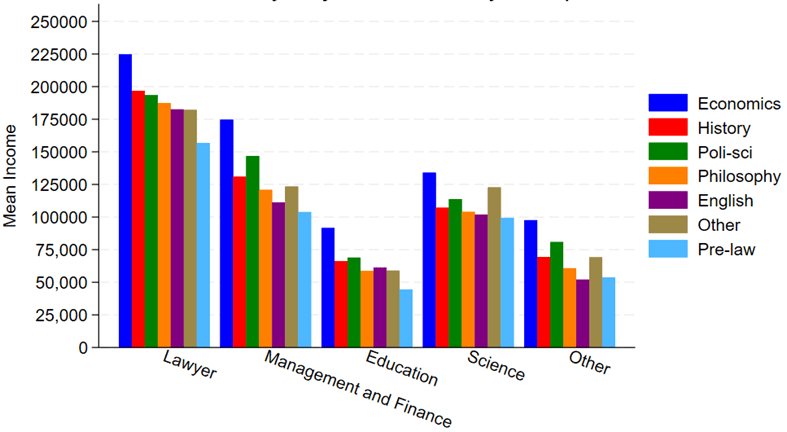
We don’t look at an exhaustive list. We place several occupations into bins and examine only a few alternative majors. Any unlisted major falls under ‘other’. Below are the raw average incomes by occupational category and college major. Note two majors in particular. First, Pre-law literally has the word ‘law’ in the name and is marketed as preparation for law school. However, it is the undergraduate major associated with the lowest paid lawyers. For that matter, Pre-law majors have the lowest pay no matter what their occupation is. Second, Economics majors are the most highly paid in all of the occupations.
Of course, covariates and interactions abound. We can estimate the contribution to income of majors and their contributions to specific occupations. The equation below says that there is a general effect (γ) on income for each particular major. It also says that each major can have a more specific effect (σ) on income when a person chooses particular occupations. The ‘general’ effect can be construed as the general human capital associated with having a specific major and the other major-occupation effects are the human capital impacts associated with specific occupations. In the below specification, ‘Other’ occupation and major is the baseline.

Below are the results. The college major ‘general’ and occupational category impact are listed on the left and the coefficients with 95% standard errors are color-coded by major. Awkwardly, pre-law majors don’t earn any more or less than the baseline ‘other’ major generally or in any occupational category, including lawyers. This makes one wonder about what exactly that major does for a person. Maybe plenty. But it doesn’t show up in the income data. Economics has the largest positive general effect on income at +13.5%. Economics also has no occupation-specific effects. This sort of implies that Econ majors just have a more productive grasp on reality, rather than being good at tasks specific to individual occupations.
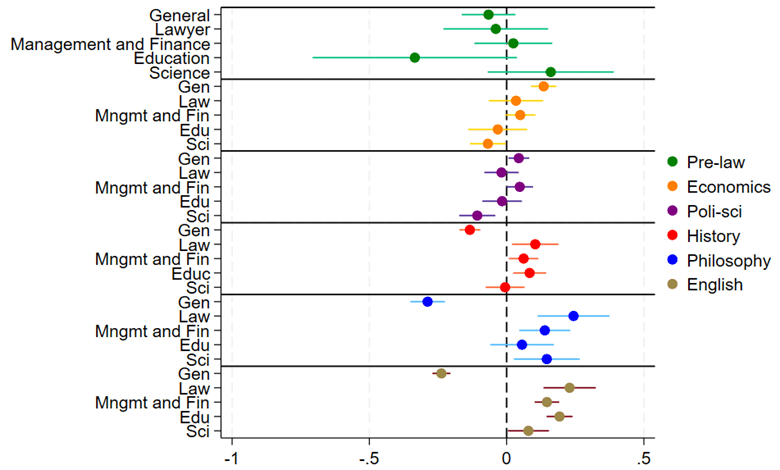
Other majors also imply interesting stories. History majors have much worse general human capital, but they excel in particular occupations, such as law, management & finance, and education. Those occupations allow history majors to be the highest earners vs history majors in other occupations. Philosophy and English majors are similar. These majors all impart lower general human capital, but they can be more highly paid among their college major cohort by pursuing careers in law or management.
According to the above figure, a highly paid lawyer would be one that had an economics major. While it’s true that philosophy majors are paid more when they are lawyers, the premium is inadequate to overcome the general negative effect on income of being a philosophy major in the first place.
What’s the takeaway? Do economics departments impart greater human capital to students than other departments? Maybe. It’s also possible that a student’s major choice signals a pre-existing capacity to perform in a particular area of study. Few people want (or are permitted) to earn Cs & Ds throughout college and have that be the GPA in their major. So, there is probably a great deal of selection effect. How would we know?
Well, since productive characteristics are somewhat heritable, we should expect that controlling for parent income would substantially attenuate all of the coefficients that are related to heritable human capital. Due to sample size challenges, we expand the data to include 2018-2023 (omitting 2020). Controlling for parent income in the above specification results in the coefficients below. What do you see? All of the otherwise significant effects of college majors on income disappear for Economics and Poli-Sci majors. So do all of the occupation-specific impacts of History and Philosophy majors, though they are still associated with lower pay in general. The only occupation-specific effects that remain are for English majors who are able to offset some of their lower income by becoming Educators or by working in management or finance.
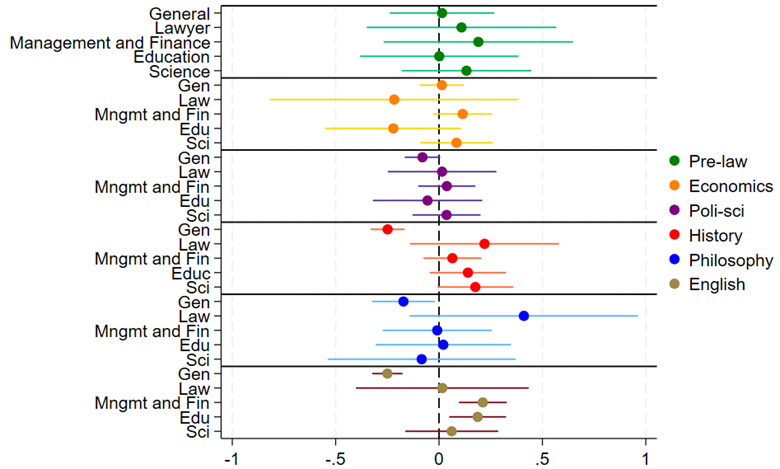
For anyone following along, we can walk away with two big conclusions. First, a pre-law degree is worth, on average, the same as other majors and is not particularly well-suited for earning more income as a lawyer. In addition, economics majors tend to earn more in all occupations, maybe due to some very productive general human capital. However, the last figure strongly implies that this human capital was already an added ingredient before the students earned their degree. They earn income like their parents earn income. In other words, majoring in economics, on average, is a signal of greater human capital. The above analysis implies that it doesn’t impart greater human capital.*
*Typical caveats about omitted variables, etc., etc.
*From the email: It’s possible that the pre-law bachelor’s students are systematically from lower quality schools that carry such a degree. It’s also possible that respondents erroneously included their pre-law program as their major field, which may account for the large standard errors (measurement error).


Great data find, thanks. Interesting about econ majors rising to the top. Every econ prof should be waving this in front of their students, make them feel good about their major.
Does choosing econ show you are a smart person to start with, or does econ training itself make you better at any job, or do econ-trained folks end up in higher-paid subspecialities… like corporate tax lawyer vs. divorce lawyer?
LikeLiked by 1 person
Thanks, that’s a great question. I don’t know the answer. But the occupational categories do have subcategories. If the data is thick enough, there’s no reason I can’t find out!
LikeLike
I suspect this is econ majors being smarter to begin with and being more likely to choose corporate law, but I’ll definitely share the highest-paid major for lawyers fact with students.
LikeLike