We Should Pay for Good Journalism

This week the NYT likely misreported a geopolitical event and ran a misleading photo to go with it.

NYT Uses Photo of Wrong Location for Hospital Story by David Zweig on Substack

U.S., Experts Say Evidence Suggests Palestinian Militants’ Rocket Hit Gaza Hospital (WSJ)

The NYT has run a kind of response.

This makes me think of Putin’s failed assault on Kyiv. Putin has succeeded in getting many thousands of people killed, but his initial goal of the invasion was not achieved. Putin was 70 years old when he thought he could take Kyiv in 2022. He had photos in mind, but probably with the old kind of newspaper reporting and Soviet-style control over media. Now every villager holds up an iPhone and livestreams marauding soldiers. However, if you go to the Wikipedia timeline of events, you can see how important “traditional” journalism still is. Sources include the New York Times and Al Jazeera (based in Doha, Qatar). Paying for journalism affects the world. Saying what journalists “should” be doing without paying for any newspaper subscriptions has less of an effect I would think.

Can anyone be an entrepreneur?

Hardly the most important thing going on this week, but Matt Yglesias said something I have some evidence against. Yglesias claimed that, “basically anyone could massively increase the value of a large plot of land in the United States if he were exempted from land use rules.”

What percent of people do you think could massively increase the value of a barren plot of land, even with no land use rules?

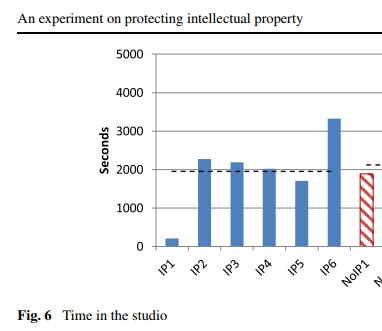
When I ran an experiment about intellectual property protection with Bart Wilson, we created a space for people to mine valuable “creative” goods, analogous to writing a hit song. The goods could be distributed to the rest of the subjects in the experiment to create a surplus for everyone.

This screenshot shows time spent in the “studio” for groups that did have intellectual property protection. Group 1 (IP1) spent less time in the studio even than any of the groups who were not offered intellectual property protection. We concluded that Group 1 did not have any people with entrepreneurial tendencies. We had not expected this to happen, so we highlighted the role of entrepreneurs in our conclusion from this experiment. Institutions interact with entrepreneurship. We found that more “entrepreneurship” emerged under the IP institution.

Is the repair revolution coming?

Every sentence in this article is fascinating, since I have been writing about fast fashion.* Anything I put in quote form comes from The Guardian.

The word “revolution” in the title of this article is minor clickbait. Perhaps it would be more accurate to say: “Clothes repaired in workshop, 19 people employed” That wouldn’t get any clicks. However, I am an idealist, and I am going to stay a bit on board with the revolution. I, too, have pondered and grieved over the amount of waste heading into landfills. There could be some kind of revolution ahead, whether it is of the repair type or not.

The communal garden and bespoke textile art lend a creative startup feel, and the slogan “repair is the new cool” appears everywhere. But what’s happening here is far from ordinary startup stuff. At United Repair Centre (URC), newcomers to the Netherlands from across the world, many of them former refugees, are using their tailoring skills to mend clothes on behalf of some of the world’s biggest brands. 

Immigrants are sewing, but no Dickensian horrors here. This place “has a laid-back Dutch vibe.”

Ambrose, who greets me, mans the front desk. He’s a 20-year-old Palestinian fashion fan, who was born in Syria and lived in Abu Dhabi before moving to the Netherlands in May; he is working in parallel with studying for a fashion and design diploma. Ambrose started at URC in May and loves it: the way he gets to work in collaboration with the tailors, giving advice and learning from their years of experience. “It’s really easy, fun, chill … “

The verdict is in. Work is fun.

Repair might be cool, but is it new? Consider Jo March from “Little Women” who was an American bouncing around between rich and poor status in the 1860s. American GPD per capita in 1860s was less than $3,000. That would be considered very poor today. Since manufactured goods were expensive and Jo March had a low opportunity cost of time, she spent lots of time mending clothes. Her passion was writing but she had no choice – that was how she contributed to her household production. Very few families at that time, even in the upper class, could afford to regularly buy new clothes from a shop.

Don Boudreaux explained that even modern rich people “recycle” clothes when it’s in one’s selfish interest. Washing and “re-use” of clothes, typically, is beneficial enough to outweigh the cost of maintaining and storing them. Sometimes we go above and beyond by donating them or maintaining them specifically because we are trying not to “waste” something, but that comes at an individual cost to us.

The author of the article writes:

I take a taxi from the station to URC because I’m running late, but I’m taken aback when en route the driver points out the many conveniently located stations and tram stops I could use for my return journey.

This is a perfect encapsulation of why rich people do not repair clothes. They are zipping around to high-productivity work meetings. The opportunity cost of time has gone up. Taking the bus is costly in terms of time, the scarcest resource of the rich.

Where I see hope for the repair “revolution” is in artificial intelligence (AI). AI can make up for our scarce time and attention. If AI can make repairs less costly in terms of time, then rich people might do it. If it doesn’t make economic sense, then it won’t scale the way the author is hoping.

Currently, the “revolution” is employing 19 people full-time. By the year 2027, all they are hoping for is to expand to 140 tailors. Hardly a revolution on the jobs front. But that’s the hopeful scenario. If it’s labor-intensive, then it won’t work. (See my ADAMSMITHWORKS post on cloth production and labor.)

Is repair reaching a tipping point?

There’s one unlikely scenario in which expensive repairs will get paid for. What rich people resoundingly want is kitchen renovations and new clothes, partly because it confers status. Could it become cool to live with those outdated cabinets and wear that repaired Patagonia vest for the next two decades? … could it? Vision: “Wow. I see that you guys have outdated ugly countertops. Nice. You resisted the desire to renovate your kitchen even though it’s within your budget.”

Even changing status markers are unlikely to tip the scale in the case of broken equipment or torn clothes. AI might allow us to repair a refrigerator instead of trash it.

URC tracks repairs using software initially developed by Patagonia, which it has built on and uses for the other brands involved.

There it is. Software makes the dream work.

Shein and the like are out there, churning out, in dizzying volumes, fast fashion that can’t be repaired.

In my conversations with Americans, many do not know what “fast fashion” is. That’s fast fashion. The 19-140 tailors are currently no match for Shein.

There isn’t always much common language – operational manager Hans says they resort to Google Translate quite a bit – but there’s plenty of laughter.

The AI, again! We are living in the globalized AI-powered future.

Lastly, the article was brought to my attention on Twitter (X) by Bronwyn Williams and Anna Gat.

* I’m going to have a fashion article coming soon in this series: https://www.cato.org/defending-globalization

Video for new ChatGPT users

Have you not gotten around to trying ChatGPT for yourself yet?

Ethan and Lilach Mollick have released a series of YouTube videos that encapsulate some current insights, aimed at beginners, posted on Aug. 1, 2023. It covers ChatGPT, Bing, and Bard. Everyday free users are using these tools.

Practical AI for Instructors and Students Part 2: Large Language Models (LLMs)

If you are already using ChatGPT, then this video will probably feel too slow. However, they do have some tips that amateurs could learn from even if they have already experimented. E. Mollick says of LLMs “they are not sentient,” but it might be helpful to treat them as if they are. He also recommends thinking of ChatGPT like an “intern” which is also how Mike formulated his suggestion back in April.

  • I used GPT-3.5 a few times this week for routine work tasks. I am not a heavy user, but if any of our readers are still on the fence, I’d encourage you to watch this video and give it a try. Be a “complement” to ChatGPT.
  • I’ll be posting new updates about my own ChatGPT research soon – the errors paper and also a new survey on trust in AI.
  • I hear regular complaints from my colleagues all over the country about poor attempts by college students to get GPT to do their course work. The experiment is being run.
  • Ethan Mollick has been a good Twitter(X) follow for the past year, if you want to keep up with the evolution and study of Large Language Models. https://twitter.com/emollick/status/1709379365883019525
  • Scott wrote this great recent tutorial on the theory behind the tools: Generative AI Nano-Tutorial
  • It was only back in December 2023 that I did a live ChatGPT demonstration in class, and figured that I was giving my students there first ever look at LLMs. Today, I’d assume that all my students have tried it for themselves.
  • In my paper on who will train for tech jobs, I conclude that the labor supply of programmers would increase if more people enjoyed the work. LLMs might make tech jobs less tedious and therefore more fun. If labor supply shifts out, then quantity should increase and wages should fall – good news for innovative businesses.

Solving the Participation Pickle with Pick.al

Joy: This post was written by my friend and fellow econ professor Cameron Hardwick.

One of my biggest ongoing teaching challenges is keeping students engaged during lectures.

Sure, there are ways to add interactivity here and there, but sometimes there’s just no way around an old-fashioned lecture.

There are a few ways of dealing with this, and I haven’t been satisfied with any.

  1. It’s their grade, if they zone out that’s on them. In terms of the incentives, sure, the externalities are all internalized. But as a macroeconomist, I also know: if time-inconsistency problems are hard for policymakers, how much more for students! We shouldn’t be surprised when students do poorly if the main feedback they get from paying attention or not comes a week later with the homework grade.
  2. Posing questions and waiting for answers. Either you get a minute of awkward silence, or you get the same two engaged students answering everything while everyone else keeps zoning out.
  3. Cold calling. I started doing this a few years into teaching. The advantage is that it keeps students on their toes and paying attention. But a few problems left me unsatisfied:
    1. “How about you in the red shirt”. Hard to catch a student’s attention that way, and in a class of 40 or more, learning names takes a good chunk of the semester.
    1. I had no systematic way of keeping track of participation. Every semester I’d look at the roster and still have a few names I couldn’t put a face to.
    1. Humans are really bad at making random choices! Much as I tried, I couldn’t guarantee I wasn’t biased toward or against (say) the corners of the room, or students whose names I knew.
  4. LMS software. These can offer a lot of great student participation tools. But students have to pay for them – which isn’t worth it if you’re just looking for one feature. On top of that, then you’re locked into an ecosystem.

So, I made an app myself. It does one thing and does it well.

Pick.al (pronounced Pickle) picks students at random from a roster and keeps track of participation points. I can now pose a question in class, ask “what do you think…”, pull out my phone and hit a button, and have a name.

I can also record the quality of their answers:

  • ✓: 1 point, good attempt! (Since this is for participation points, I record ✓ whether right or wrong, as long as they give it a good shot)
  • ?: 0.5 points, if they ask “wait, what was the question?”
  • ×: 0 points, if they’re not there or don’t respond at all.

There’s also a 1-5 scale option, for those who want a more fine-grained evaluation.

This has a lot of benefits in the classroom:

  • Since I can call on students by name, I learn names more quickly.
  • Pick.al chooses randomly from the pool of students who have been called on the least so far. So, I know my participation points are as fair as possible.
  • Students know they can get called on at any time, so they pay attention more in class, and then do better on the homeworks and tests.
  • Students appreciate being brought in more frequently. One noted on the evaluations the first semester I piloted it: “something specific I like is he got the class involved by calling people out which forced them to test their knowledge which is something teachers need to do more of.”

Using Pick.al is as simple as registering (with an email address or an OrcID), uploading a roster, and then hitting a button during class. You can also swipe through the history and edit or undo participation events, and go back in the admin interface and add, edit, and remove participation events after the fact if necessary.

Pick.al is secure and password-protected, and has a number of handy features:

  • You can set excused absences if a student lets you know beforehand, so their name doesn’t come up until a certain date.
  • You can select specific students from the roster in a sidebar, if you want to give credit to – say – a student who raises his hand unbidden.
  • If you’d like to use the classroom computer instead of pulling out a phone, you can use it with full keyboard navigation.
  • Scores can be downloaded as a CSV to be put in your own gradebook.
  • Private notes can be added to students to show up when their names are selected, e.g. “sits in the back corner”

If you use it and find a bug or have an idea that would make it more useful to you, feel free to let me know. It’s been a great tool in my own classes, and I hope it’ll be useful for other teachers to keep students engaged too.

Review of Cowen Tabarrok Econ Textbook

It’s been almost a decade since I taught principles of economics classes. One major allocation of my time this semester is course prep, since I am teaching 3 different classes.

For my Principles of Microeconomics course, I chose Modern Principles of Economics, because I figured Tyler and Alex had done a good job and I have heard good reviews from others.

I’m writing a short review of their instructor resources, and then I’ll have to get back to course prep.

  • Like most textbooks, they provide you with slides that you can modify. Not having to start from scratch on lecture slides is great.
  • They also have teacher guides for each chapter. I find these helpful, because I have not taught this class in many years. Even though “I’m an economist,” there is still a technique to presenting these ideas for the first time to undergraduates. No need to re-invent that wheel completely.
  • They have suggestions for in-class activities. For example, to illustrate demand shifts, ask the students about a recent celebrity scandal and how that created a fall in the demand for concert tickets. It works. Everyone loves talking about celebrity scandals. It will be an evergreen idea. There are always new scandals for each semester – the students know more about it than the professors. My students (Fall 2023) informed me that Lizzo got in hot water for fat-shaming.
  • Their online learning platform called Achieve within MacMillan works well. It integrates really well with Canvas, our LMS. One warning I would give you is to make sure that students buy Achieve through an account on their .edu email address. I have headaches over students signing up with a personal email address and then not having their data integrate with Canvas.
  • You can sign up for EconInbox, which will email you topical relevant news stories right before you would want to present them in class. You’ll have to tell them ahead of time what your schedule of topics is, but that is something you ought to have worked out in your syllabus at the beginning of the semester. Obviously, you can’t cover every chapter in one semester. There are far more resources, generally, than you can use. But picking and choosing from a great library is easier than trying to build something from scratch yourself.
  • Lastly, the Cowen Tabarrok textbook integrates nicely with the free Marginal Revolution University video library. MRU is free to all. So, as an instructor you could still use it heavily even if you are not assigning their textbook or even if you are not doing Achieve. Still, I think that making use of the MRU resource is easiest if you are using their textbook. A fun video that might even be worth using class time for is Avengers: The Story of Globalization

Pilates Works and Free Videos Make It Easier to Commit

One of today’s best econbloggers, Matt Yglesias, just wrote “What I learned losing 70 pounds: Medical interventions work, among other things”

This is not about lemon juice or cutting out dessert. Matt wrote about getting surgery that he paid for out of pocket. No one wants to talk about medical stuff publicly. No one wants to admit that they have a hard time doing obvious correct things like eating less and exercising. Matt did this to help people. He’s inspired me to share something about health, too.

Around the time my second child was 6 months old, I decided it would be nice to get back into some kind of “shape.” So, it was time to head out the door and try to run around the block. Ouch. My knee was wrong.

To keep this short, so I’ll just say that I already knew what a doctor would tell me to do. I knew that I should do targeted exercises to strengthen the muscles around the knee. There are very boring ways to do that, such as counting reps by yourself in a quiet room.

Likewise, Matt Y knew that he could lose weight by simply eating less. It’s easier said than done. Matt took advantage of money and new technology to get results. In a less extreme way, so did I. Instead of doing “physical therapy,” I joined a friend’s Pilates studio. I paid someone to talk to me and count my reps and play music. I paid for accountability. It worked.

There is even better news. If you have Youtube access, you can get almost the full benefit of Pilates classes for free by following along with videos. Or, you can pay a little bit for even better videos with no ads. This is just one way that economic growth and technological innovation have made our lives much better.

A lot of our readers are men. You might think this only applies to women in yoga pants. Not so.

There is a certain stigma surrounding Pilates due to its vast popularity amongst women owing to its numerous health benefits and its versatility (suitable to all age groups and ability levels). However, Pilates was actually developed by a man named Joseph Pilates to help rehabilitate injured soldiers imprisoned during World War 1.

https://www.thephysiocompany.com/blog/2020/6/8/10-reasons-men-should-do-pilates-too

Soldiers! World Wars! Dude stuff!

Rat to Research Discourse

I made this Decreasing Marginal Utility rat picture when I was an undergraduate, and it caught on. A textbook asked me for permission to print it.

This week on Twitter (X.com), someone said it was their favorite graph. Upon replying I learned that he had used it for teaching. It’s fun when you know one of your ideas is out in the world helping people.

For real? I absolutely HOWLED when I found it on a google image search! Bravo! I taught HS Econ for many years and this was the kind of stuff that kept kids awake!

https://twitter.com/arburnside/status/1702690454884487495

Blogger privilege is to manifest a new conversation on here. If one of my research articles were to achieve the same level of influence as the stuffed rat, then people might tweet something along the following lines:

An Experiment on Protecting Intellectual Property,” (2014), with Bart Wilson. Experimental Economics, 17:4, 691-716.

This original project, both in terms of methodology and subject, is one of the first controlled experiments on intellectual property protection, which has inspired subsequent lab work on this issue. We present a color cube mechanism that provides a creative task for subjects to do in an experiment on creative output. The results indicate that IP protection alone does not cause people to become inventors, although entrepreneurs are encouraged to specialize by IP protection.

Smile, Dictator, You’re On Camera,” (2017), with Matthew McMahon, Matthew Simpson and Bart Wilson. Southern Economic Journal, 84:1, 52-65.

The dictator game (DG) is attractive because of its simplicity. Out of thousands of replications of the DG, ours is probably the controlled experiment that has reduced “social distance” to the farthest extreme possible, while maintaining the key element of anonymity between the dictator and their receiver counterpart. In our experiment the dictator knows they are being watched, which is the opposite of the famous “double-blind” manipulation that removed even the view of the experimenter. As we predicted, people are more generous when they are being watched. Anyone teaching about DGs in the classroom should show our entertaining video of dictators making decisions in public: https://www.youtube.com/watch?v=vZHN8xyp6Y0&t=22s

My Reference Point, Not Yours,” (2020) Journal of Economic Behavior and Organization, 171: 297-311.

There is a lot of talk about reference points. No matter how you feel about “behavioral” economics, I don’t think anyone would deny that reference-dependent behavior explains some choices, even very big ones like when to sell your house. Considering how important reference points are, can people conceive of the fact that different people have different reference points shaped by their different life experiences? Results of this study imply that I tend to assume that everyone else has my own reference point, which biases my beliefs about what others will do. Because this paper is short and simple, it would make a good assignment for students in either an experimental or econometrics class. I have a blog post on how to turn this paper into an assignment for students who are just learning about regression for the first time.

If Wages Fell During a Recession,” (2022) with Daniel Houser, Journal of Economic Behavior and Organization.  Vol. 200, 1141-1159.

The title comes from Truman Bewley’s book Why Wages Don’t Fall during a Recession. First, I’ll take some lines directly from his book summary:

A deep question in economics is why wages and salaries don’t fall during recessions. This is not true of other prices, which adjust relatively quickly to reflect changes in demand and supply. Although economists have posited many theories to account for wage rigidity, none is satisfactory. Eschewing “top-down” theorizing, Truman Bewley explored the puzzle by interviewing—during the recession of the early 1990s—over three hundred business executives and labor leaders as well as professional recruiters and advisors to the unemployed.

By taking this approach, gaining the confidence of his interlocutors and asking them detailed questions in a nonstructured way, he was able to uncover empirically the circumstances that give rise to wage rigidity. He found that the executives were averse to cutting wages of either current employees or new hires, even during the economic downturn when demand for their products fell sharply. They believed that cutting wages would hurt morale, which they felt was critical in gaining the cooperation of their employees and in convincing them to internalize the managers’ objectives for the company.

We are one of the first to take this important question to the laboratory. The nice thing about an experiment is that you can measure shirking precisely and you can get observations on wage cuts, which are rare in the naturally occurring American economy.

We find support for the morale theory, but a new puzzle got introduced along the way. Many of our subjects in the role of the employer cut the wages of their counterpart, which probably lowered their payment. Why didn’t they anticipate the retaliation against wage cuts? That question inspired the paper “My Reference Point, Not Yours.”

Other people’s money: preferences for equality in groups,” (2022) with Gavin Roberts, European Journal of Political Economy, Vol. 73.

Andreoni & Miller (2002) have been cited over 2500 times for their experiment that shows demand curves for altruism slope down. Economic theory is not broken by generosity. We extend their work to show that demand curves for equality slope down. Individuals don’t love inequality, but they also don’t love parting with their own money. There is a higher demand for reducing inequality with other people’s money than with own income.

Willingness to be Paid: Who Trains for Tech Jobs?” (2022), Labour Economics, Vol 79, 102267. 

This is the last paper I’ll do here. At this point, readers probably would like a funny animal picture. Here’s a meme about the difficult life of computer programmers:

For decades, tech skills have had a high return in the labor market. There is very little empirical work on why more people do not try to become computer programmers, although there are policy discussions about confidence and encouragement.

I ran an experiment to measure something that is important and underexplored. One thing I found is that attempts to increase confidence, if not carefully evaluated, might backfire.

Would you predict it’s more important to have taken a class in programming or for a potential worker to report that they enjoy programming? My results imply that we should be doing more to understand both the causes and effects of subjective preferences (enjoyment) for tech work. 

A few more decades to go here… I will try to top the stuffed rat picture.

Asking EWED if the Aliens Visited

All the chatter about aliens made me want to do something new: poll my excellent co-bloggers.

Overall, this group does not put the probability of alien intelligent life existing at 0%. It is not possible to prove that aliens are nowhere in a vast universe. A separate question is whether the recent unboxing event in Mexico or the sightings by US military pilots raises the probability that aliens have visited earth. This group does find that recent evidence to be very convincing.

Here are the group thoughts, separated by paragraphs but not indented as quotes:

I don’t think that I have enough information to put a probability on aliens existing. I am not compelled by recent evidence. 

I’m near 50% that they’re out there somewhere in the universe, less than 10% that they are visiting Earth, though some recent evidence (the US military videos, not the Peruvian mummies) is compelling enough to raise this slightly. The 50% is coming from the Fermi paradox, and what I find most compelling from the last few years isn’t any of these potential sightings on Earth, but rather the recent attempts to model the Fermi paradox differently.  Sandberg, Drexler and Ord (2018) argue that when you use probability distributions instead of point estimates in the Drake equation, it is actually reasonable to expect that we are alone in the universe. Robin Hanson has a different model where alien life is common in the universe, but we shouldn’t expect to see them yet.

I put the probability of aliens existing between 0.01% and 10%, but  I find none of the recent evidence compelling enough to have raised my probability. 

Put the probability of aliens existing between 0.01% and 10%. I find some recent evidence compelling enough to have raised my probability.

I doubt that aliens exist, and I find all recent evidence uncompelling.

Joy again: Part of the reason for doing a poll is that I have not dug into this. I have not watched all of the videos, or even most of the most famous videos. I did skim “The UFO craze was created by government nepotism and incompetent journalism” and the part that makes the most sense to me is that UFO stories are great for clicks (clicks are web traffic -> money).

Christine Lagarde on Instability in 2023

Christine Lagarde, President of the European Central Bank, gave a speech called “Policymaking in an age of shifts and breaks” at Jackson Hole in August 2023.

She mentioned multiple factors that make the near future hard to predict, from the effect of A.I. on jobs to the war in Ukraine.

In the pre-pandemic world, we typically thought of the economy as advancing along a steadily expanding path of potential output, with fluctuations mainly being driven by swings in private demand. But this may no longer be an appropriate model.

For a start, we are likely to experience more shocks emanating from the supply side itself.

A line I found interesting, because of my paper on sticky wages:

Large-scale reallocations can also lead to rising prices in growing sectors that cannot be fully offset by falling prices in shrinking ones, owing to downwardly sticky nominal wages. So the task of central banks will be to keep inflation expectations firmly anchored at our target while these relative price changes play out.

And this challenge could become more complex in the future because of two changes in price- and wage-setting behaviour that we have been seeing since the pandemic.

First, faced with major demand-supply imbalances, firms have adjusted their pricing strategies. In the recent decades of low inflation, firms that faced relative price increases often feared to raise prices and lose market share. But this changed during the pandemic as firms faced large, common shocks, which acted as an implicit coordination mechanism vis-à-vis their competitors.

Under such conditions, we saw that firms are not only more likely to adjust prices, but also to do so substantially. That is an important reason why, in some sectors, the frequency of price changes has almost doubled in the euro area in the last two years compared with the period before 2022.

Once Covid changed our lives so much, then things kept changing. Firms are raising prices because consumers got used to change.

At this Jackson Hole meeting, both J. Powell, the chair of the Federal Reserve, and Lagarde indicated that they are trying to get inflation under control and back to the 2% target. If you want to get this information via podcast, listen to “Joe Gagnon on Inflation Progress and the Path Ahead: Breaking Down Jerome Powell’s Jackson Hole Speech

After reading her interesting speech, I had to know more about C. Lagarde. On Wikipedia, I discovered:

After her baccalauréat in 1973, she went on an American Field Service scholarship to the Holton-Arms School in Bethesda, Maryland.[18][19] During her year in the United States, Lagarde worked as an intern at the U.S. Capitol as Representative William Cohen’s congressional assistant, helping him correspond with French-speaking constituents from his northern Maine district during the Watergate hearings.

Since my post about “awards for young talent” was found and shared on Twitter, I have continued thinking about it. According to Wiki, C. Lagarde has received several prestigious awards. Her progression through the “Most Powerful Woman in the World” ranking is something.

Imagine being that close to the top back in 2015 and getting beat out by American Melinda Gates.  But today, Lagarde is winning over both Melinda French Gates and Kamala Harris. Will an economist climb to #1? Lagarde is currently sitting at #2 when I checked the Forbes website.