Not all robots have faces

Through Twitter, I have become aware of the SNOO. I’m quoting SNOO literature

Unfortunately, babies don’t sleep well on flat, still beds in totally quiet rooms. In fact, over 50% of

babies still wake up once a night after 6 long months. That’s a problem because poor baby sleep

causes the #1 new parent stress: EXHAUSTION!

SNOO gives a perfect 4th trimester of gentle shushing and rocking…all night long. And, it quickly

responds to your babies’ fussies with stronger sound and jiggly motion…

The bed hears your baby cry and rocks them back to sleep! I can probably count the number of times I have slept through the night in the past 6 years on two hands. If used wisely, this machine sounds like an incredible gift to families. (I can also see problems if used unwisely.) If the baby is crying for longer than 3 minutes, then the machine turns off and the expectation is that a parent needs to step in.

This reminds me of Tyler Cowen’s book Average is Over.

Continue reading

Covid Pandemic Diary Part 2

I pick up from my previous post in May 2020.

That tweet from early May captures some of the joys and frustrations of working from home with small children. It was hard to get work done. My career suffered. At the same time, in my case, there were happy moments. My kids got more time with me and also with each other. One reason I didn’t go crazy is that we could get outside and the weather was decent throughout “lockdown”.

Something that happened quietly is that two-income parents hired private nannies and never mentioned it on social media. I know there are lots of families who did not do that and had a hellish year trying to parent while working from home. In my case, daycare was back open in June with extra health precautions.

Late Spring was a time when it seemed like the United States might be the worst-performing country. Certain parts of Asia were models of efficiency and cooperation, by comparison.

Late May is when I breathlessly tweeted that I had purchased a box of masks. Finally, the supply caught up with demand. Masks became plentiful and cheap. That helped us find ways to be together without such a high chance of spreading germs.

July 2020 – My public school system (which had gone virtual in the Spring) announced that elementary parents would have a choice of in-person (with masks) or virtual for the Fall. Our schools have been open all year (with masks) and no major outbreaks.

High school and middle school students did more forced remote days than elementary-aged kids. I really appreciated the creativity and flexibility. Remote school is harder on younger kids (and parents of younger kids).

I emailed my city representative to ask for a drive-through testing site in our city. He said he would bring it up at the council meeting that night. Within two weeks, they had done it! This was incredible. I did not expect that because of one request this would suddenly just happen. I suppose there were enough people who wanted it already. It probably helped that city council elections were right around the corner and he could take credit for doing something helpful. Twice in 2020, I used my city hotline to get an appointment for a Covid test.  

In August, my university got ready to bring students back for some in-person classes, while also offering remote options for every class. The campus sprouted one-way walking stickers and masks were required everywhere.

Economists moved conferences online. On September 10, 2020 I stayed up a little late to catch one of my Chinese colleagues presenting at the ESA worldwide virtual conference. My daughter didn’t want to stay in bed, so I let her stare at the Zoom meeting for a bit.

I have said nothing so far about politics in 2020, the year of politics. The televised debate between President Trump and now-President Biden in September of 2020 was a stressful event for me. If we can’t even speak to each other, then no amount of good ideas will help us solve problems. That sad moment in American history made me more determined to maintain this blog as a place to talk about ideas.

The Fall of 2020 was when intellectual soldiers like Alex Tabarrok were alerting us to the fact that we could have vaccines if the government would let us. I was following that news and doing some signal-boosting. Some of my friends on social media announced that they were participating in vaccine trials – thanks!

My university offered rapid tests to employees at the end of the Fall semester. It almost felt like a miracle to be able to just know in 15 minutes if I was carrying Covid or not (yes, I know about the false negatives).

There were moments in peak-wave when local hospitals were full because of Covid. Alabama’s worst month as measured by deaths was January 2021. When Covid was spreading widely in December 2020, I believe a lot of people did not expect that vaccines would be available so soon in the future. On the margin, a few more people might have foregone holiday parties if they had known.

Vaccines became available to medical professionals around January 2021. That was exciting news, since we had all been feeling bad about the doctors and nurses treating infectious Covid patients.

Earlier than I expected, I was able to get the Pfizer vaccine because of my “educator” status in the state of Alabama. It is convenient that I live near UAB hospitals. They had the technology for cold storage and administering the Pfizer vaccine. It was a huge relief to get the vaccine while teaching in-person classes. Since I had been following vaccine news closely, it felt like a huge achievement.

There was a period of time when conversation among my neighbors and colleagues revolved around the vaccine. Water cooler talk was “which one did you get?” or “did you have side effects?”  People told stories about how a friend called to tell them that one place had extra doses at the end of the day. Even when it was technically reserved for old people only, some young people found connections. One of my students told me he wouldn’t be in class because he was going to drive 6 hours to another state to get a vaccine. I don’t want to make the system sound corrupt, because it largely was not. It’s just a fact that some places couldn’t distribute all of their doses to the people who were designated for them. It was better to get the leftovers into arms than waste them.

I treasured that energy, and I miss it. Now, in May 2021, after all the work that went into producing vaccines, Americans are refusing to show up for shots.
Covid Pandemic Diary Part 1

Last week on Twitter, a writer in France reached out for accurate information about what is going on the US right now with regard to vaccines.

This got me thinking about the value of narratives and true stories. I’m going to chronicle a few of the Covid events experienced by me personally. Myself and the adults in my family are fully vaccinated, so life is starting to feel normal again, even though I still wear masks in many public places. I’d like to write this down in case it is useful and so that I don’t forget it.

Continue reading

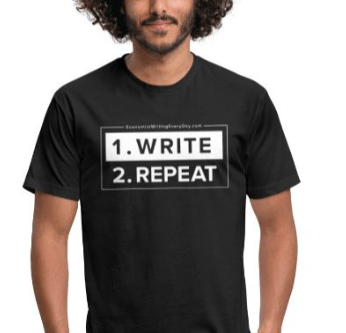
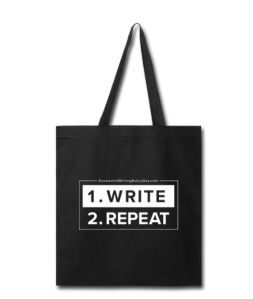
Write Repeat

We at EWED hope that we are creating quality ungated content to make the world a better place. This blog is also a commitment device to write more.

Everyone expects that the only way to get better at running is to run. Not everyone realizes that writing more makes you a better writer.

As a reminder for myself to write, I created an EWED design line in the same store that I posted about yesterday.

Black T-Shirt

Tote bag for all your pens and notebooks.

There a a few other styles and iterations at the store.

The Epsilon Delta Sorority

When I was a first-year graduate student in an economics Ph.D. program, I was taking a class we called Math Econ (taught by Dr. Omar Al-Ubaydli, at the time). I also was lucky to be renting a house along with several other women in the same program. For a few weeks, our group study sessions featured epsilon and delta.

Like many aspiring economists, I had taken Real Analysis at my undergraduate institution to bulk up on math skill and impress the admissions committee.*  

I never had a chance to join a sorority as an undergraduate student. It does look fun to walk around wearing a Greek code that is only fully understood by other members of a club. So, in grad school, I wanted to make shirts for what I called our “epsilon delta sorority”. We had Greek letters and a sisterhood (brotherhood). There are lots of women and men who are in the epsilon delta sorority.

It only took a decade for me to realize my dream. I have created shirts and shipped them to the girls I lived with. So more people can join, I created a store: https://shop.spreadshirt.com/economist-writing-every-day/

Here’s me wearing a t-shirt for women

Here’s a version for men

We have accessories, too. Why not? Life is too short to not put this on a mug. Someone already told me they want to give this to their daughter, so I added kids’ sizes.

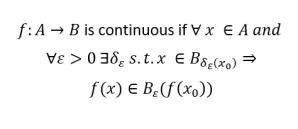
I pulled out an old paper from my Math Econ course binder for this post. Here is something I had written for the class:

*If you are looking for an introduction, try Khan Academy. Taking Real Analysis before you get to an economics Ph.D. program is helpful, although not always necessary. Multivariable calculus is more practical than Real Analysis and used on a more routine basis for economists. Some subfields require more formal proofs than others.

The Top Shot Blockchain Phenomenon

Samford Business student Wes Crane writes: Remember when people used to buy and sell physical sports trading cards? Recently the NBA has partnered with Dapper Labs, a company that specializes in blockchain (the same technology used for Bitcoin and Ethereum), to create and sell a digital art form of non-fungible tokens, or “NFT”s, that contain video clips of highlight moments which can be traded online at https://nbatopshot.com.

Continue reading

Current Research on the Gig Economy – Palagashvili

Online platforms are allowing us to trade used goods more easily than before. Similarly, sites like UpWork and Uber are making it easier to trade small blocks of human labor. Since the gig economy is growing (as documented by Dimitri Koustas), it’s important to understand how it is affecting workers.

Liya Palagashvili of Mercatus has a working paper with Paoula Suarez “Women as Independent Workers in the Gig Economy” examining particularly how the growing opportunities to work on a gig basis has affected women in different ways than men. They note, for example, that (in 2014–2015) 87 percent of independent workers on the Etsy platform were female, while 14 percent of workers on Uber’s platform were female.

Abstract: New technologies and digital platforms have ushered in a rise of gig, freelance, contract, and other types of independent work. Although independent workers and the gig economy as a whole have received plenty of attention, little research has examined the heterogeneity of work characteristics among different independent work opportunities, specifically as it relates to the participation of women in this workforce. Existing data indicate that some digital platforms are more male dominated, whereas others are more female dominated. What accounts for these differences? In this paper, we empirically examine the heterogeneity of work within independent work opportunities in relation to female participation by analyzing work characteristics in the United States from the Occupational Information Network (O*Net) database that reflect greater temporal flexibility, which has been shown to vary across occupations and to attract more female workers. Our findings suggest that women in the independent work context do self-select into the types of independent work jobs that reflect greater temporal flexibility, as is the case for women working in traditional employment. However, our findings also reveal that the way in which the existing literature measures temporal flexibility in traditional work settings may not be the same as the way it is measured in the context of independent work. We discuss the implications of our findings for public policy and labor laws. (emphasis mine)

Current Research on the Gig Economy – Koustas

Dmitri Koustas of U. Chicago has a forthcoming paper “Is New Platform Work Different than Other Freelancing?”

Abstract: The rise of freelance work in the online platform economy (OPE) has received considerable media and policy attention in recent years, but freelance work is by no means a new phenomenon. In this paper, we draw on I.R.S. tax records to identify instances when workers begin doing online platform work versus other freelance/independent contractor “gig” work for firms. We find gig work occurs around major reductions in outside income, and document usage over the lifecycle. Our results provide suggestive evidence on motivations for entering into each type of work. (emphasis mine)

His work was cited in the LA Times last year

people take on this work primarily because they’ve lost a job or some of their income — and particularly for younger workers, app-based services have been significantly more lucrative than more traditional side hustles.

I got to (virtually) talk to Dmitri Koustas, who is now a leading expert on gig work, this week. He became interested in the gig economy when he was thinking through a more traditional econ. question of generally how people modulate their labor supply in response to income shocks.

He also has a working paper “Is Gig Work Replacing Traditional Employment? Evidence from Two Decades of Tax Returns”

First half of the Abstract: We examine the universe of tax returns in order to reconcile seemingly contradictory facts about the rise of alternative work arrangements in the United States. Focusing on workers in the “1099 workforce,” we document the share of the workforce with income from alternative, non-employee work arrangements has grown by 1.9 percentage points of the workforce from 2000 to 2016. More than half of this increase occurred over 2013 to 2016 and can be attributed almost entirely to dramatic growth among gigs mediated through online labor platforms. We find that the rise in online platform work for labor is driven by earnings that are secondary and supplemental sources of income. Many of these jobs do not show up in self-employment tax records… (emphasis mine)

R.I.P. Borders

An analytics textbook is usually full of success stories (i.e. XYZ Corp. invested in a data warehouse and everything got better). I decided that my students needed to hear a downer for balance. What better example than Borders?

Borders was a fixture of suburban New Jersey in the 90’s. You could browse books or media and get coffee there. When I asked undergraduates in 2018 if they remember Borders, I learned how far south Borders had expanded (to Nashville, but not to Birmingham).

Never fear. All of my students knew the Kanye West song “All of the Lights”. The lyrics are:

Continue reading

Blood Clots for You and Me

On April 13, 2021, CDC and FDA recommended a pause in the use of Johnson & Johnson’s Janssen COVID-19 Vaccine. When I first heard that the FDA was pausing the J&J vaccine because of less than 10 blood clots out of millions of patients, I thought I’d really get to the bottom of blood clots and blog about it. Other people (some of them are the kind of doctor that helps people) have already done a pretty good job in the past few days.

First, it is a tragedy that the vaccine is not being give to every male over 50 who wants it. Doing so would free up many thousands of other types of vaccines for young women.

Continue reading