Dale Carnegie wrote a famous book called How to Win Friends and Influence People. The title suggests that the more friends you have, the more influence you have.
Something I have seen from many friends since 2016 is messages about how they are cutting off ties with anyone on the political right.
Bad far-right actors mobbed the US Capitol last night. The violence scared me, and it scared people around the world who want to believe in the American Dream. After the traumatic attack, I saw one of my Facebook friends making the statement again last night.
Like most Americans, I am a Facebook user. I learn from keeping many “friends.” I understand that many of them are not actually friends providing emotional support to me, but I get to see lots of heartfelt statements from both sides of the political divide. This helps me understand how statements from media figures are landing with the public.
I’m currently working on understanding the gender gap in tech careers. Here’s a paper published in 2016 about a survey conducted in 2011. They found that male students reported more time on the computer for leisure. However, if they asked about computer use for school activities, there is no gender difference. The question remains as to how much one’s leisure time and subjective attitudes affects one’s ability to take a high-income software engineering job.
Abstract: This study responds to a call for research on how gender differences emerge in young generations of computer users. A large-scale survey involving 1138 university students in Flanders, Belgium was conducted to examine the relationship between gender, computer access, attitudes, and uses in both learning and everyday activities of university students. The results show that women have a less positive attitude towards computers in general. However, their attitude towards computers for educational purposes does not differ from men’s. In the same way, being female is negatively related to computer use for leisure activities, but no relationship was found between gender and study-related computer use. Based on the results, it could be argued that computer attitudes are context-dependent constructs. When dealing with gender differences, it is essential to take into account the context-specific nature of computer attitudes and uses.
Dan Wang is a writer who currently lives in Beijing. He’s released another long letter about what is going on in China. I’ll share the part that caught my attention.
Waiting politely in line is a pretty strong norm in America. I had heard from several sources that Chinese norms for waiting in an orderly line were weak. Here’s an update on that:
And for years, Xi has emphasized following clear rules of written procedure, under the rubric of “law-based governance.” Since then, the state has improved regulatory systems, for example in setting clear standards for license approvals and in securities and antitrust regulation. The state has removed some of the arbitrary aspects of governance, thus bringing serious enforcement actions following the passage of relatively clear regulations. That has improved facts on the ground. Companies and lawyers tell me that a decade-long effort by the State Council to ease doing business has yielded real results. Obtaining business licenses no longer requires a relentless pace of wining and dining, and has instead become close to a matter of routine. I haven’t been able to verify this fact for myself, but one of my friends told me that the office of the National Development and Reform Commission used to be ringed by some of the fanciest restaurants in Beijing, offering mostly private rooms; many of these restaurants have now closed, following the professionalization of business approvals.
The lived experience of being in Beijing has improved in parallel. I remember what a nightmare it was to buy a high-speed rail ticket for the first time years ago, which involved lots of yelling and multiple people cutting in line. Today, I purchase one on my phone, with no need to obtain a paper ticket, and the lines to board are more or less orderly.
China is changing.
Incidentally, I tried to start a company when I was about 19 in New Jersey. Applying for a tax ID number for my sole proprietorship was quick and easy. All I had to do was fill out a form and pay a small fixed fee to some government office.
EWVED could be our new name. Americans worked so hard to develop a vaccine (here’s Jeremy’s ode to development) and now we are seeing the distribution become painfully slow.
This is outrageous. Maryland has only administered 17% of the available vaccine doses and Gov. Hogan is blaming OWS for not delivering enough! And for not providing logistical and financial support for local departments.
Today is the last Sunday of 2020. The disruption to employment and rise of remote work might be the bigger story of 2020. However, for a significant fraction of Americans, 2020 is also the year their ability to meet as an in-person church was curtailed. Gathering in a room with many people singing is an efficient means of spreading the virus. For some, church has been an online-only experience since March.
Social scientists are interested in religiosity. Christian devotion has often been measured by asking how many times a person goes to church.
My colleagues who study the economics of religion will have an important issue to study. How does the switch to online church in 2020 affect Christian engagement in the future? How will this affect our ability to track long-term trends on religiosity?
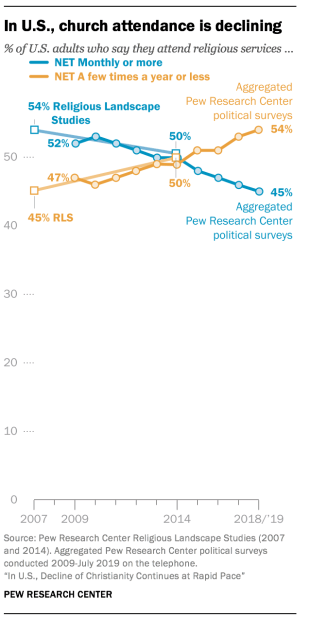
If it is true that large gatherings are safe in a year from now, it will be interesting to compare in-person church attendance in 2022 to 2019. If it turns out that attendance has decreased, then we would need to see a break in the trend to conclude that Covid is the cause. Here’s a graph of church attendance in an article from B.C. (Before Covid).
A book that was published in the 1950s made it sound like, even then, people who attended church weekly were in the minority. Joy Davidman published Smoke on the Mountain in 1953.
The inspiration for this post was reading this line about “remote” church experiences:
Others, instead of stirring their stumps, listen in comfortable living rooms to a sermon on the radio, arguing that it is “just the same.” They have forgotten that one of the first necessities of a Christian life is a congregation…
Overall, Davidman is disappointed in how few of her American countrymen attend church. Early in life, she was a militant atheist. She’s a Christian at the time of writing, but still somewhat militant.
Davidman frowns on radio church, when in-person church was available. However, virtual church today is closer to the traditional visual church experience. Going forward, it will be important to consider whether people who use the internet for church experiences should get counted.
Here are some examples of what churches have been up to, virtually:
Larger churches have been podcasting and Youtube-ing for years. One of the top productions is Bethel Church of Redding, CA. They even already had their own Bethel.tv ecosystem, so shutting down in-person services for Covid probably coincided with an increase in viewership for them.
What to do on the Monday before Christmas? My 5-y-o son was beginning a long winter break from school. Thanks to Covid, we were home all day. I wanted my son to do a few chores and some learning.
There were some fun activities I knew we would end up doing that day, such as playing chess and letting him watch some TV. One option would have been for me to order him around all day. If he balked at cleaning up his room, I could threaten to withhold TV. Instead, I made a jar of activities written on slips of paper.
He picked papers out one at a time. The only rule I imposed was that he would do that activity immediately. If he drew tidying his room, then we went straight to his room. Mixing in papers that read “30 minutes of TV” and “pick a snack to share” made the game seem fun. He would have ended up watching TV anyway. I included a paper in the bowl that said, “give Mommy a compliment.” Everyone needs some affirmation!
This tactic was so successful that it got me thinking about how adults, including myself, could benefit from something similar. Adults need structure. I contemplated whether I would want someone to put all my activities for the day in a jar. Something I have done and even paid for is to go to a gym and have a fitness instructor tell me what to do for an hour.
One reason the jar game worked is that my son could not do all the fun activities first before the more unpleasant tasks (i.e. math worksheet). Almost every successful writer says that they write first thing in the morning. They don’t procrastinate.
If you’d like to hear from a real live human who actually does the writing scheduling thing, you can listen to Jennifer Doleac’s recent interview on The Hidden Curriculum podcast. She really does the thing! No wonder she’s so amazing and professionally successful. (She’s also generous with her time and supportive of young scholars.)
I think many of us could think of an excuse for not scheduling every hour of our work days a week ahead of time, as she does. I feel like I have excuses, but I also bet I could get closer. A great book on productivity is Deep Work. Something I took away from that book is that, even if you can’t go full Doleac, every person can do better.
The author, Cal Newport, points out something we all know by now: constantly checking email and social media eats up your day and reduces productivity. After arguing that it’s optimal to block out hours for exclusive intense focus, Newport deals with the objection that some people need to be accessible to others throughout the day. A manager or teacher needs to read and respond to emails promptly. Newport’s response was something like “Ok. However, you can probably check your email LESS frequently than you currently do.”
The New Year is coming. Let’s try again. Let’s try harder. I want to waste LESS time than I currently do. And I’ll so some more of the surprise jar game with my son.
One of the many things I meant to do and did not have time for this Fall was a photo study of the political signs in my neighborhood. I did snap a few pictures, such as this one of a conservative house:
The next one is not a Biden/Harris sign, but they are supporting the Democrat senator Doug Jones.
The Biden signs far outnumbered the Trump signs. It’s a safe assumption that most Trump voters did not put out signs.
Tonight, you cannot tell which households supported which candidate. I think my election photo journalism failure might actually turn into a different story. Observe this street
Something CUTE that my Alabama neighbors do is put up an outdoor Christmas tree with white lights, like so:
When you drive down a street past dozens of these in a row, the effect is wonderful (and hard to capture adequately with my phone camera). It’s neither a political statement nor an anti-political statement. It’s a community that thrives despite their differences. This is something beautiful they do to enjoy together.
Like many neighborhoods, we also have “that house”:
Forget “The Christmas Prince” or “The Prince Christmas” or whatever is on Netflix. Why not spend your holiday refreshing this new vaccine dashboard?
Here’s the announcement:
Launching a new dashboard to track local news reports and state press releases on how many vaccine doses will be allocated to each state, since there seems to be no public federal effort. Browse each state's allocations and a map of doses per capita.https://t.co/CUP2W2ph7X
I personally know a few health care workers who got their shots (do not say “jab” to me) this past week. It’s all very exciting! Here at University of Alabama at Birmingham (UAB), the medical community has freezers, fortunately.
Jeremy and Doug have both talked about allocation this week. Economists get really jazzed about allocating scarce resources. It’s been frustrating to watch first tests and now vaccines not be available on a market. Excellent points are also made every week over at Marginal Revolution on how we are missing an opportunity to get the incentives right. Supply. Curves. Slope. Up. (Thousands. Dying. Every. Week.)
I’m relatively new to Birmingham, Alabama. I was nervous about moving to a place with famously long hot humid summers. My intuition since moving here is that there are many days throughout the year when, at some point in the day, the weather is nice for doing something outside with my kids.
Yesterday, Sunday, was very nice. To have such a nice warm sunny day in mid-December is strange to me. I grew up further north where Decembers are chilly. Here is a picture of a neighbor’s son enjoying the summer-like feel of this technically-winter day. This picture was taken at noon.
Although I am grateful for this particular day, I also think about the hot summer days when noon is a time to hide indoors with air conditioning. Is it nice here? How can that question be answered scientifically?
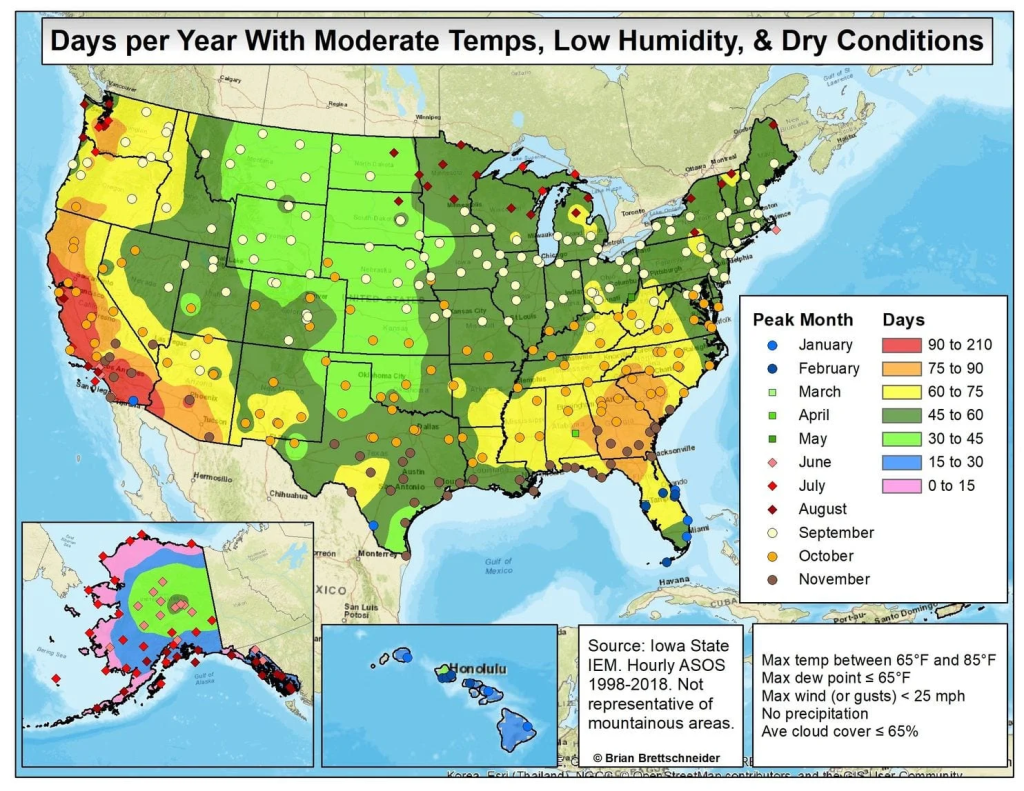
There is actually a great map of answers, available on several websites, credited to Brian Brettschneider, thanks to data from Iowa State.
This map confirmed my intuition. My old life in New Jersey was in the dark green zone, and my new life in Alabama is one level better, in terms of how many “nice” days you can expect in a year.
If you don’t have climate control, then you might be more worried about weather extremes. If you are lucky enough to have a regulated indoor environment, then a nice place to live is largely a question of how many days you get when it’s nice to “go out”.
This map accounts for “nice days”. I wonder if New Jersey would seem closer to Alabama if the measure changed to “nice daylight hours”. Yesterday was beautiful, but it was dark by 5pm. When I get time, I’m going to make a map of where in the lower 48 you can enjoy dinner outside after work many times per year (and why is it Southern California?).
In the course of research work, I read “Sticky Prices as Coordination Failure” today, published in 1991 by L. Ball and David Romer.
They suggest that “coordination failure is at the root of inefficient non-neutralities of money”. They write an elegant theory of price setting and adjustment that includes a menu cost. A menu cost is imposed on an individual who adjusts prices. The name comes from the fact that some restaurants face a literal cost for switching the paper menus.
If changing prices is costly then there is inertia. People tend to stay where they were before, even if adapting to fluctuating external conditions is more efficient.
According to their model of rational individual agents, people will change if the expected benefit of adjustment is larger than the menu cost. In some cases, the optimal action for an individual depends on what others are doing. Thus
Increases in price flexibility by different firms are strategic complements: greater flexibility of one firm’s price raises the incentives for other firms to make their prices more flexible. Strategic complementarity can lead to multiple equilibria in the degree of nominal rigidity, and welfare may be much higher in the low-rigidity equilibria.
An implication is that if you are surrounded by people who are open to constantly changing, then you yourself will be more likely to adapt. The world is always fluctuating, so welfare is higher for communities that can adapt quickly. Example of changing circumstances include global warming and novel safety procedures suddenly needed during the time of Covid.
In this paper, “multiple equilibria” means that a community might settle at a high-wealth level or a low-wealth level simply because of what everyone else is doing. Ball and Romer don’t try to figure out which equilibrium is more likely to be the outcome in reality.
No one in their model would be out of equilibrium (unnecessarily poor) if it were not for the “sticky” prices. As the title implies, coordinating the optimal levels of production and consumption is difficult because of the inertia of prices.
In their conclusion, they reflect on the role of government when multiple equilibria are possible:
… with multiple equilibria, policy can be less coercive. Instead of prohibiting certain contract provisions, the government could simply convene meetings of business and labor leaders to coordinate adjustment … Second, by moving the economy to a new equilibrium, temporary regulations can permanently change the degree of nominal rigidity.
They assume that after a recession, the price adjustment that needs to happen is “for decentralized agents to reduce nominal wages in tandem.” It’s interesting to see, culturally speaking, how hesitant they seem to strongly recommend government intervention through inflation. I feel like writers in econlit today would not be shy about saying they think governments should intervene through monetary policy, if they believe that to be true.
In my JEBO paper, I found that a little inflation caused workers to not lower production so much in response to a real wage cut after a recession. In our environment, I would say “cooperation” was more important than “coordination”, because there were only two agents and their decisions were sequential.







 Economist Writing Every Day