China Cracks Down on Cryptocurrencies

The Chinese Communist Party (CCP) is all about control. In the well-known words of Chairman Mao:

Every Communist must grasp the truth, “Political power grows out of the barrel of a gun.” Our principle is that the Party commands the gun, and the gun must never be allowed to command the Party.

These days political power is linked to economic power and control of information, as well as raw military firepower. Cryptocurrencies have assumed financial importance and they entail information processing and tracking.

On the other hand, a key driver for cryptocurrencies is precisely to escape from the domination of big central authorities, such as the CCP. Proponents of crypto revel in the fact that anyone with a PC can get in on “mining” and that the crypto universe does indeed operate on the web as a largely democratized enterprise. Anybody can transact large sums with anybody, with a moderate degree of anonymity.

These two different visions of life collided on Sept. 28 when the Chinese government banned nearly all crypto-related transactions:

China’s central bank said on Friday that all cryptocurrency-related transactions are illegal in the country and they must be banned, citing concerns around national security and “safety of people’s assets.” The world’s most populated nation also said that foreign exchanges are banned from providing services to users in the country.

In a joint statement, 10 Chinese government agencies vowed to work closely to maintain a “high pressure” crackdown on trading of cryptocurrencies in the nation. The People’s Bank of China separately ordered internet, financial and payment companies from facilitating cryptocurrency trading on their platforms.

The central bank said cryptocurrencies, including Bitcoin and Tether, cannot be circulated in the market as they are not fiat currency. The surge in usage of cryptocurrencies has disrupted “economic and financial order,” and prompted a proliferation of “money laundering, illegal fund-raising, fraud, pyramid schemes and other illegal and criminal activities,” it said.

Offenders, the central bank warned, will be “investigated for criminal liability in accordance with the law.”

The Chinese government will “resolutely clamp down on virtual currency speculation, and related financial activities and misbehaviour in order to safeguard people’s properties and maintain economic, financial and social order,” the People’s Bank of China said in a statement.

Well, those are the bare facts. It’s good to know the CCP is so diligently safeguarding people’s assets and public order. And as noted, Mao’s successors would not naturally favor systems that allow people to just do what they want to do, free from guidance from the Party. But inquiring minds want to know or at least speculate further regarding the reasons for this move and its consequences.

Brian Liu and Raquel Leslie highlighted two other motivations for this crackdown. One motivation  concerns China’s desire to launch its own state-controlled digital currency. This will give the government heightened ability to track every single transaction by every single user. It would also provide China with a new means of exerting influence over other nations and corporations:

The ban comes as the People’s Bank of China (PBOC), China’s central bank, is piloting its own digital currency, the eCNY or “digital yuan.” Unlike private cryptocurrencies, the eCNY is issued directly by the central government and is being designed to provide the PBOC with near-real-time financial data on user transactions. Some observers fear that the eCNY will be used as a tool to strengthen the Chinese Communist Party’s domestic surveillance. Others worry that the eCNY will be used to retaliate against international companies that speak out on human rights issues. Fan Yifei, a deputy governor of the PBOC, announced last week that the eCNY has entered a “sprint stage” ahead of the February 2022 Winter Olympics in Beijing.

Another motivation may be to help prevent wealthy Chinese from taking their money abroad:

The crypto ban may also be intended to deter capital flight. Despite past crypto crackdowns and strict capital controls, wealthy Chinese have used cryptocurrencies to funnel more than $50 billion overseas in 2020. As China is in the middle of an economic slowdown that has been exacerbated by other regulatory crackdowns on the tech and education sectors, China may be redoubling its efforts to ward off skittish entrepreneurs from exporting their money overseas.

Will this crackdown fully succeed? Many observers doubt it. They think that people will find ways to do what they want to do, using platforms that are hosted outside China.

As for the digital yuan, well, it kind of goes against most of the reasons people have gravitated to crypto. It represents a move back to government control and surveillance. It is not really a “crypto” currency at all, but simply another form of regular money.  It could get traction, however, in international trade among countries who have reasons to try to escape from the current U.S. dollar dominance. Also, China could hand out its digital currency like candy to impoverished nations, to get them on board. Millions, maybe billions of people live without regular banking access, and so a medium of exchange and store of value that requires only a cell phone to move funds around town or around the world could be attractive. At any rate, count on China to make the digital yuan a big “thing” for international visitors due at the February 2022 Olympics.

The price of Bitcoin took this news in stride. It continues to bounce around in the same $40,000-$50,000 range that it has been in for the past three months. And being banned by China is not a death-knell for a financial entity.  Indeed, it could be a contrarian indicator. Consider that China has also banned Youtube, Facebook, Google, Instagram, Pinterest, and even (because of his uncanny resemblance to President Xi) Winnie the Pooh.

Europe Natural Gas Shortage: Factories Shut, Maybe Worse to Come

Shut down your old reliable coal and nuclear power plants. Replace them with wind turbines. Count on natural gas fueled power plants to fill in when the breeze stops blowing. Curtail drilling for your own natural gas, and so become dependent on gas supplied by pipeline from Russia or by tankers chugging thousands of miles from the Middle East. What could possibly go wrong?

That is what Europe is discovering now as natural gas prices have quintupled, taking electricity prices up with them. Europe is having a hard time finding enough gas supply to fill up storage facilities to get them through the winter. If consumers are prioritized, widespread industry shutdowns are possible if there is a cold winter. Prices for many things will rachet up, with implications for inflations and in turn for central banks’ response to inflation. (The Fed’s Powell has been talking down the current inflation as merely transitory).

 In the UK, energy companies are going bankrupt because the wholesale price that at which they purchase gas is higher than the government-mandated cap on gas price they can charge consumers. Plants which use natural gas as a feedstock like fertilizer plants are shutting down, which impacts farmers. Carbon dioxide is a byproduct of some of these operations, and the resulting shortage of CO2 is affecting meat-packers who use it in their operations. Indeed, a food producer has warned that the Christmas dinner could be “cancelled.” That’s just how bad it is. The Brits are even delaying the shutdown of the country’s largest remaining coal-burning power plant.

Jason Bordoff of the Columbia Climate School and the Center on Global Energy Policy just published a long article giving his perspective on all this. He identifies several contributing factors:

( 1 ) Cold and hot weather affected gas consumption this year. Winter in much of the Northern Hemisphere was unusually cold earlier this year, which boosted gas demand for heating. And then a hot summer consumed more gas to make electricity for air conditioning. 

( 2 ) Other sources of electricity have been hampered. “Wind generation in Europe has been far below average this year due to long periods of less windy weather. …Demand for fossil fuels is set to spike further as Germany takes another three nuclear reactors off the grid this year as part of its nuclear shutdown. Meanwhile, drought conditions in China and South America have led to reduced hydropower output, drawing supplies of globally traded gas into those markets instead.”

( 3 ) The post-COVID economic recovery has boosted industrial demand.

( 4 ) Russia has restricted gas deliveries to Europe though the existing pipeline that runs through Ukraine. (Many observers see this as a pressure tactic to get Europe to switch over to a northern pipeline route, which would then remove the importance of Ukraine for Russian gas marketing, which would then give Russia a freer hand to resume military harassment of that country.) Also, European countries have restricted their own gas production. The Dutch are curtailing the production rate at their big Groningen gas field because local residents fear earthquakes from ground subsidence, and the Brits have restricted fracking of promising gas fields due to public protests.

As might be expected in our interconnected world, the European supply crunch has affected U.S. prices, which are at their highest level in five years. America exports gas via liquified natural gas (LNG) tankers, but U.S. gas supplies so far have not responded much to the price increase. The hostility of the Biden administration and pressure from green-leaning investors has discouraged petroleum companies from expanding drilling.

Meanwhile, California is running its own experiment in green energy  adoption:             

California, for example, is having trouble keeping the lights on as it rapidly scales the use of intermittent solar and wind power. It recently requested an emergency order from the U.S. federal government to maintain system reliability by, among other actions, allowing the state to require certain fossil fuel plants scheduled to retire to stay online and by loosening pollution restrictions. California is also proposing to build several temporary natural gas plants to avoid blackouts, even as the state shuts down the Diablo Canyon nuclear power plant, which produces more zero-carbon electricity than all the state’s wind turbines combined.

Professor Bordoff notes that “Many projections for how quickly and how much clean energy can be scaled are based on stylized models of what is technically and economically possible”, and unsurprisingly calls for policies which mitigate volatility, e.g., “…regulatory and infrastructure policies can facilitate more integration, flexibility, and interconnectedness in the energy system—from power grids to pipelines—so there are more options to pull energy supplies into a market when needed.”

Oh, and this restatement of the obvious:  

Uncertainty about the pace of transition may lead to periodic shortfalls in supply if climate action shutters traditional fossil fuel infrastructure before alternatives can pick up the slack—as may be starting to happen in some places now. And if fossil fuel supply is curbed faster than the pace at which fossil fuel demand falls, shortfalls can result in market crunches that cause prices to spike and exacerbate existing geopolitical risks. In fact, this is what the International Energy Agency just warned is happening in oil markets—a striking contrast to what it said only a few months ago, when it warned that new fossil fuel supplies would not be needed if nations were on track to achieve net-zero emissions by 2050.

Me? After working through  all this material, I’m going to go buy me some shares of ExxonMobil, the largest natural gas producer in the U.S.

Likely Collapse of Chinese Real Estate Conglomerate Evergrande Roils World Markets

Nearly a year ago, on this blog we described the sequence of events that led to the Great Recession ( or “Global Financial Crisis”) of 2008-2009. The underlying problem was real estate-related debt: as inflated housing prices collapsed, many people couldn’t (or wouldn’t) pay their mortgages. Various financial dominos fell, but the one that gets singled out as the single most critical event was  the collapse of Lehman Brothers investment bank on September 15, 2008. The Dow Industrial average fell 504 points that day, and loss of confidence in the financial markets led to a freeze-up in credit, which was/is the lifeblood of business.

The likely bankruptcy of the gigantic Chinese real estate conglomerate Evergrande is being discussed as another possible “Lehman Moment”. It is hard to comprehend just how big this outfit is. It owns more than 1,300 real estate projects across China, directly employs 200,000 people, and is indirectly sustains some 3.8 million jobs. It got that big by borrowing (including selling bonds) and spending enormous amounts of money. The problem now is that it seems like it cannot service its $300 billion debt. Once things like this start to go bad, they often get much worse, quickly. Other parties stop wanting to do business with you, and it all goes downhill. (A famous reply in Ernest Hemingway’s The Sun Also Rises to the question, “How do you go bankrupt?” was “Gradually, and then suddenly”). The market prices on Evergrande’s bonds indicate that the market expects bankruptcy, with bondholders getting only about 25 cents on the dollar.

If this collapse materializes fully, a lot of investors will lose a lot of money, a lot of suppliers of building materials to Evergrande will not get paid and may go broke, and a lot of real estate development in China will freeze up for the time being.  Goldman Sachs estimates a 1-4% hit to China’s GDP, which is huge, and would reverberate across the whole world.

Wall Street seems to have been ignoring this drama, until yesterday (Monday). Blam, stocks fell around 2%, and were still headed south at the end of trading. Is this the start of The Big One? Well, that makes for dramatic commentary, but most observers seem to take a more nuanced approach. First, the all-powerful Chinese government could order the People’s Bank of China to “fix this”. We all now know that central banks have magical powers to create as much money as needed to, e.g., buy all outstanding Evergrande bonds at near-par. On the other hand, the Chinese government lately has been clamping down on speculation. So there may be some sort of compromise, a semi-orderly unwinding, with bondholders feeling some pain, but actual real estate operations being sold off and continuing under some other names.

Wall Street may be more worried about whether the Fed announced on Wednesday that it will take away the punch bowl by tapering of its bond purchases. The last time the Fed did that, in 2018, stocks took a long and hard tumble. Again, a range of outcomes is possible here.

Ironically, all these concerns, as long as they don’t really turn into something serious, may be a bullish indicator for stocks. Stocks are said to “climb a wall of worry”; it is when everyone is totally complacent that is a setup for a crash. Time will tell whether the Evergrande difficulties end up being part of  a bullish wall or a bearish cliff.

In States that Ended the Extra $300/Week Unemployment Benefits, People Returned to Work at Over Twice the Rate than in the Other States

Anecdote # 1. In June we stayed a couple nights in a motel in western Massachusetts. The proprietor was outside watering flowers and trimming shrubs. I asked about business. He told me, “Well, we are starting to get customers back, though we are still hurting. But my bigger problem is that I cannot find a single person who wants to come back and work. Between federal and state unemployment benefits, they are making $850 a week, which is over $21 per hour. Anybody can claim those benefits, you don’t even have to prove that you were laid off. I cannot match that money, much less beat it.  My wife and I are doing all the work. I don’t know how we will manage long term.”

I murmured something sympathetic, and opined hopefully that if these benefits run out in September, folks might come back to work. This area has been economically depressed for decades, and normally people would jump at any kind of job. He shook his head and said that the state benefits would continue, and that his key workers have told him that they have saved so much money from unemployment and stimulus funds (and perhaps being allowed to skip rent or mortgage payments due to federal “forbearance” laws) that they may never come back to work.

Anecdote #2. In July my wife and I went into a hardware store in northern Virginia to buy some stuff. The employees were helpful and efficient. My wife complimented them, and said something like it must be nice working in an environment where everyone seemed to have a good attitude. The clerk’s response was yes, but they were having to work more overtime than they really wanted. And why was that? Because  the other workers won’t come in, because they were making about as much money staying home on unemployment – – so why should they bother working?

Those are a few personal data points on the effects extending the big unemployment benefits. I have read numerous other anecdotes from small businessmen and women that they cannot operate as fully as they would like because they cannot get help. And really, anybody with eyeballs can see the Help Wanted signs everywhere today.

Deeper thinkers than I will have to tease out all the ramifications of this situation. In GDP growth terms, it seems clear that incentivizing people to not work is a bad thing. On the one hand, we could say, “Just pay the workers more and they will come”. That is fine, if a business can raise the prices it charges for its products to cover the added labor costs, but that can only go so far. What is more likely is that businesses will figure out ways to get by permanently with fewer workers. This may lead to higher nominal productivity per worker, but also more structural unemployment.

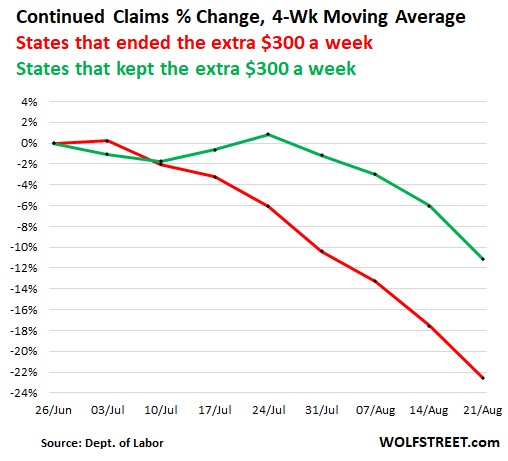
Without further ado, here are some data which may illuminate the extent to which extended unemployment benefits have kept people from working. The nation has been running a real time experiment over the past several months. 27 states (“red” states, as you would have guessed) stopped the extra $300/week benefits in June, while 23 states and DC retained them.

Wolf Richter has compiled some numbers on unemployment insurance (UI) claims by state, reported weekly by the Department of Labor. A data point of “continued claims” reflects the number of people that have claimed UI for at least one week. A drop in continued claims would indicate that they have started working again. He lumped the states into two groups, “Enders” who terminated the extra unemployment benefits, and “Keepers” who retained them. Here are the results through the end of August:

These results seem to speak for themselves. Far more people went back to work in the “Ender” states (32% vs. 14%).  Here are the same results, reported as four-week rolling averages for smoothing, though that introduces a time lag:

Richter quotes the Wall Street Journal to the effect that:

Economists at Goldman Sachs analyzed the behavior of workers in the July jobs report after adjusting for age, gender, marital status, education, household income, industry and occupation of a respondent’s current or prior job. They said they found “clear evidence that benefit expiration increased the rate at which unemployed workers became employed.”

Goldman Sachs estimated that if all states had ended benefits, July payroll growth would have been 400,000 stronger. Economists at the firm projected the nationwide benefit cutoff this month will account for 1.5 million job gains through the end of the year.

Richter notes that after the federal cutoff, some states will continue to offer the $300/week funded with leftover stimulus money, but he expects overall more people to report for work this fall. I think that is likely, but I am concerned that conditioning a lot of people to not work for 1.5 years may have given us a long-lasting step downward in the percentage of adults who are willing to work. Some other post, some other time, maybe I will explore how we saw that effect in the wake of the 2008-2009 Great Recession where again people got conditioned to getting by without working.

P.S. Zachary Bartsch’s recent post on this blog, Redesigning Unemployment Insurance, speaks to some of these issues of incentivizing people to (not) work.

Suggestions for Comfortable and Effective Face Masks, e.g., Korean KF94’s

With Covid cases and deaths surging despite widespread vaccinations, face masks are back in. Back in the dark days of early-mid 2020, all commercial masks of any kind were allocated to medics/first responders. Back then, the only mask option for the rest of us was to cobble together something made of regular cloth. But studies I looked at show that the protective performance of those cloth masks, and even standard rectangular surgical masks, is really quite poor [1].

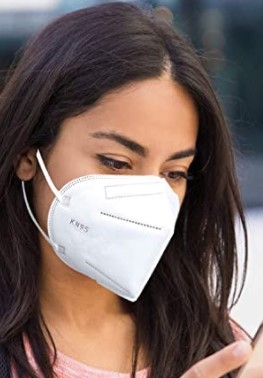
A cloth or surgical mask is definitely better than nothing, but is much inferior to other mask options which are now widely available. If you are going to bother with a mask at all, why not use a more effective one? A well-known effective mask is the KN-95. It has a kind of aggressive beak-like profile, as shown below, and typically uses elastic earloops. It gives good protection because it seals to the face (including around the nose, thanks to a malleable metal strip there) and is made of appropriate multi-layer filter materials. It is the standard protective respiratory mask in China, whereas in the U.S. the standard protective mask is an N95, with elastic straps that go around the whole head, not the ears.

Image Source: Amazon

I got a box of ten KF95’s back in June of 2020. I loved them – they were comfortable, worked OK with my glasses, and clearly sealed well to my face. However, I gave some of these away to family members, lost a few, and used the rest so many times so they started to lose their shapes.

There are lots of KN95’s for sale on Amazon, all made in China. Not all of these may be of the same quality. Some but not all of these brands were tested and approved by the FDA for emergency use; this article from March 2021 notes some of these brands that were for sale on Amazon at that time. It seems the approved Powecom masks are still for sale.

A problem with most of these Amazon KN95’s is that the earloops are painfully tight around the ears. I pored over the comments to try to select masks where at least some of the reviewers claimed the masks didn’t hurt. Alas, all my KF95’s are pretty much unbearable for a guy like me with maybe an oversized head. (I compared the length of their earloops with my original comfortable KF95, and indeed the earloops are clearly shorter on all the new ones).

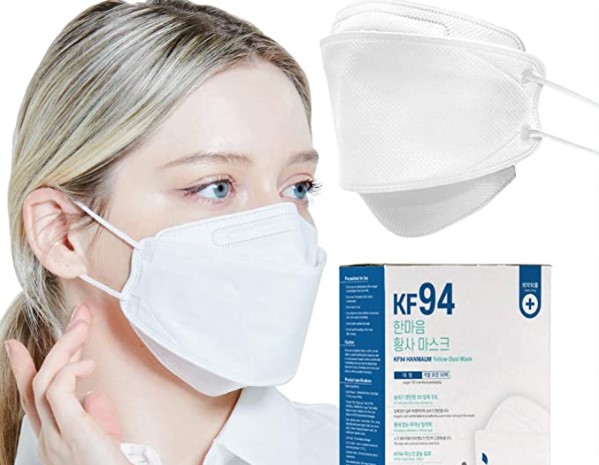
In the course of reading dozens of reviews of KN95 masks, I saw several comments recommending KF94 masks instead. These are made in South Korea. They are standard personal protective equipment in that country, and as such must meet certain standards for fine particle capture. They look a little different than most masks, but seem less beak-like than the KN95s. They have a flattish rectangular middle part which is the main filter, with two triangular sections that cover the nose and the chin:

Image: Amazon

So I got a box of KF94’s, large size, and they are wonderfully comfortable for me. No stress on the ears, and sealing over the whole face. The shape of the mask keeps it from rubbing on your mouth. The “Large” size I got was actually a tiny bit looser than felt optimal, so I tied tiny knots in the lower part of the earloops to shorten them a bit. My wife uses a mask extender strap (e.g., HX AURIZE Mask Extender Strap on Amazon) around the back of her head to pull the KF94 earloops a little tighter, with the added benefit that if she wants to take the mask off temporarily, it can hang around her neck via the extender strap. In sum, the KF94s are a win, and I highly recommend them.

I see on Amazon that small (for e.g. 7-12 year old children) and medium KF94 masks are also available. One caveat on buying is to make sure that you are buying from an actual Korean seller, else you risk getting an inferior Chinese knockoff.

Back to my unusable KN95’s. I know that you can use mask extender straps like the HX Aurize straps linked above, or similar homemade hacks, to go behind your head and take some of the direct pressure off the back of the ears. However, I found using a behind-the-head strap still put pressure on part of my ears, and was just an added complication. I thought, surely there must be some way to make those darned earloops simply longer. What I did for one mask was to cut the earloops close to the bottom of the mask, and tie in a small rubber band into each loop, to make them effectively longer. (I put a dab of glue on the cut ends of the earloops, to keep them from unravelling). That worked out well, so I can recommend this as a “hack”. I also see on Amazon that you can order ¼” wide white elastic ear loop type band material, and I think I will buy some. I can then take more of my tight KN95 masks, cut the existing earloops, and tie in an extra inch or two of this elastic to get the length right for my head size.

ENDNOTE

[1] Some studies on masks:

(A) https://pubmed.ncbi.nlm.nih.gov/32845196/  Kim, et al. 2020. They had seven Covid-inflected patients cough five times with various masks on, and with petri dish sitting in front of them to catch germs. A surgical mask did no better than no mask at all (3 out of 7 patients’ petri dishes got infected in both cases), whereas zero out of 7 patients’ petri dishes got infected for a full N95 respirator made by 3M (not a Chinese KN95) or for a Korean-made KF94 mask.

(B) https://www.acpjournals.org/doi/10.7326/M20-6817   Bundgaard, et al., 2020. Done in Denmark around April-June 2020. From 6000 participants, all of whom initially tested Covid-negative, half were randomly selected to wear standard surgical-type masks while in public and half to not wear masks. (These are the usual rectangular masks that do not seal tightly to the face). Incidence of Covid infection after about a month was assessed for each group. For mask-wearers, the infection rate was about 1.8% versus 2.1% for the non-masked group. According to the standard statistical definitions, this was not enough to show that wearing that type of mask gave significant protection against becoming infected. That said, the difference between the 1.8% and the 2.1% is compatible with a 46% reduction to a 23% increase in infection on 95% confidence intervals. Depending on how you want to slice the numbers, it seems fair to say that there may have been “some” effect of the masks here. Also, it should be noted that this study did not test whether wearing a surgical mask would help keep an infected person from spreading the disease (I suspect the answer to that would be “yes, sort of”).

(C) https://pubmed.ncbi.nlm.nih.gov/33087517/ Ueki, et al., 2020. They used two full size human mannequin heads, and tied masks on their faces. The “Spreader” head was piped to have a stream of covid-aerosol-laden air coming out of its mouth. The “Receiver” head had a pipe that pulled air in through its mouth and through a gelatin membrane filter to collect the covid viruses that made it through the masks. Some of the results are shown below. I am not sure how to summarize them accurately in a few words. Note that these plots are on log scales, so small visual differences in the bars are actually big (see the numbers at the bottom of the bars). It seems clear that the cloth (cotton) and the surgical masks blocked some virus spreading compared to no masks, but a full N95 mask was much more effective (the N95 was tested with its edges naturally resting on the contours of the mannequin face, and also “fit” with the edges sealed against the face with adhesive tape). A KN95 or KF94 mask was not tested here.

POSTSCRIPT

After publishing this POST, I noted Jeremy Horpedahl’s post from last week, suggesting that the costs of wearing masks may be worth it even if they give a 10-15% decrease in viral incidence. Jeremy referenced an article by Bryan Caplan who questions the trade-offs with wearing masks having only marginal effectiveness vs. the discomfort and the dehumanization of having people’s faces obscured. Caplan in turn referenced a survey of research by Jeffrey Anderson (August, 2020) which summarized many real-life randomized controlled trials with populations wearing/not-wearing masks (presumably the surgical kind, not N95/KN95/KF94 better-sealing types) which found generally no benefit to wearing these types of  masks in reducing the incidence of virus transmission. (These studies were mainly pre-Covid, dealing with SARS and other viruses). This overall result is roughly consistent with the Danish study mentioned above, which did not find a significant difference for using those types of masks to protect from viral infections.

Lightning Strike Out My Back Door

I know the Big News at the moment is how to evacuate people from Kabul who should have been evacuated weeks ago; as with Vietnam fifty years ago, there never was realistic hope that the U.S. backed regime could withstand an utterly determined foe without our military support. I am old enough to remember the frantic Vietnamese trying to cling to the last helicopters leaving the roof of the U.S. embassy in Saigon, because again the American authorities did not evacuate in time. But I have nothing special to offer on this topic except deepest sympathies for all the poor Afghan progressives who will be rounded up, killed or (if they are lucky), “reeducated” by the Islamic fundamentalists. And who knows what the thousands of Al Qaeda aligned operatives, captured at the cost of thousands of American soldiers’ lives, will do now that they have been freed from detention.

So, shamelessly turning inward – – a couple of nights ago during a thunderstorm we heard a loud crack of thunder which was simultaneous with a bright flash of lighting. Either our house or some nearby tree had been struck. I stuck my head out the window to look for fire, but saw none.

Later, we saw long vertical rips in the bark of a pine tree right beside our row of houses. I’ll share photos below. Here is what we see from the house side. There are vertical rips in the bark near the base of the tree, and also visible going up about 30 feet to a fork in the trunk. I could not see any marks or broken branches above that.

On the far side of the trunk at the base there was an even wider gash, with shredded bark on its sides, and also trench in the ground extending away from the tree. Presumably the lighting instantly boiled the moisture in the bark and dirt, and the sudden steam made the bark and soil explode.

Since it does not take much of an electrical jolt to paralyze your diaphragm, these markers of the lightning strike are a good reminder as to why we are advised to NOT stand under a tall tree during a thunderstorm.

Liquid Smoke Flavorings Give Less Carcinogens Than Smoked Meat and Fish

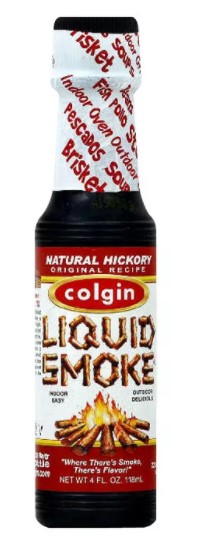
Someone forwarded me this article by Superfoodly, Is Liquid Smoke Flavor Safe or Cancer in a Bottle? This article seems to have useful health information. I will unpack the physical basis for this below, but the key takeaway is:  smoked foods (i.e., have been exposed to actual smoke) like smoked turkey, and especially fatty meat/fish like salmon, have appreciably more carcinogens than food flavored by “liquid smoke” type flavorings.

Continue reading

Air Fryer: Redundant, Self-Indulgent Counter-Space-Waster?

While we were all imprisoned at home in 2020, we turned to eating food, and preparing food to eat in order to occupy and comfort ourselves. People baked bread for the first time in their lives. When yeast in the stores ran out, the internet was alive with tips on how to get sourdough cultures started. And a lot of air fryers were marketed and bought.

The premise of air fryers seems unassailable: quickly circulate very hot air (up to 450 F/230 C) to get that delicious fried crispiness with minimal oil, and get it in minutes with minimal fuss and cleanup. Since we had an offer of getting an air fryer at a discount, I consulted my wise friend, the internet. I wanted to love air fryers, but it seems they don’t cook much differently than a modern countertop convection toaster/oven (“turbo broiler”). There are some space-age-looking air fryers with a more slender, curvaceous profile which has a somewhat smaller footprint than a rectangular turbo broiler, but the capacity is typically only enough for one person or a couple with modest appetites.

Continue reading

Why is the COVID Delta Variant So Infectious?

The “delta variant” of COVID-19 is far more virulent than the original strains, and is largely responsible for the recent surges in COVID cases in the U.S. and worldwide. Centers for Disease Control and Prevention Director Rochelle Walensky told the Senate on July 15  that the delta variant now makes up 83% of U.S. cases, up from 50% at the beginning of this month. It was first detected in India, then spread to the U.K. and the U.S., and around the world.

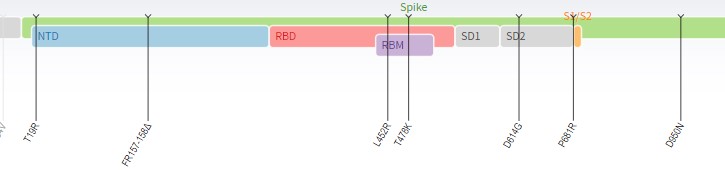
What is it that makes the delta variant so infectious? From a molecular point of view, here are the known functional mutations in the DNA that produces the “spike” proteins in the virus which bind to human cells:

Source: Stanford

Four of these mutations in particular are believed to contribute to the virulence of this strain, as discussed here. Among other things, they can cause the spike protein to bind more strongly to our cells, and inhibit our immune response. See here for 3-D model of the virus spike binding to human receptor, showing the locations of those mutated proteins.

As a result of those mutations the delta variant grows faster inside people’s respiratory tracts and reaches much higher levels. Per NPR,

On average, people infected with the delta variant had about 1,000 times more copies of the virus in their respiratory tracts than those infected with the original strain of the coronavirus, the study reported.

In addition, after someone catches the delta variant, the person likely becomes infectious sooner. On average, it took about four days for the delta variant to reach detectable levels inside a person, compared with six days for the original coronavirus variant.

… People who have contracted the delta variant are likely spreading the virus earlier in the course of their infection.

How can we stop it? It is pretty simple:  get vaccinated (or never be in a closed space with other unvaccinated humans). Vaccines don’t totally prevent you from getting COVID initially, so you might still have early symptoms and also be able to spread the virus to others for a few days. However, vaccines are highly effective in helping your immune system to quickly shut down any infection you do get before the symptoms get severe. This is true for all for essentially all strains of COVID, including delta.

Again per NPR,

Preliminary data shows that in some U.S. states, 99.5% of COVID-19 deaths in the past few months were among people who weren’t vaccinated, said CDC director Dr. Rochelle Walensky at a White House press conference in early July.

And 97% of those currently hospitalized with COVID-19 are unvaccinated, according to Walensky.

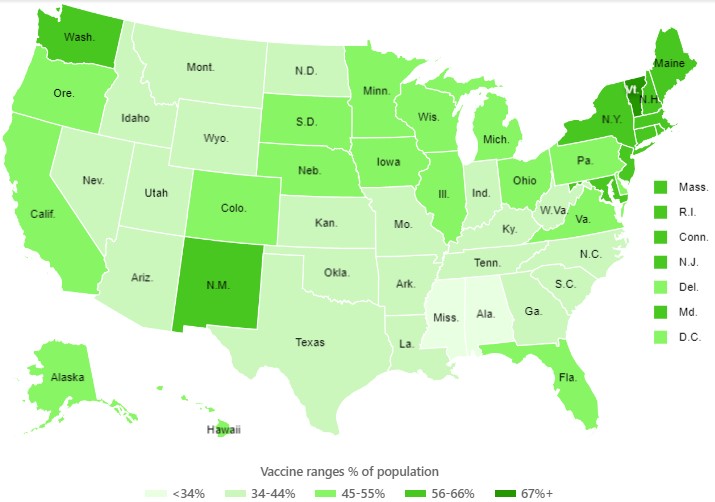
Just compare the two maps below of which American states have high/low vaccinations and high/low COVID incidence, and draw your own conclusions:

Percent Vaccinations. Image source: ABCnews

COVID Case Density. Image source: ABCnews