1970’s SNL on the Problem of Inflation

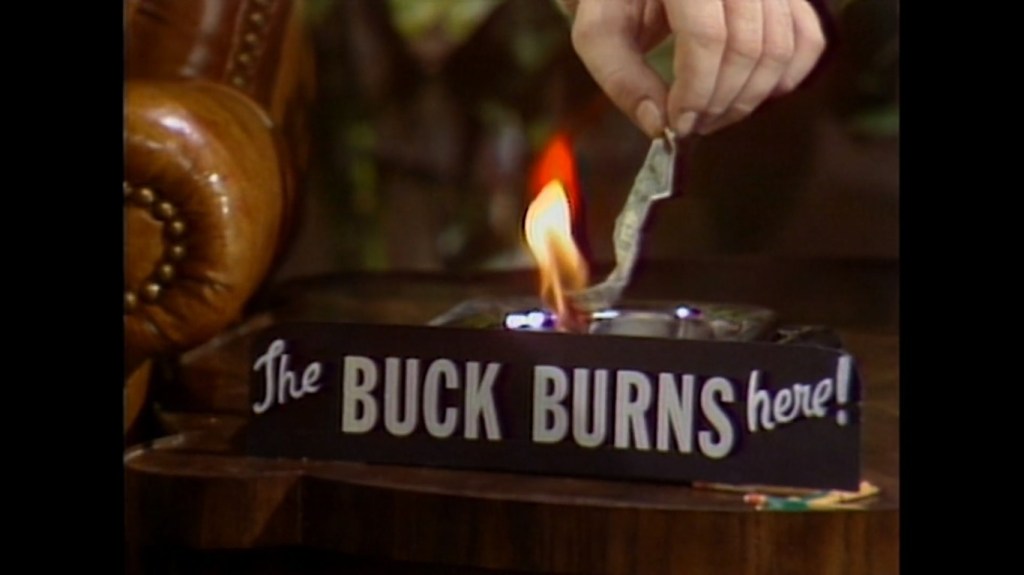
Any student of economics knows that inflation emerged as a big issue in the late 1970’s, first under the presidency of Jimmy Carter. The newly minted Saturday Night Live rose to the occasion. First, Dan Akroyd as Jimmy Carter proposed that that every American take 8 per cent of his or her money and burn it (Season 3, Episode 17, 4/15/1978), to reduce the money supply.

The President demonstrated leadership here by burning 8% of the $12.50 in his daughter’s little peanut bank:

A few months later (Season 4, Episode 4, 11/4/1978), the President changed his mind. Since austerity did not seem to be working, he offered a new approach – –  “Inflation is our friend”:

Continue reading

Rudyard Kipling As Macroeconomic Commentator

In a random article I read on investing the author cited (in defense of commonsense finance versus novel economic flimflam) the following passage by Rudyard Kipling:

And that after this is accomplished, and the brave new world begins

When all men are paid for existing and no man must pay for his sins,

As surely as Water will wet us, as surely as Fire will burn,

The Gods of the Copybook Headings with terror and slaughter return!

I was vaguely familiar with Kipling as an author of children’s stories like The Jungle Book and for writing poems celebrating British imperialism, but this seemed like some sort of macroeconomic commentary. “All men are paid for existing” sounds very much like Universal Basic Income, and “no man must pay for his sins” is consistent with a culture of blame-shifting. I was not aware of Kipling-as-economist, so I looked up the reference here.

This verse is the closing stanza of Kipling’s “The Gods of the Copybook Headings”. He penned this in 1919, as an expression of concern over trends in post-WWI Anglo-European society. “Copybook Headings” were maxims which appeared at the top of schoolchildrens’ copybooks in nineteenth-century Britain and America; the pupils would learn penmanship, vocabulary, spelling, and hopefully socially-useful values by copying these sayings over and over down the page. These maxims were based on traditional morals or on Bible sayings, like “A stitch in time saves nine” or “If a man will not work, let him not eat”.

I found that other investing advisers, such as John Bogle, also cited this poem in support of value-oriented financial strategies and claimed that it “beautifully captur[ed] the thinking of Schumpeter and Keynes”. Kipling felt that the old time-tested values were being replaced by trendy, flashy fads, but society would come to grief by rejecting the old common-sense virtues.  Eventually the “Gods of the [innovative] Market” would tumble, their “smooth-tongued wizards” would be silenced, and the public would realize that it is still the case that “Two and Two make Four.”

Without further ado, here is the complete poem:

The Gods of the Copybook Headings

AS I PASS through my incarnations in every age and race,

I make my proper prostrations to the Gods of the Market Place.

Peering through reverent fingers I watch them flourish and fall,

And the Gods of the Copybook Headings, I notice, outlast them all.

~

We were living in trees when they met us. They showed us each in turn

That Water would certainly wet us, as Fire would certainly burn:

But we found them lacking in Uplift, Vision and Breadth of Mind,

So we left them to teach the Gorillas while we followed the March of Mankind.

~

We moved as the Spirit listed. They never altered their pace,

Being neither cloud nor wind-borne like the Gods of the Market Place,

But they always caught up with our progress, and presently word would come

That a tribe had been wiped off its icefield, or the lights had gone out in Rome.

~

With the Hopes that our World is built on they were utterly out of touch,

They denied that the Moon was Stilton; they denied she was even Dutch;

They denied that Wishes were Horses; they denied that a Pig had Wings;

So we worshipped the Gods of the Market Who promised these beautiful things.

~

When the Cambrian measures were forming, They promised perpetual peace.

They swore, if we gave them our weapons, that the wars of the tribes would cease.

But when we disarmed They sold us and delivered us bound to our foe,

And the Gods of the Copybook Headings said: “Stick to the Devil you know.”

~

On the first Feminian Sandstones we were promised the Fuller Life

(Which started by loving our neighbour and ended by loving his wife)

Till our women had no more children and the men lost reason and faith,

And the Gods of the Copybook Headings said: “The Wages of Sin is Death.”

~

In the Carboniferous Epoch we were promised abundance for all,

By robbing selected Peter to pay for collective Paul;

But, though we had plenty of money, there was nothing our money could buy,

And the Gods of the Copybook Headings said: “If you don’t work you die.”

~

Then the Gods of the Market tumbled, and their smooth-tongued wizards withdrew

And the hearts of the meanest were humbled and began to believe it was true

That All is not Gold that Glitters, and Two and Two make Four

And the Gods of the Copybook Headings limped up to explain it once more.

~

As it will be in the future, it was at the birth of Man

There are only four things certain since Social Progress began.

That the Dog returns to his Vomit and the Sow returns to her Mire,

And the burnt Fool’s bandaged finger goes wabbling back to the Fire;

~

And that after this is accomplished, and the brave new world begins

When all men are paid for existing and no man must pay for his sins,

As surely as Water will wet us, as surely as Fire will burn,

The Gods of the Copybook Headings with terror and slaughter return!

Commentary:

This poem made little sense to me until I read some commentary by the Kipling Society. I’ll reproduce just a few excerpts here. Everything below is taken verbatim from that commentary except a couple of my side comments in square brackets:

~~~~~~~~~~~~~~~~~~~~~~~~~~~~~~~~~~~~~~~~~~~~~~~~~~~~~~

Against the fundamental, unchanging values of life – the “Copybook Headings” which a child was expected to imbibe while learning to write – Kipling sets the transient, fashionable “Gods of the Market-Place”, which can be taken to refer to both trendy attitudes and the public figures associated with them.

Kipling argues that throughout the ages mankind has always been jostled between wisdom and foolishness. The references to past periods of time appear to reinforce the air of an historical survey, but the geological terms are fake, and Kipling’s concern is not with the past, but with post-war Britain. In the final two stanzas of the poem, the knockabout satire is replaced by a sterner prophetic tone:

As surely as Water will wet us, as surely as Fire will burn,
The Gods of the Copybook Headings with terror and slaughter return!

Notes on the text
[Verse 2]

living in trees Kipling starts his story with the first human ancestors.

Uplift, Vision and Breadth of Mind the capitals emphasize the trendy empty terms used by the Gods of the Market-Place [as evolving human society tries to transcend the elementary facts of nature such as water wets and fire burns, which even the gorillas honor].

[Verse 3]

word would come That a tribe had been wiped off its icefield When the Gods of the Copybook Headings are ignored, retribution follows, whether among savage tribes or in the heart of civilisation

[Verse 4]

Wishes were Horses ‘If wishes were horses, beggars would ride’ and a Pig had Wings ‘If a pig had wings it would fly’. Both these traditional sayings pour scorn on wishful thinking.

[Verse 5]

Cambrian a real geological period. Here, as Keating points out, it stands for the Welshman Lloyd George, who was Prime-Minister for much of the Great War. (Cambria is the Latin name for Wales). Lloyd George was the chief British negotiator for the Treaty of Versailes in 1919 which officially ended the War. This disarmed Germany but pledged all the Great Powers to disarm themselves progressively. Kipling strongly disapproved of Lloyd George, the Liberals, and the Treaty.

‘Stick to the Devil you know.’ The usual form of this saying is ‘better the Devil you know than the one you don’t.’ Here it means that being prepared for war is better than being disarmed and defenceless.

[Verse 6]

Feminian a made-up term which sounds suitably geological. It refers to the emancipation of women, a lively issue at the time [and perhaps to the new morality which increasingly separated sexual activity from committed marriage; the result being a decrease in child-bearing and an increase in infidelity].

‘The Wages of Sin is Death.’ See Paul’s Epistle to the Romans 6,23.

[Verse 7]

Carboniferous Another genuine geological period, in which coal measures were formed. Here it stands for the increasing power of trade unions, particularly the coal-miners.

robbing selected Peter to pay for collective Paul ‘Robbing Peter to pay Paul’ is a traditional phrase, usually meaning borrowing money to pay off debt. Here it means taxing the productive part of the population to support the idle. [This is a live issue in 2021…]

The Internet Knows Everything

About ten years ago, movers showed up to pack up and move our worldly goods across town. Because this was a short move, we went with some local, low-priced labor, instead of name-brand professionals. From a previous move, we knew that the legs of our baby grand piano could and should be removed for transport. Unfortunately, none of the movers knew how to detach the legs, and neither did I. I squirmed underneath and looked up, and did not see how to do it. I only saw some massive screws that looked like they were not about to move.

The internet to the rescue – – a quick search led to a YouTube video showing somebody moving a piano like ours, and just reaching under and knocking something with a rubber mallet, and voila, off came the legs. I could not see exactly what they did, but when I crawled under the piano again to look for something easily knocked aside, which had to be there, it was obvious what to do.

Continue reading

The Rise and Fall (?) of Bitcoin Price

Well, it has been a fun party. Here is a chart of Bitcoin prices over the last year or so. Folks that bought in before December were up X4 or more by April. Woo-hoo! But prices have dropped by half in the past two months. Many articles were published over the winter justifying ever greater heights for Bitcoin. It was to be the digital equivalent of gold as a store of value. Also, it is touted as being decentralized and free of government manipulation – – a global, privatized people’s currency. What happened?

Source: Seeking Alpha
Continue reading

Composting Toilets May Help Save the World

A key discovery of nineteenth century science was that diseases can be transmitted via pathogens in human waste.  In regions of high population density, this can lead to epidemics if adequate sanitation facilities are not available. A milestone in epidemiology was the 1854 cholera outbreak in London. A physician named John Snow analyzed the incidence of the disease and concluded that the Broad Street public water pump was the source of infection. Even though he had no explanation in terms of germ theory at that time, he persuaded the authorities to remove the handle of that pump. This stopped the cholera epidemic. The well from which this pump drew had been dug a few feet away from an infected cesspool. A replica of this pump still stands in London:

Continue reading

DarkSide Goes Too Far with Colonial Pipeline Ransomware Attack

The ransomware attack on the Colonial fuel pipeline that supplies the U.S. East Coast is such a rich story it is hard to know what to discuss in a brief blog post. As anyone who gets news feeds knows, the software that took out Colonial is supplied by a (probably Russia-based) criminal enterprise called DarkSide. DarkSide’s business model is called “Ransomware-as-a-Service” (RaaS). They partner with affiliates who use the software to perform the actual attacks. The affiliates get paid something like 10-25% of the ransom money.

An article by Sophos Labs, a company that fights ransomware, gives details on how these attacks work. Typically, an attacker gets initial access to a company’s system by tricking some employee into revealing passwords or other critical information (“phishing”). The attacker then spends two or three months roaming around inside the systems, building up credentialling to get more and more access. They steal (“exfiltrate”) sensitive information like accounting, personnel, and R&D. This table shows some of the “tools” used in these attacks:

When it’s showtime, they encrypt the information on the company computers, which typically makes operations grind to a halt. They then demand ransom (in the form of Bitcoin). If the ransom is paid, they will send the victim a decryption program to allow them to decrypt their files.  If their demands are not met, they will publicly release the stolen, sensitive information. So this extortion is a double threat, to both operations and information exposure.

Here is an example of (I believe) an actual ransom demand note:

(Sorry, the text is hard to read).  DarkSide is professional in their own way. They assure their victims that they really will get their data restored if the ransom is paid: “…We value our reputation. If we do not do our work and liabilities, no one will pay us. This is not in our interests. All our decryption software is perfectly tested and will decrypt your data. We will also provide support in case of problems.”   Think of that, a help desk for your ransomware.

DarkSide likes to align themselves with Robin Hood, kind of: “Take from the rich, and give to the poor  keep it”. They claim to be apolitical, just in it for the money, and to not target nonprofits. They even offer to donate money to charities, so we can all feel good about this. (Charities typically refuse to accept stolen money, though).

In most cases, it is far cheaper for the victim to pay the ransom than to tough it out and try to scramble to restart their systems cold and to risk exposure of sensitive information.  DarkSide, after all, has its reputation to protect, so they scale the ransom demands accordingly, but make sure the victims hurt if they do not pay.

Forbes cybersecurity expert Davey Winder explains that with the Colonial hack, however, Darkside (and the affiliate who did the actual hacking) stirred up something of a hornet’s nest.

If you cut off gasoline supplies to the Washington, D.C. area, you better think through the consequences. I am sure that top national security officials were grilled by top top government officials as to “How could this happen?”, and, “You aren’t going to let them get away with this, are you?”. After some days of public waffling on the issue, it seems Colonial did pay DarkSide some $5 million. But..apparently DarkSide did not get to keep the loot, though it is hard to know what is real and what is public theater.

According to Winder,

DarkSide was effectively forced into retreat by alleged law enforcement or unspecified government disruption of the publicity blog and the ransom negotiation dark web site.

The main Russian-language criminal forum that acted as a recruitment post for potential affiliates banned all ransomware groups from advertising. The cryptocurrency wallets used by DarkSide were, it has also been said, found and funds exfiltrated.

You can follow some of the links in the paragraph above for more of the details here. (Most people may not realize the Bitcoin is not as private as imagined. Every transaction is out in public view; although technically the identities of transactors is cloaked behind anonymous user’s ID numbers, sophisticated data analysis programs can be used to trace transactions pretty reliably).

DarkSide has announced some “nicer” guideline for its further extortions. It seems like the good guys at least partially won that battle, but the war goes on. Winder further comments:

The business model will change, just as it has always evolved, but it won’t go away. Why would it when there are so many big corporate targets out there continuing to make the mistakes that let these attackers onto their networks?

If I were king, this is what I might do: Sentence the CEO of any company which is successfully hacked to six months in prison. Overnight, you would see corporate priorities magically realigned, necessary resources allocated, internal security protocols enforced, and so on. I predict the incidence of such hacking would drop by an order of magnitude within three months of such an “executive order”.

Bracing for the Swarm of “Charismatic” Cicada Bugs

In the Mid-Atlantic region of the U.S., there are two basic types of cicadas. One type appears every year, but in small numbers. One bug up in a tree can fill a whole block with its buzzing sound. But every seventeen years, the periodic cicadas, also (incorrectly) called “17-year locusts”, emerge and drown out every sound but their own. They can make a residential neighborhood sound like an airport. The seventeen year swarm is due to emerge any day now.

Continue reading

Was “World War II” Just a Myth?

May 5, 2415

[To:] Mark Livingstone,

25 The Standards,

Verneville, Alassippi

Dear Mark:
in your last letter you made one palpable hit, but only one: I admit that the atomic wars of the Twenty-first Century and the cataclysms of the Twenty-second Century destroyed so much of our cultural inheritance, including nearly all our Nineteenth and Twentieth Century history, that there is very little we can turn to of those times that is authentic. Apparently that is the only point we will be able to agree on.

I cannot possibly believe, for instance, as you do, that there ever did exist an Abraham Lincoln as so glowingly portrayed by our two or three surviving “history” digests; nor can I believe there ever was a World War II, at least such as they described. Wars, yes – there have always been wars, and a World War II may have occurred – but certainly not with such incredible concomitants.

In short, your history is much too fictional for me.

Continue reading

Stoned Age Cave Paintings

It has long been argued that many of the artists drawing on cave walls were not merely trying to draw the external world as accurately as possible. Rather cave art was:

A deliberate mix of rituals inducing altered states for participants, coupled with brain chemistry that elicits certain visual patterns for humanity’s early chroniclers.

The cave painters had rituals that involved taking drugs (undoubtedly plants) that they consumed in a frenzy to get to this creative state. This behavior and the same results were noted by 1960s-era academics studying the effects of peyote, a hallucinogenic cactus found in North America.

Some drawings which illustrate these patterns are:

There seem to be a number of geometric patterns like honeycombs, tunnels and funnels, cobwebs, and spirals which show up repeatedly across different continents. This has fueled speculation that those prehistorics were tripping out on veggies like peyote and magic mushrooms. In his “Stoned Ape” theory, the late Terrence McKenna proposed that consumption of shrooms gave the earliest humans higher energy and group cohesion and helped humanity to evolve the use of language.

A more recent study by Tel Aviv University researchers suggests that another way that Stone Age artists got into an altered state was plain oxygen deprivation. Many sites of cave art, particularly in France and Spain, are at the end of long, narrow passages. If a couple of guys got into one of those rooms, with a blazing torch or two, the oxygen level would soon be significantly depleted:

They found that oxygen concentration depended on the height of the passageways, with the shorter passageways having less oxygen. In most of the simulations, oxygen concentrations dropped from the natural atmosphere level of 21% to 18% after being inside the caves for only about 15 minutes. 

Such low levels of oxygen can induce hypoxia in the body, a condition that can cause headache, shortness of breath, confusion and restlessness; but hypoxia also increases the hormone dopamine in the brain, which can sometimes lead to hallucinations and out-of-body experiences, according to the study.

Drawings like the following from the Altimira cave are pretty impressive under those circumstances: