Dear Mark: in your last letter you made one palpable hit, but only one: I admit that the atomic wars of the Twenty-first Century and the cataclysms of the Twenty-second Century destroyed so much of our cultural inheritance, including nearly all our Nineteenth and Twentieth Century history, that there is very little we can turn to of those times that is authentic. Apparently that is the only point we will be able to agree on.
I cannot possibly believe, for instance, as you do, that there ever did exist an Abraham Lincoln as so glowingly portrayed by our two or three surviving “history” digests; nor can I believe there ever was a World War II, at least such as they described. Wars, yes – there have always been wars, and a World War II may have occurred – but certainly not with such incredible concomitants.
In short, your history is much too fictional for me.
It has long been argued that many of the artists drawing on cave walls were not merely trying to draw the external world as accurately as possible. Rather cave art was:
A deliberate mix of rituals inducing altered states for participants, coupled with brain chemistry that elicits certain visual patterns for humanity’s early chroniclers.
The cave painters had rituals that involved taking drugs (undoubtedly plants) that they consumed in a frenzy to get to this creative state. This behavior and the same results were noted by 1960s-era academics studying the effects of peyote, a hallucinogenic cactus found in North America.
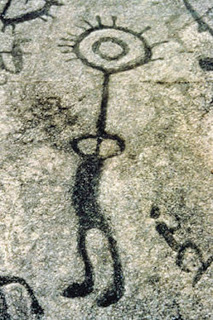
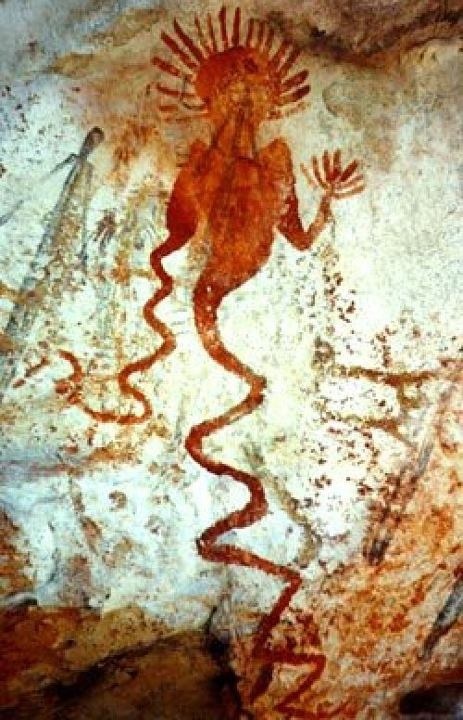
Some drawings which illustrate these patterns are:
There seem to be a number of geometric patterns like honeycombs, tunnels and funnels, cobwebs, and spirals which show up repeatedly across different continents. This has fueled speculation that those prehistorics were tripping out on veggies like peyote and magic mushrooms. In his “Stoned Ape” theory, the late Terrence McKenna proposed that consumption of shrooms gave the earliest humans higher energy and group cohesion and helped humanity to evolve the use of language.
A more recent study by Tel Aviv University researchers suggests that another way that Stone Age artists got into an altered state was plain oxygen deprivation. Many sites of cave art, particularly in France and Spain, are at the end of long, narrow passages. If a couple of guys got into one of those rooms, with a blazing torch or two, the oxygen level would soon be significantly depleted:
They found that oxygen concentration depended on the height of the passageways, with the shorter passageways having less oxygen. In most of the simulations, oxygen concentrations dropped from the natural atmosphere level of 21% to 18% after being inside the caves for only about 15 minutes.
Such low levels of oxygen can induce hypoxia in the body, a condition that can cause headache, shortness of breath, confusion and restlessness; but hypoxia also increases the hormone dopamine in the brain, which can sometimes lead to hallucinations and out-of-body experiences, according to the study.
Drawings like the following from the Altimira cave are pretty impressive under those circumstances:
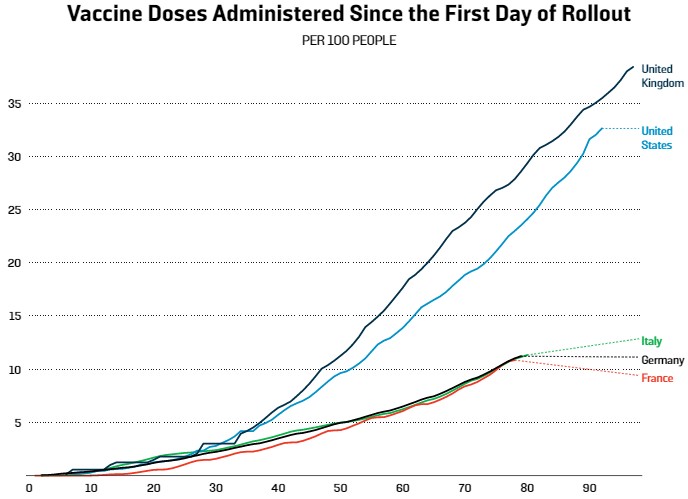
A big story regarding Covid in the past month or two has been how slowly Europeans are getting vaccinated. The graph below depicts how vaccinations in the EU are lagging behind the U.S. and U.K.
Global supply chains and just in time inventory work great – – until they don’t. Every car these days is a rolling computer, with semiconductors in every vehicle. No chips, no cars. For various reasons, there is a big worldwide shortfall in the chips needed for cars and trucks, which is causing auto assembly lines to shut down for extended periods. Car prices are already rising in response.
Chip production as a whole was slowed down this past year because of Covid effects at the factories. More importantly, chip production was switched away from automobiles to lighter consumer products. Auto assembly lines were curtailed due to the virus, resulting in reduced demand for those specific chips in 2020. The thinking among chip makers was that in the midst of a deadly pandemic, consumers would be sitting home ordering goodies from Amazon or Alibaba, rather than cruising car dealers or spending on travel. Indeed, U. S. spending on durable goods exploded in 2020, fueled in part by generous unemployment and stimulus payments, and this has soaked up existing chip production.
However, car buying has come back earlier than expected. Chip manufacturing is a lengthy process, taking some 26 weeks from start to finish. Chip makers are scrambling to add new capacity and to reconfigure their manufacturing lines for autos, but this shortage will not resolve until later in the year.
The original 1947-48 finds of scrolls in caves near the Dead Sea were a huge sensation. Preserved by the aridity of that region in the southwestern part of Israel, these scrolls dated back to around 100 B.C.-100 A.D. They included Hebrew texts of much of the Old Testament, which were about a thousand years older than previously known Hebrew Old Testament manuscripts. There were also other writings peculiar to the Jewish community that lived near those caves, which gave new insights into the religious and social currents of that day.
The last of those manuscript finds by scholars was in 1961. Since then, there has been only trickle of artifacts from looters who have dug up items to sell, but with no proper historical context. In the last few years, the Israel Antiquities Authority (IAA) has mounted an exhaustive survey of every nook, cranny, and hole in that Judean Desert area, in order to forestall further loss of ancient artifacts. The IAA has now announced some finds from that survey. They include further Bible texts (in Greek), the oldest known woven basket (10,500 years old), and a 6,000 year old mummified skeleton of a child, covered with a cloth. The searchers also found arrow and spear tips, coins, sandals and even lice combs, all from the time of the Bar Kochba revolt (133-135 A.D.).
Most of our financial transactions are managed by centralized institutions like banks and credit card companies. We trust that these companies will properly manage transactions, so no one can spend the same dollar twice. In other words, if you have $300 in your checking account, you can’t use your debit card to buy a $300 message chair, and then quickly purchase a $300 patio furniture set before the first purchase clears.
Satoshi Nakamoto, the enigmatic inventor of Bitcoin, wanted to set up a digital currency which would not be controlled by or dependent on any central institution. Rather, there would be a big network of thousands of independent computing nodes, which collectively would record and vet financial transactions. A big problem he faced was how to prevent the sort of double-spending described above. With a decentralized system, it was possible that one node, or a couple of nodes in cahoots, could quickly enter two transactions which would spend the same chunk of digital currency twice, before the rest of the nodes could catch the error. And without a central authority, who would have the authority to correct such errors?
Nakamoto’s solution was the blockchain. He defined and implemented it specifically for Bitcoin, but the concept is so elegant and powerful that hundreds of other digital coins were quickly set up also using blockchains. This in turn has spawned a whole multi-billion dollar “decentralized finance” industry around these blockchain based currencies.
There are several conceptual pieces that are put together to make the working Bitcoin digital currency. The data which defines Bitcoin transactions is stored in a data structure called a blockchain. A key feature of blockchains involves cryptographic “hashing”. That is the focus of today’s post.
A hash function is any function that can be used to map initial data of arbitrary size to fixed-size values. The initial data may be called the key or the message. The values returned by a hash function are called hash values, hash codes, digests, or simply “hashes”. A common use for hashing in the past has been to do large-scale data storage and retrieval more efficiently, as described in Wikipedia. That link also discusses how some actual hashing calculations are done.
Here we will focus on cryptographic applications of hashing. For this purpose, hash functions are chosen which are for all practical purposes one-way. It is straightforward to start with the “message” and compute the hash. But it is not feasible to start with the hash and back-calculate the initial message, even if you know the algorithm used for the hash function. Typically the only way to find the message is to run a brute-force search of all possible inputs until you find a match to the output hash.
Everybody knows that Bitcoin is a “digital currency”. But what does that really mean, and what is Bitcoin really good for? Who developed it? Turns out, oddly, that we don’t actually know. Can you buy a pizza with it? Turns out that perhaps the most famous pizza purchase of all time was made with Bitcoin.
With all the uproar around the election in December, the news of the SolarWinds data breach did not get the attention it deserved. Some well-resourced foreign organization, almost certainly in Russia, succeeded in infiltrating the data systems of an astounding 18,000 or more U.S. organizations. These included major federal agencies such as the Pentagon, the Department of Homeland Security, the State Department, the Department of Energy, the National Nuclear Security Administration, and the Treasury, and other big targets like Microsoft, Cisco, Intel, and Deloitte, and organizations like the California Department of State Hospitals, and Kent State University. Security watchdogs run out of adjectives (“11 out of 10”) in characterizing the magnitude of this hack.
At the same time, security experts cannot help admiring the sheer artistry of this exploit. Hackers themselves often view their codes as a work of art. According to one cybersecurity expert, “Programmers and hackers like to sign their work like artists…So they sign that code in various ways. Often, they’ll leave their initials or they’ll try to be cute and put some sort of cryptic message.” So how was this hack accomplished?
We noted earlier the hubbub over a hive of little investors on Reddit outfoxing some big Wall Street firms who had made massive short bets on the stock of GameStop. Some of the narrative around this event has painted short selling as a secret, evil practice only available for the big guys. But none of that is true.


 Economist Writing Every Day
