For decades, our family favorite holiday cookie recipe has been a hearty ginger cookie containing, among other things, wheat germ. The original recipe author claimed that these cookies “got my family through Alaskan winters”. That’s hard core.
With my family’s help, I made big batches for decades to hand out among colleagues at work. This always included my boss and boss’s boss, and their admins. (Cynics may think what they wish of my motives there.) Also, we like to hand out small, decorated bags of cookies to all our neighbors for several houses in all directions. We like to try to build community as we can, and this is often the only time we get to exchange words with some neighbors.
However, there are two downsides to that ginger cookie. First, it is very labor-intensive. The final mixing with a stiff dough takes a lot of muscle, and forming the cookies takes an assembly line with multiple steps: with the help of a spoon, form the sticky dough into a ball, then roll the ball in sugar, then place on baking tray, then press a blanched almond (can only find these in specialty vendors these days) into the top of the ball. Second, this ginger cookie is a bit on the dry side – – I would usually recommend consuming them with coffee or milk as I handed them out.
Two years ago, however, an esteemed family member pointed me to a radically different recipe, for an oatmeal chocolate chip cookie. That seemed kind of decadent compared to my old favorite, but worth a try. It solved the two drawbacks for the ginger cookies. Making it is easy, just scoop into the dough and plop onto the cookie sheet. (I did buy a cookie scoop for this). And there was no need to apologize for dryness. These babies are just plain delicious. So now I make large batches of these cookies to hand out to neighbors at Christmas.
Without further ado, here is a link to the recipe for Chewy Oatmeal Chocolate Chip Cookies, by Sally McKenney of Sally’s Baking Addition. You do have to follow the directions, including the step of creaming the butter (see links in recipe for what “room temperature” means) and sugar, and using old-fashioned (not instant) oatmeal.
Here are some of my tweaks to this recipe:
Make two double batches, in two separate large bowls. Chill in fridge several hours. Set aside several hours to bake them all.
Don’t bother creaming butter alone. Just add sugars to butter and stir in with wood spoon, then beaters. Add flour, using spoon and then beaters. For adding oats, chips, etc., just use spoon.
I backed out some of the chocolate chips, and added chopped walnuts: so, in each double batch I have total 3 c choc chips (e.g. 2.25 c regular chips, ¾ c mini chips), plus 1 c chopped walnuts. It’s worth getting good chocolate chips. Ghirardelli seems to be the best chocolate chip. Guittard also gets raves.
The recipe calls for big cookies (a full, large scoop, about 3 Tbsp), but those may spread too much, and I want more cookies, so I use about ¾ full large scoop.
Bake at 355 F instead of 350 F, to speed it up a bit. (My oven is wimpy, electric). Parchment paper works well to keep cookies from sticking.
In March and April of this year, I moaned and groaned here in blogland, chronicling my attempts to recover my funds from an interest-bearing account at crypto firm BlockFi.
Back in 2021, interest rates had been so low for so long that that seemed to be the new normal. Yields on stable assets like money market funds were around 0.3% (essentially zero, and well below inflation), as I recall. As a yield addict, I scratched around for a way to earn higher interest, while sticking with an asset where (unlike bonds) the dollar value would stay fairly stable.
It was an era of crypto flourishing, and so I latched onto the notion of decentralized finance (DeFi) lending. I found what seemed to be a reputable, honest company called BlockFi, where I could buy stablecoin (constant dollar value) crypto assets which would sit on their platform. They would lend them out into the crypto world, and pay me something like 9 % interest. That was really, really good money back then, compared to 0.3%.
On this blog, I chronicled some of my steps in this journal. First, in signing up for BlockFi, I had to allow the intermediary company Plaid complete access to my bank account. Seriously, I had to give them my username and password, so they could log in as me, and not only be able to withdraw all my funds, but see all my banking transactions and history. That felt really violating, so I ended up setting up a small auxiliary bank account for Plaid to use and snoop to their heart’s content.
BlockFi assured me that they only loaned my assets out to “Trusted institutional counterparties” with a generous margin of collateral. What could possibly go wrong??
What went wrong is that BlockFi as a company got into some close relationship with Sam Bankman-Fried’s company, FTX. Back in 2021-2022, twenty-something billionaire Sam Bankman-Fried (“SBF”) was the whiz kid, the visionary genius, the white knight savior of the crypto universe. In several cases, when some crypto enterprise was tottering, he would step in and invest funds to stabilize things. This reminded some of the role that J. P. Morgan had played in staving off the financial panics of 1893 and 1907. SBF was feted and lauded and quoted endlessly.
For reasons I never understood, BlockFi as a company was having a hard time turning a profit, so I think the plan was for FTX to acquire them. That process was partway along, when the great expose’ of SBF as a self-serving fraudster occurred at the end of 2022. FTX quickly declared bankruptcy, which forced BlockFi to go BK as well. SBF was eventually locked up, but so were the funds I had put into BlockFi. The amount was not enough to threaten my lifestyle, but it was enough to be annoying.
BlockFi Assets Begin to Thaw
I got emails from BlockFi every few months, assuring customers that they would do what they could to return our assets. Their bankruptcy proceedings kept things locked, but eventually they started to return some money.
As I noted in a blog post, in April, 2024, I was able to recover about 27% of my account. At the time, there was no clear prospect of getting the rest. Along the way, I clicked on a well-camouflaged scam email link, which gave me some heartburn but fortunately no harm came of it.
And now, hooray, they have finally returned it all, following their successful claw-back of assets from SBF’s organization(s). This vindicates my sense that the BlockFi management was/is fundamentally honest and good-willed, and was just a victim of SBF’s machinations.
Some personal takeaways from all this:
Keep allocations smallish to outlier investments
Sell out at the first serious signs of trouble
Triple-check before clicking on any link in an email
Having been forced to engage in opening crypto wallets and transferring coins, I have a better feel for the world of crypto which had seemed like a black box. It does not draw me like it does some folks, but if circumstances ever require me to deal in crypto (relocate to Honduras?), I could do it.
It seems to be an accepted fact that there is a momentum effect with stock prices: a stock which has done well over the past 6-12 months is likely to continue to do better than average over the next six months or so. A number of funds (ETFs) have been devised which try to take advantage of this factor.
On the other hand, sometimes trends reverse, and stock that was hot twelve months ago has now run up in price, and may be due for a pause.
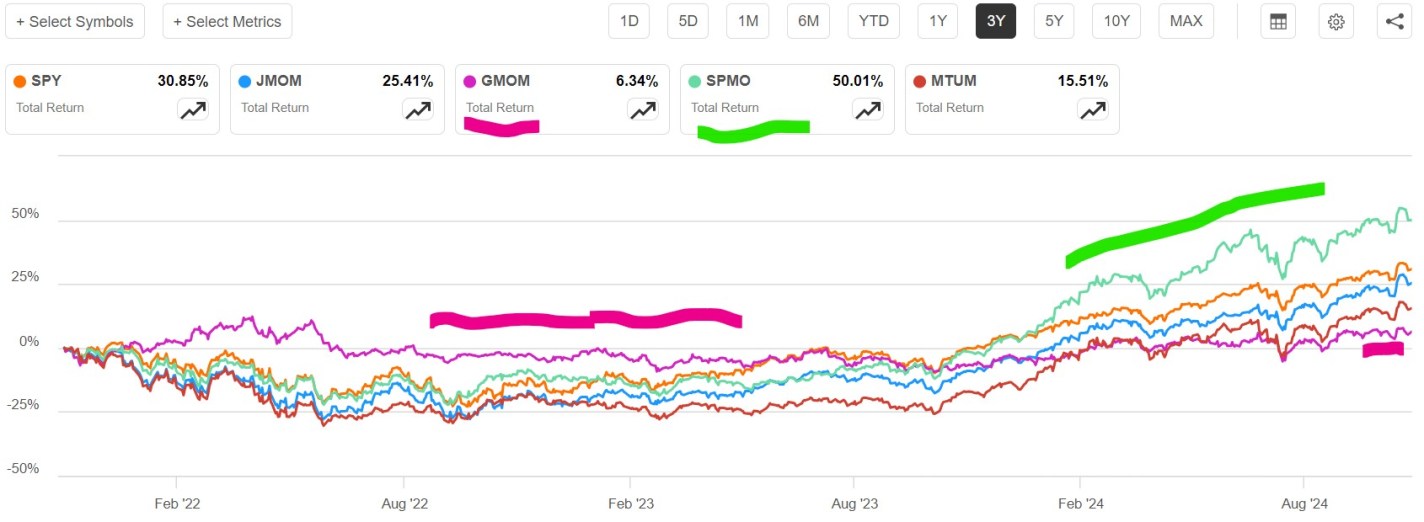
Here we will compare several momentum ETFs against the plain S&P 500 fund, SPY. In order to make it an apples-to-apples comparison, I am looking mainly at momentum funds that primarily draw from the S&P 500 large cap universe of stocks, excluding small-cap or tech only funds. [1] These large cap momentum funds are MTUM, JMOM, and SPMO. These funds all select stocks according to various rules. Besides trying to identify stocks with raw price momentum, these rules typically aim to minimize risk or volatility. I added one outlier, GMOM, that is very diversified. This fund does not hold individual stocks. Rather, it draws on some 50 different ETFs, including funds that focus on fixed income, commodities, or international or small cap as well as large cap US stocks, seeking to hold funds that show good relative momentum.
A plot of total returns over the past three years for these funds is shown below. It can be seen that plain SPY (orange line) beat all of the momentum funds except for SPMO (green line) in this timeframe. This is partly explained by the fact that SPY itself is a sort of momentum fund: the more a given stock’s price goes up, the bigger its representation in this capital-weighted fund. Also, over the past ten years or so, simply the biggest companies (the big tech quasi-monopolies like Google, Microsoft, etc.) have been generating more and more earnings, leaving the traditional auto and oil companies and banks, etc., in the dust.
By not focusing on U.S. large cap stocks, the diversified GMOM (marked with purple highlighter line) is less volatile. Its price did not drop nearly as much as the other funds in 2022, but it missed out on the great 2023-2024 stock run-up. SPMO (marked with green highlighter) really took off in that 2023-2024 big tech fiesta, by virtue of being concentrated in stocks like Nvidia, which went up roughly 10X in this timeframe. But this outperformance may be something of a one-off lucky strike. SPMO is still about the best of the momo funds, normally at least keeping up with SPY, but it does not consistently outperform it.
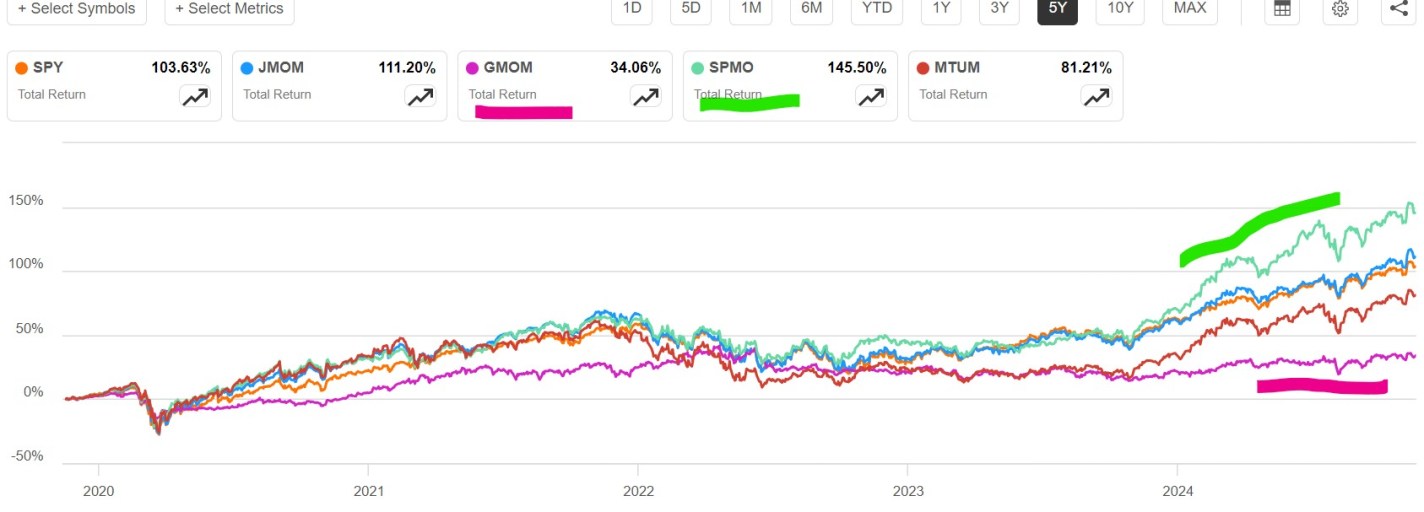
The five-year plot below illustrates similar trends, though it is a bit harder to read. Again, SPMO (green highlighter) largely keeps up with SPY, with a big outperformance spurt at the end. And GMOM is pretty flat; that really hurt it in the big 2020-2021 runup of big tech stocks. Over this five-year timeframe, JMOM kept up with SPY, and actually edged a bit ahead. MTUM, like most of the stock momo funds, actually ran ahead of SPY in the 2020-2021 runup, but fell somewhat more in 2022, and then got left in the dust in 2023. It is likely that it fell prey to trend reversal, which is a constant hazard for momentum funds. For most of 2022, the “best” stocks were dull value stocks, while tech stocks did terribly. Thus, a plain momentum algo fund would come into 2023 loaded with non-tech stocks. I suspect that is what happened to MTUM.
It happens that the SPMO algo has features that try to protect it from loading up on non-growth stocks during a bear market. So, it seems to be the best general momentum stock fund. It selects stocks which have shown positive momentum over the past twelve months, with the most recent month excluded (so as not to discriminate against a stock which had a temporary drop). Its chief vulnerability is that it only updates its holdings once every six months (mid-March and mid-September), so it is often acting on very old information. (Supposedly, it is better to update a momentum fund every three months).
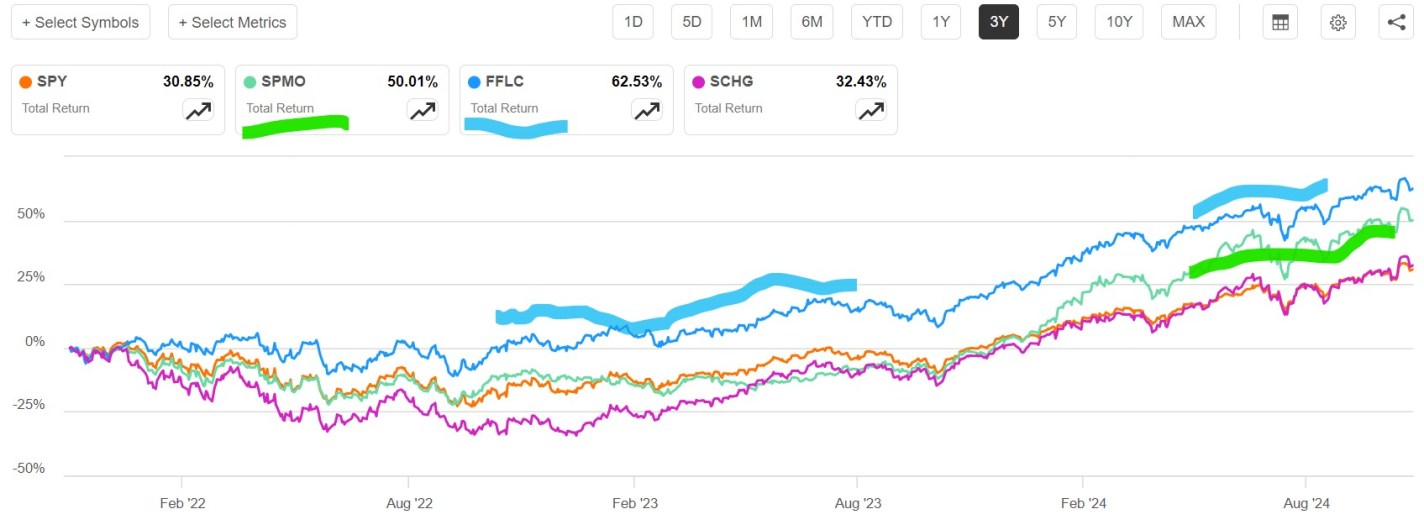
How does SPMO compare to a top actively-managed fund like FFLC or plain growth stock fund SCHG? The three-year plot below shows that FFLC (blue line, 63% total return) beat SPMO (green line, 50% return). Although SPMO had an impressive surge in the past year, FFLC just kept steadily outperforming SPY over the whole three-year period. This suggests that having good human judgement at the helm, able to adapt to differing market environments (2022 bear vs. 2023-2024 tech bull) can do better than a single, focused algorithm. I prefer a fund which keeps steadily outperforming “the market” (i.e., S&P 500) rather than one which only occasionally has moments of glory, so I hold more FFLC than SPMO.
In the plot above, the growth fund SCHG suffered more in 2022 when the tech high-flyers fell to earth, but made up for it in 2023-2024, to end up matching SPY over three years. On longer time-frames, SCHG handily beats SPY, as we noted in an earlier article on growth stocks.
[1] See this Insider Monkey article for a listing of ten best U.S. stock momentum funds. Some of these focus on small cap, mid cap, or technology stocks.
Will Growth Stocks Continue to Trounce Value Stocks?
It’s no secret that growth stocks, mainly big tech companies like Apple and Microsoft, have massively out-performed so-called value stocks in the past fifteen years. Value stocks tend to have lower price/earnings and steady earnings and low price/earnings. They include sectors such as petroleum, utilities, traditional banks, and consumer products. These companies often pay substantial dividends from their cash flow.
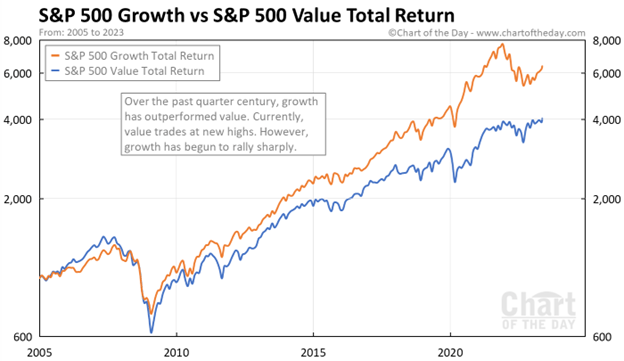
Here are some charts which make the point. This 2005-early 2023 chart shows value stocks (blue curve) having a small edge 2005-2008, then the growth stocks (orange curve) keep ripping higher and higher. Financial stocks, which mainly fall in the value category, were hit particularly hard in the 2008-2009 downturn.
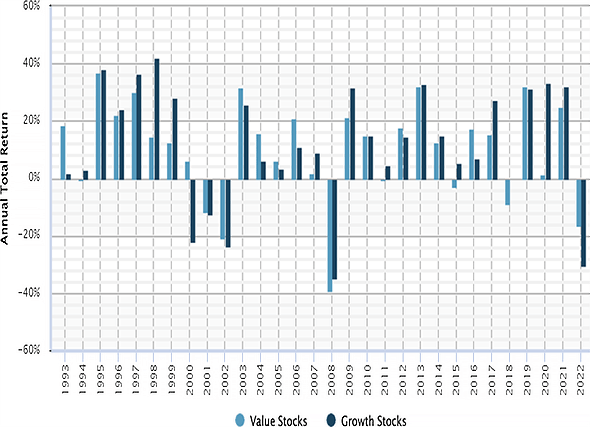
Here is a bar chart display of annual returns of value stocks (blue bars) and of growth stocks for the years 1993-2022. In 1997-1999 growth stocks outperformed. This was the great tech bubble – I remember it well, investors were shoveling money into any enterprise with a customer-facing website, whether or not there was any reasonable path to profitability. Reality caught up in 2000 (“What was I thinking??”), tech stock prices crashed and then tech was hated for a couple of years. But by 2009 or so, today’s big tech firms had emerged and established their quasi-monopolies, and started actually making money and even more money.
So, is the answer to just allocate all your equity portfolio to big tech and walk away? This is a question I have been asking myself. Even as growth stocks dominate year after year, there have continued to be voices warning that this is anomaly; historically, value stocks have performed better. So, with the sky-high valuations of today’s big tech, there is due to be a big mean reversion where the “Magnificent 7” get crushed, and Big Banks and Big Oil and Proctor & Gamble and even humble utilities finally get to shine.
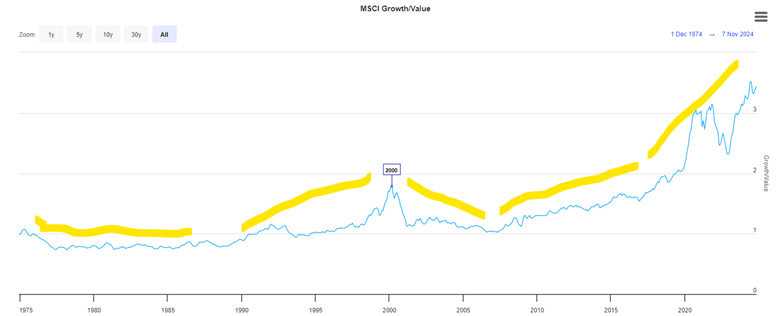
I don’t have a chart that goes that far back, but I have read that over the past 100 years, value has usually beat “growth”. Here is a hard-to-read plot of value vs growth for 1975-2024. I have added yellow highlighter lines to mark major trend periods. Growth underperformed 1975-1990, then growth picked up steam and culminated in the peak in the middle of the chart at 2000. Growth then underperformed 2000-2008, as noted earlier, as the excesses of the tech bubble were unwound, and people made paper fortunes in the real estate bubble of 2001-2007.
Growth has dominated since 2009, excerpt for 2022. That was the year the Fed raised interest rates, which tends to punish growth stocks. However, with their unstoppable increases in earnings (accounting for the vast majority of the earnings in the whole S&P 500), big tech has come roaring back. Yes, they sport high P/E ratios, but they have the earnings and the growth to largely justify their high valuations.
I have been influenced by the continual cautions about growth stocks becoming overvalued. Many an expert has advocated for value stocks. In June of this year, Bank of America head of US equity strategy Savita Subramanian told an audience at the Morningstar Investment Conference: “I have one message to you: Buy large-cap value.” So, for the past couple of years, I have gone relatively light on big tech and have over-allocated to “safer” investments like fixed income and value stocks. Silly me.
In the last few months, I finally decided to give up fighting the dominant trend, and so I put some funds into SCHG, which is specifically large cap growth, and in other growth-heavy funds. As you may imagine, these funds are loaded with Nvidia and Meta and other big tech. They have done very well since then.
How about going forward? Will the growth dominance continue, or will the dreaded mean reversion strike at last? At some point, I suspect that big tech earnings will slow down to where their high valuations can no longer be supported. But I don’t know when that will be, so I will just stay diversified.
Boilerplate disclaimer: Nothing here should be taken as advice to buy or sell any security.
Typically, the federal government spends more than it takes in. This has been going on for decades. At moderate levels, i.e. moderate debt/GDP ratios, this is not cause for concern. Presumably the national economy will grow enough to service the debt.
Historically, deficit spending would temporarily increase during some crisis like a major recession or major war, then it quickly tapered back down again. There was a general understanding, it seems, among most voters and most politicians that huge deficits were not healthy; one would not want to burden future generations with a lot of debt.
During the 2020-2021 epidemic experience, however, politicians found they got instant popularity by handing out trillions in stimulus money; anyone who squeaked that we couldn’t afford this much largesse got run over. And this spend-big, tax-small mentality has now become entrenched. Both presidential candidates have been traversing the nation promising juicy tax cuts. Apparently, we the people have decided to vote ourselves lots of free money right now, and the heck with future generations.
Here is a forecast from the Congressional Budget Office, with the optimistic assumption that we will never get another recession, showing that the recent levels of deficit are much higher than historical norms:
This is just the yearly deficit, not the exponentially-growing accumulated debt. The influence of the total debt may be seen in the mushrooming interest outlays. Below is another chart with data from the St Louis Fed, displaying both deficit level and unemployment over the past 80 years. Again, deficit spending would ramp up during recessions, due to reduced tax revenue and increased spending on unemployment benefits, etc., but then it would ramp right back down again. It failed to come back down completely after the 2008-2009 recession, and indeed started ramping up around 2016, even with low unemployment.
I don’t see this trend changing, and so investors need to take this into account. Here I will summarize some key points from analyst Lyn Alden Schwartzer in her article on the Seeking Alpha investing site titled Why Nothing Stops The Fiscal Train.
She notes that besides the primary deficit, the interest paid on the federal debt is a transfer of money to mainly the private sector, and so is further stimulus. This is one factor that has helped keep the economy stronger, and inflation higher, than it would otherwise be.
Some key bullet points in the article are
The U.S. faces structurally high fiscal deficits driven by unbalanced Social Security, inefficient healthcare spending, foreign adventurism, accumulated debt interest, and political polarization.
Investment implications suggest favoring equities and scarce assets over bonds, with defensive positions in T-bills, gold, and inflation-protected Treasury notes.
Fiscal dominance will likely lead to persistent inflation, asset price volatility, and potential stagflation, making traditional recession indicators less reliable.
A neutral-to-negative outlook on U.S. stocks in inflation-adjusted terms, with better prospects for international equities and cyclical mid-sized U.S. stocks.
She suggests looking to the recent histories of emerging economies to see what happens in nations with perhaps stagnating real economies kept afloat by ongoing federal deficits. Her tentative five-year outlook for investing is bearish on the major U.S. stock indices (gotten overpriced) and on government bonds (real returns, in light of anticipated ongoing inflation, will be low), but bullish on international stocks, inflation-protected bonds, short-term T-bills, gold, and bitcoin (again, all mainly driven by expected stubborn inflation as the money supply keeps growing):
-For U.S. stocks, I have a neutral-to-negative view on the major U.S. stock indices in inflation-adjusted terms. They’re starting from an expensive baseline, and with a high ratio of household investable assets already stuffed into them. However, I do think that among the universe of more cyclical and/or mid-sized stocks that make up smaller portions of the U.S. indices, there are plenty of reasonably priced ones with better forward prospects.
-For international stocks, I think the 2024-2025 Fed interest rate cutting cycle is one of the first true windows for them to have a period of outperformance relative to U.S. stocks for a change. It doesn’t mean that they certainly will follow through with that, but my base case is for a meaningful asset rotation cycle to occur, with some of the underperforming international equity markets having a period of outperformance. At the very least, I would want some exposure to them in an overall portfolio, to account for that possibility.
-For developed market government bonds, like the U.S. and elsewhere, I don’t have a positive long-term outlook in terms of maintaining purchasing power. A ten-year U.S. Treasury note currently yields about 3.7%, while money supply historically grows by an average of 7% per year, and $20 trillion in net Treasury debt is expected to hit the market over the next decade. So I think the long end of the curve is a useful trading sardine, but not something I want to have passive long exposure to.
-A five-year inflation-protected Treasury note, however, pays about 1.7% above CPI, and I view that as a reasonable position for the defensive portion of a portfolio. T-bills are also useful for the defensive portion of a portfolio. They’re not my favorite assets, but there are worse assets out there than these.
-Gold remains interesting for this five-year period, although it might be tactically overbought in the near-term. It has had a nice breakout in 2024, but is still relatively under-owned by most metrics, and should benefit from the U.S. rate cutting cycle. So I’m bullish as a base case.
-Bitcoin has been highly correlated with global liquidity, and I expect that to continue. My five-year outlook on the asset is very bullish, but the volatility must be accounted for in position sizes for a given portfolio and its requirements.
I’ll add two comments on this list. First, the bond market is usually pretty good about figuring things out, and has evidently realized that endless huge deficits mean endless huge bond issuance and ongoing inflation. Thus, even though the Fed is lowering short-term rates, bond buyers have started demanding higher rates on long-term bonds. And so long-term government bonds may not be as bad as Schwartzer thinks.
Second, for reasons described in The Kalecki Profit Equation: Why Government Deficit Spending (Typically) MUST Boost Corporate Earnings, when you work through the various sectoral balances in the macro economy, most of the huge deficit spend dollars will end up in either corporate earnings or in the foreign trade deficit. So the ongoing deficits will continue to buoy up U.S. corporate earnings, and hence U.S. stock prices.
For many people nowadays, investing in “stocks” means buying a fund like SPY or VOO which tracks the large cap S&P 500 index, or maybe QQQ or QQQM which track the tech-heavy NASDAQ 100 index. These types of funds are exchange-traded funds (ETFs), which very low annual fees (around 0.2% or so). These are so-called passive funds, which mechanically buy and sell stocks such that their holdings match what is in their respective indices. No extra judgment on stock picking is required.
An alternative is to pick stocks yourself, or to buy into a fund with active management, where humans (and their algorithms) try to buy stocks which will beat the passive indices, and try to avoid losing stocks. The active versus passive debate has been going on for decades. There will always be some active funds that outperform in any given year. These successes help keep the allure of active management alive. On average, though, the performance of active funds (before fees) is generally not much different than the passive funds. Thus, with their added fees, the active funds are net losers.
However, there are always cheerful fund managers with a story on how they have a plan to kill it this year, and there are investors willing to buy those stories. Sometimes these fund managers take financial advisors out for expensive lunches, and, behold, said advisors then recommend these actively managed funds to their clients. And so, there are plenty of active funds that still exist. New ones are minted every year, even as some older ones go out of business.
A problem with benchmarking against a cap-weighted fund like SPY or QQQ is that these passive indices are actually very effective. These work as closet momentum-rewarding funds: as the share price of, say, Microsoft goes up and up (presumably because of accelerating earnings), its representation among the biggest 500 companies (by stock capitalization) goes up. Thus, the better, growing companies automatically keep making bigger contributions to the indices, while fading companies sink to lower and lower per cent weighting. That works well to relentlessly home in on the relatively few stocks that account for the gains of the entire market, and to weed down all those other firms, most of which are net losers on stock price over time. This algorithm governing the cap weighted funds is tough for active management to beat.
Having stated these challenges, I’d like to compare performance of some actively-managed funds that have shown enhanced performance in recent years. The problem is, of course, we cannot know if this outperformance will continue. But hopefully looking at performance and discussing the underlying strategies of the funds may help investors decide if they would like to participate in any of them.
Two broad categories of stock funds are growth and value. Growth looks at how fast a firm is increasing revenues, earnings, etc. Most tech stocks command high share prices because of their growth prospects, rather than current earnings (although many of the current big tech leaders generate gobs of cash). Value looks at measures such as price/earnings and price/sales and price/book value, hoping to find undervalued firms whose price does not yet reflect the underlying value. Tech funds are generally under-represented in the value category.
Here we will look at five good actively-managed ETFs, and compare total returns (with dividends reinvested) to the S&P 500 fund SPY. They all claim to incorporate both growth and value into their stock picking. These five funds are:
SPGP – This is a supposed “growth at a reasonable price” fund, which seems to weight value more than growth. In top ten holdings, there is only one tech stock, a 2.7% weighting of Nvidia. There are four petroleum companies, and diverse smattering of other types of firms.
GARP – Another “growth at a reasonable price” (note “G.A.R.P.”) fund. This tilts heavily toward growth: seven of the top ten holdings are tech, with 5.43% Nvidia.
PVAL – As indicated in the name (Putnam Focused Large Cap Value), this is a value fund, but with some growth considerations – – The top ten are: Walmart (retail), Exxon Mobil (petro), Thermo Fisher Scientific, Citigroup, Bank of America (finance), Oracle (tech), UnitedHealth Group (healthcare), Coca-Cola, NXP Semiconductors, and PulteGroup (homebuilder).
MOAT – – “VanEck Morningstar Wide Moat” – This fund seeks to replicate the performance of the Morningstar® Wide Moat Focus Index, which in turn tries to identify a diverse group of U.S. large companies with wide “moats”, that give them sustainable advantages over competitors. Four measures are used to determine a corporation’s dominance: Intangible Assets (brands, patents, proprietary technologies); Switching Costs (inconvenient for the customer to find an alternative); Network Effect (when customers use one service, they adopt additional company services); Cost Advantage.
FFLC – This fund uses “fundamental analysis” and looks for companies that can take advantage of trends in “technological advances, product innovation, economic plans, demographics, social attitudes, and other factors”. An analysis of the fund’s holdings (heavy in big tech; 6% Nvidia) shows a strong focus on growth and momentum, with a moderate value weighting.
All these funds have plausible rationales for choosing the stocks they do. A big question is always: how much of a company’s promise is already reflected in its stock price? If everyone else has already figured out that, say, Microsoft will have high sustained earnings growth, then maybe the current share price is so high that it will not go up any faster than the broad market.
Now for the charts. I will discuss 1-year, 3-year, and 5-year charts, so we can see how the fund strategies worked in different market regimes. The one-year chart covers the raging bull market of the past twelve months, especially in AI-related tech/growth stocks. The 3-year chart encompasses a lengthy bear episode that occupied most of 2022, in reaction to the raising of interest rates to tamp down inflation. The 5-year chart includes the brief but sharp pandemic panic March-April 2020, sandwiched in a huge rise in internet-related big tech stocks 2019-2021.
One-Year Chart
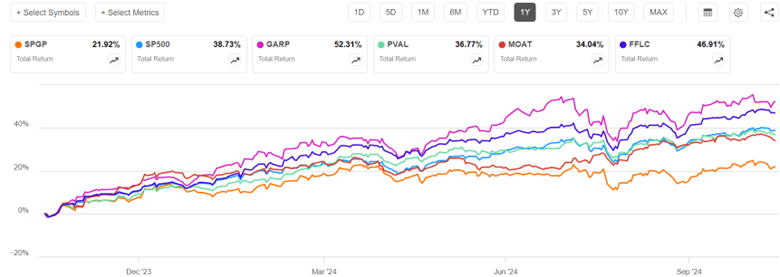
Over the past one year, GARP (52% return) soared way above S&P 500 (blue line, 39%), but with high volatility, consistent with its heavy growth/tech exposure. FFLC steadily pulled ahead of SP500 over the past twelve months, racking up a 47% return. PVAL and MOAT finished close to SP500, while tech-poor SPGP flat-lined in the most recent six months and so got left far behind.
Three-Year Chart (End Oct 2021-end Oct 2024)
The defining features of the past three years were a roughly 21% bear market decline in S&P 500 during Jan-Oct 2022, followed by a strong recovery, which was interrupted by a moderate slump July-Oct 2023. FFLC and PVAL performed nearly identically for the first third of this time period (through early March, 2023). They dropped much less than SP500 in 2022, and so by early March, 2023 they were some 15% ahead of SP500. PVAL’s lead over SP500 shrank a bit over the next twelve months, and then widened March-July 2024, to give PVAL (43%) a 16% advantage over SP500 (27%) at the end of three years. FFLC just kept steadily widening its lead over SP500, ending with a 58% return over this three-year time period. MOAT and SPGP also fell less than SP500 in 2022, but fell more than PVAL and FFLC, and they did not keep pace with the tech-led surge in 2023-2024. In the end, MOAT finished essentially even with SPY, and SPGP finished lower (18%). Tech-heavy GARP crashed harder than SP500 in 2022, but more than made up for it with the 2024 tech-fest, finishing well above SP500 and tied with PVAL at 43%.
I won’t show the full five-year chart, since some of the funds did not start prior to that period. But I will make a few semi-quantitative comments. The five-year time period is a little kinder to SPGP – this fund showed a fairly consistent lead over SP500 in 2021 as well as 2022, and so got rave reviews then in the investing literature. It was only in the past six months that it performed so poorly.
FFLC got off to a rocky start, falling about 10% behind SP500 in 2020-2021, although its winning ways since then gave it the overall best 5-year performance. GARP and MOAT pretty much kept pace with SP500 Oct 2019-Oct 2021, so their five-year performance vs SP500 is about the same as for three-year (GARP soundly beat SP500, MOAT roughly tied).
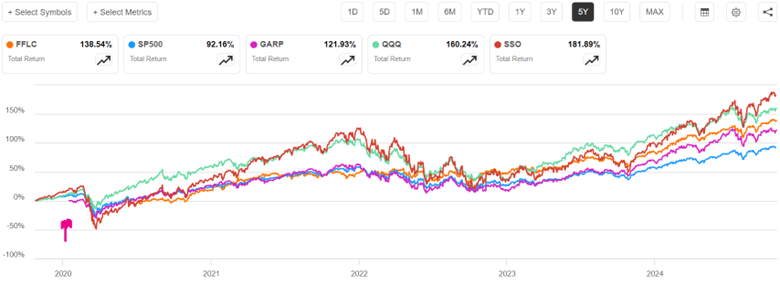
One more chart (below), a five-year comparison of SP500 to FFLC (overall winner among the active funds discussed above) and GARP (tech-heavy) to QQQ (passive, tech-heavy, tracks NASDAQ 100 stocks) and SSO (its stock price moves up and down 2X the daily price movement of S&P500). GARP didn’t start operation till early 2020 (marked by red arrow on chart), to its curve should be shifted up to make a fair comparison with the others; with this correction, it would end up roughly tied with FFLC, with both these funds beating SP500 by about 33% (135% return vs 92%). But even these stellar active funds were soundly beaten by QQQ and even more by the passive 2X fund SSO. Holders of SSO, however, would have suffered heart-stopping drawdowns along the way (e.g. over 50% loss in market value in early 2020).
Readers can draw their own conclusions from this flyover of results. Just like you can fool people some of the time, any active fund may beat “the market” (e.g., S&P 500) some of the time. Some active funds seem to beat the market most of the time. But it is most unlikely that any given fund will beat it all of the time. The S&P 500 algorithm is actually pretty effective. It may behoove the investor to make their own judgement as to what market regime we are in or are about to be in, and to choose active funds which are more likely to thrive in that regime.
I am motivated to include some FFLC (for overall consistent good performance) and PVAL (for a bit of crash protection) in my holdings. But I recognize that their performance could deteriorate in the future, if their investing style no longer works in some new market regime. SPGP is a cautionary example, going from rock star in 2021-2022 to awful in 2024. Even FFLC had an unfavorable first year of operation. The tech giants that dominate QQQ continue to also dominate earnings growth, so QQQ may continue to outpace SP500.
As far as SSO, I earlier wrote on strategies for 2X returns using 2X funds or call options. If you think stocks are going to keep going up, it can make sense to hold these 2X funds. Many advisors, though, recommend against just buy and hold because of the enormous possible losses in a crash; too many investors panic and sell at a low price in that situation. I hold some QLD, which is a 2X QQQ fund, but only as a minor component of my portfolio. Also, if I can overcome fear in the moment, I plan to swap out of plain vanilla stock funds and into a 2X fund like SSO after the next big dip in the market, and then swap back out of SSO after the market recovers.
Disclaimer: Nothing here should be considered advice to buy or sell any security.
I focus much of my investing energy in the “high yield” area, finding stocks that pay out highish yields (8-12%, these days). Unless the company really hits hard times and has to cut its payout, I know I will make those returns over the next twelve months. But with ordinary stocks, you cannot count on any particular returns. The price of any stock a year from now will be the earnings per share (which can be forecasted with some degree of accuracy) times the price/earnings ratio, which is largely dependent on the emotions (“animal spirits”, in the words of Keynes) of the millions of market participants. Will I find a “greater fool” to buy my Amazon stock in a year for 20% more than I paid for it??
I have never gotten really comfortable with that as an investing model, and so I have erred on the side of caution and generally held less than the recommended 60% or so of my portfolio in plain stocks. In hindsight, that was a mistake. Every $10,000 put into the plain, dumb S&P500 fund SPY twenty years ago has turned into roughly $200,000. One reason for my caution has been a steady stream of articles that always warn that stocks are overvalued; after going up so much in the past X years, surely returns will be poor for the next several years.
But I try to learn from my mistakes, and I am now forcing myself to hold more equities than I “feel” like. To support this hopefully rational behavior, I am paying more attention to articles that present bull cases for stocks. One author on the Seeking Alpha investing site who has been consistently and correctly bullish for the past two years is Lawrence Fuller. Here I will summarize his Oct 9 article with the tongue-in-cheek title Be Afraid, Be Very Afraid. (To read articles on Seeking Alpha, you may have to start a free account, where you just have to give them an email address; I use my secondary “junk” email for these sorts of applications, which tend to send a lot of junky (not malicious) notifications).
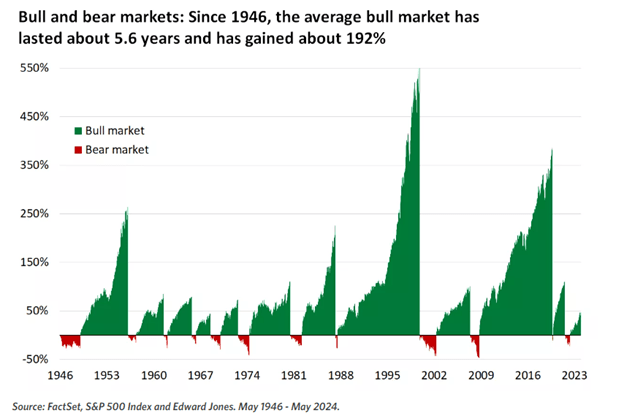
He first addressed the angst that says, “Stocks have already run up so much, they are due for a crash”, by means of this chart showing cumulative returns in preceding bull markets:
It is obvious that, compared to the average bull market, we are still in early innings with the present bull which started in Oct 2022.
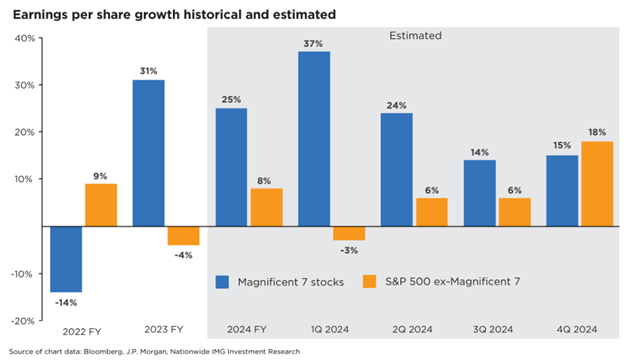
Fuller also makes the case that the good news on earnings has spread recently from the so-called Magnificent Seven big tech stocks (Microsoft, Apple, Nvidia, etc.) to the broader market. This should serve to support further price rises in the broad indices:
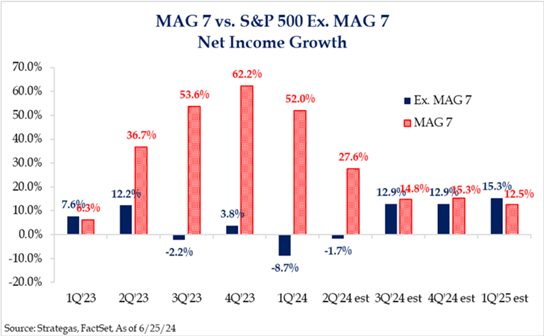
The chart below, which shows a similar story, in terms of net income growth:
He concludes:
“It is also important to recognize that the valuation of the S&P 500 is far more reasonable when we exclude the exceedingly expensive Magnificent 7 and focus on the remaining 493. In fact, we don’t have the valuation problem that bears purport we have today. Hence, I advised investors to avoid the market-cap-weighted indexes and focus on equal weight or look at sectors that had been left behind during the bull market to date…Therefore, I suggest not succumbing to fear. Instead, focus on whether the weight of evidence suggests we should be in wealth accumulation mode or wealth preservation mode.”
In a follow-up article, Are You Worried About An Overvalued Market? , Fuller notes that small cap stocks (as defined by the Russel 2000 index, which is held by the IWM fund) are more reasonably valued than big tech, and so are likely to outperform over the next year.
Economic data will appear alarming due to hurricane impacts, but the economy is growing at 3% with strong corporate profit prospects and low recession risk.
Inflation is on track to fall to 1.8% by May, with real wage growth outpacing pre-pandemic trends. Future inflation is expected to remain stable at 2.1% over the next 30 years.
Market valuation is not as overvalued as feared, with potential for significant upside (up to 30% to 38%) based on corporate profit growth and falling interest rates.
Short-term market volatility is normal; long-term investors should embrace corrections for potential high returns as fundamentals remain strong.
The average 2-year return after a 10+% correction is 35%, meaning long-term investors should embrace corrections as wonderful buying opportunities. Buy with confidence in the face of any short-term market weakness, as long as you stick to your optimal personal asset allocation, based on your specific risk profile and financial needs.
This article has a number of interesting and informative sections, including on why cash flow/enterprise value is a better metric for assessing the valuation of a stock than price/earnings.
Last week as the U.S. National Weather Service was warning Florida residents of incoming 120 mile/hour winds, folks in the U.K were informed by the BBC weather app that the wind speed outside was – – wait for it – – 18,995 mph. Hurricane force winds were displayed for many cities worldwide. Not to mention temperatures of around 400 F for Nottingham, New York, and Sydney.
The BBC of course issued retractions and apologies, blaming a third-party data supplier. Said supplier, meteorological forecasting company DTN has apologized for what it called a “technical error”.
I had my Brave browser do an AI search/summary on the topic, “What measures does the BBC take to prevent or mitigate the impact of third-party supplier issues on its weather forecasting app?”. Here is what it told me:
Based on the provided search results, the BBC takes the following measures to prevent or mitigate the impact of third-party supplier issues on its weather forecasting app:
Diversified data sources: The BBC uses multiple data suppliers, including MeteoGroup, to ensure that its forecasts are accurate and reliable. This diversification helps to reduce dependence on a single supplier and minimizes the impact of issues with a particular supplier.
Real-time updates: The BBC’s weather app provides real-time updates, which enable it to quickly respond to and correct any errors or inaccuracies caused by third-party supplier issues.
Error detection and correction: The BBC’s weather experts closely monitor forecasts and are able to detect and correct errors or inaccuracies caused by third-party supplier issues.
Technical redundancy: The BBC has implemented technical redundancy measures, such as backup systems and fail-safes, to minimize the impact of third-party supplier issues on its weather forecasting app.
Collaboration with other organizations: The BBC collaborates with other organizations, such as the Met Office and Scottish airline Loganair, to improve forecast accuracy and mitigate the impact of third-party supplier issues.
Investment in technology and AI: The BBC invests in advanced technology and artificial intelligence to improve the accuracy and reliability of its weather forecasts, reducing the reliance on third-party suppliers and minimizing the impact of issues.
Monitoring and maintenance: The BBC regularly monitors and maintains its weather forecasting app and underlying systems to identify and address potential issues before they become critical.
These measures demonstrate the BBC’s proactive approach to mitigating the impact of third-party supplier issues on its weather forecasting app, ensuring that users receive accurate and reliable forecasts.
That all sounds great in theory, but in practice something failed last week. I guess there is so far no fool-proof substitute for having a pair of human eyeballs look at material before it is flung out into cyberspace. But that might cost money.
Nobody is saying, but it would not surprise me if the BBC adds yet another layer of auto-checking to its robo-forecasts, to at least flag physically unrealistic numbers.
For many years, it has been stated as settled science that Americans need to cut back their sodium intake from the current averages of about 3400 mg/day to less than 2400 mg sodium (about 1 teaspoon of table salt). The 2400 mg figure is endorsed by the National Academies, as described in the 164-page (we’re from the government and we’re here to help) booklet Dietary Guidelines for Americans published by USDA and HHS. The reason given is that supposedly there is a roughly linear relationship between salt intake and blood pressure, with higher blood pressure correlating to heart disease. The World Health Organization (WHO) recommends less than 2000 mg.
The dietary salt boat has been rocked in the past several years by studies claiming that cutting sodium below about 3400 mg does not help with heart disease (except for patients who already incline toward hypertension), and that cutting it much below 2400 mg is actually harmful.
The medical establishment has come out swinging to attack these newer studies. A 2018 article (Salt and heart disease: a second round of “bad science”? ) in the premier British medical journal The Lancet acknowledged this controversy:
2 years ago, Andrew Mente and colleagues, after studying more than 130000 people from 49 different countries, concluded that salt restriction reduced the risk of heart disease, stroke, or death only in patients who had high blood pressure, and that salt restriction could be harmful if salt intake became too low. The reaction of the scientific community was swift. “Disbelief” was voiced that “such bad science” should be published by The Lancet. The American Heart Association (AHA) refuted the findings of the study, stating that they were not valid, despite the AHA for many years endorsing products that contain markedly more salt than it recommends as being “heart healthy”.
This article went on to note that, “with an average lifespan of 87·3 years, women in Hong Kong top life expectancy worldwide despite consuming on average 8–9 g of salt per day, more than twice the amount recommended by the AHA recommendation. A cursory look at 24 h urinary sodium excretion in 2010 and the 2012 UN healthy life expectancy at birth in 182 countries, ignoring potential confounders, such as gross domestic product, does not seem to indicate that salt intake, except possibly when very high, curtails lifespan.”
In 2013, an independent review of the evidence by the National Academy of Medicine (NAM) concluded there to be insufficient evidence to support a recommendation of low sodium intake for cardiovascular prevention. However, in 2019, a re-constituted panel provided a strong recommendation for low sodium intake, despite the absence of any new evidence to support low sodium intake for cardiovascular prevention, and substantially more data, e.g. on 100 000 people from Prospective Urban Rural Epidemiology (PURE) study and 300 000 people from the UK-Biobank study, suggesting that the range of sodium intake between 2.3 and 4.6 g/day is more likely to be optimal.
… In this review, we examine whether the recommendation for low sodium intake, reached by current guideline panels, is supported by robust evidence. Our review provides a counterpoint to the current recommendation for low sodium intake. We suggest that a specific low sodium intake target (e.g. <2.3 g/day) for individuals may be unfeasible, have uncertain consequences for other dietary factors, and have unproven effectiveness in reducing cardiovascular disease. We contend that current evidence, despite methodological limitations, suggests that most of the world’s population consume a moderate range of dietary sodium (1–2 teaspoons of salt) that is not associated with increased cardiovascular risk, and that the risk of cardiovascular disease increases when sodium intakes exceed 5 g/day.
Some researchers have propagated a myth that reducing sodium does not consistently reduce CVD but rather that lower sodium might increase the risk of CVD. These claims are not well-founded and support some food and beverage industry’s vested interests in the use of excessive amounts of salt to preserve food, enhance taste, and increase thirst. Nevertheless, some researchers, often with funding from the food industry, continue to publish such claims without addressing the numerous objections.
Ouch.
I don’t have the expertise to dig down and make a ruling on who is right here. But I do feel better about eating my tasty salty chips, knowing I have at least some scholarly support for my habit.
Having a peanut allergy is a serious health concern, both as an adult and for one’s child. For a sensitized person, exposure to peanut-containing products can be fatal if an Epi-pen or emergency room is not available for an epinephrin injection. Since this is an economics blog, I’ll note that a 2012 survey estimated the economic cost of any food allergy in US children at $24.8 billion annually, or $4184 per child. This includes direct medical costs, and the indirect costs, including opportunity costs, for children and their caregivers.
Out of an abundance of caution, pediatricians in the 1990s started recommending that parents keep peanuts from their infants and children. Instead of protecting children, however, this policy has done just the opposite. The incidence of peanut allergies has soared, with now some 2.5% of the pediatric population showing peanut allergies:
Around the year 2000 peanut allergies began to skyrocket. Sales of EpiPens, used in cases of peanut-induced anaphylactic shock, became a major expense for parents and a growing profit center for the manufacturer. … So, what changed? How did peanuts go from cheap, nutritious food source to become the little death pills that we think of them today? The answer is not what you would expect: pediatricians created the peanut allergy epidemic.
Meanwhile, the more that health officials implored parents to follow the recommendation, the worse peanut allergies got. From 2005 to 2014, the number of children going to the emergency department because of peanut allergies tripled in the U.S. By 2019, a report estimated that 1 in every 18 American children had a peanut allergy.
Peanut allergies in American children more than tripled between 1997 and 2008, after doctors told pregnant and lactating women to avoid eating peanuts and parents to avoid feeding them to children under 3. This was based on guidance issued by the American Academy of Pediatrics in 2000.
You probably also know that this guidance, following similar guidance in Britain, turned out to be entirely wrong and, in fact, avoiding peanuts caused many of those allergies in the first place.
That should not have been surprising, because the advice violated a basic principle of immunology: Early exposure to foreign molecules builds resistance. In Israel, where babies are regularly fed peanuts, peanut allergies are rare. Moreover, at least one of the studies on which the British advice was based showed the opposite of what the guidance specified.
As early as 1998, Gideon Lack, a British pediatric allergist and immunologist, challenged the guidelines, saying they were “not evidence-based.” But for years, many doctors dismissed Dr. Lack’s findings, even calling his studies that introduced peanut butter early to babies unethical.
When I first reported on peanut allergies in 2006, doctors expressed a wide range of theories, at the same time that the “hygiene hypothesis,” which holds that overly sterile environments can trigger allergic responses, was gaining traction. Still, the guidance I got from my pediatrician when my second child was born that same year was firmly “no peanuts.”
It wasn’t until 2008, when Lack and his colleagues published a study showing that babies who ate peanuts were less likely to have allergies, that the A.A.P. issued a report, acknowledging there was a “lack of evidence” for its advice regarding pregnant women. But it stopped short of telling parents to feed babies peanuts as a means of prevention. Finally, in 2017, following yet another definitive study by Lack, the A.A.P. fully reversed its early position, now telling parents to feed their children peanuts early.
But by then, thousands of parents who conscientiously did what medical authorities told them to do had effectively given their children peanut allergies.
This avoidable tragedy is one of several episodes of medical authorities sticking to erroneous positions despite countervailing evidence that Marty Makary, a surgeon and professor at Johns Hopkins School of Medicine, examines in his new book, “Blind Spots: When Medicine Gets It Wrong, and What It Means for our Health.”
Rather than remaining open to dissent, Makary writes, the medical profession frequently closes ranks, leaning toward established practice, consensus and groupthink.
This article describes further instances of poorly-founded medical advice. Women were scared away from helpful estrogen hormone replacement therapy for many years because of unfounded fears of breast cancer. Blood donor institutions suppressed concerns about AIDS in donated blood, in order to not rock the boat:
In 1983, near the beginning of the AIDS crisis, the American Red Cross, the American Association of Blood Banks and the Council of Community Blood Centers rejected a recommendation by a high-ranking C.D.C. expert to restrict donations from people at high risk for AIDS. Instead, they issued a joint statement insisting that “there is no absolute evidence that AIDS is transmitted by blood or blood products.” The overriding concern was that Americans would not trust the blood supply, or donate blood, if people questioned its safety.
As with the advice on peanuts, a reversal came about far later than it should have. It took years for the blood banking industry to begin screening donors and it wasn’t until 1988 that the F.D.A. required all blood banks to test for H.I.V. antibodies. In the interim, half of American hemophiliacs, and many others, were infected with H.I.V. by blood transfusions, leading to more than 4,000 deaths.
That is poignant for me, since a good friend of mine died from AIDS that he contracted through a blood transfusion in that timeframe.
Well, what to do now about peanuts? It seems an obvious action is to expose infants to peanuts, at 4-6 months, along with other solid foods – – perhaps with the caveat to start with small doses and preferably stay within driving distance of an emergency room should that be needed. As for children who now manifest peanut allergies, there is some hope of desensitizing them if you start young enough, preferably no more than three years old.



 Economist Writing Every Day