Is the Monster Jobs Report Just a Head-Fake?

Financial markets have sustained themselves for nearly two years now on the hope that within 1-2 quarters, the Fed will finally relent and start lowering interest rates. This hope gets dashed again and again by data showing stubbornly persistent high employment, high GDP growth, and high inflation, but the hope refuses to die.

Long-term interest rates had been falling nicely for the last month, based on expectations of rate cuts in the fall. Then came Friday’s jobs report, and, blam, up went 10-year rates again.  The Bureau of Labor Statistics (BLS) published its “Establishment” survey of data gleaned from employers. Non-farm payrolls rose by US 272k.  This was appreciably higher than the 180k consensus expectation.

The plot below indicates that this number fits into a trend of essentially steady, fairly high employment gains (suggesting ongoing inflationary pressures):

There are fundamental reasons to take the BLS Establishment figures with a grain of salt. They have a history of significant revisions some months after first publication. Also, BLS uses a  “birth/death” model for small businesses, which can account for some 50% (!) of the job gains they report.  [1]

Another factor is that all of the net “jobs” created in recent quarters are reported to be part-time. According to Bret Jensen at Seeking Alpha, “Part-time jobs rose 286,000 during the quarter, while full-time jobs fell by just over 600,000. This is a continuation of a concerning trend where over the past year, roughly 1.5 million part-time positions were created while approximately one million full-time jobs were lost. This difference is that the BLS survey does not account for people working two or three jobs, which are now at a record as many Americans have struggled to maintain their standard of living during the inflationary environment of the past couple of years.”

It seems, then, that this week’s huge “jobs added” figure is not to be taken as indicating that the economy is overheated. However, it is still warm enough that rate cuts will be postponed yet again. A different BLS survey (“Household”) showed unemployment creeping up from 4.0% to 4.1%, which again suggests a more or less steady and fairly robust employment picture.

As far as drivers of inflation, I would look especially at wage growth. That is fitfully slowing, but not nearly enough to get us to the Fed’s 2% annual inflation target. My sense is that ongoing enormous federal deficit spending will keep pumping money into the economy fast enough to keep inflation high. High inflation will prevent significant interest rate cuts, assuming the Fed remains responsible. The interest payments on the federal debt will balloon due to the high rates, leading to even more deficit spending.  If we actually get an economic downturn, leading to job insecurity and a willingness of workers to accept slower wage growth in the private sector, the federal spending floodgates will open even wider.

This makes hard assets like gold look attractive, to hedge against inflating U.S. dollars. This is one reason China has been quietly selling off its dollar hoard, and buying gold instead.

[1] For more in-depth treatments of employment statistics, see posts by fellow blogger Jeremy Horpedahl, e.g. here.

How an All-U-Can-Eat Special Driven by a Controlling Investor Pushed Red Lobster Over the Edge

The Red lobster restaurant chain has historically positioned itself in what was hopefully a sweet spot between slow, expensive, full-service restaurants, and cheaper fast-food establishments. With its economies of scale, the Red Lobster franchise could engage in national advertising and improved supply contracts, giving it an advantage over small family-owned local restaurants.

The firm has been struggling for a number of years, caught between the quasi-upscaling of many fast-food chains, and the rise of fast-casual competitors like Chipotle. Also, seafood is more expensive to procure compared to chicken and beef, and the pandemic made a long-lasting dent in their revenues. That said, Red Lobster has been viable business for decades.

However, the firm has been adversely affected by financial engineering by outside companies. General Mills spun off Red Lobster to a company called Darden Restaurants in 1995. In 2014 Darden sold Red Lobster to a private equity firm called Golden Gate Capital for $2.5 billion. Golden Gate promptly plundered Red Lobster by selling its real estate out from under it. Instead of owning their own land and buildings, now the restaurants had to pay rent to landlords.  This put a permanent hurt on the restaurant chain’s profits. After this bit of financial engineering, the private equity firm in 2019 sold a 49% stake to a company called Thai Union. Thai Union bought out the rest of Red Lobster ownership from Golden Gate in 2020.

The Iron Fist from Outside

Thai Union is a huge seafood producer, which operates massive shrimp farms in Southeast Asia and sells a lot of shrimp to Red Lobster.
Although Thai Union initially said they would not interfere in the operations of Red Lobster, that’s not how it panned out.

An article by CNN author Nathaniel Meyersohn details how Thai Union took effective control of red lobster management decisions by 2022. Given the restaurant chain’s poor financial performance, it’s understandable that Thai Union would want to shake things up, but unfortunately the hatchet men they brought in appeared to have done more harm than good. Numerous off the record conversations agreed that the outside CEO was unnecessarily rude as well as incompetent. Knowledgeable Red Lobster veterans were driven out, and morale plummeted. Per Meyersohn:


Thai Union’s damaging decisions drove the pioneering chain’s fall, according to 13 former Red Lobster executives and senior leaders in various areas of the business as well as analysts. All but two of the former Red Lobster employees spoke to CNN under the condition of anonymity because of either non-disclosure agreements with Thai Union; fear that speaking out would harm their careers; or because they don’t want to jeopardize deferred compensation from Red Lobster…

Former Red Lobster employees say that while the pandemic, inflation and rent costs impacted Red Lobster, Thai Union’s ineptitude was the pivotal factor in Red Lobster’s decline.

“It was miserable working there for the last year and a half I was there,” said Les Foreman, a West Coast division vice president who worked at Red Lobster for 20 years and was fired in 2022. “They didn’t have any idea about running a restaurant company in the United States.”

At Red Lobster headquarters, employees prided themselves on a fiercely loyal culture and low turnover. Some employees had been with the chain for 30 and 40 years.  But as Thai Union installed executives at the chain, dozens of veteran Red Lobster leaders with deep knowledge of the brand and restaurant industry were fired or resigned in rapid succession. Red Lobster ended up having five CEOs in five years…

Former Red Lobster employees describe a toxic and demoralizing environment as Thai Union-appointed executives descended on headquarters and interim CEO Paul Kenny eventually took over the chain in 2022. Kenny, an Australian-born former CEO of Minor Food, one of Asia’s largest casual dining and quick-service restaurants, was part of the Thai Union-led investor group that acquired Red Lobster.

Kenny criticized Red Lobster employees at meetings and made derogatory comments about them, according to former Red Lobster leaders who worked closely with Kenny…

At the direction of Thai Union, Kenny became interim CEO, according to Red Lobster’s bankruptcy filing.

In the months after Kenny took over, Valade’s leadership team and other veteran leaders left. In July of 2022, the chief operations officer and six vice presidents of operations overseeing restaurants were abruptly fired shortly before Red Lobster’s annual general manager conference.

Kenny appointed a Thai Union frozen seafood manager, Trin Tapanya, as Red Lobster’s chief operations officer overseeing restaurants. Tapanya had no experience running restaurants. He did not respond to CNN’s requests for comment.

Other Thai Union representatives also became more closely involved across Red Lobster’s supply chain, finance, operations and strategy teams…Thai Union took a larger role in Red Lobster’s supply chain decisions, despite pledges in 2020 that it would not interfere.

Red Lobster had spent decades developing a wide array of suppliers to buy at competitive prices and mitigate the risks of becoming too reliant on any single supplier.

Thai Union blew that up.

Red Lobster employees say they were pressured by Thai Union representatives to buy more seafood from Thai Union. Thai Union representatives also began sitting in on meetings between Red Lobster and seafood suppliers, said one of the former Red Lobster employees who witnessed these conversations. Thai Union was the direct competitor of these other seafood suppliers, and suddenly had intimate access to their products, prices and strategy. “Our suppliers were really upset that [Thai Union representatives] were in those meetings with them,” this person said.

Red Lobster now claims that Thai Union pushed out other shrimp suppliers, “leaving Thai Union with an exclusive deal that led to higher costs to Red Lobster”.

The “Endless Shrimp” Disaster
The final blow to Red Lobster was offering an every-day special of all the shrimp you can eat. The firm had historically offered occasional all you can eat specials, to draw in first-time customers. But they had learned from a disastrous extended all you can eat crab special back in 2003, that if you are not very careful, you can lose a ton of money letting people eat all they want of an expensive food item.

Apparently, Thai Union pressured Red Lobster into offering an every-day “Endless Shrimp” special starting in June, 2023. Old guard Red Lobster management tried to push back, but were overruled. For Thai Union, this was of course a chance to sell more shrimp. But it led to huge losses on the part of Red Lobster. Internet personalities boosted their viewings by wolfing down plate after plate after plate of expensive shrimp:

The deal quickly went viral on social media. People started posting videos on Tik Tok showing how many shrimp they could eat. It became something of a challenge where people would try to eat as many shrimp as possible to gain social media clout. For example, a YouTuber called The Notorious Bob ate 31 plates of shrimp. Each plate has six shrimp so he ate 186 shrimp in total … another YouTuber called Sir Yacht stayed at Red Lobster for 10 hours and ate 200 shrimps throughout the day.

Red Lobster has now filed for Chapter 11 bankruptcy protection from its creditors, while it further downsizes to try to stay afloat. Thai Union has written down its investment in Red Lobster to the tune of $540 million, and its creditors now own the company.

The various actors in our current financial system played their usual roles here: General Mills spun off a non-core business; a private equity firm plundered its acquisition and then dumped it, presumably making gobs of money in the process for its partners; a supplier acquired a downstream company to develop a more integrated business line; a venerable American brand simply lost ground (think: Sears) in the competitive market place as tastes and competition changed over time, with vicious cost-cutting unable to save it.

This story is somewhat tragic, but I’m not sure there are any real villains, apart from the obnoxious outside CEO. Thai Union is a powerhouse seafood supplier, but they simply did not understand the American restaurant business and could not come up with a viable plan to fix Red Lobster. The now-unemployed restaurant workers may be victims, but the cooks and wait staff and store managers who worked extra hard, short-handed to keep serving their customers well despite horrible upper management – – to me, those are the heroes here.

On Good and (Mostly) Bad Investments

I ran across an article by Lyn Schwartzer on seeking Alpha last week, which I thought was insightful regarding investments. Here is my summary.

The article is Most Investments Are Bad. Here’s Why, And What To Do About It.    The article’s first bullet point is “Historical data shows that the majority of investments, including bonds, stocks, and real estate, perform poorly.” Unpacking this, looking at various investment classes:

Bonds and Stocks

Investment-grade bonds typically pay interest rates just a little above inflation, so it’s not surprising that they have been mediocre investments over the long-term. The prices of long bonds (10 years or more maturity) tended to rise between about 1985 and 2020, as interest rates came steadily down, but that tailwind is pretty much over.

It has been known for years, e.g. from a study by Hendrik Bessembinder, that only a tiny fraction of stocks makes up the vast majority of returns in equity markets. I wrote about this a couple of years ago on this blog.:

The rise of the S&P is entirely due to huge gains by a tiny subset of stocks. The average stock actually loses money over both short and long time periods. … half of the U.S. stock market wealth creation [1926-2015] had come from a mere 0.33% of the listed companies… Out of some 26,000 listed companies, 86 of them (0.33%) provided 50% of the aggregate wealth creation, and the top 983 companies (4%) accounted for the full 100%. That means the other 25,000 companies netted out to zero return. Some gave positive returns, while most were net losers.

As investors, we of course want to know how to lock in on those few stocks that will perform well. I see two approaches here, not mentioned in the article. One is to be very good at analyzing the finances and market environments of companies, to be able to pick individual firms which will be able to grow their profits. Being lucky here probably helps, as well.   An easier and very effective method is to simply invest in the S&P 500 index funds like SPY or VOO. Because these funds are weighted by stock capitalization, they inexorably increase their weighting of the more successful companies and dial down the unsuccessful companies. This dumb, automatic selection process is so effective that it is very difficult for any active stock-picking fund manager to beat the S&P 500 for any length of time.

What the article suggests in this regard is to focus on businesses that have “durable competitive advantages (network effects, powerful brands, intangible property, economies of scale, oligopoly participation, and so forth),” or to try to pick up decent/mediocre companies at a low price.

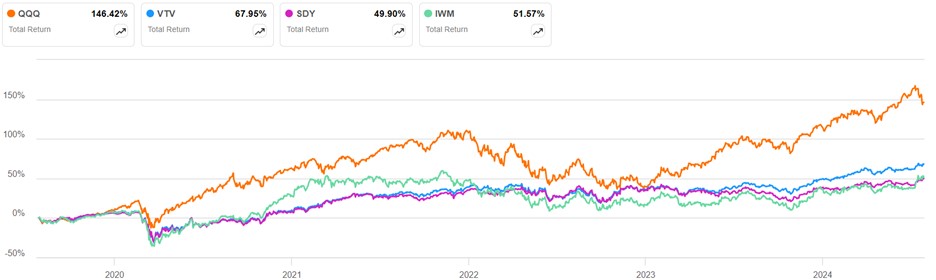
The big tech companies which are mainly listed on the NASDAQ exchange have these durable advantages, and indeed the QQQ fund which is comprised of the hundred largest stocks on the NASDAQ has far outpaced the broader-based S&P 500 fund over the last 10 or 20 years.

Real Estate

All of us suburbanites know that owning your own home has been one of the best investments you can make, over the past few decades. The article points out, however, that real estate in general has not been such a great performer. If your property is not located close to a thriving metropolitan area, where people want to live, it can be a dog.    The article cites abandoned properties all around Detroit (“large once-expensive homes that are now rotting on parcels of land that nobody wants”), and notes, “In Japan, there are millions of abandoned countryside homes that are nearly free. Many of them are in beautiful and safe rural areas, and yet there is insufficient demand for them.”

And so, “Most real estate falls somewhere between those extremes. It performs decently, especially when considering that it can replace the owner’s rental income or be rented out for cashflows, but after maintenance and taxes are considered, its unlevered total return from price appreciation and cashflow generation net of maintenance leaves something to be desired relative to gold.”

Gold As a Reference

The article uses gold as, well, the gold standard of investing returns. The supply of gold creeps up roughly 1.5% per year, so after say 95 years there is four times as much physical gold as before. We find that an ounce of gold will buy more food or more manufactured goods than it did a century ago, but that is because our efficiency of producing such things has increased faster than the gold supply. On the other hand, “All government bonds have underperformed gold over the long run, and most unlevered real estate has underperformed gold as well.” Stocks in the broad U.S. market (most foreign stock markets did more poorly) greatly outperformed gold, but that is only accomplished by the top 4% of stocks. The other 96% of stocks as group did not generate any excess returns.

Owner-Operators versus Passive Investors

I am looking at these issues from the point of view of a passive investor – I have some extra cash that I want to plow into some investment, and have it return my original capital plus another say 10%/year, without me having to do extra work. It turns out that many companies, especially smaller ones, provide useful products to customers and they make enough profit to pay off the owner/operators and the employees, but not enough to reward outside passive investors, too. These companies serve an important role in society, but are not viable investment vehicles:

Being an owner-operator of a business, or a worker at a business, makes a lot of sense. However, the vast majority of businesses are not strong enough to provide good returns for outside passive investors after all expenses (including salaries) are considered.

Good returns for outside passive investors are reserved for only the best types of companies; companies that are so dominant and high-margin that even after paying all of their executives and workers, they have plenty of excess profits for outside passive investors. Although stocks from any sector can have these characteristics, Bessembinder’s research found that major outperformers were disproportionally concentrated in the technology, telecommunications, energy, and healthcare/pharmaceutical sectors. They are on the right side of an emerging tech trend, they have network effects, they have economies of scale, they have protected intangible property such as patents, or they are part of an oligopoly, and so forth.

Similarly, real estate (especially unlevered), works most easily when it is occupied or used by the owner. After all, you must live somewhere. Now, you can make money buying and renting/flipping properties, but that typically demands work on your part. You add value by fixing the tenant’s toilet or arranging for a plumber, or by scoping the market and identifying a promising property to buy, and by working to upgrade its kitchen. All this effort is not the same as just throwing money at some building as a passive investor, and walking away for five years.

Upping Returns via Leverage

This is a packed sentence: “Historically, a key way to turn mediocre investments into good investments has been to apply leverage. That’s not a recommendation; that’s a historical analysis, and it comes with survivorship bias.”

For example, banks have historically borrowed money (e.g. from their depositors) at lowish, short-term rates, and combined a lot of those funds with the bank corporate equity, to purchase and hold longer-term bonds that pay slightly higher rates. Banks are often levered (assets vs. equity) 10:1. This technique allows them to earn much higher returns on their equity than if they used their equity alone to buy bonds.

It is easy to leverage real estate. If you put 20% down and borrow the rest, bam, you are levered 5:1. Now if the value of your house goes up 6%/year while you are only paying 3% on your mortgage, the return on the actual cash (the 20% down) you put in becomes quite juicy: “After maintenance and recurring taxes, the majority of unlevered real estate, even when rented out for cashflows, doesn’t outperform gold. But unlike gold, 5-to-1 leverage makes real estate actually pretty good in many contexts, and historically allows it to outperform gold.”

Large corporations can leverage up by issuing relatively low-interest bonds: “They can borrow large amounts of money for decades at low interest rates, and use that capital to organically expand their business, buy smaller companies, or buy back their own shares. Either way, they are borrowing abundant fiat currency at low rates and using that capital to build or buy business equity, and they are arbitraging that spread for shareholders.”

Savvy firms like Warren Buffett’s Berkshire Hathaway take it a step further, by having controlling interests in insurance companies, and investing the low-cost “float” funds, as we described here. From the article:

Berkshire has also made a habit out of buying small and medium sized private businesses in full. Many of these smaller companies would have higher borrowing costs if they were independent. But Berkshire can buy a lot of them, and then issue corporate debt at the parent company level at much lower interest rates than any of them could issue on their own. So he can buy a lot of unlevered cashflow-producing small or medium-sized businesses, and turn them into a portfolio of businesses that are levered with Berkshire’s very low cost of capital.

Now other companies like Ares Management and Apollo are jumping onto this arbitrage bandwagon, buying up insurance companies to get access to their captive cash, to be used for investing.

Here is another rough example of the power of leverage. The unleveraged fund BKLN holds bank loans, and so does the closed end fund VVR. But VVR borrows money to add to the shareholders’ equity. There is more complication (discount to net asset value) with VVR which we will not go into, but the following 5-year chart of total returns (share price plus reinvested dividends) shows nearly triple the return for VVR, albeit with higher volatility:

The Changing Global Economic Landscape

The article closes with some summary observations and recommendations. The past 30-40 years have been marked by ever-decreasing interest rates, and by cooperation among nations and generally increasing globalization. It seems that these trends have broken and so what worked for the last four decades (buy stocks, shun gold) may not be as good going forward:

For equity and real estate investors, the key takeaways from this piece are 1) do not extrapolate the prior decades for a given investment and instead assess it with this context in mind, 2) try to emphasize the sectors [such as Big Tech]  that Bessembinder identified as ones that disproportionally generate excess returns, and 3) look for companies that have locked in or are otherwise still able to play this arbitrage game going forward in a more difficult environment for it.

Additionally, hard monies [i.e. gold, silver] become a serious alternative once again in this context, and are worth serious consideration for a portfolio slice, because the hurdle rate for stocks to outperform them is high when there are not a lot of tailwinds at the backs of stocks.

How To Import a List of Names and Addresses into Gmail Contact Group

I recently did some business where I had a text file of names and email addresses that I wanted to send a group email to, in Gmail. Here I will share the steps I followed to import this info into a Google contact group.

The Big Picture

First, a couple of overall concepts. In Gmail (and Google), your contacts exist in a big list of all your contacts. To create a group of contacts for a mass email, you have to apply a label to those particular contacts. A given contact can have more than one label (i.e., can be member of more than one group).

To enter one new contact at a time into Gmail, you go to Contacts and Create Contact, and type in or copy/paste in data like name and email address for each person or organization. But to enter a list of many contacts all at once, you must have these contacts in the form of either a CSV or vCard file, which Google can import. So here, first I will describe the steps to create a CSV file, and then the steps to import that into Gmail.

Comma-separated values (CSV) is a text file format that uses commas to separate values. Each record (for us, this means each contact) is on a separate line of plain text. Each record consists of the same number of fields, and these are separated by commas in the CSV file.

A list of names and of email contacts (two fields) might look like this in CSV format:

Allen Aardvark, aaaardvark@yahoo.com

Bob Branson, sface33@gmail.com

Cathy Chase, cchase27@verizon.net

We could have added additional data (more fields) for each contact, such as home phone numbers and cell numbers, again separated by commas.

For Gmail to import this as a contact list, this is not quite enough. Google demands a header line, to identify the meaning of these chunks of data (i.e., to tell Google that these are in fact contact names, followed by email addresses).  This requires specific wording in the header. For a contact name and for one (out of a possible two) email address, the header entries would be “Name” and “E-mail 1 – Value”.  If we had wanted to add, say, home phones and cell phones, we could have added four more fields to the header line, namely: ,Phone 1 - Type,Phone 1 - Value,Phone 2 - Type,Phone 2 – Value   . For a complete list of possible header items, see the Appendix. 

The Steps

Here are steps to create a CSV file of contacts, and then import that file to Gmail:

( 1 ) Start with a text file of the names and addresses, separated by commas. Add a header line at the top: Name, E-mail 1 – Value . If this is in Word, Save As a plain text file (.txt). For our little list, this text file would look like this:

Name, E-mail 1 – Value

Allen Aardvark, aaaardvark@yahoo.com

Bob Branson, sface33@gmail.com

Cathy Chase, cchase27@verizon.net

( 2 ) Open this file in Excel: Start Excel, click Open, use Browse if necessary, select “All Files” (not just “Excel Files”) and find and select your text file. The Text Import Wizard will appear. Make sure the “Delimited” option is checked. Click Next.

In the next window, select “Comma” (not the default “Tab”) in the Delimiters section, then click “Next.” In the final window, you’ll need to specify the column data format. I suggest leaving it at “General,” and click “Finish.” If all has gone well, you should see an Excel sheet with your data in two columns.

( 3 ) Save the Excel sheet data as a CSV file: Under the File tab, choose Save As, and specify a folder into which the new file will be saved. A final window will appear where you specify the new file name (I’ll use “Close Friends List”), and the new file type. For “Save as type” there are several CSV options; on my PC I used “CSV (MS-DOS)”.

( 4 ) Go to Gmail or Google, and click on the nine-dots icon at the upper right, and select Contacts. At the upper left of the Contacts page, click Create Contact. You’ll have choice between Create a Contact (for single contact), or Create multiple contacts. Click on the latter.

( 5 ) Up pops a Create Multiple Contacts window. At the upper right of that window you can select what existing label (contact group name) you want to apply to this new list of names, or create a new label. For this example, I created (entered) a new label (in place of “No Label”), called Close Friends. Then, towards the bottom of this window, click on Import Contacts.

Then (in the new window that pops up) select the name of the incoming CSV file, and click Import. That’s it!

The new contacts will be in your overall contact list, with the group name label applied to them. There will also be a default group label “Imported on [today’s date]” created (also applied to this bunch of contacts). You can delete that label from the list of labels (bottom left of the Contacts page), using the “Keep the Contacts” option so the new contacts don’t get erased.

( 6 ) Now you can send out emails to this whole group of contacts. If this is a more professional or sensitive situation, or if the list of contacts is unwieldy (e.g. over ten or so), you might just send the email to yourself and bcc it to the labeled group.

APPENDIX: List of all Header Entries for CSV Files, for Importing Contacts to Gmail

I listed above several header entries which could be used to tell Google what the data is in your list of contact information. This Productivity Portfolio link has more detailed information.   This includes tips for using VCard file format for transferring contact information (use app like Outlook to generate VCard or CSV file, then fix header info as needed, and then import that file into Google contacts).

There is also a complete list of header entries for a CSV file, which is available as an Excel file by clicking his  “ My Google Contacts CSV Template “  button. The Excel spreadsheet format is convenient for lining things up for actual usage, but I have copied the long list of header items into a long text string to dump here, to give you the idea of what other header items might look like:

Name,Given Name,Additional Name,Family Name,Yomi Name,Given Name Yomi,Additional Name Yomi,Family Name Yomi,Name Prefix,Name Suffix,Initials,Nickname,Short Name,Maiden Name,Birthday,Gender,Location,Billing Information,Directory Server,Mileage,Occupation,Hobby,Sensitivity,Priority,Subject,Notes,Language,Photo,Group Membership,E-mail 1 – Type,E-mail 1 – Value,E-mail 2 – Type,E-mail 2 – Value,Phone 1 – Type,Phone 1 – Value,Phone 2 – Type,Phone 2 – Value,Phone 3 – Type,Phone 3 – Value,Phone 4 – Type,Phone 4 – Value,Phone 5 – Type,Phone 5 – Value,Address 1 – Type,Address 1 – Formatted,Address 1 – Street,Address 1 – City,Address 1 – PO Box,Address 1 – Region,Address 1 – Postal Code,Address 1 – Country,Address 1 – Extended Address,Address 2 – Type,Address 2 – Formatted,Address 2 – Street,Address 2 – City,Address 2 – PO Box,Address 2 – Region,Address 2 – Postal Code,Address 2 – Country,Address 2 – Extended Address,Organization 1 – Type,Organization 1 – Name,Organization 1 – Yomi Name,Organization 1 – Title,Organization 1 – Department,Organization 1 – Symbol,Organization 1 – Location,Organization 1 – Job Description,Relation 1 – Type,Relation 1 – Value,Relation 2 – Type,Relation 2 – Value,Relation 3 – Type,Relation 3 – Value,Relation 4 – Type,Relation 4 – Value,External ID 1 – Type,External ID 1 – Value,External ID 2 – Type,External ID 2 – Value,Website 1 – Type,Website 1 – Value,Event 1 – Type,Event 1 – Value

I bolded the two items I actually used in my example (Name and E-mail 1 – Value), as well as a pair of entries ( Phone 1 – Type and Phone 1 – Value) as header items which you might use for including, say, cell phone numbers in your CSV file of contact information.

“Roaring Kitty” Returns to Social Media, and Reignites Stock Frenzy

Back in early 2021, when we were still locked down, bored and restless, and trillions of pandemic stimulus dollars were pouring into our bank accounts to fund speculative investments, Keith Gill took to social media to argue that the stock of videogame retailer GameStop (GME) was deeply undervalued. He appeared on YouTube as “Roaring Kitty,” and on Reddit under an unsavory moniker.  He rallied an army of retail investors on Reddit to buy up shares of GME, which was heavily shorted by big Wall Street firms. As hoped by the Redditors, this led to a “short squeeze,” where the shorts were forced to buy shares to cover, which drive GME price to the stratosphere.  We discussed this phase of the drama here.

The drama continued as the jubilant retailers sucked so much money from short-selling hedge fund Melvin Capital that it ultimately shut down; the Robin Hood brokerage firm widely used by Redditors suspended trading  in GME for a crucial couple of days, leading to suspicions it caved to pressures from the Wall Street firms and threw the retail investors under the bus; and key parties, including Roaring Kitty himself, were called before a Congressional committee to explain themselves. The story of Roaring Kitty and the meme stock craze was turned into a movie last year called “Dumb Money.”

Keith Gill largely vanished from messaging boards in early 2021. But he came roaring back on Sunday (May 11), posting on X a sketch of a man leaning forward in a chair, a meme among gamers that things are getting serious:

It seems that the Kitty has not lost his magic.  That X post has garnered over 20 million views, and apparently triggered a new surge in GME stock (and in other heavily shorted stocks as well, which is a significant knock-on effect). Here is a five-year chart of GME, showing the craziness in early 2021, which then died down over the next couple of years:

GME stock had finally approached something approximating fundamental fair value, with occasional ups and downs, then Roaring Kitty posted his sketch, and, blam, the next day, the stock nearly doubled:

Keith Gill has followed up with tweets of video clips with a fight theme, including Peaky Blinders, Gangs of New York, Snatch, Tombstone, X-Men Origins: Wolverine, V is for Vendetta and The Good the Bad and the Ugly ; get that testosterone out there roiling (typical meme stock Redditors are youngish males).

As of Tuesday morning, GME had nearly doubled again, up to $57. (I am reasonably sure it will plunge again within the next few months, but I am not into shorting, and the options pricing structure does not make it easy to set up a favorable bearish trade here).

This response is not like the world-shaking short squeeze of 2021, but it still shows an impressive power of social media influencers and memes to move markets.

Proposal: Mandating Hard Prison Time for CEO’s of Companies Whose Consumer Data Gets Hacked Would Cut Down on Data Breaches

Twice in the past year, I have received robo notices from doctors’ offices, blandly informing me that their systems have been penetrated, and that the bad guys have absconded with my name, phone number, address, social security number, medical records, and anything else needed to stalk me or steal my ID.  As compensation for their failure to keep my information safe, they offer me – – – a year of ID theft monitoring. Thanks, guys.

And we hear about other data thefts, often on gigantic scales. For instance, this headline from a couple of months ago: “Substantial proportion” of Americans may have had health and personal data stolen in Change Healthcare breach”. By “substantial proportion” they mean about a third of the entire U.S. population (Change Healthcare, a subsidiary of UnitedHealth, processes nearly half of all medical claims in the nation). The House Energy and Commerce  Committee last week called UnitedHealth CEO Sir Andrew Witty to testify on how this happened. As it turned out:

The attack occurred because UnitedHealth wasn’t using multifactor authentication [MFA], which is an industry standard practice, to secure one of their most critical systems.

UnitedHealth acquired Change Healthcare in 2022, and for the next two years did not bother to verify whether their new little cash cow was following standard protection practices on the sensitive information of around a hundred million customers. Sir Andrew could not give a coherent explanation for this lapse, merely repeating, “For some reason, which we continue to investigate, this particular server did not have MFA on it.”

But I can tell you exactly why this particular server did not have MFA on it: It was because Sir Andrew did not have enough personal liability for such a failure. If he knew that such an easily preventable failure would result in men in blue hauling him off to the slammer, I guarantee you that he would have made it his business within the first month of purchasing Change Healthcare to be all over the data security processes.

Humans do respond to carrots and sticks. The behaviorist school of psychology has quantified this tendency: establish a consistent system to reward behavior X and punish behavior not-X, and behaviors will change. As one example, Iin one corporate lab I worked in, a team of auditors from headquarters came one year for a routine, scheduled audit of the division’s operations. If the audit got less than the highest result, the career of the manager of the lab would be deeply crimped. Our young, ambitious lab manager made it crystal clear to the whole staff that for the next six months, the ONLY thing that really mattered was a spotless presentation on the audit. It didn’t matter (to this manager) how much productivity suffered on all the substantive projects in progress, as long as he was made to look good on the audit.

Let me move to another observation from my career in industry, working for a Certain Unnamed Large Firm, let’s called it BigCo. BigCo had very deep pockets. Lawyers loved to sue BigCo, and regulators loved to fine BigCo, big-time. And it would be a feather in the cap of said regulators, or other government prosecutors, to throw an executive of BigCo in the slammer.

Collusion among private companies to fix prices does do harm to consumers, by stifling competition and thereby raising prices. So, back in the day when regulators fiercely regulated, statutes were enacted making it a criminal act for company agents to engage in collusion, and authorizing severe financial penalties. American authorities were fairly aggressive about following up potential evidence, and over in Europe, police forces would engage in psychological warfare using their “dawn raid” tactic: just as everyone had sat down at their desks in the morning in would burst a SWAT team armed with submachine guns and lock the place down so no one could leave. I don’t know if the guns were actually loaded, but it was most unpleasant for the employees.  BigCo’s main concern was avoiding multimillion dollar fines and restrictions on business that might result from a collusion conviction, so they devoted significant resources to training and motivating staff to avoid collusion.

Every year or two we researchers had to troop into a lecture hall (attendance was taken) and listen to the same talk by the same company lawyer, reminding us that corporations don’t go to jail, people (i.e. employees) go to jail, by way of motivating us to at all costs avoid even the appearance of colluding with other companies to fix prices or production or divide up markets or whatever. This was a live issue for us researchers, since some of us did participate in legitimate technical trade associations where matters were discussed like standardizing analytical tests. If memory serves, the lawyer advised us that if anyone in a trade association meeting, even in jest, made a remark bordering on a suggestion for collusion, we were to stand up, make a tasteful scene to make it memorable, and insist that the record show that the BigCo representative objected to that remark and left the meeting, and then stride out of the room. And maybe report that remark to a government regulator. That maybe sounds over the top, but I was told that just such a forceful response in a meeting actually saved BigCo from being subjected to a massive fine imposed on some other firms who did engage in collusion

My point is that if the penalties (on the corporate or managerial level) for carelessness are severe enough, the company WILL devote more substantial resources to preventing fails. It seems to me that the harm to we the people is far greater from having our personal data sucked out of health care and other company databases, than the harm from corporate collusion which might raise the price of copier paper or candle wax. Thus, I submit that if someone in the C-suite, like the chief information officer or the CEO, were liable to say 90 days in jail, management would indeed apply sufficient resources to data integrity to thwart the current routine data theft.

If I were king, this would be the policy in my realm. I recognize that in the current U.S. legal framework, the corporate structure shields management from much in the way of personal liability, and there are good reasons for that. I suppose another way to get at this is to have automatic fines structured to strip away nearly all shareholder value or management compensation, whilst still allowing the company to operate its business. This would be another route to put pressure on management to prioritize protection for their customers. Sir Andrew’s total compensation package has been running about $20 million/year. To my knowledge, the impact of the recent gigantic data breach on him has been fairly minimal in the big picture. Sure, it was aggravating for him to have to tell the U.S. Congress that he had no idea why his corporate division screwed up so badly, and to have to devote a good deal of effort to damage control, but I am guessing that his golf game (if he is a golfer) was not unduly impacted. He is still CEO, and collecting a princely compensation. But what if the laws were such that a major data hack would automatically result in a claw-back of say 95% of his past two years of compensation, and dismissal from any further management role in that company?  I submit that such a policy would have motivated the good Sir Andrew to have devoted proper diligence and company resources to data integrity, such that this data breach would not have happened.

I don’t mean to pick on Andrew Witty as being uniquely negligent. By all accounts he is a nice guy, but his behavior is paradigmatic of ubiquitous benign management neglect, which has consequences for us little people.

These are just some personal musings; I’m sure readers can improve on these proposals.

My Frozen Assets at BlockFi, Part3: I Finally Recovered 27% of My Original Funds.

Well, it’s finally over. As noted in previous blog posts, back when interest rates were essentially zero, I started an account with cryptocurrency investing firm BlockFi. They paid me a hefty 9% per year for lending out my crypto coin to “trusted institutional counterparties”, backed by large collateral. However, when  Sam Bankman-Fried’s FTX exchange went belly up, it took BlockFi with it. (Bankman-Fried, the former rock-star white knight of the crypto world, is now in prison for fraud).  My funds at BlockFi disappeared into the black hole of bankruptcy proceedings for about a year and a half.

Last month, a judge finally allowed a settlement for clients to withdraw their assets from their interest-bearing accounts. There were two wrinkles. First, you get far less than 100% of your funds. Most of my money got chewed up in the corporate bankruptcy itself, and then was eaten by the law firm (Kroll) processing the bankruptcy and the client reimbursement process. So,  I’m only getting about 27% percent of my money back.

As an aside, Kroll got hacked about a year ago, leaking the names and email addresses of us BlockFi clients, and so some scammer sent out a very well-crafted email that a number of people, including me (briefly) were taken in by, as I wrote earlier.  if you responded to that scam email, you ended up connecting your wallet to a scam application, which could then suck everything out of your wallet. Fortunately, I had almost nothing in my wallet for the short time I had it connected, but other victims lost considerable sums. I guess the reason why criminals continue to run crypto scams is because they are profitable, like the legendary bank robber Willie Sutton who robbed banks because “that’s where the money is.”

The other wrinkle In the BlockFi reimbursement is that they will only reimburse you with the actual cryptocurrency coin that you held, not with its dollar value. So, I had to set up a cryptocurrency wallet (I used Trust wallet) to receive my crypto, which was all in the form of the stablecoin USDC.

I had to do considerable background work to make this happen. In order to test that that wallet worked to receive USDC, I had to also set up a cryptocurrency exchange account, which I did with Coinbase (which seemed to be the most solid crypto exchange). I had to connect that account with my bank, put some money into the Coinbase exchange, buy some USDC, and send it to my crypto wallet to make sure that it all worked.


As of a week ago, after some fairly intrusive ID verification, the reimbursement machinery did finally deposit the measly remnants of my USDC into my wallet. OK, I thought, I’ll just transfer that to my Coinbase exchange account, turn the USDC into cash and be done with it all.


But not so fast… Because USDC is transferred over the Ethereum network, I had to have enough ETH coin in my Trust wallet to pay for the transfer. The network transfer cost, called the gas fee, was about eight dollars at midday, going down to about three dollars by 10 o’clock at night.

So, I had to go into my Coinbase account, convert some USDC there into ETH (incurring a $1.49 fee for that), and then send some ETH to my Wallet, incurring yet another a transfer fee there. Then I could use that ETH in my wallet to pay for the transfer of the USDC to my Coinbase exchange. Then at long last I was able to convert my USDC to cash and transfer it to my bank account, to finally put this whole BlockFi drama to rest.

Looking on the bright side of all this uproar, I now have a functioning cryptocurrency exchange account and wallet, and am familiar with elementary crypto operations. This might prove handy if I ever want to dabble more in this area or if some other need arises. For now, however, I have had enough of crypto.

ADDENDUM: Finally got all my BlockFi funds back as of November, 2024. BlockFi was able to claw back its assets from FTX, and fully reimburse its customers. Yay! This post describes the process:

https://economistwritingeveryday.com/2024/11/26/my-frozen-assets-at-blockfi-part-4-full-recovery-of-my-funds/

Instantly Filling Holes, Building Up Solids Using Superglue with Toilet Paper or Baking Soda

Speaking of microeconomics…I just learned of a hack that can save some money at home or in a business. It started with an email from an esteemed friend who leads an interesting life as a welder/rigger/artist. He helped build some of the giant sets at the Burning Man festival which, well, burned. His inquiry, with some personal references edited out, went like this:

At burning man i once watched a man save the day by patching a hole in the plastic gas tank of a golf cart with super glue, toilet paper and vinegar… Suddenly we had a functioning golf cart. Although I’ve never gotten to use this I remember this trick dearly.

Just today [my brother] was telling me about … breaking his glasses. …he had already fixed his glasses. How? He said “I’m pretty good at super glue and baking soda.”  …  He said the baking soda acts as an accelerant and gets very hard when you add super glue to it
.


Being a chemical engineer by background, and always curious about household chemistries, this got me poking about the internet. Here is what I found.

The main ingredient in most repair superglues is ethyl 2-cyanoacrylate, along with some polymethacrylate gel and a little sulfonic acid, which acts as a stabilizer. When the superglue comes in contact with moisture, that triggers the polymerization reaction, so the glue solidifies and bonds to surfaces. It works best as a very thin layer squeezed between two closely fitting surfaces. Thicker droplets of superglue may be very slow to harden or not harden at all, towards the middle.


Thus, superglue is notoriously bad for filling in gaps or spaces or holes. For gap filling, you would normally turn to epoxy glue (for strength) or silicone (for flexibility). These glues have their own advantages and disadvantages. I don’t think that either silicone or common epoxy would stand up well to gasoline.

My internet research found that porous paper, like toilet paper, tissue paper, or paper towel, can catalyze the hardening of superglue. You can stuff a hole with a wad of toilet paper, or make a shape out of paper towel, and saturate it with superglue, and it will instantly harden. For the nerds among us, I will note that paper is mainly cellulose, which is a polymer of sugar (glucose), which has water type -OH groups sticking out all over, which harbor a surface layer of adsorbed water.  This YouTube video by Mr Made  has excellent examples of using porous paper for super glue to instantly fill in a hole or build up a solid shape.

It is critical to use freshly opened superglue, and use a thin runny liquid formulation which will quickly saturate the paper, not a thick gel type superglue.

It turns out that baking powder can be used instead of porous paper with superglue to fill in holes or cracks or make solid shapes. You can sprinkle in a thin layer of baking soda, then saturate that with the glue, then add another layer of baking powder and glue, etc. This YouTube video , by The Maker,  nicely demonstrates this technique.

So there you have it, hack away with your superglue.

Don’t Try This At Home:


The main loose end from my researches involves the role of vinegar in that fix of the golf cart fuel tank at Burming Man. Vinegar is usually mentioned as a solvent for superglue, and chemically vinegar is an acid whereas baking soda is a base, so vinegar seems like the opposite of an accelerant for the polymerization. I can only speculate that for making a very thick wad of paper plus superglue to fix the fuel tank, the vinegar may have been used deliberately to slow down the glue hardening a bit. But that is just a guess. I think the cyanoacrylate superglue would have a reasonable chance to withstand gasoline, but I sure would be nervous about relying on such a patch for a fuel tank. It would not take much of a gasoline leak to make Burning Man all that more memorable. Don’t try THIS at home.

Rate Cuts Looking Dubious for 2024

Fellow blogger James Bailey and I have noted earlier this year that with inflation having  plateaued well above the target 2% level, and with the ongoing strength in the U.S. economy, the three (initially six) rate cuts that pundits predicted for 2024 may not materialize. In fact, we may get no rate cuts at all. This has implications for many things, including housing markets and investing. Also, high interest on the federal debt, layered on top of insane peacetime budget deficits (neither party is willing to tell we the people that we cannot have big spending and low taxes), means the debt will balloon. Sorry about that, grandkids.

Here is a graphic which illustrates the course of inflation as measured by the Consumer Price Index:

It seems that inflationary expectations are now firmly embedded into wage growth (which is the driver for the increase in Service costs). This mindset way be tough to break. Such is the fruit of the Fed’s head in the sand, inactive approach to raging inflation back in 2021. Instead of nipping it in the bud, they blandly assured us, “It’s just a transitory response to supply shocks”.

One very recent (yesterday) data point is the Census Bureau’s Advance Report on Monthly Sales for Retail & Food Services. This report provides initial data on consumer spending at U.S. retail establishments for March 2024; this is a valuable, timely indicator of current economic activity. According to the Census, Retail Sales expanded by +0.72%, surprising to the upside by +0.32%. This economy just isn’t slowing down.

Slow Landing versus No Landing

The dominant expectation among economists as 2023 drew to a close was that the economy would slow down significantly, gradually enough to justify Fed rate cuts, but it would not crater so fast as to bring on a recession. Now there is more and more talk of a “No Landing” scenario, where GDP keeps chugging along and rates stay high, as the new normal.

Yahoo Finance summarized the recent thinking of Wells Fargo:

The Wells Fargo Investment Institute piled on to that narrative in a note Monday upgrading its outlook for the U.S. economy. While the bank didn’t specifically predict a “no landing” outcome, researchers lifted their gross domestic product growth forecast from just 1.3% for 2024 to 2.5%—the same as last year’s rate of 2.5%.

Wells also said the U.S. unemployment rate will sit at 4.1% instead of 4.7% by the end of 2024. The tradeoff will be slightly higher inflation. The bank now sees U.S. CPI inflation of 3%, instead of its previous 2.8% estimate.

Several factors have been named to account for the unexpected strength of the U.S. economy over the past few years, including record fiscal spending, particularly on infrastructure and semiconductors; the housing market’s resilience to higher rates owing to post–Global Financial Crisis policy changes and supply issues; and even “greedflation.”

But Wells Fargo said the economy has outperformed expectations because financial conditions—a measure of the availability and cost of borrowing, as well as risk and leverage in financial markets—are actually accommodative, despite the Fed’s rate-hiking campaign.

To that point, the Chicago Federal Reserve’s National Financial Conditions Index has been in accommodative territory throughout the Fed’s hiking cycle, and decreased to –0.53 in the week ended April 5—its lowest level since February 2022.

Unless there is a sudden change, it looks unlikely to me that the Fed can cut in May or June or July. If they do not cut by August, the thinking goes, it becomes likely that they will not cut at all this year, because of the optics around the fall election.

Recovering My Frozen Assets at BlockFi 2. Scams and More Scams

As I noted last month, the crypto lending firm BlockFi has started to send back to its customers some of their funds which had been frozen for over a year, since the demise of Sam Bankman-Fried’s FTX exchange led to BlockFi likewise vanishing into the mists of Chapter 11.  As BlockFi emerges from bankruptcy, they are reimbursing customers in two tiers. Those who had crypto sitting in their “wallet” on the platform (not lent out and not earning interest), got back 100%. In my case, nearly all my assets on BlockFi were on the lending platform, earning juicy interest. For that class of assets, only a partial recovery is expected. Also, BlockFi will only send to you the crypto (e.g. Bitcoin or USDC) you owned as the crypto coin itself, not as the liquidated dollar value.

Therefore, you must establish an outside crypto wallet, and give them the external wallet address, so they can transfer the coin over a blockchain. This prospect of a connection between BlockFi (or its bankruptcy agent, Kroll) and your crypto wallet has brought out the scammers in force: if they can trick you into connecting them to your wallet, they can suck it dry in a flash.

The first thing I noticed back in early March was the proliferation of web sites that looked legit, but weren’t. When I browsed for “BlockFi withdrawal” or “BlockFi recovery,” up came a number of sites that had “BlockFi” or “Kroll” somewhere in their names, as clickbait. I don’t see any of these sites now, a month later. I assume that either those sites have been taken down as the thieves move onto the next heist, or the search engines have blotted them out.

Bogus phishing emails have also been sent out. Most insidious was an expertly-crafted email that I and other BlockFi customers received. Here is a screen shot of the now-infamous message:

As folks have pointed out, this looks pretty good. It has got the official company logo, and no misspellings. The return address on the email was BlockFi Holdings at www.everbridge.com. Unless you were vigilant, this address did not immediately raise suspicions like a random Gmail address or .ru address might.

Plus, this email was targeted to BlockFi customers, and came right when we were expecting further emails to tell us what steps to take to recovery our funds. How did the thieves have our email addresses? One speculation centers around the “Mother of All Breaches” (MOAB) when the Mailer Lite database was hacked in January. But we know that Kroll’s database was breached last year, where the lost data includes BlockFi customers’ names, email addresses, and amounts held at BlockFi, so that seems a more direct source.

Anyway, lots of BlockFi customers clicked on the link in this email. The thieves were pretty clever. First, they had you scrawl your signature on the screen. So now they have that archived, in order to do further ID theft mischief. And then, they had you connect their app to your wallet, as a trusted dApp. Over on Reddit (here and here), you can read the howls of pain from folks who got their wallets cleaned out. They are not alone – -as of late March, this scam had netted something like $5 million in digital assets.

An eerie thing about crypto is that the holdings at any address on the blockchain are public knowledge, even though you don’t know who the owner of that address is. So crypto sleuth Plumferno was able to display at least one of the BlockFi scammer’s wallets in the process of accumulating stolen assets:

This wallet (0x6C0e83422cD73fFD3A5EC4506638F6A0A8e22b38) currently holds well over $1million in Eth + various tokens combined, and as you can see, this scam is still very active – new victims are showing up in the transaction list quite regularly. Current holdings on Debank:

I am embarrassed to admit that I got taken in by this email. I tried clicking on the links, but fortunately my wallet was empty and my anti-malware resisted having me connect to the phishing site, so I did not lose any coin.  Some takeaways are:

( 1 ) Always be suspicious of emails; especially scrutinize the return address, to make sure it really is from a source you trust. Watch for almost-legit email addresses.

( 2 ) If at all possible, avoid clicking on links in emails; try to go to the actual company website and click links from there.

( 3 ) See ( 1 )

See here for the bittersweet ending to this saga (I did get some money back, but only 27% of my original funds at BlockFi).