To be on Cowen’s short list is a compliment. Of all the thinkers and writers in recorded history, Adam Smith is one of only six writers that Cowen gives serious consideration to. Next, readers will ask, “Did our guy win?”
Tyler’s book will make no one happy because he does not take anyone’s side unequivocally. A huge fan of Adam Smith (and I know several) might have wanted a book about why Adam Smith is designated as the GOAT. I don’t want to ruin the book for anyone who hasn’t read it. What you will get is very interesting and thoughtful, so I hope you’ll read the manuscript* sometime, even if your guy doesn’t win.
*completely free – can get it on your Kindle somehow I heard
What We Are Learning about Paper Books – I did write the AdamSmithWorks post in collaboration with the GPT version of the book, as a first step, along with my own memory of having read the book. And then, secondly, I consulted the book manuscript. The GPT performed fairly well… considering that it’s a GPT. I suppose I thought that interrogating the GPT would save me time. However, I can now say authoritatively that Tyler’s actual writing is so much better than what you will get from the GPT. Among other things, the GPT is much more boring than Tyler’s actual manuscript.
Daniel Kahneman, the psychologist who won a Nobel prize in economics and wrote the best-selling book “Thinking Fast and Slow“, died yesterday at age 90. Others will summarize his biography and the substance of his work, but I wanted to highlight two aspects of his style that I think fueled his unusual success among both the public and economists.
Daniel Kahneman’s new book amazes me. Not so much due to the content, though I’m sure that will blow your mind if you haven’t previously heard about it through studying behavioral economics or psychology or reading Less Wrong. It is the writing style: Kahneman is able to convey his message succinctly while making it seem intuitive and fascinating. Some academics can write tolerably well, but Kahneman seems to be on a level with those who write popularly for a living- the style of a Jonah Lehrer or Malcolm Gladwell, but no one can accuse the Nobel-prize-winning Kahneman of lacking substance.
This made me wonder if it is simply an unfair coincidence that Kahneman is great at both writing and research, or causation is at work here. True, in more abstract and mathematical fields great researchers do not seem especially likely to be great writers (Feynman aside). But to design and carry out great psychology experiments may require understanding the subject intuitively and through introspection. This kind of understanding- an intuitive understanding of everyday decision-making- may be naturally easier to share than other kinds of scientific knowledge, which use processes (say, math) or examine territories (say, subatomic particles) which are unfamiliar to most people. Kahneman says that he developed the ideas for most of his papers by talking with Amos Tversky on long walks. I suspect that this strategy leads to both good idea generation and a good, conversational writing style.
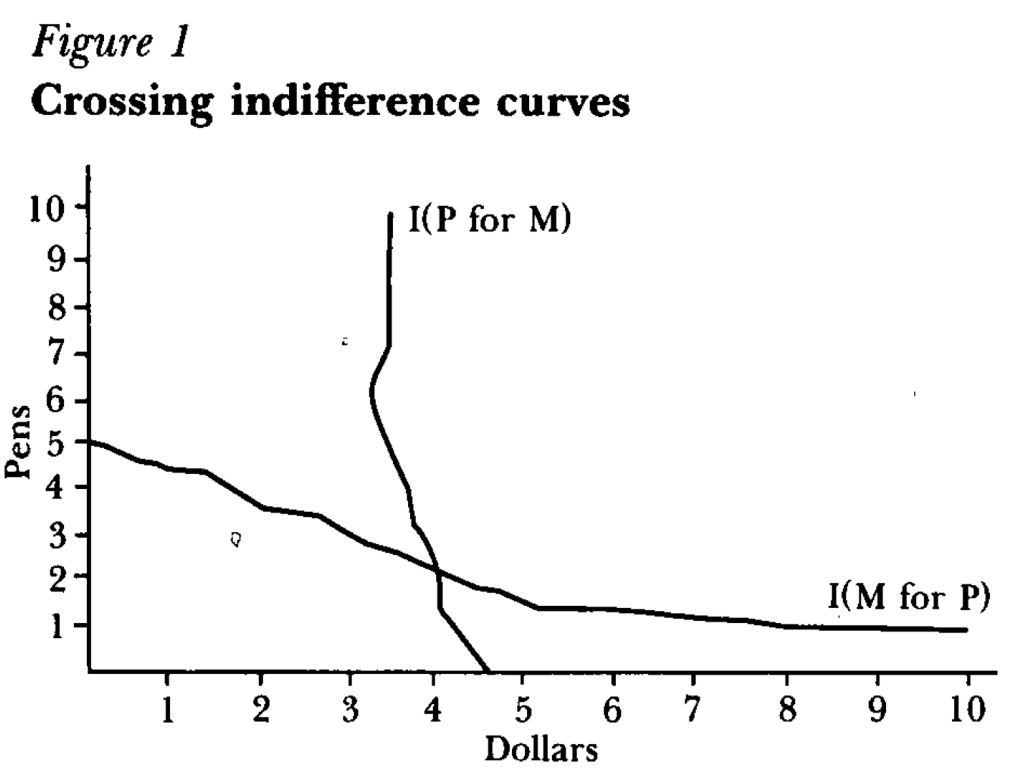
But how did a psychologist get economists to not just take his work seriously, but award him the top prize in our field? One key step was learning to speak the language of our field, or coauthor with people who do. For instance, summarizing the results of an experiment as showing indifference curves crossing where rationally they should not:
Finally, something that helped Kahneman appeal to all parties was that he avoided the potential trap of being the arrogant behavioral economist. Most economists have a natural tendency toward arrogance, kept somewhat in check by our belief that most people are fundamentally rational. Behavioral economists who think most people are irrational can be the most arrogant if they think they are the only sane one, and should therefore tell everyone else how to behave. But Kahneman avoided this by seeming to honestly believe he is just as subject to behavioral biases as everyone else.
These next two are STEM-friendly goofy books with lots of pictures to break up the text. Currently, if he has to do independent reading time, these are first choices.
Ender’s Game – Still incredible. Still feels futuristic, although the emphasis on “smart desks” instead of “smart phones” is funny. It was published in 1985.
The 5-year-old picked out “Woodpecker Wants a Waffle” at our local library and has been delighted by it. It’s a funny picture book that holds up to re-reads. See if your library has it. Public libraries are especially great for 5-year-olds who are ready to explore beyond the Dr. Suess classics at home but also not able to commit to any books worth buying.
Last week Scott offered a very negative review of one popular personal finance book, Rich Dad Poor Dad. My own take on the book is less negative, but I still wouldn’t recommend it to most people. That still leaves the question of which personal finance books are worthwhile. I gave my answer back in 2020 in a post on my personal blog. You can read the full reviews there, but I’ll give my short answers here:
Despite the title, the book is really about the basics of how to get out of debt, save for retirement, and manage credit. The material is stuff most people will figure out on their own by their 30’s or 40’s, but it’s a nice presentation all in one place and can save people from learning lessons the hard way. Perfect for a college student, someone at their first real job, or someone older who feels like they missed the memo on how all this works. His big idea is that once you set and meet good savings goals, you don’t need to feel guilty about the things you do spend money on.
This book is built around surveying millionaires and finding the commonalities in what they did to get wealthy. The core idea is that Americans with millions saved tend to have moderately high incomes but very high savings rates. Even someone with a normal income can become a millionaire- income is different from wealth. The key is to live frugally and let the compound returns on your savings work for you. The original version of the book is inspiring, but has out of date numbers; the author’s daughter recently updated it (The Next Millionaire Next Door) with more current numbers.
There are many more books about how to invest, but for broad takes on personal finance overall these are the best two I have found, and the ones I recommend to students. Still interested to hear your thoughts on more recommendations.
Ladies, Tyler Cowen has done us a solid. He included John Stuart Mill as a contender for the greatest economist of all time in large part because of his insights on gender equality.
I’m short on time at the moment. I’d like to do a better job than this, with more nuance about Hayek, but here’s the most I can do this week:
This is the 4th year in a row that the crew has put together some recommendations on products or books that we actually use, for your consideration in holiday gift buying. I’m going to put things into categories of Stuff for Adults, Kid’s Toys, Books for Adults, and Kid’s Books
Stuff for Adults (Men can be hard to shop for, so this might save Christmas!)
Scott says these scissors are amazing: “Fiskars 9 Inch Serrated Titanium Nitride Shop Shears”, available from Amazon here. Unlike some thick, heavy, or stubby heavy-duty shears, these have the feel of regular scissors, with fairly long, narrow blades. The handles are fairly substantial, and very comfortably contoured to the hand/thumb. The real magic is in the blades. They are sharp, with a very hard titanium nitride coating. Also, they have fine serrations in the cutting edge, that tend to grip the material in place as you are cutting.
Zachary recommends 5 things that he really uses at home
Food makes great presents for adults. Just give me Doritos, thanks.
Kid’s Toys
A wonderful game that you might not already have is Protect the Penguin. It’s high-energy but much less work than something like Twister. I actually enjoy playing it, too.
I’ll re-up from last year that Spot It is incredible and fits in your coat pocket. Fun for all ages. Several versions of the game. Not everyone has to know how to read or add to play so good for events with lots of ages represented. LEGO sets are always fun. If you keep the difficulty level age-appropriate than your kid should be able to play independently for an hour. I’ll put up one link but of course there are many thousands to choose from that can be tailored to any interest. My son likes Minecraft-themed sets.
Books for Adults
If you want to see all the books we have read and reviewed, just click on the Books category or go to
Not all of those posts are going to give you quick gift ideas, so if I had to pick out one from the last year it would be:
Secondhand: Travels in the New Global Garage Sale is a great book in my summer stack on fast fashion. I have always been interested in the combination problem-blessing of too much stuff. Adam Minter explains perfectly what many of us have been curious about.
You might have a relative who is very environmentally conscious or works hard to reuse and recycle. They might think it’s interesting to learn about the secondhand markets in America and beyond.
Kid’s Books
I’m reading The Hobbit aloud to my son right now and I highly recommend the experience. It’s going to take us months to get through it by reading a few pages at a time around bedtime.
Camp Out!: A Graphix Chapters Book (Bug Scouts #2) Funny graphic novel series about a group of friends in a scout troop. Probably especially fun for a kid who is in some kind of scouts program. Calvin and Hobbes is another comic series that my kid genuinely looks forward to reading.
Joke books can lead to great conversations. If the kid wants to know why something is funny, you can end up talking for a long time about the complex world.
See what we recommended in previous years. We have always had a mix of kid and adult items.
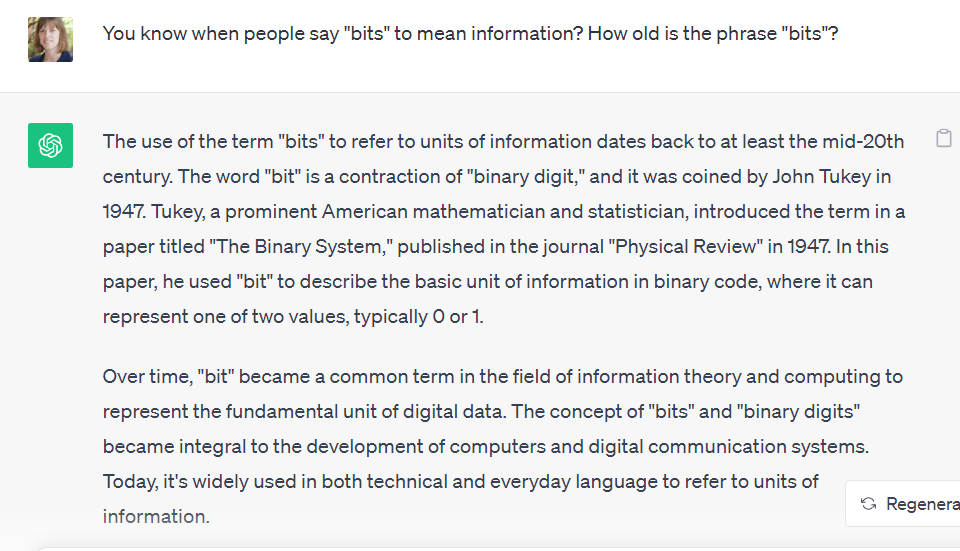
I suppose books were, for a time, the cheapest way to convey bits of information, before anyone had heard of “bits”. I asked ChatGPT to do my boring work and rehearse the history of the term “bits” so I could get my facts straight for this post.
Based on my other research, I was not confident that this paper called “The Binary System” exists. I could find no evidence of it from 5 minutes of googling. When I asked ChatGPT about it, ChatGPT apologized and said it probably isn’t real.
That kind of error would have been less likely with paper books that had human editors and authors. We hardly thought about this benefit of the old system, until it was gone. Because books had some cost to write and print, it made economic sense to employ an editor to ensure quality. For a while, no one would have thought of spewing out this ocean of associated terms that we get from ChatGPT, because it was too expensive. So, the first underappreciated benefit of printed books was that they were relatively more accurate.
This is the first “generative book” that I had ever accessed. I did the worst thing, right away. I asked the Chatbot to give away the ending, and it did.
I wish I could have bought the paper book and read until the end, using the suspense as a device to get me to learn new details about famous economists. Books and movies used to be able to use suspense to keep the audience engaged. Before generative books, that just seemed like the only way.
I didn’t think of books as special until I used a phone to (try to) learn. Now I put more value on the hours I spent reading paper books when I was younger. Authors were manipulating me through that rigid medium. I was forced to wade through pages and pages to get to the point. But what value is the “point” without the context? Getting to the point through arguments and examples, instead of just seeing a tweet, made us smarter. The second benefit of books was that we were forced to work harder.
Generative books are a further step toward poastmodernism.
A middle ground I can imagine is asking the chatbot to play coach instead of search engine. What if the Chatbot could write you a shorter version of the book that cuts out the parts you would have skimmed in a paper book? Still, just knowing that you were skimming certain parts actually created context. I took that for granted, until now.
Something has happened in the world outside of our screens that feels both “full circle” and “anti-Network State”. The BBC announced that an American tech billionaire bought the English pub where J.R.R. Tolkien and C.S. Lewis famously met to talk with a group of friends.
We could just see pictures of that place on the internet. You can see my 2014 pilgrimage to it pictured below. But people want to go in person, if they can afford it. That used to just be the only way to do things. Now that we can see what it is like to live through digital media, we are discovering the value that existed all along in 3-D doings.
Speaking of Tolkien, I’m reading The Hobbit aloud to my son right now and I highly recommend the experience. I’m glad that he is capable of enjoying it, since the pacing is so different from the media and games on screens. To get an elementary-aged boy reading from paper, I also recommend Calvin and Hobbes.
We like to put up recommendations for holiday gifting at this time of year. That paperback of Calvin and Hobbes would make a great gift for a kid (or adult!).
Zachary told us that he has printed out our own blogs for the week to read at home on paper. That’s “full circle.” Maybe print has something for us, even if it is more expensive than scrolling screens.
Buying new hardcover books at a bookshop regularly can be prohibitively expensive. But if you look at used books, you can easily walk out of a rummage sale with 10 quality books for $10.
Also, sometimes ordering older print paperback books or DVDs on Amazon is extremely cheap. Here are some of the cheap Amazon media purchases I made in 2023. I might have found them even cheaper at a local garage sale, but getting it delivered to my house saves a lot of time. I recommend all of these items over scrolling mobile screens.
Some people might prefer Kindle to paperback because it allows them to maintain a larger “library”. If you have very limited space to store books, then I can understand that advantage. However, I know that I learn better from paper. Printed media might still be worth paying for.
Afterword: I printed out two chapters of Tyler’s new book and it’s excellent.
It’s mostly very smart and serious, but this paragraph made me laugh out loud.
It’s been almost a decade since I taught principles of economics classes. One major allocation of my time this semester is course prep, since I am teaching 3 different classes.
For my Principles of Microeconomics course, I chose Modern Principles of Economics, because I figured Tyler and Alex had done a good job and I have heard good reviews from others.
I’m writing a short review of their instructor resources, and then I’ll have to get back to course prep.
Like most textbooks, they provide you with slides that you can modify. Not having to start from scratch on lecture slides is great.
They also have teacher guides for each chapter. I find these helpful, because I have not taught this class in many years. Even though “I’m an economist,” there is still a technique to presenting these ideas for the first time to undergraduates. No need to re-invent that wheel completely.
They have suggestions for in-class activities. For example, to illustrate demand shifts, ask the students about a recent celebrity scandal and how that created a fall in the demand for concert tickets. It works. Everyone loves talking about celebrity scandals. It will be an evergreen idea. There are always new scandals for each semester – the students know more about it than the professors. My students (Fall 2023) informed me that Lizzo got in hot water for fat-shaming.
Their online learning platform called Achieve within MacMillan works well. It integrates really well with Canvas, our LMS. One warning I would give you is to make sure that students buy Achieve through an account on their .edu email address. I have headaches over students signing up with a personal email address and then not having their data integrate with Canvas.
You can sign up for EconInbox, which will email you topical relevant news stories right before you would want to present them in class. You’ll have to tell them ahead of time what your schedule of topics is, but that is something you ought to have worked out in your syllabus at the beginning of the semester. Obviously, you can’t cover every chapter in one semester. There are far more resources, generally, than you can use. But picking and choosing from a great library is easier than trying to build something from scratch yourself.
Lastly, the Cowen Tabarrok textbook integrates nicely with the free Marginal Revolution University video library. MRU is free to all. So, as an instructor you could still use it heavily even if you are not assigning their textbook or even if you are not doing Achieve. Still, I think that making use of the MRU resource is easiest if you are using their textbook. A fun video that might even be worth using class time for is Avengers: The Story of Globalization
The author of Secondhand, Adam Minter, simultaneously appreciates the value created by large “impersonal” markets and also paints colorful pictures of the individual people involved. He has respect for individuals in the system who, using local knowledge, extract all the value out of what rich people consider to be trash. Minter sits in the seat of Adam Smith.
But it is not the popular movement, but the travelling of the minds of men who sit in the seat of Adam Smith that is really serious and worthy of attention.
Lord Acton, Letter of Lord Acton to Mary Gladstone
Another piece about clothes from AdamSmithWorks is: “WHO ARE YOU WEARING?” FASHION PRODUCTION IN THE AGE OF ADAM SMITH. This article does “the pin factory” for clothes. The global supply chain is incredible, just looking at manufacturing alone. Minter takes it further by following goods all the way from their first consumer to their very last user.
There is some good news about how the world is getting better as the average person gets richer, but trash does also cause problems as we consume more stuff. Does Minter write about the environmental concerns of the “fast fashion” camp? He has a different idea than what others have proposed like taxing by volume or banning some commercial activity. In terms of practical advice, Minter advocates for labeling consumer goods by how long they are expected to last. It’s tragic when someone spends $20 on a good that will wear out after 1 year when they should have spent $30 on a good that will last 10 years. There are some “dollar bills on the ground” here because consumers don’t accurately assessing quality at the time of purchasing. The power of brands to signal quality helps with this problem, but if you don’t want washing machines piling up in landfills then you might want stores to put a greater emphasis on durability at the point of sale. We do something like that with nutrition labels, so it is possible.
Secondhand: Travels in the New Global Garage Sale is a great book in my summer stack on fast fashion. I have always been interested in the combination problem-blessing of too much stuff. Adam Minter explains perfectly what many of us have been curious about.
Secondhand is America-centric, but he also travels to Japan to observe a country that is ahead of us both in terms of the demographic crisis and the mechanisms for handling old stuff. The reports from Africa are very interesting.
I have been wondering what is happening with Goodwill and with recycling in general. What hope do we really have of keeping goods out of the landfill? What should I do with a shirt my kid has grown out of? (The lady at work I used to give clothes to now runs away at the sight of me. I gave her too many bags.)
The Goodwill collection center near me looks cluttered and weird. After reading Secondhand, I’m more optimistic about dropping off bags there.
The barrier to sorting the used goods of the rich world is the scarcity of time and attention. This paragraph about a used book seller in Japan is heart-breaking:
It’s a thirty-year-old hardback novel, and the edition is rare. If it were at a traditional bookstore, it’s command a premium price. But Bookoff is about volume, and there’s a problem: not only does it lack a barcode, but it lacks an ISBN… “So there’s no way to price it in Bookoff’s system,” Kominato says. With a grimace, he gently places it on top of the books filling the recycling cage and steps away. (pg 40)
At least the book will get recycled into new paper, and the reality is that it was providing negative value as clutter in someone’s home.
Back in America, Minter describes what happens to donated goods at Goodwill in detail. Sometimes high-quality clothes are identified, but it is hard to get a good price for them. Some customers expect to pay less than $5 for a shirt, no matter what.
Customers are all about price, not quality…They won’t buy a $6.99 shirt that will last. If that’s the option, they’ll buy a $2.99 shirt from Walmart. (pg 57)
Some consumers are in the habit of treating clothes almost like disposable goods instead of durable assets. They won’t pay for quality. Going out and getting a new replacement shirt costs less than lunch.
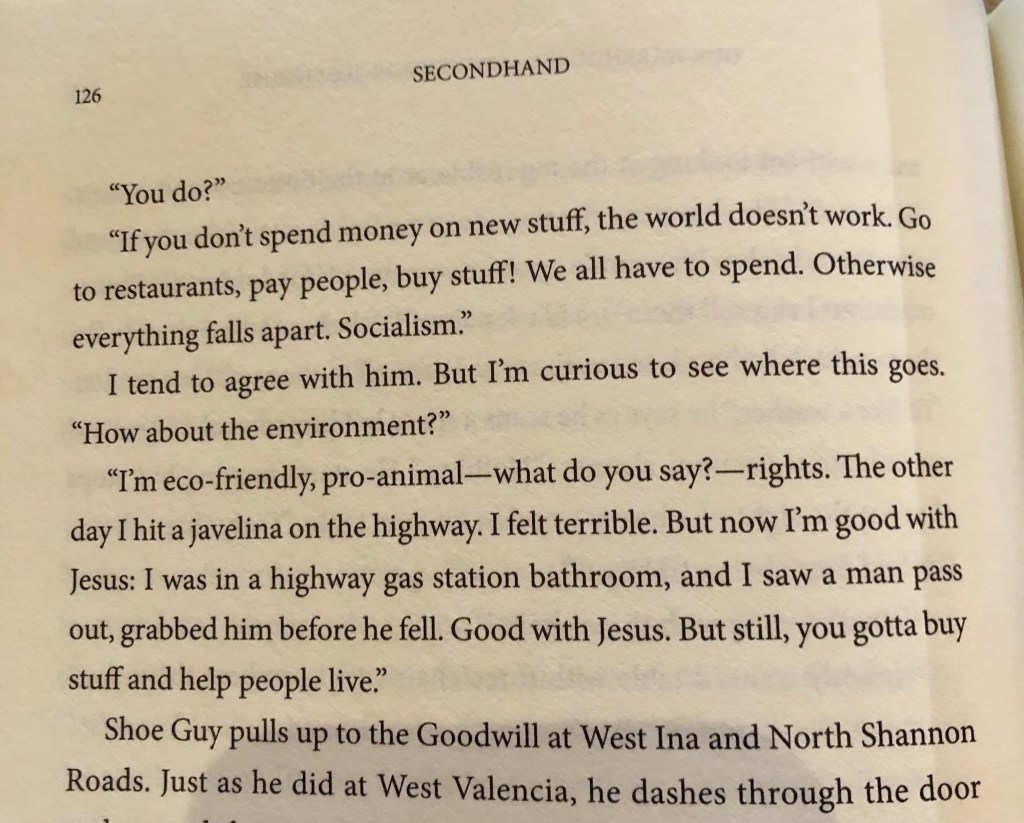
I don’t want to give away too much, since you will want to go get the book yourself. Here’s the funniest page:
Lastly, I’ll share a personal win. I know that I’ll need a school backpack for my youngest in August. I went to a local rummage sale and went to the backpack section. I found one that is good enough (some scuffs but plenty of sparkles). I’m happy about keeping this sparkly pink backpack out of the landfill for a few more years. I walked out of the sale with a load of gear that cost a total of $10. Next, I went to a coffee shop to work where I also spent $10. Used textiles and books are dirt cheap.




 Economist Writing Every Day