The chart originates from Statista, as you can see from the label in the image. But it is very frequently shared on social media, Reddit, and elsewhere (often with the Statista label clipped), occasionally generating millions of views and lots of heated comments.
But it’s a bad graph. In so many ways. Let’s break them down.
The data comes from BLS’s Consumer Expenditures Survey. I use this data frequently, as regular readers probably know. The data in the viral chart is from 2021 (more on that in a moment), but if I create a similar chart using the most recent data in 2023 but also include spending by those older than Baby Boomers (primarily the Silent Generation), you will notice a curious thing:
There was a recent Planet Money Podcast episode that includes a fun exercise. An NPR employee produces a dozen chicken eggs and wants to sell them at cost to another employee for $5. That’s the setup. How does the employee decide who should receive the eggs? Clearly, the price mechanism won’t work since the price is fixed. A lottery is also not allowed. The egg recipient could engage in arbitrage, reselling the eggs for a higher price. But that’s not very likely and would be socially awkward. The egg producer wants to make someone happy. Who would he make the happiest?
That’s the challenge that the Planet Money team tries to solve.
First, they started with a survey. Rather than asking coworkers to rank a long list of things that includes eggs, the survey adopts a more robust method of pairwise comparisons. Do you prefer toast vs eggs? Eggs vs oatmeal? Toast vs oatmeal? and so on. One problem that they encounter, however, is that there is a lot of diversity among preparations methods. My oatmeal is better than my eggs. But my brother’s oatmeal is not. As it turns out, there is not a standard quality of prepared oatmeal and prepared eggs. So the survey is a flop.
Then they consult an economist. They decide to try to measure “willingness to pay”, which is an economic concept that identifies the maximum that a person could pay for something without becoming worse off. They couldn’t really ask the coworkers what their WTP is. People are social creatures and have many reasons to lie, mislead, signal, and to simply not know. Since someone’s WTP reflects preferences and values, we need a way to solicit the true preference while avoiding lies and most mistakes. Here’s how the economist suggested that they reveal the coworker preferences.
Step 1: Tell the coworker these rules.
Step 2: Coworker reports their WTP for a single egg in dollars
Step 3: A random price will be chosen by a machine. If the price is above the self-reported WTP, the coworker is not allowed to buy the egg. If the price is below the WTP, then the coworker must buy the egg at the random price.
Chickens were apparently domesticated from the red jungle fowl (Gallus gallus), a native of southeast Asia, thousands of years ago. Humans have been selectively breeding them ever since. Traditionally, chickens were valued mainly for their eggs. Surplus roosters would get eaten, of course, and tough overage laying hens would end up in the stewpot. But your typical chicken was a stringy, hardy bird whose job was to stay alive and to lay eggs.
Raising chickens en masse just for eating started in 1923 with Celia Steele of southern Delaware, somewhat by accident. She wanted to set up a small flock of egg-laying chickens to supplement her husband Wilmer’s Coast Guard salary. She placed an order for 50 chicks, but it was mistakenly heard as 500. When she got this huge shipment, she thought fast and decided to raise them to eating size (“broilers”) and then immediately sell them. She built a coop designed for grow-out, rather than for egg-laying. This enterprise was profitable, so she expanded operations. She doubled production the next year, and by 1926 she had 10,000 chickens. Her neighbors saw her success, and also went into the broiler biz. Thus was spawned the modern broiler industry. All this was aided by the general prosperity in the 1920s, together with technical progress in refrigeration and transportation. Her first broiler house is now on the U.S. Registry of Historic Places.
However, chickens themselves were still scrawny by today’s standards. As of 1948, chicken meat was still an expensive luxury. With the broiler (meat chicken) market established, breeders naturally tried to develop strains that would grow big and fast. That not only allows more meat to be grown in a given flock, but fast growth means less feed is consumed to get to market weight.
For several years around 1950, A&P Supermarkets sponsored a “Chicken of Tomorrow” program, overseen by the USDA, to promote improved broiler breeding. As examples of chickendom as of 1948, here are plucked carcasses of contestants for the Chicken of Tomorrow contest of that year. Note how stringy they are, compared to the plump, meaty bird you buy at the grocery store today:
Without going into much detail, the ultimate product was a cross (hybrid) between the Cornish chicken and other breeds. Cornish cross chickens were initially bred for size and growth rate. By say the 1990s, that led to birds that were so heavy that they sometimes could not support their own weight. More recent breeding programs promote leg strength and other health factors, as well as sheer growth.
To produce today’s optimized broiler is a complex process. Breeders must maintain something like four purebred strains, and then carefully cross-breed them, and then cross-breed some more, to get the final hybrid chick to send out for farmers to raise. Only these hybrids have the optimized characteristics; you can’t just take a bunch of these crossed chickens and breed a good flock from them:
Only a few large outfits can afford to do this, so most hatcheries are supplied by a handful of big breeders. However, there seems to be enough competition to keep the prices down for the consumer. Some folks will always find something to complain about (reduced genetic diversity or hardiness, etc.), but they are welcome to breed and grow less efficient chickens, if it pleases them.
In terms of dollars: “The inflation-adjusted cost of producing a pound of live chicken dropped from US$2.32 in 1934 to US$1.08 in 1960. In 2004, the per-pound cost had dropped to 45 cents, according to the USDA Poultry Yearbook (2006).”
According to the National Chicken Council, in 1925 it took a broiler chicken an average of 112 days to reach a market weight of 2.5 pounds. As of 2024, the market weight has soared to 6.5 pounds, and chickens reach that weight much faster, in 47 days (about the time it takes leafy green vegetables). The net result is that now it only takes about 1.7 pounds of feed to grow one pound of chicken, compared to 4.7 lb/lb in 1925. This nearly three-fold reduction in resource consumption translates into lower consumer costs, lower load on the environment and agricultural resources, and even lower CO2 generation. The largest jump feed conversion efficiency (from 4 to 2.5 lb/lb) occurred between 1945 and 1960, thanks to the development of the Cornish cross.
While I was in southern Vermont last month, I visited a maple syrup production operation. The actual shed is called a “sugar house”, and the operation is called sugaring, even though the main product is the syrup.
When I was a boy, my dad hung some buckets on taps into the two maple sugar trees in our yard to collect the sap. He boiled the sap in a big old copper tub/kettle set on cinder blocks over a wood fire. You do have to boil and boil, since it takes about 45 gallons of sap to make one gallon of syrup. The other 44 gallons is boiled off by the heat of the burning firewood.
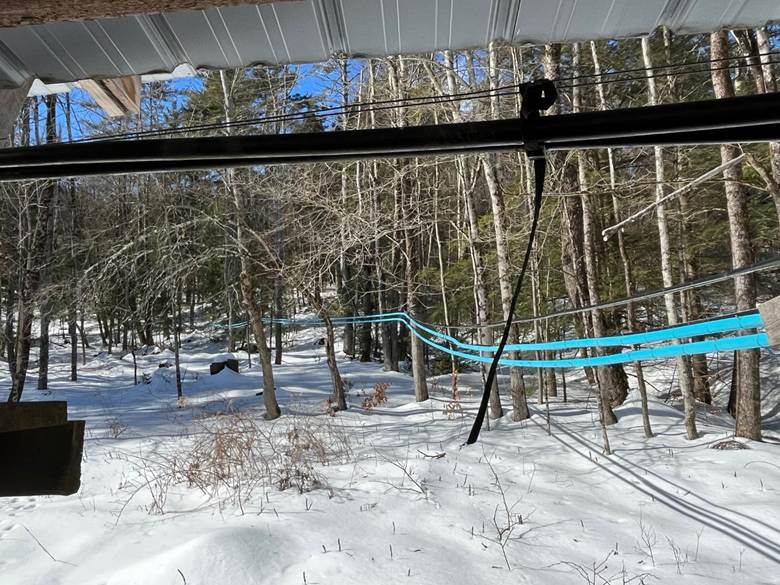
David Franklin’s operation in Guilford, VT (near Brattleboro) is much more efficient than that. The sugar house is set at the base of a long slope. The sap from the taps in the trees goes into tubing that connects into more tubing which goes downhill, so hundreds of trees feed into the long blue tubing shown here, which goes into collection tankage:
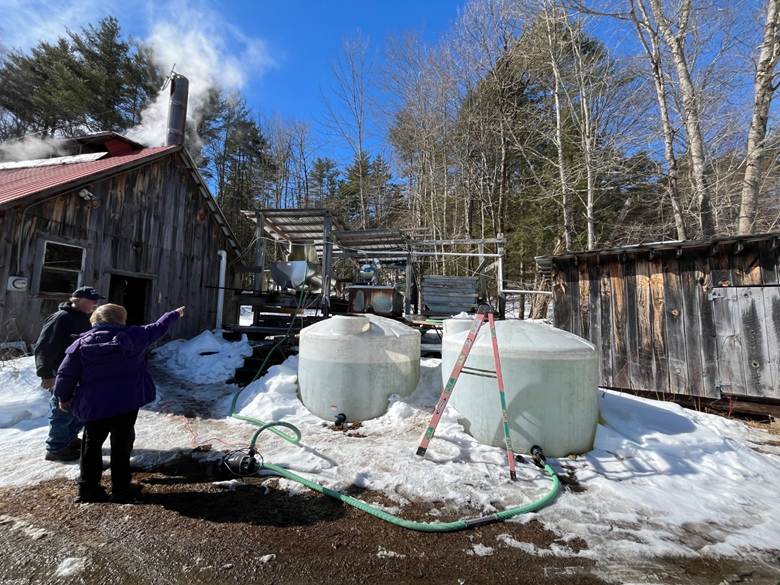
The tanks and pumps are arranged to optimize storage and then allow gravity flow into the equipment in the sugar house:
There is a big vat in the shed, around 4 ft wide x 12 ft long, where the sap is boiled by a wood fire kept going in a lower chamber.
The men have been cutting and splitting wood for months, to get ready for the sugaring season. Running this operation takes two or three people. Typically, there is one man keeping his eye fixed on the temperature and other properties of the sap that is being boiled, to make sure that the syrup is drawn off at the right consistency and is not overcooked. The syrup should be drawn off when the temperature reaches 219 degrees F (104 C). Another man keeps a timer set, and every six minutes he opens the door to the fire box and throws in half a dozen pieces of wood to keep the fire burning hot:
There is also filtering and handling of the drawn-off syrup, and checking the tankage outside. As a (retired) chemical engineer, I appreciated an improvement that was added to the boiling operation. Originally, all the steam from the boiling just went into the air of the shed, making it clammy and causing condensation from the roof to drip down onto workers’ heads. The heat of this steam was basically wasted. But they added a fairly high-tech “Steamaway” heat exchanger that sits on top of most of the boiling vat. The steam rises up through channels of incoming sap from the outside. The cool sap is warmed by the rising steam to around 194 F before entering the boiling vat. This preheating means less firewood is needed to make the syrup. Also, much of the steam is condensed into hot water which can be used for washing operations. A bonus is that much less steam ends up in the atmosphere of the shed, so no more dripping onto heads.
The owner, David Franklin, and his family had the vision for this operation. They built the large shed that houses the operation themselves, and invested in the expensive equipment. David is an old-school farmer, of the type skilled in every aspect of workmanship so they can do their own welding and building and equipment repair instead of paying others to do it. Keeping a large farm running smoothly is a complex task that takes more energy and practical know-how than most suburbanites or city dwellers can imagine. The other men running the sugaring operation are all smart and efficient and hard-working, and all retired from responsible, skilled professions. It seems they do the sugaring largely out of the enjoyment of doing a job well alongside worthy companions.
However, they are all over sixty years old. They can’t keep it up indefinitely since there is a lot of physical labor involved, yet the operation can’t afford to hire young people who would do the work just for money.
It is not clear to me, therefore, what the future of operations like this will be in 15 years, as this current generation of workers ages out. Unlike a lot of production, maple syrup making cannot be simply outsourced to Asia.
Anyway, David Franklin’s syrup is delicious. You can buy some on-line here. Or if you swing by the Franklin Family Farm in Guilford, you can also get some farm fresh eggs and certified organic hamburger, and stew meat.
A number of weeds growing around your house are edible. Chickweed (Stellaria media) is found in lawns and random areas in cooler climates. It pops out ahead of most other plants in the spring, though it also grows year-round.
It can grow low, hiding in the grass, but it is easier to harvest as a taller standalone clump. Here is a clump from my yard, with the roots and tougher lower parts cut off:
People eat it raw, but I prefer to blanch it first to reduce any bitterness and to get rid of any critters or contaminants. To do that, I got two cups of water boiling in a Pyrex measuring cup, then dropped the chickweed in and stirred it around for a minute, followed by a cool water quench in a colander. The chickweed was then in a wilted state, but still green and crunchy and (as I understand) retaining nearly all its nutrients.
For me, chickweed functions like arugula or cilantro or Italian parsley, as an interesting and worthwhile addition to a salad or sandwich. I would not relish a whole plate of it.
Speaking of nutrients, in folk medicine chickweed is credited with amazing powers. Eat The Planet tells us that:
Chickweed is full of vitamins A, B1, B2, and C as well as fiber and protein. Due to its nutritional contents and numerous medicinal properties, this cold-weather herb has been used in folk medicine for hundreds of years. It can treat many different conditions, such as constipation, bowel problems, iron-deficiency anemia, asthma, bronchitis, joint pains, and blood disorders. It can also aid weight loss by making you feel fuller for longer.
You can also apply the herb directly onto the skin to treat itchiness, bruises, boils, ulcers, and psoriasis. To do this, you can either bruise the leaves or steep the stems in hot water before applying them directly onto the affected areas.
There is no indication that any of the plant’s constituents possess therapeutic activity. Its vitamin content is too low to be of therapeutic value.
Verywellhealth stakes out a middle ground, noting that chickweed has demonstrated significant anti-inflammatory and anti-viral activity in lab experiments with animals, but also noting that these results may or may not translate to efficacy in humans:
Juice or extracts made from chickweed have been studied in test tubes or mice models for the following conditions:
Hepatitis B. Chickweed was shown to have anti-hepatitis B virus activity in a test tube study.
Obesity. Chickweed extract given to overweight mice decreased the amount of food they consumed and their absorption of fats.
Diabetes. Chickweed leaf extract demonstrated antidiabetic effects, such as lowering blood sugar and hemoglobin A1c in mouse models.
Heart problems in people with diabetes. Chickweed tea given to diabetic rats did not improve their blood sugar levels but did seem to protect against cardiomyopathy.
Anxiety. Chickweed given to mice showed similar activity as diazepam, a classic anxiety medication in the benzodiazepine family.
Everyone is talking about the price of eggs. Even the President. That’s despite the fact eggs, on average, constitute about 0.1% of consumer spending (according to the Consumer Expenditure Survey for 2023). Even so, economists always get excited when people talk about prices.
On prices at the current moment, I wrote a blog post for the Cato Institute looking at the relevant supply and demand factors, and trying to explain why wholesale egg prices are falling so quickly. When will these falling wholesale prices translate into lower retail prices? The NY Times asked this question, and I tried to answer it for them (answer: perhaps in a few weeks).
But let’s step back from the current moment and take a longer-term perspective on egg prices. This chart shows the long-run real price of eggs, measured in terms of how much time an average worker would need to work to afford 1 dozen eggs:
Economists rely on trade data. The historical Foreign Commerce and Navigation of the United States reports detailed monthly figures on imports, exports, and re-exports. This dataset spans decades, providing a crucial resource for researchers studying price movements, consumption patterns, and the effects of war on global trade.
The U.S. Department of Commerce compiled these reports to track the nation’s commercial activity. The data cover a vast range of commodities, including coffee, sugar, wheat, cotton, wool, and petroleum. Officials recorded trade flows at a granular level, enabling economists to analyze seasonal fluctuations, wartime distortions, and postwar recoveries. Their inclusion of re-export figures allows for precise estimates of domestic consumption. Researchers who ignore re-exports risk overstating demand by treating imports as goods consumed rather than goods in transit.
You may have seen on your social media recently that the price of TVs has fallen 98% since 2020. That’s certainly what the data from the BLS says. This would seem to imply that a one-thousand dollar TV in the year 2000 would now be priced at $20. While we have seen amazing things in the market for TVs, we’re not seeing $20 TVs. One take away might be that the data is just wrong. But that data is always wrong. The question is how the data is wrong and whether it’s a problem.
The reason for the disagreement between the data and the price on the shelves is due to something called ‘Hedonic Adjustment’. The idea is that some goods have quality features that change over time, even if the price doesn’t change so much. In the case of TVs, we might see higher resolution, flatter screens, larger screen sizes, smart features, etc. TVs are not a stable set of qualities. They are a bundle of characteristics, and those characteristics have some wiggle room while still satisfying some sensible criteria for being a TV. In theory, every single good is a bundle of services that we value. The reason that the some CPI categories have fallen so much is not only because the price has fallen necessarily. Rather, the amount of services that we get from a TV has increased so that each dollar that we spend can purchase more of those TV features.
I’ve written about proteins twice before. Once concerning protein content generally and then another concerning amino acid content of animal proteins. The reason that I stuck to animal proteins initially was because I held a common and false belief: Singular vegetarian foods aren’t complete proteins. The meat-eaters gotchya claim is that meats contain complete proteins. After all, we’ve heard a million times that beans and grains are often eaten together because they form a complete protein. The native North Americans? Corn and beans. Subcontinent Indians? Rice and Lentils or chickpeas. Japan? Rice and soy. Choose your poor or vegetarian population in the world, and they combine beans and grains. We’ve always been told that it’s because the combination constitutes a ‘complete protein’.
But you know what else constitutes a complete protein? Any of those foods all by themselves. What the heck. I haven’t been lied to. But I’ve certainly been misled. Let me briefly tell you my research journey. My recommended daily intake (RDI) are from the World Health Organization and the amino acid data is from the US Department of Agriculture. Prices are harder to pin down in a representative way, but I cite those too.
For decades, our family favorite holiday cookie recipe has been a hearty ginger cookie containing, among other things, wheat germ. The original recipe author claimed that these cookies “got my family through Alaskan winters”. That’s hard core.
With my family’s help, I made big batches for decades to hand out among colleagues at work. This always included my boss and boss’s boss, and their admins. (Cynics may think what they wish of my motives there.) Also, we like to hand out small, decorated bags of cookies to all our neighbors for several houses in all directions. We like to try to build community as we can, and this is often the only time we get to exchange words with some neighbors.
However, there are two downsides to that ginger cookie. First, it is very labor-intensive. The final mixing with a stiff dough takes a lot of muscle, and forming the cookies takes an assembly line with multiple steps: with the help of a spoon, form the sticky dough into a ball, then roll the ball in sugar, then place on baking tray, then press a blanched almond (can only find these in specialty vendors these days) into the top of the ball. Second, this ginger cookie is a bit on the dry side – – I would usually recommend consuming them with coffee or milk as I handed them out.
Two years ago, however, an esteemed family member pointed me to a radically different recipe, for an oatmeal chocolate chip cookie. That seemed kind of decadent compared to my old favorite, but worth a try. It solved the two drawbacks for the ginger cookies. Making it is easy, just scoop into the dough and plop onto the cookie sheet. (I did buy a cookie scoop for this). And there was no need to apologize for dryness. These babies are just plain delicious. So now I make large batches of these cookies to hand out to neighbors at Christmas.
Without further ado, here is a link to the recipe for Chewy Oatmeal Chocolate Chip Cookies, by Sally McKenney of Sally’s Baking Addition. You do have to follow the directions, including the step of creaming the butter (see links in recipe for what “room temperature” means) and sugar, and using old-fashioned (not instant) oatmeal.
Here are some of my tweaks to this recipe:
Make two double batches, in two separate large bowls. Chill in fridge several hours. Set aside several hours to bake them all.
Don’t bother creaming butter alone. Just add sugars to butter and stir in with wood spoon, then beaters. Add flour, using spoon and then beaters. For adding oats, chips, etc., just use spoon.
I backed out some of the chocolate chips, and added chopped walnuts: so, in each double batch I have total 3 c choc chips (e.g. 2.25 c regular chips, ¾ c mini chips), plus 1 c chopped walnuts. It’s worth getting good chocolate chips. Ghirardelli seems to be the best chocolate chip. Guittard also gets raves.
The recipe calls for big cookies (a full, large scoop, about 3 Tbsp), but those may spread too much, and I want more cookies, so I use about ¾ full large scoop.
Bake at 355 F instead of 350 F, to speed it up a bit. (My oven is wimpy, electric). Parchment paper works well to keep cookies from sticking.






 Economist Writing Every Day