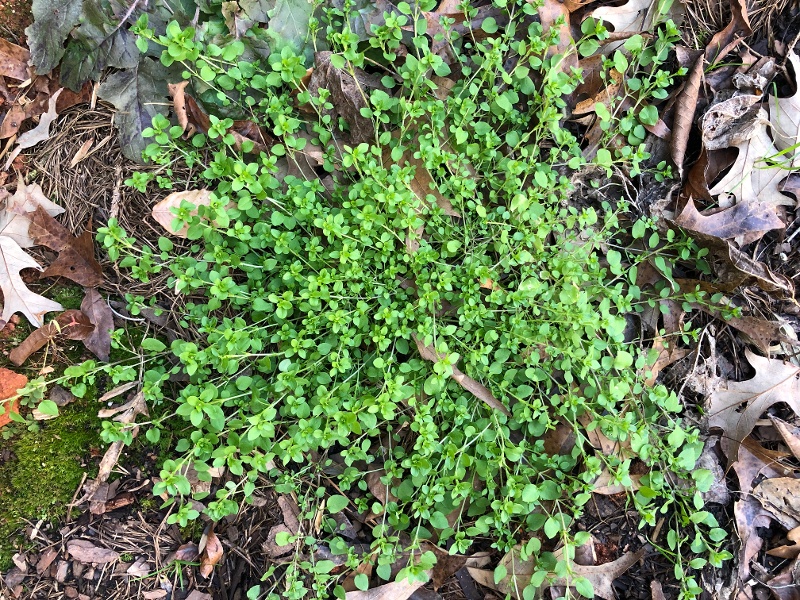
I don’t like wasting time bending over and pulling out weeds, one by one. Much more efficient to go squirt squirt and eliminate lots of weeds at a time. But I realized in the past year that the Roundup I spritzed on the weeds in my mulch beds and sidewalk cracks just wasn’t killing them like it used to. The weeds would shrivel a bit, but then many would bounce right back. So, when I went to Home Depot to buy some more this week, I looked at the ingredients on the label. What?? Where is the glyphosate? For decades, “Roundup” was synonymous with glyphosate.
Glyphosate has several desirable properties as an herbicide. You spray it on the leaves, and it kills the plants right down to the roots. However, it has minimal residual toxicity in the soil, so it is unlikely to kill any plants you did not spray, and you can replant quickly in a soil patch that you had cleared with glyphosate. Farmers love it, because you can buy genetically engineered strains of crops like corn that are immune to glyphosate, so you can spray your fields to kill weeds without harming standing crops.
The glyphosate story is much bigger than homeowners bending over to pull weeds. The chemical has become indispensable for current agriculture. Global glyphosate sales are about $10 billion per year, and its impact on crop productivity is enormous. A 2017 study (apparently not paid for by Monsanto) predicted dire effects of discontinuance:
World prices of all grains, oilseeds and sugar are expected to rise, especially soybeans (+5.4%) and rapeseed (+2%). The welfare impacts are mostly negative, with global welfare falling by $7,408 million per year. Land use changes will arise, with an additional cropping area of 762,000 ha, of which 53% derives from new land brought into cropping agriculture, including 167,000 of deforestation. These land use changes are likely to induce the generation of an additional 234,000 million kg of carbon dioxide emissions.
What’s not to like about glyphosate? Well, maybe it causes cancers in humans. This is a contested claim, and I don’t have the expertise to penetrate the arguments. Because glyphosate makers like Monsanto and its successors Bayer have deep pockets, lawyers on contingency have swarmed like killer bees to file lawsuits, over 100,000 of them, of which about 60,000 remain active globally.
National security issues have muddied the waters here. For instance, Robert F. Kennedy, Jr. led a landmark legal case against Monsanto in 2018, securing a $289 million jury verdict (later reduced on appeal to $20.4 million) for a school groundskeeper who developed non-Hodgkin’s lymphoma after prolonged exposure to Roundup. That case energized a bazillion further lawsuits. But now Kennedy is going along with the current administration’s position that it is strategically necessary to maintain production and responsible access to glyphosate: farmers demand it, and Bayer operates the only plant in the U.S. producing significant amounts of elemental phosphorus, which is a vital material for defense and, increasingly, for lithium batteries.
Naturally, Bayer denies that glyphosate is particularly harmful. The firm continues to sell the product to farmers and landscape professionals, but it has removed it from retail bottles of Roundup you see on Home Depot shelves, in an effort to reduce exposure for further litigation.
What have they substituted for good old glyphosate? I found a brew of three other chemicals. I can report reliably that this mixture is much less effective, especially on grasses and on well-established weeds. The Internet backs up my observations. The Iowa State garden extension has a great table of the real-world effects of all common herbicides.
So, what to do? For grasses in my backyard gravel patch, I am spraying multiple times. If that doesn’t work, I may try covering that area with a black tarp for a month to kill the grass. I have considered buying a propane flamethrower weeder, but that seems only effective on the same things the current wimpy Roundup kills (small/young broadleaf weeds).
For mulched areas, I am incentivized to keep up with fresh mulch to keep weeds from growing in the first place. For larger weeds, I have now found myself bending down low, grasping them close to the ground, and actually pulling them out by hand.

 Economist Writing Every Day