Surely you have heard by now that a solar eclipse is coming. As the April 8 date approaches, the media/social media coverage will likely rise to a roar. I think we all know that the experience of being in the path of a total solar eclipse is eerie and memorable – – birds and insects can fall silent as night-like darkness falls, and a noticeable chill may be felt in the air.
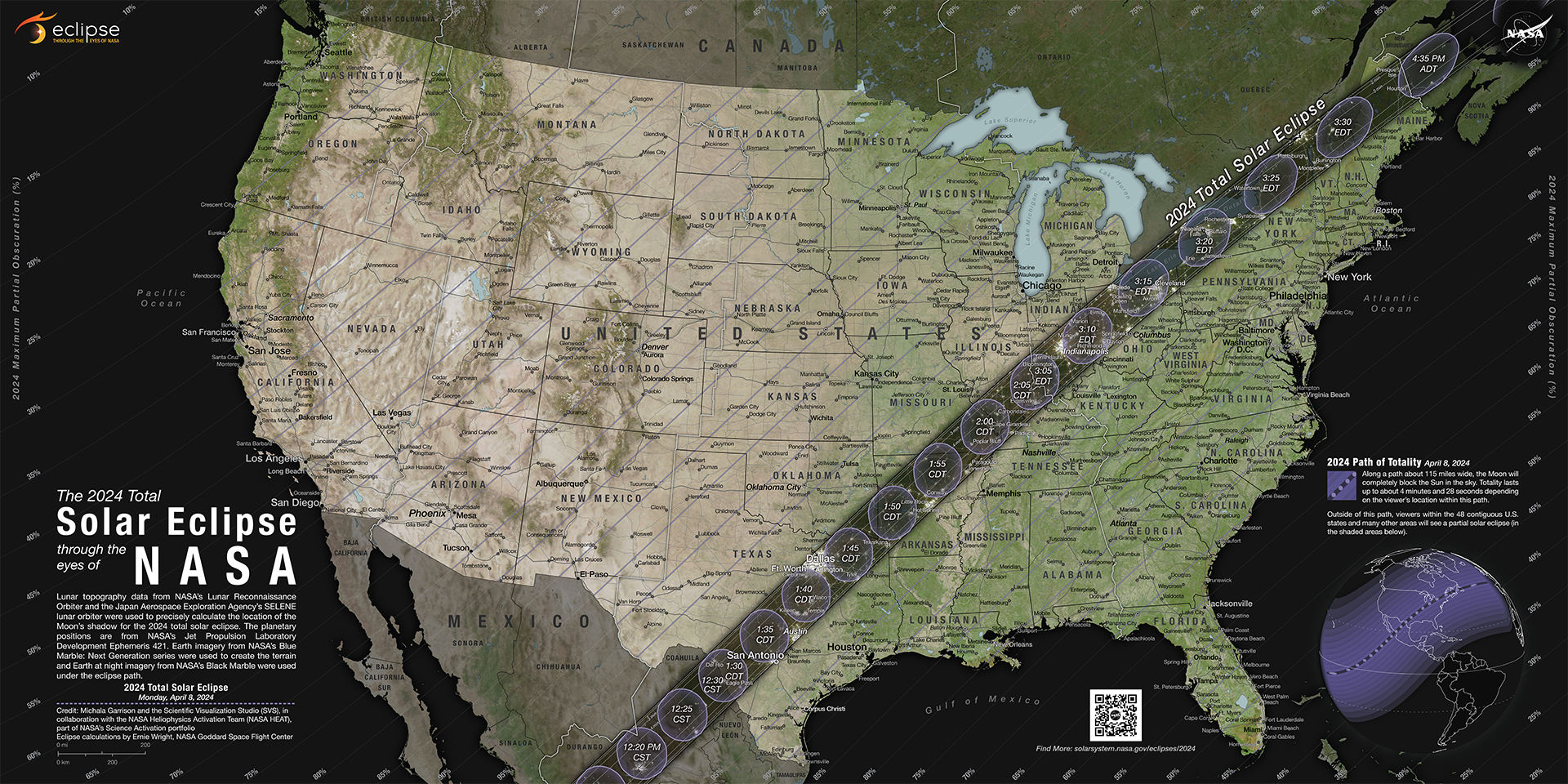
Maps abound of the eclipse path across North America. For the U.S., it starts in Texas around 1:30 Central time, traverses southern Indiana and northern Ohio around 3:10 Eastern and ends in northern Maine about 3:30. Here is a snip I took from this NASA map, where I zoomed in the Midwest/Northeast section, and traced in red the lines of 90% totality:
If you really want the 100% experience, and if you want it to last the full four minutes, you must be in a relatively narrow strip. And if you want to have good chance of not having clouds obscure the fun, you may need to fly to central Texas. Buffalo, New York is in the middle of the eclipse path, but it is a notoriously overcast place.
But lots of folks, including residents of Chicago, Toronto, and the Boston-Washington corridor, live within the zone of (nearly) 90% totality, where you can see the moon sliding across most of the sun’s disk over the course of a few minutes, and experience significant darkening. The next solar eclipse to touch the U.S. will not be until 2044, and that will be barely visible from three less-populated states, Montana, North Dakota, and South Dakota.
So, I suggest you take the opportunity to enjoy this one to the max. This absolutely entails using special glasses with filters designed for safe viewing of the sun. Do not even think of looking at the sun without such glasses, and be alert lest children pick up the wrong cues and try to look at the sun.
The good news is that eclipse glasses are still available. I ordered some from Amazon a couple days ago that arrived two days later, and I saw them for sale in Lowe’s today. I got some extra to share with random friends and strangers. This can be a great chance to interact with neighbors and children.
The price per pair of glasses varies a lot, so do comparison shop. I look for ones that say “CE and ISO Certified” like these. Be safe and have fun!
In the true definition of a worst-case scenario, an unnamed California bride-to-be is reported to have called off her entire non-refundable wedding reception worth $15,000, after learning something about her fiance.
But…she took the disaster and turned it on its head, donating the reception party complete with dinner, dessert, drinks, DJ, dancing, and photo booth to a non-profit called Parents Helping Parents which provides community support to parents with children who have special needs.
…Organizers at PHP sent out invitations for the “Ball for All” and had all the seats reserved 48 hours before the event. … “Nearly everyone [there] was a young adult with special needs, their parent or a member of the care team,” Daane said. “Their joy and delight really told the story about how special and unique this event was—the moment the ballroom was opened, and we all filed into a beautiful candlelit room with tables draped in white linen.”
Yay!
This cheering item is on the “Good News Network”, which I had never heard of before. Other headlines on this site include:
Irishman Whips Out Fiddle to Entertain Passengers in Flight–and People Dance a Jig in the Aisle (WATCH)
Singing or Playing Music Throughout Life is Linked with Better Brain Health While You Age
and
She’s a Pet Detective Who’s Tracked Down and Reunited 330 Lost Dogs with Owners for Free–Using Thermal Imaging.
I think it is great to publicize such civic acts. Let’s make this the new normal.
Axios just surveyed over 2,000 U.S. adults to find that “Americans rank the importance of regulating AI below government shutdowns, health care, gun reform…” Without pressure from the public to pass new legislation, Congress might do nothing for now, which will lead to the rapid advance of LLM chatbots into life and work.
The participants seem more worried about AI taking jobs than they are excited about AI making life better. There is some concern about misinformation.** So, they don’t think AI will have no impact on society, but they also don’t see enacting regulation as a top priority for government.
At my university, the policy realm I know best, we will probably not be “regulating” AI. We have had task forces talking about it, so it’s not because no one has considered it.
The Axios poll revealed gender gaps in attitudes toward AI. Women said they would be less permissive about kids using AI than men. Also, “Parents in urban areas were far more open to their children using AI than parents in the suburbs or rural areas.” Despite those gaps in what people say, I expect that the gaps in what their children are currently doing with technology are smaller. Experimental economists are suspicious of self-reported data.
**Our results did not change much when we ran the exact same prompts through GPT-4. A version of my paper on AI errors that I blogged about before is up on SSRN, but a new manuscript incorporating GPT-4 is under review: Buchanan, Joy, Stephen Hill, and Olga Shapoval (2023). “ChatGPT Hallucinates Nonexistent Citations: Evidence from Economics”. Working Paper.
This makes me think of Putin’s failed assault on Kyiv. Putin has succeeded in getting many thousands of people killed, but his initial goal of the invasion was not achieved. Putin was 70 years old when he thought he could take Kyiv in 2022. He had photos in mind, but probably with the old kind of newspaper reporting and Soviet-style control over media. Now every villager holds up an iPhone and livestreams marauding soldiers. However, if you go to the Wikipedia timeline of events, you can see how important “traditional” journalism still is. Sources include the New York Times and Al Jazeera (based in Doha, Qatar). Paying for journalism affects the world. Saying what journalists “should” be doing without paying for any newspaper subscriptions has less of an effect I would think.
Every sentence in this article is fascinating, since I have been writing about fast fashion.* Anything I put in quote form comes from The Guardian.
The word “revolution” in the title of this article is minor clickbait. Perhaps it would be more accurate to say: “Clothes repaired in workshop, 19 people employed” That wouldn’t get any clicks. However, I am an idealist, and I am going to stay a bit on board with the revolution. I, too, have pondered and grieved over the amount of waste heading into landfills. There could be some kind of revolution ahead, whether it is of the repair type or not.
The communal garden and bespoke textile art lend a creative startup feel, and the slogan “repair is the new cool” appears everywhere. But what’s happening here is far from ordinary startup stuff. At United Repair Centre (URC), newcomers to the Netherlands from across the world, many of them former refugees, are using their tailoring skills to mend clothes on behalf of some of the world’s biggest brands.
Immigrants are sewing, but no Dickensian horrors here. This place “has a laid-back Dutch vibe.”
Ambrose, who greets me, mans the front desk. He’s a 20-year-old Palestinian fashion fan, who was born in Syria and lived in Abu Dhabi before moving to the Netherlands in May; he is working in parallel with studying for a fashion and design diploma. Ambrose started at URC in May and loves it: the way he gets to work in collaboration with the tailors, giving advice and learning from their years of experience. “It’s really easy, fun, chill … “
Repair might be cool, but is it new? Consider Jo March from “Little Women” who was an American bouncing around between rich and poor status in the 1860s. American GPD per capita in 1860s was less than $3,000. That would be considered very poor today. Since manufactured goods were expensive and Jo March had a low opportunity cost of time, she spent lots of time mending clothes. Her passion was writing but she had no choice – that was how she contributed to her household production. Very few families at that time, even in the upper class, could afford to regularly buy new clothes from a shop.
Don Boudreaux explained that even modern rich people “recycle” clothes when it’s in one’s selfish interest. Washing and “re-use” of clothes, typically, is beneficial enough to outweigh the cost of maintaining and storing them. Sometimes we go above and beyond by donating them or maintaining them specifically because we are trying not to “waste” something, but that comes at an individual cost to us.
The author of the article writes:
I take a taxi from the station to URC because I’m running late, but I’m taken aback when en route the driver points out the many conveniently located stations and tram stops I could use for my return journey.
This is a perfect encapsulation of why rich people do not repair clothes. They are zipping around to high-productivity work meetings. The opportunity cost of time has gone up. Taking the bus is costly in terms of time, the scarcest resource of the rich.
Where I see hope for the repair “revolution” is in artificial intelligence (AI). AI can make up for our scarce time and attention. If AI can make repairs less costly in terms of time, then rich people might do it. If it doesn’t make economic sense, then it won’t scale the way the author is hoping.
Currently, the “revolution” is employing 19 people full-time. By the year 2027, all they are hoping for is to expand to 140 tailors. Hardly a revolution on the jobs front. But that’s the hopeful scenario. If it’s labor-intensive, then it won’t work. (See my ADAMSMITHWORKS post on cloth production and labor.)
Is repair reaching a tipping point?
There’s one unlikely scenario in which expensive repairs will get paid for. What rich people resoundingly want is kitchen renovations and new clothes, partly because it confers status. Could it become cool to live with those outdated cabinets and wear that repaired Patagonia vest for the next two decades? … could it? Vision: “Wow. I see that you guys have outdated ugly countertops. Nice. You resisted the desire to renovate your kitchen even though it’s within your budget.”
Even changing status markers are unlikely to tip the scale in the case of broken equipment or torn clothes. AI might allow us to repair a refrigerator instead of trash it.
URC tracks repairs using software initially developed by Patagonia, which it has built on and uses for the other brands involved.
There it is. Software makes the dream work.
Shein and the like are out there, churning out, in dizzying volumes, fast fashion that can’t be repaired.
In my conversations with Americans, many do not know what “fast fashion” is. That’s fast fashion. The 19-140 tailors are currently no match for Shein.
There isn’t always much common language – operational manager Hans says they resort to Google Translate quite a bit – but there’s plenty of laughter.
The AI, again! We are living in the globalized AI-powered future.
Lastly, the article was brought to my attention on Twitter (X) by Bronwyn Williams and Anna Gat.
I don’t like when celebrities are ‘caught’ saying deplorable things in a heated moment. Sometimes they say really awful things, specifically about observables such as race, weight, sex, nationality, odor, etc. Plenty of people have done it. I won’t mention the names or link to any particulars here.
My problem isn’t that I wish celebrities had better behavior – although I do. My problem is with the entire fallout of how we’re all supposed to take the celebrity seriously when they were enraged. When people get angry they say things that are designed to hurt others. People will say things that they don’t mean or wouldn’t normally say. And it’s not like they are betraying some unspoken belief that they’ve hidden. Angry people often say wicked things for the sole purpose of hurting someone else’s feelings. In the moment, the offender tries hard to communicate disrespect – not due to a lack of respect – but due to how it will make the other person feel.
I find the entire circumstance weird. If someone is boiling over and saying patently ridiculous things to me and calling me names, then I have a very hard time taking them seriously. All the same, context matters and words can hurt. It’s weird that we know that people can say untrue things in order to hurt us, and then it actually hurts us. Strange.
All the chatter about aliens made me want to do something new: poll my excellent co-bloggers.
Overall, this group does not put the probability of alien intelligent life existing at 0%. It is not possible to prove that aliens are nowhere in a vast universe. A separate question is whether the recent unboxing event in Mexico or the sightings by US military pilots raises the probability that aliens have visited earth. This group does find that recent evidence to be very convincing.
Here are the group thoughts, separated by paragraphs but not indented as quotes:
I don’t think that I have enough information to put a probability on aliens existing. I am not compelled by recent evidence.
I’m near 50% that they’re out there somewhere in the universe, less than 10% that they are visiting Earth, though some recent evidence (the US military videos, not the Peruvian mummies) is compelling enough to raise this slightly. The 50% is coming from the Fermi paradox, and what I find most compelling from the last few years isn’t any of these potential sightings on Earth, but rather the recent attempts to model the Fermi paradox differently. Sandberg, Drexler and Ord (2018) argue that when you use probability distributions instead of point estimates in the Drake equation, it is actually reasonable to expect that we are alone in the universe. Robin Hanson has a different model where alien life is common in the universe, but we shouldn’t expect to see them yet.
I put the probability of aliens existing between 0.01% and 10%, but I find none of the recent evidence compelling enough to have raised my probability.
Put the probability of aliens existing between 0.01% and 10%. I find some recent evidence compelling enough to have raised my probability.
I doubt that aliens exist, and I find all recent evidence uncompelling.
Joy again: Part of the reason for doing a poll is that I have not dug into this. I have not watched all of the videos, or even most of the most famous videos. I did skim “The UFO craze was created by government nepotism and incompetent journalism” and the part that makes the most sense to me is that UFO stories are great for clicks (clicks are web traffic -> money).
Parenthood rapidly became much easier and safer between the 1930s and 1950s. The spread of labour-saving devices in the home such as washing machines and fridges made raising children easier; improvements in medicine making childbirth safer; and easier access to housing made it cheaper to house larger families.
Anvar Sarygulov & Phoebe Arslanagic-Wakefield
I hate to be the next person publicly talking about Joe Jonas and Sophia Turner. I wish them both the best, and this kind of attention is probably hard on their kids. Anyway… what interests me about this case is that parenting seems to have been hard on them, even though Joe Jonas is worth $50 million. They could have a washing machine on every floor of their huge house. So, do the Works in Progress authors really understand the Baby Boom?
We seem to be somewhat exhausted by all the dire predictions around Covid, now that life has largely gotten back to the normal. Shops and theaters are open, and people are once more crowding aboard those floating petri dishes called cruise ships. The most vulnerable segments of the population have mainly been vaccinated, and each new strain of the disease seems less harmful. All the anti-vaxxers I know have had Covid at least once and hence have some level of immunity, or else they caved and got vaccinated after seeing a close friend or relative die back in the winter of 2021-22. One enduring benefit of Covid is much more availability to work from home.
One of the direst prognostications was that the world would suffer a more or less permanent step down in standards of living due to “long Covid.” According to this narrative, untold numbers of healthy young or middle-aged people would remain debilitated indefinitely due to the ongoing after-effects of a Covid infection: struck down in their prime, never to rise again.
A recent review of the field in Nature concluded, “The oncoming burden of long COVID faced by patients, health-care providers, governments and economies is so large as to be unfathomable”. Ouch. The federal government has provided $1.15 billion for research into the problem of long COVID and its mitigation.
Just the Facts
A couple of facts stand out: First, in many cases, scans of internal organs have shown changes in victims’ hearts and lungs and brains, following a severe Covid infection. Second, many people have reported symptoms such as weakness, fatigue and general malaise, impaired concentration and breathlessness, weeks after the primary symptoms of the disease have resolved.
How big a problem is this? I cannot, in the scope of a short blog post, adequately canvass all the data and literature. I will just cite a few numbers and charts, and let the professional data analysts dig into the fine points.
One meta-analysis found that a full “41.7% of COVID-19 survivors experienced at least one unresolved symptom and 14.1% were unable to return to work at 2-year after SARS-CoV-2 infection.” [That number seems much higher than my personal observations would suggest]. A CDC survey found that as of July 26-Aug 7, 2023, about 5.8 % of all Americans (which is 10.4% of Americans who ever had Covid) report experiencing some effects of long Covid, with 1.5% of all American adults experiencing significant activity limitations as result of long Covid. These numbers show a modest downward trend with time.
The chart below depicts the incidence of long Covid in England, again showing a modest downward trend in the latest year:
Weekly estimates of prevalence of COVID-19 and long COVID in England. Source.
Correlation versus Causation
So: we have many people experience severe symptoms from Covid, but most resolve within a few months at most. That leaves a small but nontrivial minority of Covid victims reporting problems long after that window. A significant question is whether Covid of itself caused those long-term symptoms, or just precipitated some problem that was bound to show up anyway.
I have read poignant anecdotes of perfectly healthy young people who suffer from brain fog two years later. But I have lived long enough to be wary of generalizing from poignant anecdotes. After all, the whole anti-vaccination movement has been fueled by poignant anecdotes of, say, perfectly normal two-year-olds going autistic shortly after getting their vaccine shots.
The 2023 metastudy referred to earlier found that long Covid sufferers tended to be older, and had pre-existing medical comorbidities. Similarly, we have known since 2020 that the cohorts most likely to die from Covid were older folks (such as me!), many of whom were bound to die anyway.
In this light, the data brought forth by James Baily in his recent article on this blog, Long Covid is Real in the Claims Data… But so is “Early Covid”?, is most interesting. He noted that on average people use more health care for at least 6 months post-Covid compared to their pre-Covid baseline, which is consistent with some measure of long Covid. However, those same individuals also spent significantly more on healthcare 1-2 months before their Covid diagnosis. This seems consistent with the notion that some of what gets blamed on Covid would have occurred sooner or later anyway.
A Nuanced View of Long Covid
An article in Slate by Jeff Wise has dug deeper into the data. He noted that the survey-based datasets that have been largely used to estimate the effects of long Covid tend to be biased: those who feel ongoing symptoms are more likely to complete the surveys, giving rise to some of the largish numbers I have shared above. Newer, better-controlled retrospective cohort studies tend to show much lower ongoing incidence of symptoms, especially compared to control groups who had not had Covid. The feared tidal wave of mass disabilities never arrived:
“The best available figures, then, suggest two things: first, that a significant number of patients do experience significant and potentially burdensome symptoms for several months after a SARS-CoV-2 infection, most of which resolve in less than a year; and second, that a very small percentage experience symptoms that last longer. ”
Further, “Another insight that emerges from the cohort studies into long COVID is that it is not so easy to prove causality between a particular infection and a symptom. Almost all the symptoms associated with long COVID can also be triggered by all sorts of things, from other viruses to even the basic reality of living through a pandemic.”
Finally:
It looks more as if people who complain of long COVID are suffering from a collection of different effects. “I think there’s quite a heterogeneous group of people all sailing under the one flag,” said Alan Carson, a neuropsychiatrist at the University of Edinburgh in Scotland. Some patients may be experiencing the lingering aftereffects that occur in the wake of many diseases; some patients with chronic comorbidities might be experiencing the onset of new symptoms or the continuation of old ones; others might be affected by the sorts of mood disorders and psychiatric symptoms you’d expect to find in a population undergoing the stress of a global pandemic.
Another Slate article from last month gently debunks alarmism stemming from a Nature Medicine study of U.S. veterans who showed increased susceptibility to disease even two years after contracting Covid.
There is often great difficulty in discerning the actual organic, biochemical basis for the reported symptoms. This makes it hard to come up with a pill or a shot that might adjust the body’s metabolic pathways in order to cure them. Thus, simply treating the symptoms as such may offer the best near-term relief. To that end, a team of French researchers had the audacity to propose that much of the fatigue and brain fog associated with long Covid may be largely in our heads. In an article in the Journal of Psychosomatic Research Why the hypothesis of psychological mechanisms in long COVID is worth considering , Lemogne, et al. noted strong links between a patient’s prior expectations of symptom severity and the actual reported outcomes. The intent of the researchers is not to belittle the reported distress of long Covid sufferers, but to point towards established therapeutic methods to help treat disorders with at least a partial psychosomatic basis:
Many potential psychological mechanisms of long COVID are modifiable factors that could thus be targeted by already validated therapeutic interventions. Beside the treatment of a comorbid psychiatric condition, which may be associated with fatigue, cognitive impairment or aberrant activation of the autonomous nervous system, therapeutic interventions may build on those used in the treatment of ‘functional somatic disorders’, defined as the presence of debilitating and persistent symptoms that are not fully explained by damage of the organs they point. These disorders are common after an acute medical event, particularly in women, and include psychological risk factors, such as anxiety, depression, and dysfunctional beliefs that can lead to deleterious, yet modifiable health behaviors. Addressing these factors in the management of long COVID may provide an opportunity for patient empowerment.
In sum: A significant number of those who contract COVID suffer ongoing symptoms for a number of months afterward. Over a billion dollars of research has been directed at the problem. The severity of these symptoms tends to decline with time, in the vast majority of cases resolving by twelve months. This leaves some individuals still suffering fatigue and brain fog over a year later. Studies are ongoing to discern the organic basis of these complaints, and the exact role that COVID may have played, in the light of the fact that complaints of enduring fatigue and brain fog were not uncommon before the pandemic. We hope that following the science will bring more relief here.
Circling back to our original interest in the economic impact of long COIVD, early studies indicated that a large fraction of the population might continue to be debilitated, to the point of being unable to work, with significant effects on the workforce and GDP. Actual data (e.g., on disability claims) indicate that these problems have not actually materialized.
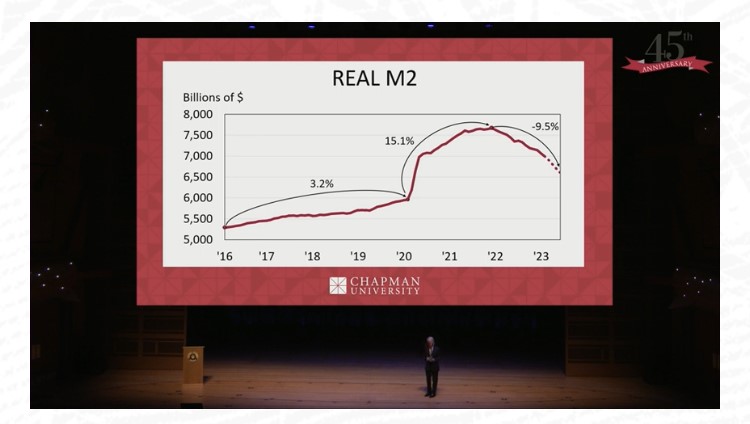
I watched the Chapman Economic Forecast Update for 2023 live on June 22 (you can watch the whole thing free here). Go to their website for free videos and links. They have an excellent track record for being correct.
This time, Dr. Jim Doti believes we are headed for a recession by the third quarter of 2023 or at least what he conservatively calls a “slowdown”. He hates to make dramatic predictions or deliver bad news, but he saw the inflation brewing back in 2021, and I remember him correctly predicting what was to come.
For one thing, the dramatic growth in the money supply at the beginning of the pandemic has been corrected into a sharp contraction of the money supply.
People have been joking about how the recession isn’t happening.
The middle segment of the forecast, which I recommend watching, is about investing. Fadel Lawandy cautions that stocks are not a good bet right now, with a likely recession looming.
The third segment is focused on the economy of California. I didn’t finish that part, since I don’t live there anymore.



 Economist Writing Every Day